Table of Contents
The booking and appointment applications have become crucial to sectors that rely on structured scheduling and client management. Hospitals, clinics, therapists, salons, universities, gyms, and service-based business organisations are all utilizing digital reservation systems to automate their booking systems, decrease no-show rates, maintain calendars, and enhance customer communication. Appointment booking app development using Python has contributed significantly to this change, as Python is quick, flexible, and reliable enough to build powerful booking systems.
According to reports, the global online appointment scheduling market is growing at a 15% CAGR. With growing demand, the number of businesses seeking to have their appointment booking apps developed with Python has increased, as it offers real-time booking, payment platforms, automated messages, and secure user access.
This article answers all the questions about appointment scheduling app development, including what functions, technology stack, how to develop it, cost, and time to build it.
Why Choose Python for an Appointment Booking App?
Python is a high-performance, mature language that powers the world’s booking systems. Its architectures enable rapid development, scalability, and simple third-party integration. Python is ideal for long-term business stability.
Top Python Frameworks for Booking Apps
- Django – Ideal with full-stack scalability, security, and large reservations.
- Flask – Perfect for lightweight, modular booking apps.
- FastAPI – Ideal for current fast-API-driven appointment systems.
- Pyramid – An Adaptable alternative to tailored and multifaceted scheduling workflows.
The Python ecosystem enables simple integration with calendars, notifications, CRM systems, real-time slot synchronization, and user authentication.
What Features Should a Python Booking App Include?

An efficient booking system should simplify scheduling, reduce user effort, and handle real-time updates without errors. Due to their scalability and reliability, Python frameworks enable this. Business owners should prioritize user convenience, admin efficiency, and long-term flexibility when choosing features for appointment booking apps using Python. Below we have listed the features to integrate into a Python app development for a booking system:
Must Have User Features
- User registration and login
- Service selection with clear categorization
- Calendar integration to show available dates
- Real time slot booking with conflict prevention
- Notifications and reminders for appointments
- Payment integration for online transactions
Having these essentials ensures a user-friendly flow that encourages repeat bookings.
Admin Panel Features
Admins and staff need tools that simplify daily management. Important admin features include:
- Appointment management dashboard
- Staff scheduling tools
- Analytics and booking reports
- Pricing and discounts management
- Customer feedback and rating system
Optional Advanced Features
Smarter features that enhance the user experience can help businesses differentiate themselves in competitive industries. The following are ideal for premium booking platforms:
- AI based recommendations for scheduling
- Integration with CRMs or ERP systems
- Video consultation or built in chat feature
With these enhancements, your platform will become more valuable, support personalization, and compete with enterprise-level products.


How to Develop an Appointment Booking App Using Python: Step-by-Step Guide
A powerful development process ensures that your system is also reliable, scalable, and user-friendly. The professional sequence for developing the appointment scheduling app is provided below.
Step 1: Project Goals and Audience
Before writing code, define:
- The target audience
- User pain points
- Appointment flow
- Expected scalability
- Third-party integrations are necessary
The expectations will guide the design of the UI, its workflow logic, and feature priorities.
Step 2: Select the appropriate Python Framework and Tech Stack
A Python booking application uses:
- Django or Flask for backend
- PostgreSQL/MySQL as the main database.
- Celery for task scheduling
- Redis for caching
- FastAPI API -based booking drive systems.
- AWS, Google Cloud or Azure to be deployed.
The structure that you adopt is based on your scalability, performance, and integration requirements. If you need guidance on selecting the right stack, you can also review Shiv Technolabs’ web app development services for custom booking platforms.
Step 3: UI and UX Design Process
Design has to be natural and fast. The UI-UX process includes:
- Wireframing every screen
- Prototyping booking flow
- Creating responsive designs.
- Designing user and administrator clean dashboards.
- Providing accessibility and a low-friction level.
A powerful UI will retain users and boost their conversion rates.
Step 4: Backend Development
Python is superior in backend development. Core modules include:
- Creation and cancellation of an appointment.
- Calendar integration
- Role management and user authentication.
- Overlapping booking conflict detection.
- Real-time availability status.
- Automated reminders
- Service-based pricing logic
The Python application development of booking systems entails much emphasis on the speed and precision in slot management.
Step 5: Payment and Notification Integration
Widely used integrations are:
- Payments through Stripe or PayPal.
- Twilio for SMS
- SendGrid to remind through email.
- Firebase is used by the company to send push notifications.
Every integration is set to be secure, compliant and real-time updated.
Step 6: Testing and Launch
Prior to launch, developers carry out:
- Unit tests
- Load and stress tests
- Integration tests
- User acceptance tests
- Calendar sync checks
- Test of conflict and concurrent.
After successful quality checks, the application is uploaded to cloud servers for use as a production application.
How Much Does It Cost to Build a Python Booking App?
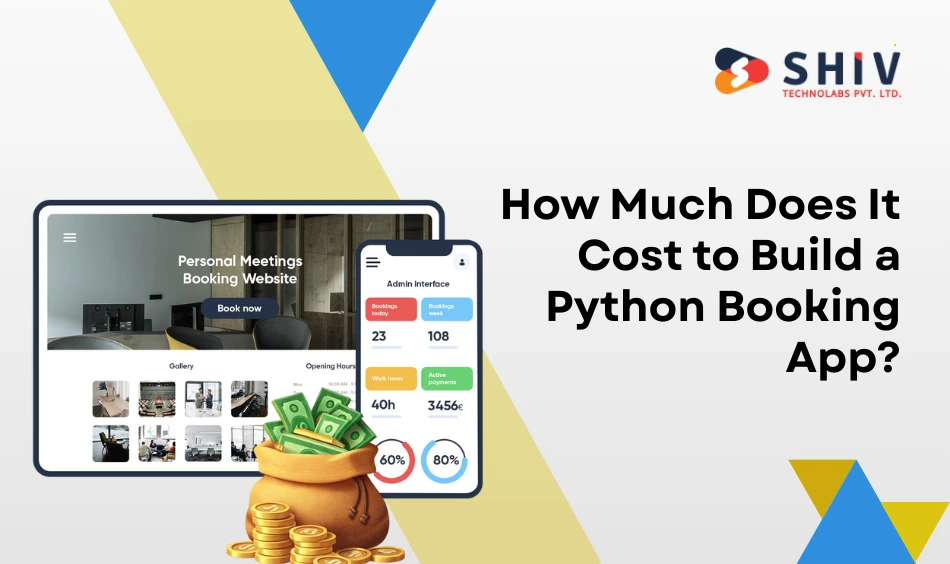
The price is based on features, complexity and integration requirements. The question businesses tend to ask is, “How much does it cost to develop a booking app using Python?” The answer can be seen at various stages of development.
Cost Breakdown
| Development Stage | Description | Estimated Cost (USD) |
|---|---|---|
| Basic MVP App | Core booking and calendar system | $10,000 – $20,000 |
| Mid Level App | Payments, notifications, analytics | $20,000 – $40,000 |
| Advanced App | AI scheduling, CRM integrations, multilingual support | $40,000 – $70,000 plus |
This table shows the popular cost ranges for small MVPs to enterprise-grade booking platforms.
How Long Does It Take to Develop a Booking Platform with Python?
A number of companies would like to understand the time frame for developing a booking platform. The time would be based on functions and sophistication.
Development Timeline
| Stage | Tasks | Duration |
|---|---|---|
| Planning and Research | Requirement gathering | 1 – 2 weeks |
| Design and Prototyping | UI and UX design | 2 – 3 weeks |
| Backend Development | Core booking functionality | 4 – 6 weeks |
| Testing and Deployment | QA and release | 2 – 3 weeks |
Depending on the team size and integration requirements, it typically takes 9-14 weeks for a full build.
Common Challenges in Appointment Booking App Development Using Python
No booking system can be without problems. These problems are addressed using Python.
Handling Concurrent Bookings
Several users may attempt to reserve the same time slot. Django Python frameworks manage atomic transactions, ensuring that there are no accidental bookings.
Real-Time Data Synchronization
Slots, staff availability, and cancellations must be updated immediately. Python is compatible with Redis and Celery API queues with real-time synchronization.
Secure User Authentication and Payments
Booking sites deal with confidential information. Python will also provide access control via JWT, OAuth, encryption, and secure payment integrations to protect user data.
How to Choose the Right Python Developers for Your Booking App
You should have developers who understand scheduling logic and Python frameworks to develop a reliable booking system. In recruiting to create an appointment booking application in Python, seek:
Familiarity with Django or Flask
The backend frameworks need to be familiar to developers to ensure secure user management and robust scheduling.
Knowledge of REST APIs and Databases
Python developers must be conversant with MySQL, PostgreSQL, Redis and API structure. You can also refer to Shiv Technolabs’ guide on developing Python APIs for scalable booking interfaces.
Third-Party Integration Experience
All payment gateways, CRM tools, and SMS and email services should integrate harmoniously.
The Python-based booking systems task requires engineers who know how to scale the system and handle user and administrative workflows.
Hire Skilled Developers to Build Your Python Booking App
Building a trustworthy booking system requires working with a team that understands Python at an architectural level. Shiv Technolabs is an experienced Python web development company that can turn ideas into scalable appointment platforms. Whether you need a healthcare scheduling app, salon booking, or an enterprise reservation system, our team provides a solution that is performance-oriented, secure, and scalable in the long term.
Custom Design and Workflow Setup
Our team designs your workflow to adapt to your business model, whether medical, spa, event, coaching, or service booking.
Each screen is streamlined with reduced steps and lots of clarity to ensure that the users sail through the booking flows easily. The outcome is an enhanced customer experience and the platform’s intuitiveness.
Third Party Integrations
Our key integrations include payment gateways, SMS and email solutions, customer relationship management platforms, analytics software, calendars, and application programming interfaces for automation. These combinations enable your booking app to be an entire ecosystem. The data flows are also correct and real-time, ensuring consistent data performance as your customer base continues to expand.
Cloud Maintenance and Hosting
Your booking app is also implemented on secure cloud platforms such as AWS, Google Cloud, and Azure, with full monitoring and scaling. Updates, patches, and backups are handled by us, as is performance tuning to ensure your system is fast and reliable. Businesses can rest assured that the backend is always stable.
Cross Platform Compatibility
We ensure your Python booking system is compatible with mobile browsers, desktops, tablets, and hybrid mobile apps. Our team develops responsive interfaces and maintains consistent background communication to ensure a consistent user experience across the board. This strategy will promote greater adoption and make your platform more customer-friendly across all devices.
24/7 Technical Support
Shiv Technolabs offers a lifetime after-sales services. We have a support team that oversees performance, solves problems quickly, handles upgrades, and ensures all scheduling features are taken care of.
This 24/7 support ensures your business continues to run efficiently and that you can concentrate on growing your business rather than addressing technical issues.
Conclusion
Python continues to be among the most suitable technologies for developing secure, scalable, and fast appointment scheduling applications. Its structures, libraries, and integration support result in easy, cost-effective development. Python is easy to work with for complex operations, whether in booking logic or real-time updates. If you would like a highly customised platform, you should collaborate with an experienced Python web development firm to ensure your booking system is properly designed from the start.
Shiv Technolabs provides full development solutions, including UI design and backend architecture, as well as integration and deployment.
Frequently Asked Questions (FAQs)
1. What is the best framework for appointment booking app development using Python?
It is the most popular option because it offers strong security, an in-built administrator panel, and very fast development. In the case of API-based development, FastAPI is also a good solution due to its performance and modern design.
2. Can I integrate payment gateways in a Python-based booking app?
Yes. Python is compatible with all popular payment gateways such as Stripe, PayPal, RazorPay and Authorize.net. The programmers can incorporate payments using the appropriate encryption and API authentication.
3. How secure are booking apps developed using Python?
Python is highly secure and encrypted, uses token authentication, supports secure sessions, and has a robust backend architecture. Python-based booking applications can securely store sensitive customer information and payment data when implemented correctly.
4. How long does it take to launch a full-featured appointment scheduling app?
A fully featured appointment scheduling application typically takes 10 to 14 weeks to build, depending on UI design, complexity, integrations, and team size.
5. Is Python suitable for both mobile and web booking platforms?
Yes. The backend of mobile and web booking can be implemented using Python. Python and Flutter or React Native are widely used by developers to create mobile applications, where Python handles the logic, and the others handle cross-platform execution.