Table of Contents
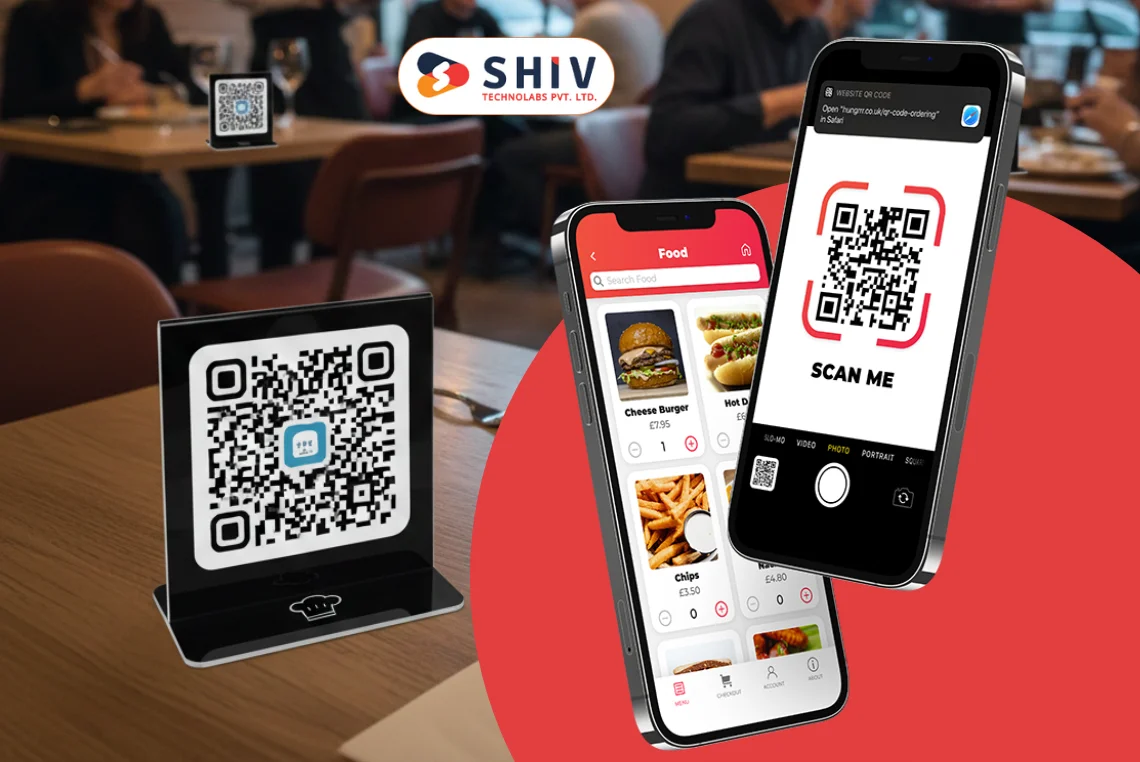
Dining culture has changed. Visitors have become more demanding regarding convenience, speed, and hygiene the moment they enter a restaurant. A large number of restaurants are turning to restaurant app development to introduce contactless ordering, allowing customers to place orders via QR codes and online menus.
An excellent QR code ordering system makes ordering quicker, cleaner, and more pleasurable. It helps restaurants serve more tables, reduce wait times, and satisfy customers. According to reports, QR Code scans have increased by 433% over the last 4 years, leading to significant growth. These great evolutions and growth have brought up the need for a QR code ordering system.
This article will feature the advantages of QR code ordering systems for restaurants, how they work, key features, approximate pricing, and the procedures required to ensure a successful integration.


What Makes QR Code Ordering So Popular Among Modern Restaurants?
The surge of QR ordering adoption does not come in a flash. It is indicative of evolving diners’ expectations and real-world advantages to the restaurant operators. The attractiveness is easy for customers and effective for employees.
Customers Love Instant No-Wait Ordering
Visitors will no longer have to wait for a waiter to arrive to offer the menu and accept orders. They simply glance at the menu when they get to their table. This gives customers control and saves time, particularly during rush hours.
Menus Can Be Updated in Real Time
A QR ordering solution in the restaurants allows the managers to modify the prices update dishes, sold out items, or promotions in real time. There is no necessity to reprint paper menus. This allows it to be flexible and thus the menu is always accurate.
No Dependency on Printed Menus
Printed menus become dirty, lost or ruined. They also need printing expenses and replacement. A QR code menu in restaurants can remove all of these issues and it will save printing cost and lower environmental waste.
Improved Operational Speed and Accuracy
Guest orders are sent straight to the kitchen or POS. This minimizes human error when employees fill orders manually and reduces communication delays. Hence, kitchen staff receive clear instructions and restaurants serve faster.
Strong Adoption Trend Among Restaurants and Diners
A good number of restaurants worldwide have adopted online ordering. Almost 70% of restaurants in the US currently offer payment or menu access via QR code.
Since both customers and restaurants recognize the obvious benefits, a QR code ordering system is becoming an inherent part of contemporary food service.
How Does a QR Code Ordering System Work in a Restaurant?
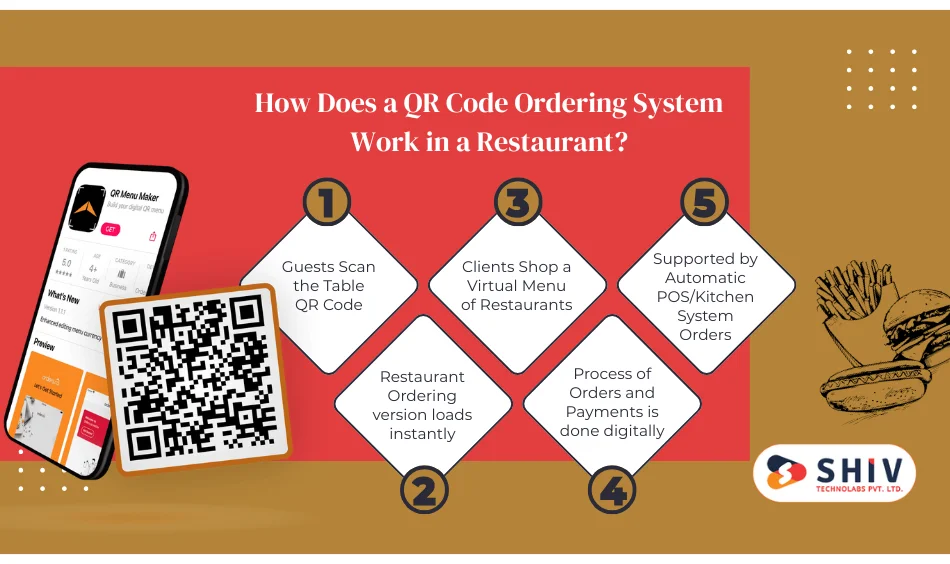
The flow makes restaurants plan and implement the system in the most appropriate way. A seamless QR ordering system integrates the guest experience with the backend systems, kitchen operations and payment processing through a single loop.
Guests Scan the Table QR Code
Each table has a different QR code, located on the table, menu stand, or receipt. The customer scans it with his/her smartphone camera. No further app installation is needed when using the browser-based version of the restaurant.
Restaurant Ordering version loads instantly
Once the scan is complete, a clean digital menu opens on the user’s phone. It must be blisteringly quick and pre-programmed to the mobile screen. Branding, restaurant category and ease of navigation are what customers see.
Clients Shop a Virtual Menu of Restaurants
The menu is up to date with offerings. Restaurants can display pictures, descriptions, variants (size, spice level, extras), real-time availability and prices. This makes customers make them easy in their choices and minimizes confusion.
Process of Orders and Payments is done digitally
Customers pick, add to cart, select variants and place order through the same interface. The system features payment gateways that support card wallets or UPI or any other payment method. This fulfills the no-contact ordering process.
Supported by Automatic POS/Kitchen System Orders
As soon as the order is placed, it is transferred to the restaurant’s point-of-sale system or kitchen display. This sync will enable order processing, inventory reorganization and correct billing with minimal human intervention.
Routing orders, payment confirmation, notification and inventory updates are done through the backend integration. This saves on employee manpower and increases efficiency, particularly during the busy hours.


What Are the Benefits of a QR Code Ordering System for Restaurants?
A properly implemented QR ordering solution in a restaurant delivers significant value across operations and the guest experience. The advantages are quantifiable and improved throughput and customer satisfaction are common measures of this. Significant advantages of QR code ordering system involve
- Faster table turnaround
- Lower staff workload
- Fewer order errors
- Improved hygiene and safety
- Combined payment and reward systems.
Here is a quick comparison of before and after implementing QR ordering:
| Factor | Before QR Ordering | After QR Ordering |
|---|---|---|
| Order Time | 10 to 15 minutes | 3 to 5 minutes |
| Staff Involvement | High | Minimal |
| Menu Updates | Manual reprint | Instant |
| Customer Experience | Average | Interactive and seamless |
The overall impact is the increased efficiency of operations and makes the process of eating quicker and less hazardous for both customers and employees. Research indicates that restaurants with online menus and QR code ordering have higher customer satisfaction and repurchase intention, driven by perceptions of ease and convenience.
A different survey indicates that hundreds of restaurants worldwide currently use QR codes for menu displays, payments and loyalty integration.
How to Add a QR Code Ordering System to Your Restaurant App
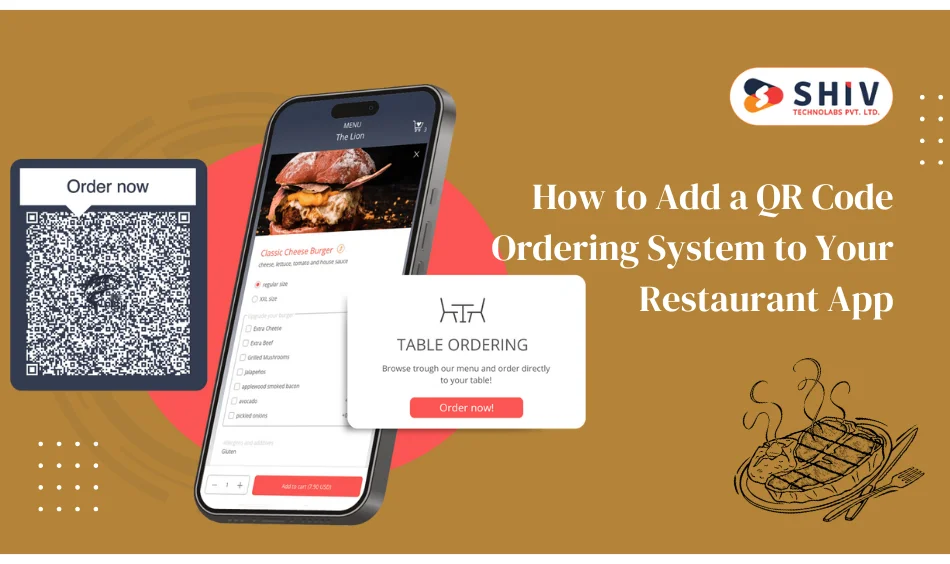
QR ordering is an upgrade that restaurants with existing apps or those planning to create new ones can consider. The following is a systematic course to develop or upgrade the functionality in the right direction.
Step 1: Assess Your Current App and Backend Architecture.
Start with auditing of the existing systems. Ensure whether your POS is API compatible in case you have an inventory management system as well as whether the data structure on the back end can support real-time updates. This assessment determines breadth and depth prior to commitment.
Step 2: Select a Tech compatible with QR and POS Systems
Choose a stack that supports dynamic menus, order placement, payments, and kitchen/POS connections. If you want platform support, talk to a mobile app development team experienced with these integrations.
Step 3: Adopt QR Menu API
Install a system that creates unique QR codes for each table or order. Backend is required to relay live menu information, relay it to the frontend and process cart, order placement and payment gateway requests.
Steps 4: Accuracy, Speed and UI Consistency Test
Test menu load speed across multiple devices, verify order accuracy across different variants and test payment gateways before going live. Make the UI user-friendly.
Step 5: Implement and receive Customer Feedback
In the early rollout, gather user feedback on how quickly the interface loads, the clarity of the interface and the simplicity of payment. Rely on them to optimize UX and performance. For concept ideas, see AI for restaurants: smart ordering & personalized menus.
Turning to expert mobile app development services helps accelerate this process with less friction and professional-grade reliability.
How Much Does a QR Code Ordering System Cost?
The cost of a QR ordering solution depends on the complexity, features and required integrations. The approximate cost range is shown below, depending on the level of sophistication.
Typical Cost Components
In calculating the investment amount to consider the portions:
- UI and menu design and layout
- POS and database integration.
- Integration of the payment gateway.
- QR code creation and distinctive code control.
- Order routing, synchronization with the kitchen or POS.
- Inter-testing and performance management.
Estimated Cost to Build a QR Code Ordering System
| App Type | Features Included | Estimated Cost |
|---|---|---|
| Basic | Static digital menu and order view | $2,000 to $4,000 |
| Intermediate | Payment gateway, analytics reporting | $5,000 to $8,000 |
| Advanced | Multi branch support, AI insights analytics | $10,000 to $15,000+ |
These are ranges of what would be expected to spend in developing small and medium restaurants. It increases costs when your restaurant has a multi-branch operation or a complex menu variant or when your menu depends on heavy custom backend logic.
What Influences the Cost
- App size and complexity
- Level of custom design required.
- Integration endeavors with the present ordering or POS system.
- Requirement of a secure payment gateway and compliance.
- Continuous updates and maintenance.
Though initial costs are high in many restaurants, there is a high return on investment due to faster turnarounds, higher table throughput, higher labour costs and increased order accuracy.
How Does QR Ordering Improve Customer Experience?
In addition to back-end efficiencies, QR ordering enhances the dining experience in ways that are important to guests. When properly carried out, it creates a long-term positive impression and fosters loyalty.
Instant Menu Access
As soon as a guest is seated, they can access the full menu on their phone. There is no wait to be served by a server or a physical menu, so ordering starts immediately.
Easy Checkout and Payments
The digital orders simplify payment. Visitors do not have to wait till they receive paper or card swipe bills. The built-in payment options make the app convenient and trustworthy.
Personalized Display Based on Device or Preferences
Online menus are able to conceal unavailable items or emphasize deals or tailor content depending on the time of the day or client history. This customization causes the experience to look high-end and bespoke.
Contactless Trust Factor
Contactless ordering can be hygienic, safe and comfortable in a post pandemic world. Visitors enjoy less physical interaction and less greasy ordering areas.
Quick Service and Better Control
Customers are able to place orders and make amendments or additions and pay without delaying the personnel. Their orders are delivered to the kitchen, which shortens waiting time by far.
Research on the industry has also identified that almost 3/4 of restaurants all over the world have implemented QR menus and no-contact ordering systems and many of them have claimed an increase in engagement and repeat visits.
Dining QR ordering is modern, intuitive and empowering. In the case of restaurants, it creates trust, lowers friction and increases the overall satisfaction.
What Key Features Should Be Included in a QR-Based Restaurant App?
If you are going to develop or renovate your application, this set of functions provides the basic list of points to include in the requirements for a satisfying QR ordering system that meets the demands of contemporary diners and effective practices.
- Smart QR scanning recognizes the table code and goes to the right menu.
- Capabilities to edit the menu dynamically to make item prices available in real-time.
- POS connection with kitchen notifications (see POS integration tips)
- A variety of payment types, such as wallets, digital payments and local multiple payment options, including cards.
- Feedback and loyalty capabilities to promote repeat business.
- POS and delivery are integrated to facilitate pickup or delivery orders along with dine in.
With established mobile app development services, these features will fit well to provide you with a reliable scalable system.
Why QR Code Ordering Is the Future of Dine In and Takeaway Apps
The digitization of the ordering process is not just a fashion. It is an economic transformation of the relationship between restaurants and diners. Competition can never match investing at this time.
Increasing Customer Demand for Online Convenience
The greater the number of consumers with smartphones and mobile wallets who demand to order and pay anywhere, such as in dining establishments, the better. A non-contact system of order fulfillment is such.
Cost reductions and Operation transparency
Reducing printed menus reduces waste and printing expenses. Order errors drop. Staff workload decreases. Order tracking and inventory are made transparent.
Stronger Data Insights Through Analytics
Digital ordering provides restaurants with data on ordering patterns, popular dishes, peak hours and customer preferences. This information is used to make decisions about menu planning, promotion and staffing.
Scalability
A QR ordering system can be scaled to serve multiple locations. The centralized backend and POS integration with new branches can become operational in a very short time without the need to reinvent systems.
Competitive Edge
Early adopters of QR ordering earn a reputation as a modern, most efficient restaurant. It turns out to be a differentiator of customer experience and operational efficiency.
Restaurants that adopt the new QR code ordering system enjoy the benefits of future growth, increased profits and stronger brand loyalty.
Ready to Add QR Ordering to Your Restaurant App?
This is the moment to take action to modernise your restaurant business or mobile application. An all-inclusive QR-based ordering system built on a clean architecture framework, with responsive design and payment options, has the potential to transform the guest experience and increase revenue.
Shiv Technolabs is the best restaurant app development company, dealing in mobile app development services for restaurants. We develop no-contact ordering systems, tailored QR menus and an automated backend to enable fast table service and a safe checkout. Our technology will future-proof your restaurant, leaving it to the guests and boosting profits.
We can help you create a QR code ordering experience that customers will love and that increases your profits.
Conclusion
The QR code technology is transforming modern dining. A properly implemented QR code ordering service enhances speed, hygiene and customer satisfaction, while reducing staff overhead. This digital change is a necessity for those restaurants that desire efficiency, scalability and excellent experiences.
If you have a vision for modernizing your app or developing a new one, collaborate with an established restaurant app development agency to make it a reality. Shiv Technolabs is among the most trusted restaurant app development companies, specializing in end-to-end ordering solutions that give you a competitive edge and align with your branding and business operations.
Frequently Asked Questions (FAQs)
1. What is a QR code ordering system?
A QR code ordering system allows customer to scan a QR code on their table or at the entrance and see a digital menu on their smartphone, order and pay. It is the alternative to printed menus and hand-written order taking: a continuous flow without contact.
2. How much does it cost to build QR ordering system?
The price of a QR ordering system will depend on features and complexity. Even a simple one with a fixed menu and an order display could cost $2,000 to $4,000. A fully functional installation, including payments, analytics and multi-branch functionality, can cost between $10,000 $15,000 or more.
3. Can I integrate QR ordering into my existing app?
Yes, by choosing expert mobile application development services, you can have them retrofit QR menu integration into an existing app backend. The upgrade speeds up ordering, reduces errors and adds features such as payments and kitchen sync.
4. What are the benefits for restaurants?
The advantages of a QR ordering solution for restaurants include increased table turnover, reduced staff workload, fewer mistakes, better hygiene, integrated payments and enhanced customer satisfaction, resulting in increased loyalty and repeat business.
5. Is it safe for online payments?
Yes, secure payment gateways and encryption have been applied in modern QR ordering systems. Online payment by QR code is secure and safe. The payment integration is conducted in accordance with conventional standards of security.