Table of Contents
The oil and gas business is at a crossroads of peril, substantial financial risk, and stringent regulatory controls. Working daily around explosive material, heavy equipment, offshore rigs, pipelines, and high-pressure systems, teams perform their duties.
There is no room in these kinds of settings for a single slip to result in massive environmental destruction, injuries to the workforce, or even fines of millions of dollars. With escalating reporting needs, compliance regulations, and increasingly sophisticated operations, paper logs and Excel spreadsheets become ineffective.
Developed business worlds are resorting to more sophisticated systems (and professionals providing oil and gas software development services) to create stable EHS Software for Oil Companies that enable them to remain safe and compliant at all levels.
The EHS Software of oil companies can provide real-time access to incidents, hazards, environmental impacts, personnel training, equipment safety status, and regulatory reporting. Reports claims that improved digital safety systems can also cut incident rates by 35% and operational losses by millions.
This guide covers everything you need to know about EHS Software Development, including pricing, functionality, value, integration, and why a custom solution is a long-term investment for oil and gas companies.
What is EHS Software and Why Does the Oil Industry Need It?
EHS is an acronym of Environmental, Health, and Safety, which is a centralized system designed to deal with compliance, safety, and environmental performance at the workplace. Although all industries require safety mechanisms, oil and gas firms have much more to lose due to the presence of dangerous substances, flammable materials, heavy machinery, and drilling processes.
The most significant safety issues are addressed by EHS Software for Oil Companies, which replaces manual reporting with automated, real-time systems to monitor the safety performance of rigs, refineries, pipelines, offshore platforms, and transport fleets — often tied into broader custom software and AI/ML tools for faster decisions.
Who Uses EHS Systems in Oil and Gas?
- HSE managers
- Field operations teams
- Drilling supervisors
- Refinery safety officers
- Corporate compliance teams
- Environmental analysts
- Maintenance engineers
What Does EHS Software Help Manage?
- Track and report incidents
- Automate compliance reporting.
- Audit and inspection.
- Track emissions and safety KPIs.
- Control employee safety training.
- Create and control permit-to-work forms.
- Track near-miss events
- Survey chemical and environmental exposure.
- Standardize reporting to the regulators.
With a good EHS platform, there is increased accountability, regulatory alignment, and a real-time understanding of safety performance across all operations.
How Much Does It Cost to Build Custom EHS Software for Oil Companies?

Custom EHS software is a long-term investment that oil companies need to gain control over workflows, automation, integrations, and compliance structures. The cost also varies across the board depending on the level of sophistication, integrations, and scalability the solution requires.
Here are the Key Factors That Affect Development Cost:
1. Software Type: Basic vs Advanced vs Enterprise
- Incident reporting and audits are examples of basic EHS tools.
- Mid-tier solutions will include dashboards, analytics, and mobile access.
- Enterprise suites are supplemented with IoT sensors, AI predictions, and ERP unification.
2. Feature Requirements
The more modules the more expensive it costs, e.g.:
- Permit-to-work
- Hazard identification
- Tracking of safety, based on behavior.
- Automation of emergency response.
3. Integrations
- Leak or air quality sensors in IoT. (IoT app development).
- ERP software such as SAP or Oracle.
- In the realm of HR training and certifications platforms.
- Asset management systems
4. Hosting Model
- Cloud solutions are less expensive in the short term.
- On-premise, i.e. On-site deployments need security audits and servers.
5. Compliance Requirements
Oil and gas companies should observe:
- OSHA
- ISO 45001
- API safety standards
- EPA, ESG reporting (environmental regulations).
Increased compliance implies longer development time.
6. Experience in Development Partners
The development of a special Custom EHS Software Development Company minimizes risk, expedited delivery, and precision- this has a direct impact on the cost and quality.
Estimated Cost
Below is the realistic cost range for different types of EHS software:
| EHS Software Type | Estimated Cost (USD) | Description |
|---|---|---|
| Basic Platform | $20,000 – $40,000 | Incident logs, audits, safety reports |
| Advanced Cloud-Based | $40,000 – $80,000 | Dashboards, analytics, mobile access, automations |
| Enterprise EHS Suite | $80,000 – $150,000+ | AI engine, IoT sensors, ERP integration, multi-site management |
This is the bracket that most oil and gas companies would be in when engaging one of the Custom EHS Software Development Company.


Tips to Manage EHS Software Development Cost
Strategic planning can be used to lower development cost by oil companies:
- Build a basic product and develop it over time.
- Rebuilding is to be avoided by using a modular architecture.
- Only the necessary 3rd party systems should be integrated.
- Code reuse to minimize coding.
- Subcontract to EHS Software Development professionals.
What Are the Key Features of an Effective EHS System?
The desired quality of the EHS system should not only be powerful but also easy to use in actual field conditions. The EHS System design has the following Key Features that aid companies in the oil industry to remain safe in their operations:
Real-Time Incident and Hazard Reporting
Oil sites require instant observation of anything out of the ordinary such as chemical leaks, fires, equipment breakdown, and spills and near misses. Real-time reporting ensures:
- Faster emergency response
- Proper root-cause analysis
- Reduced manual paperwork
- Improved safety culture
Field workers can report incidents in real time using mobile apps.
Risk Assessment Automation
EHS platforms are used to identify and analyze:
- Job hazards
- Equipment risks
- Chemical exposure risks
- Safety task risks
Risk scoring is automated to enable managers to determine the tasks that require urgent intervention.
Compliance and Audit Management
Oil companies are to conduct hundreds of compliance checks annually. EHS tools automate:
- OSHA compliance
- ISO standards
- Audit scheduling
- Evidence collection
- Documentation management
This minimizes the exposure to disastrous fines and enhances regulatory relations.
Permit-to-Work System
An effective permit management system is used to make sure that:
- Hot work
- Confined space entry
- Electrical tasks
- Lifting and rigging tasks
- Equipment isolation
Maintain workflow accountability at all levels.
Environmental Monitoring Tools
Oil and gas are environmental risks. EHS software monitors:
- Emissions
- Waste
- Pollution
- Water contamination
- Spill response
The companies remain in compliance and defend their brand with real-time environmental information.
Safety Training Management
EHS systems are used to monitor employee qualifications, training time, and course refresher- this ensures that untrained personnel will not be allowed to carry out hazardous duties. For cross-system control, link to HR or LMS via custom APIs.
Mobile Access for Field Teams
The field workers must have fast access to:
- Safety manuals
- Training material
- Work permits
- Incident forms
- Equipment safety logs
Mobile-first design will make it accessible everywhere.
Dashboards and Analytics
Analytics assist leaders in realizing:
- Incident trends
- Compliance status
- Equipment performance
- Risk exposure
- KPI improvements
Information-based knowledge paces up decision-making.
What Are the Real Business Benefits of EHS Software for Oil Companies?
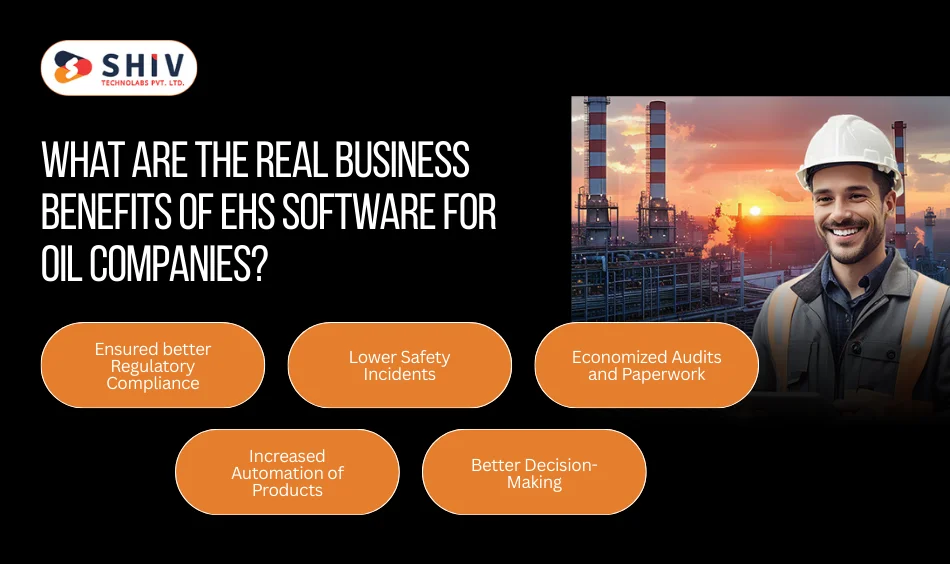
The implementation of the new EHS tools by oil companies has a serious effect on operations, leadership, and compliance.
Ensured better Regulatory Compliance
Automated reporting will help companies comply with OSHA, EPA and HSE requirements- less penalties and audits.
Lower Safety Incidents
Live alerts, anticipatory risk rating and safety education minimize accidents, injuries, and downtimes.
Economized Audits and Paperwork
Digital records eliminate manual records and speed up compliance reviews.
Increased Automation of Products
Automated processes replace several manual operations, allowing teams to focus on their core work.
Better Decision-Making
The trends, risks, equipment, and safety performance across the sites can be seen through centralized dashboards.
Through this, businesses avoid a lot of planned downtime, save on costly safety malfunctions, and enhance their reputation. Collaborating with a Custom EHS Software Development Company like
Shiv Technolabs can ensure the system is tailored to the specifics of oil operations.
How to Select the Right EHS Software Development Partner?
Choosing the right EHS partner will make or break your EHS system. Below is are checklist to follow while choosing the right EHS partner:
Assess EHS Projects in the past
Ask for:
- Case studies
- Live product demos
- Platforms constructed to drill, refine or pipeline crews.
Verification of ISO and HSE Complaints
The developer needs to be aware that:
- ISO 45001
- Process safety standards
- Environmental regulations
Suitability of Tech Stack Review
Ideal technologies include:
- Cloud (AWS, Azure)
- Python
- Node
- React or Vue
- PostgreSQL
- Secure mobile frameworks
Ensure Long-Term Support
EHS systems evolve. The development partner should be able to provide:
- Continuous maintenance
- Security updates
- New feature support
- Performance optimization
The use of a Custom EHS Software Development Company with experience guarantees the scalability and precision.
How Does EHS Software Fit into Oil and Gas Digital Transformation?
Modern oil companies that invest in digitalization cannot do without EHS tools.
Digital Platforms Integration
EHS software is integrated with:
- ERP systems
- IoT sensors
- Asset management tools
Workforce management systems: Within an organization, workforce management systems play a crucial role in the operations of the organization.
Predictive analytics and Maintenance
Connected sensors detect:
- Gas leaks
- Pressure variations
- Equipment overheating
This will help prevent accidents before they occur.
Sustainability Reporting
EHS software helps track:
- Emissions
- Carbon footprint
- ESG performance
This aligns with global sustainability.
An effective EHS system is one of the main components of any oil and gas software development service that is intended to undergo digitalization.
Conclusion
The oil and gas industry is one of the most challenging sectors in terms of safety and compliance worldwide. The EHS tools enable companies to make reporting easier, minimise incidents, assess environmental risks, and remain compliant with varying regulations. The EHS platform that is best suited is right, as it balances perfectly on price, capabilities, and long-term ROI, particularly when it is designed around the actual field team and HSE manager workflows.
Collaborating with Shiv Technolabs, a reliable oil and gas software development company, helps energy companies develop secure, scalable, and compliance-oriented EHS systems that facilitate continuous improvement and operational excellence.
At Shiv Technolabs, we provide end-to-end oil and gas software development services, including advanced dashboards, mobile applications, analytics, IoT connections, permit systems, and custom workflows tailored to oil and gas operations.
If your organization is ready to raise safety management to a new level and accelerate digital transformation with EHS Software Development, contact us today. We will assist you in developing a strong EHS system tailored to your operational reality.
Frequently Asked Questions (FAQs)
1. How much does the average cost of EHS software building cost?
It usually costs between $20,000 and $150,000, depending on the number of modules, integrations, and the deployment model. Simple tools are cheaper, whereas enterprise solutions with IoT, analytics, and ERP integrations are located within the high price range.
2. What is the time frame for developing an EHS system?
The average time to complete an MVP for most oil companies is 3 to 6 months, and the full implementation of an enterprise-level EHS platform with AI, IoT, and multi-site automation takes 8 to 12 months.
3. What are the characteristics of every EHS software?
The basic modules include incident tracking, risk management, audits, compliance reports, environmental monitoring, dashboards, training management, and the permit-to-work system.
4. Is the EHS software compatible with oilfield systems?
Yes, EHS systems are connected to the ERP, IoT sensors, HR tools, and cloud infrastructure securely via APIs. This allows single reporting between the drilling, refinery, and pipeline operations.
5. What are the primary advantages to energy companies?
Companies will have fewer incidents, improved compliance, automated reporting, real-time visibility, enhanced training, safer operations and more efficient audits. This results in less punishment and greater operational productivity.