Table of Contents
ClickUp is now among the most popular project management and productivity tools in the SaaS world. It has enabled millions of users worldwide to reinvent how teams handle tasks, work together, automate processes, and track progress across projects. Its easy interface, live team collaboration tools, and flexible customisation encourage hundreds of entrepreneurs to consider how they can build a SaaS like ClickUp.
Companies that intend to compete in the market for productivity software often need professional SaaS development services to build a scalable, secure, and feature-rich ClickUp clone app development that meets their requirements.
According to reports, 91% companies believe that boosting their revenues. A system similar to ClickUp will help companies centralise tasks, automate repetitive work, improve communication, and boost employee productivity.
Here, we will cover key features to include, a step-by-step development process, realistic cost expectations, and the long-term business advantages of a ClickUp-like SaaS platform.
What Makes ClickUp a Great Example of a SaaS Platform?
The unique feature of ClickUp is that it is an ecosystem that includes several productivity tools in one. Instead of having a single tool for tasks, a different tool for chats, and a different tool for reports, all tasks, chats, and reports are in a single dashboard in ClickUp. This makes it simpler and more productive, which is one of the most significant motivators for entrepreneurs who want to create a ClickUp-like SaaS.
ClickUp is successful due to:
- Flexibility to people, groups, and organizations.
- Over 1,000+ application integrations.
- Personalized dashboards, views, and workflows.
- User-friendly, simple UI that reduces time to onboard.
ClickUp’s standout aspects include:
- Task & workflow automation
- Team collaboration tools
- Custom dashboards and various project views.
- Right-time reporting and analytics.
Why Should You Build a SaaS Like ClickUp?
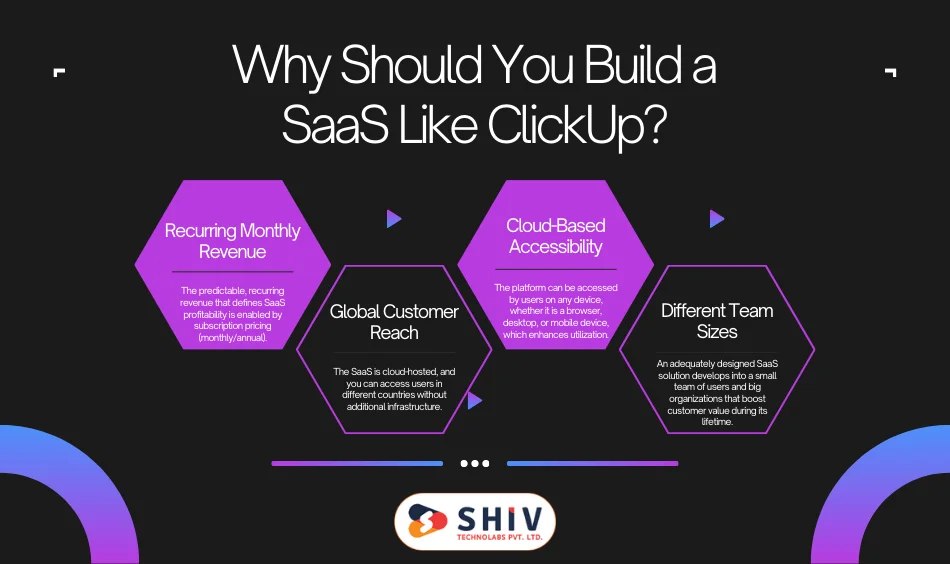
The trend is a shift towards remote work and hybrid teams, as well as global automation, which has led to enormous demand for productivity and collaboration SaaS platforms. Developing a platform like ClickUp is not only a technical endeavour but also a sound business model.
The development of a similar SaaS on ClickUp presents an opportunity for long-term monetization and growth.
Recurring Monthly Revenue
The predictable, recurring revenue that defines SaaS profitability is enabled by subscription pricing (monthly/annual).
Global Customer Reach
The SaaS is cloud-hosted, and you can access users in different countries without additional infrastructure.
Cloud-Based Accessibility
The platform can be accessed by users on any device, whether it is a browser, desktop, or mobile device, which enhances utilization.
Different Team Sizes
An adequately designed SaaS solution develops into a small team of users and big organizations that boost customer value during its lifetime.
What Core Features Should a ClickUp-Like SaaS Include?
Your software should feature sophisticated capabilities, a clean UX, and automation to compete in the productivity market. The main characteristics of a SaaS application similar to ClickUp are listed below.
To build a successful SaaS platform, you need to add features that are on the same level as the fundamental properties of ClickUp or even more.
Task & Workflow Management
The user is expected to be able to build tasks, set deadlines, dependencies, build subtasks, and view the progress in a graphical form.
Includes:
- Checklists
- Gantt charts
- Board (Kanban) view
- List view
- Calendar view
Teamwork and Communication Technology
A ClickUp clone application should have real-time collaboration.
Essential tools include:
- Chat and team messaging
- @Mentions for team updates
- File attachments
- Voice messaging
- Comment threads on tasks


Automation & Integrations
Automation reduces repetitive tasks and helps tie your SaaS to the tools teams already use.
Common integrations:
- Slack
- Google Drive
- OneDrive
- Notion
- CRM systems
- Email apps
Reporting & Dashboards
Managers who monitor performance must have analytics.
Key reports:
- Team productivity
- Workload management
- Time tracking
- Task completion history
User Access & Security
A multi-tenant architecture will ensure that all company data is secured.
Includes:
- Role-based permissions
- SSO integrations
- Data encryption
- Audit logs
- Multi-workspace architecture
Key Modules in a ClickUp-Like SaaS Platform
| Feature | Purpose | User Advantage |
|---|---|---|
| Task Management | Organize projects | Improves efficiency |
| Collaboration | Real-time teamwork | Enhances communication |
| Dashboards | Visual performance tracking | Better decision-making |
| Automation | Reduces manual tasks | Saves time |
| Security | Protects user data | Builds trust |
How Do You Build a SaaS Like ClickUp?
Building a SaaS platform like ClickUp requires more than just code. It is an ordered process comprising a combination of product strategy, UX design, architecture planning, backend engineering, real-time capabilities, integrations, and nonstop testing.
It aims to create a platform that is fast, intuitive, and powerful enough to support individuals, agencies, enterprises, and remote teams. The following is a breakdown on the working of the development process.
Step 1: Define Product Scope and Target Users
An idea of what your SaaS platform will solve should come first before you start the design or development. ClickUp’s popularity lies in its focus on productivity, collaboration, and workflow automation. Your platform has to find its niche or unique value.
Key decisions during this stage include:
- Who are the biggest users of it: startups, freelancers, enterprises, or a certain industry?
- What should version one (tasks, chat, dashboards, automation) contain?
- What can be done later in development to save time and cost?
- What is your competitive advantage over ClickUp and other SaaS applications?
This strategic clarity helps eliminate wasteful labor and provides your team of developers with goals.
Step 2: Design the UI and Plan the MVP
After defining the scope, user journeys, wireframes, and interface designs, the next step is to build them. The popularity of ClickUp can be explained not only by its features but also by its minimal and clean interface that is easy to customize. Your SaaS must be designed the same way.
The UI/UX stage includes:
- Mapping the whole user flow
- Creation of dashboards, workspace, task boards and reports.
- Designing a layout that is flexible both in small and large teams.
- The interface must ensure it stays clean, even when the user adds hundreds of tasks.
With SaaS MVP development services, businesses can roll out a working product more quickly with only the minimum essential functionality. It aids in legitimizing the concept, collecting actual feedback, and avoiding spending anything on the construction itself.
Step 3: Choose the Right Tech Stack
A ClickUp-style application requires a high-performance, infinite-scale, and future-proof technology stack. It should support real-time updates, automation engines, and a multi-tenant architecture.
A commonly used backend and frontend stack includes:
- Frontend: React.js or Vue.js to create fast and interactive user interfaces.
- Backend: Nest.js, or Node.js, to scale server-side code.
- Database: PostgreSQL when structured data is needed or MongoDB when the schema is flexible.
- Live functions: Firebase or WebSockets to receive tasks in real-time.
- Cloud hosting: AWS, Google Cloud, or Azure.
- Authentication: OAuth, JWT, or SSO integrations.
This technology stack will provide the same backbone as modern SaaS applications such as ClickUp, Monday, and Asana.
Step 4: Develop, Test, and Deploy the Platform
Designs are approved, architecture is agreed upon, and development ensues. Here, the engineering teams will assemble every module and ensure everything runs smoothly. Development usually follows agile sprints:
- Sprint planning
- Module development
- Feature-by-feature implementation
- Live integration functionality.
- Rules and triggers of automation.
- Notifications engine
- Third-party integrations
The QA team also conducts tests to determine the stability, performance, and usability after every sprint. This includes:
- Manual testing
- Automated testing
- Security checks
- Stress tests of heavy usage.
- Hardware and software compatibility.
When testing is over, the SaaS is brought to the cloud, and it is configured to be used in real-time, and it is ready to receive customers. The collaboration with industry-experienced SaaS development service providers will accelerate development, prevent technical errors, and deliver enterprise-grade performance.
How Much Does It Cost to Build a SaaS Like ClickUp?
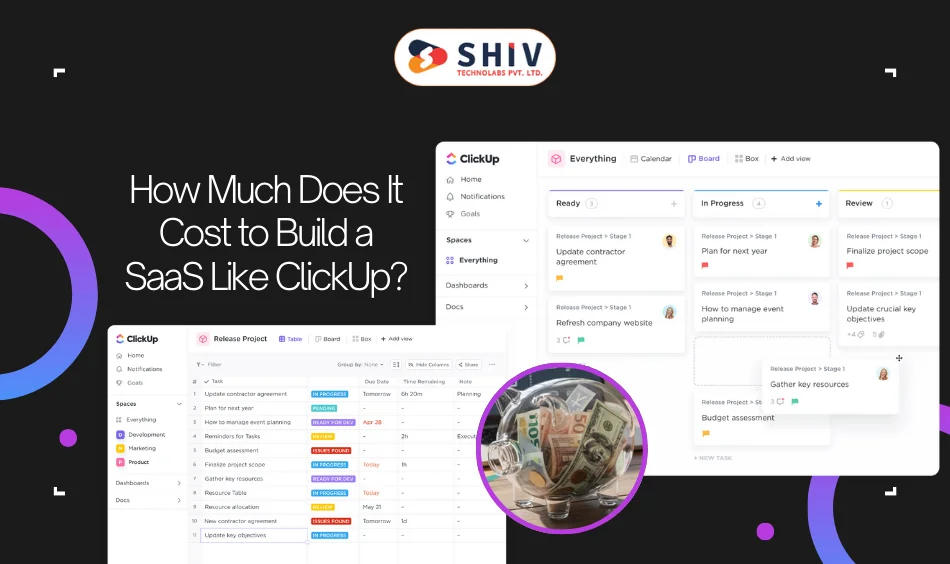
Knowing the cost of developing a SaaS like ClickUp helps you plan your development.
Cost depends on:
- UI/UX design complexity
- Number of features
- Enhanced automation and third-party integration.
- Tech stack and hosting needs
- Team size and expertise
Estimated Development Cost Breakdown
| Phase | Approximate Cost (USD) | Timeframe |
|---|---|---|
| MVP Development | $25,000 – $40,000 | 2–3 months |
| Full Platform Build | $60,000 – $120,000 | 5–8 months |
| Ongoing Maintenance | $1,000 – $3,000/month | Continuous |
To minimize costs, the majority of clients begin with an MVP and add functions as users increase. It is among the most effective ways of developing a SaaS platform.
Also Read: How to develop Saas Application: The Ultimate Guide
What Are the Benefits of Building a ClickUp-Like SaaS Platform?
Creating a SaaS platform that is presented as an analog to ClickUp is not a simple technology project. It is a long-term business investment that would bring about a recurrent revenue and attract a global customer as well as scale to an enterprise-level product. The success of ClickUp teaches that nowadays, companies appreciate centralized workplaces where teams can work, automate tasks, and access data wherever they go.
A similar ecosystem to ClickUp can provide the same possibilities: high retention, high monetization, and continuous development.
The most influential advantages of a SaaS application, such as ClickUp, are as follows.
Subscription-Based Revenue Stability
Foreseeable revenue is one of the most effective benefits of SaaS. If users pay a monthly or annual subscription fee, revenue is predictable and can be scaled. The consistency enables long-term planning, reinvestment in product enhancement, and long-term business development.
Why this matters
- Stable income minimizes risk in finance.
- You are able to bring up various pricing levels on various features.
- Enterprise subscriptions create great lifetime value.
You are not reliant on a single sale; rather, more income will be earned as more people start using it.
Scalable User Architecture
A platform similar to ClickUp expands with its clientele. With freelancers, enterprise teams, and all kinds of users, your software will offer high-level infrastructure flexibility.
Technical benefits
- Thousands of workspaces are supported by multi-tenant architecture.
- Adding of unlimited team members, projects, and tasks is allowed.
- Rapid onboarding is enabled by cloud-based hosting as demand rises.
Scalability transforms your platform into something that can be used long-term, rather than a short-term solution.
Multi-Device Accessibility for Modern Teams
An advanced SaaS platform should be omnipresent, whether on the web, desktops, or mobile devices. High accessibility will increase usage and customer loyalty.
Customer benefits
- Teams can work from anywhere.
- Immediate updates of tasks are synchronized.
- Mobile-first or offline is better for increasing adoption rates.
Working with the platform becomes part of users’ daily routine, leading to high retention.
Higher Customer Retention Through Automation
The popularity of ClickUp is founded on automation. Teams achieve time savings by having tasks circulate automatically, notifications sent at the appropriate time, and workflows run without manual intervention.
Benefits
- More productivity among teams.
- Reduced human error
- Faster project delivery
- Better user satisfaction
Automation features bring about long-term engagement. As companies depend on automation guidelines, they seldom change platforms.
Attractive to Investors and Enterprise Clients
SaaS is more preferable to investors since it is predictable, scalable and high-margin.
An app similar to ClickUp, and more so one with a robust feature roadmap, is strong in early- and growth-stage financing rounds.
Why investors value SaaS productivity tools
- Recurring revenue
- Clear user growth metrics
- Good customer lifetime value.
- Weak churn is associated with high automation and co-operation.
- Multi-product expansion potential.
Centralized productivity platforms are also valued by the enterprise clients due to their ease of use in the internal operations.
Opportunity to Enter a Fast-Growing Market
One of the quickest-expanding SaaS segments is project management software. As firms adopt hybrid and remote work, productivity and team collaboration tools keep on increasing every year, according to various reports on the industry.
Market advantages
- High population size of the target in industries.
- Great penetration among startups, SMEs, and enterprises.
- Rising workflow optimization needs across the globe.
A similar site like ClickUp puts your business within a good market that is profitable and growing fast.
Strong Upsell and Add-On Revenue Opportunities
As soon as your core platform is running, add other sources of revenue:
Potential upsells
- Advanced reporting suite
- AI-powered automation
- Workflow templates library
- Unlimited storage
- Premium integrations
- Security features are Enterprise-grade.
This tiered pricing scheme yields greater average revenue per user and provides the customers with flexibility.
Long-Term Brand Authority in SaaS Ecosystem
Solutions to genuine productivity problems in little time gain reputation and trust. An all-inclusive SaaS service platform becomes the hub of the team communication process, and it is hard to substitute by any of the rivals.
Resulting advantages
- High customer loyalty
- Strong referrals
- Positive public reviews
- Higher brand valuation
Long-term relevance is achieved when your platform becomes a part of the day-to-day workflow of a customer.
How to Choose the Right Partner for ClickUp-Like SaaS Development
The selection of the appropriate team determines the difference between a successful and a failed product.
- SaaS architecture and APIs Experience: Your development partner should be aware of multi-tenant systems and real-time features.
- Proven UI/UX Expertise: The success of SaaS is based on clean design and rapid onboarding.
- Continued Maintenance Services: The package must include post-launch updates, bug fixes, and scaling.
- Transparent Communication: There should be clear updates, documentation, and development based on milestones.
An experienced SaaS development company like Shiv Technolabs can deliver your product promptly and ensure it works perfectly.
Conclusion
The development of SaaS platforms, such as ClickUp, is a promising prospect for any company looking to break into the global productivity technology market. By employing the right strategy, feature set, and architecture, you will be able to build a high-performance platform that can drive collaboration, automate workflows, report, and be productive at scale. A formal development model will enable effective delivery and a future-proof SaaS platform that can be expanded as user workload increases.
Shiv Technolabs is a proven SaaS development firm involved will give your product the best opportunity to succeed, from conception through launch and beyond. At Shiv Technolabs, we focus on SaaS design, multi-tenant architecture, real-time collaboration tools, and building ClickUp-like systems that are more usable and performant than the norm.
Frequently Asked Questions (FAQs)
1. What is the cost of developing a SaaS such as ClickUp?
Development costs vary depending on feature depth, technology stack, and team size, ranging from $25,000 to develop an MVP to $120,000 to build a full-fledged ClickUp-like platform.
2. What do you consider are the most essential features of a SaaS app similar to ClickUp?
Major modules include task management, collaboration tools, dashboards, automated workflows, integrations, notifications, and secure user access management.
3. Is it possible to start a SaaS MVP development business?
Absolutely, MVP creation allows startups to test ideas quickly, gather user feedback, manage risk, and add features strategically based on actual user behavior.
4. What is the duration of construction of a project management SaaS platform?
Given that a normal MVP is 2-3 months, and a full-fledged platform, including automation, integrations, and advanced dashboards, is 6-9 months.
5. What are the long-run advantages of SaaS platform development?
The long-term benefits include a steady stream of revenue, worldwide scalability, improved customer retention, automation-driven productivity, and sustained profit growth.