Table of Contents
Online shoppers judge your brand at checkout, where speed and trust decide every order today. Many teams pick Laravel development services to build reliable payment flows that scale with traffic and frequent product updates. The framework gives you a clean structure, clear testing paths, and mature tools for cards, wallets, and bank methods.
Strong Laravel payment gateway integration creates a stable Laravel online payment solution that handles spikes without breaking key flows. With Laravel checkout integration, you can add Stripe, PayPal, Razorpay, or regional rails while keeping business logic tidy. Clear errors, reliable callbacks, and audit-ready logs help teams ship changes with confidence during busy campaigns.
Fast, low-friction payments cut cart abandonment and lift repeat purchases across mobile and desktop screens. Better success rates reduce support workload and protect revenue during ad pushes or holiday peaks. This guide explores best practices, integration steps, and security techniques for Laravel payment gateway integration in modern ecommerce platforms.

Why Is Laravel Payment Gateway Integration Important for Ecommerce Success?
Payments drive margin, retention, and brand reputation because shoppers decide in seconds whether to finish the order. A checkout that feels quick and safe supports higher approval rates and larger baskets during promotion bursts and seasonal campaigns. With Laravel payment gateway integration, you can combine speed with strong standards and clear observability across every step.
Laravel brings middleware, events, and jobs that help payments run smoothly without cluttering core code. You get a Laravel online payment solution that supports retries, refunds, and status sync, helping teams keep accurate records. See Laravel best practices for patterns you can apply right away.
Top Benefits of Integrating Payment Gateways in Laravel:
- Consistent checkout experience across devices
- Automated payment validation and refund support
- Global and multi-currency capabilities
- Real-time reporting and transaction logs
How Does Laravel Simplify Checkout Integration for Online Stores?
Laravel’s modular design keeps payment logic tidy and testable across complex catalogs and busy sales calendars. Service providers register gateway clients, while middleware guards sensitive routes, and event listeners capture state changes for downstream processes. Clear controllers handle intents, confirmations, and failures, so cart and order models stay focused on business rules.
Composer makes Laravel checkout integration fast by pulling trusted SDKs and well-known packages with clear version control and vendor support. You can integrate Stripe with Cashier for subscriptions, or call the direct APIs for one-time charges and wallets. PayPal, Razorpay, PayTabs, and Authorize.Net slot in through clean services with request signing, webhooks, and error mapping. For queues and background jobs, Laravel Horizon gives you a dashboard to watch throughput and failures.
These patterns reduce risk during scale events like flash sales, new launches, or festival traffic. They also help teams add new methods or regions without rewrites, because gateway code stays isolated from storefront features. The options below show how to integrate a payment gateway in Laravel for common markets.
Comparison of Popular Payment Gateways for Laravel Stores
Top Payment Gateways Compatible with Laravel Ecommerce
| Payment Gateway | Integration Method | Ideal Use Case | Security Highlights |
|---|---|---|---|
| Stripe | Laravel Cashier package / direct API | Global subscriptions & retail apps | PCI-DSS Level 1, tokenized transactions |
| PayPal | REST SDK via Composer | Cross-border transactions | Two-factor auth, sandbox testing |
| Razorpay | Laravel package + API keys | Indian market and B2C apps | AES encryption, webhook validation |
| PayTabs | REST API integration | GCC and MENA businesses | PCI certified, multi-currency support |
| Authorize.Net | SDK / API setup | U.S. B2B platforms | Fraud detection suite (FDS) |
What Are the Key Steps to Integrate a Payment Gateway in Laravel?
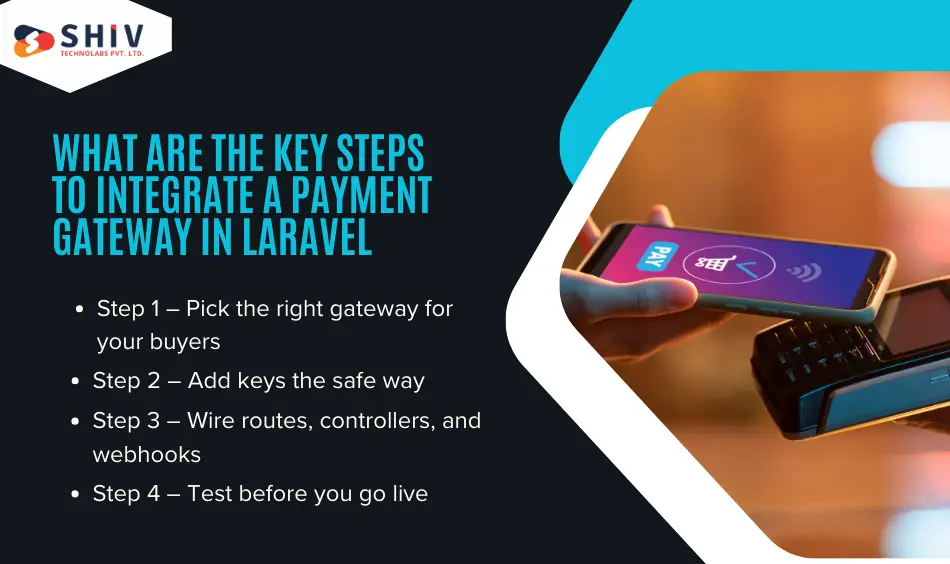
A clear plan keeps checkout fast during busy periods and protects revenue on campaign days. Use this roadmap to run Laravel payment gateway integration with confidence.
Step 1 – Pick the right gateway for your buyers
Study recent orders and buyer behavior, then choose methods that match real demand. Map cards, bank transfers, and wallets to each region and device profile. Rank partners by approval rates, fees, and settlement speed to guide rollout.
Step 2 – Add keys the safe way
Keep credentials outside source code and load them through a safe configuration. Separate test and live values to avoid accidental charges during QA. Rotate keys on a schedule, remove stale entries, and restrict viewing rights by role.
Step 3 – Wire routes, controllers, and webhooks
Keep a small surface: start the payment, confirm the result, and accept provider callbacks. Validate incoming messages, record references, and update order status in one place. Send receipts, stock updates, and shipping tasks to background jobs so Laravel checkout integration stays quick.
Step 4 – Test before you go live
Run passes for approvals, declines, time limits, slow replies, and duplicate requests. Add retry with backoff for transient faults and guard against double charges with request tokens. Reconcile daily by matching provider activity to your orders and refunds.


How Can You Secure Transactions During Laravel Payment Gateway Integration?
Payment trust drives repeat purchases and lowers disputes. Laravel gives you strong building blocks for safe flows from cart to capture.
Essential Security Practices to Implement
- Force HTTPS with SSL/TLS
- Apply CSRF protection in forms
- Sanitize inputs with Laravel validation rules
- Encrypt sensitive data at rest and in transit
- Implement token-based authentication for API requests
Add rate limits to payment and callback endpoints to cut scripted noise. Keep shopper-facing errors short and friendly, while writing full details to server logs with masked fields. Lock down admin tools with roles, IP rules, and multi-factor checks to lift Laravel transaction security without slowing buyers.
What Are the Best Practices to Improve Laravel Payment Gateway Performance?
High-traffic stores need short request paths and steady approvals when ads land. Focus on speed, resilience, and clear fallback signals, and your Laravel payment gateway integration will hold up under pressure.
Performance Enhancement Checklist
- Use queues for background work so the main request returns fast
- Cache non-sensitive provider metadata to cut repeated external calls
- Tighten database queries and add indexes to reduce load times
- Watch jobs and traces; alert on rising latency and failure clusters
- Trim external calls; load only data needed for the current step
Load test with real patterns and traffic bursts, not only happy paths. Track time to first response, callback delay, and retry impact to spot weak links early. With these habits, your Laravel checkout integration stays quick, reliable, and ready for peak days.
How to Choose the Right Team for Laravel Payment Gateway Integration?
Payment work touches revenue, fraud risk, and customer trust. You need a partner who treats checkout as mission-critical. A skilled Laravel development company plans for peaks, vendor outages, and post-payment workflows from day one.
Look for teams that ship clear code, stable releases, and fast support. Ask for case notes covering carts, webhooks, and refunds. Strong Laravel payment gateway experts will share audit trails, rollback steps, and playbooks for peak days.
Checklist for Hiring Laravel Payment Experts
- Proven portfolio of Laravel payment projects
- Knowledge of PCI and data privacy laws
- Ability to integrate multiple payment systems
- Offers support and maintenance after deployment
What Are the Common Challenges in Laravel Payment Gateway Integration and How to Resolve Them?
Even solid builds face production surprises. Latency spikes, invalid credentials, and webhook errors can block carts and confuse reports. Plan for noisy networks, duplicate posts, and partial refunds. Treat each issue as a repeatable play with logs, retries, and clear ownership. This approach keeps Laravel payment gateway integration steady during peaks.
Typical Issues and Their Fixes
| Challenge | Likely Cause | Laravel-Based Solution |
|---|---|---|
| Payment timeouts | Slow API response | Add queue and retry logic with Jobs; set timeouts and circuit breakers |
| Invalid API keys | Misconfigured credentials | Store in .env; rotate keys; map via config; verify per environment |
| Webhook failures | Incorrect endpoint URL | Validate signatures; confirm routes; test in sandbox before live |
| Refund issues | Missing API permission | Add controller checks; handle partial refunds; log provider refs |
| Duplicate transactions | Repeated client requests | Add idempotency tokens; dedupe by attempt ID; lock on order ID |
Why Laravel Payment Gateway Integration Is Ideal for High-Performance Ecommerce Platforms
Laravel suits fast-moving stores that need a clear structure and strong guardrails. Its routing, middleware, queues, and events let teams ship payment flows that hold up under heavy traffic. You get clean logs, predictable jobs, and quick rollback paths when a vendor slows down.
The open-source ecosystem and active community cut delivery time without hiding the internals. That mix creates a dependable Laravel online payment solution for enterprise checkouts and growing brands alike.
Also Read: When to Hire a Laravel Development Agency for Your Web App
How Do You Monitor Payments and Catch Issues Early?
Strong reporting turns payment data into fast fixes when something breaks during campaigns or peak days. Use Laravel’s queues, events, and logs to track health, find patterns, and act before customers drop.
Metrics to Track Daily
- Authorization rate by method, device, and region
- Step-by-step checkout drop-off for Laravel checkout integration
- Decline codes grouped by issuer, BIN, and reason
- Gateway latency and webhook delay trends
- Retry count, timeout rate, and error bursts
- Refund ratio, chargeback ratio, and dispute outcomes
- Payout timing, fees, and net revenue after costs
Reconciliation Checklist
- Match captures, voids, and refunds to order records
- Lock duplicates with idempotency keys and attempt IDs
- Store gateway references for every state change
- Review partial captures and split payments daily
- Compare provider exports with your ledger and inventory
- Alert on threshold breaches and missing webhooks
This data-first approach strengthens Laravel transaction security and keeps checkout steady when vendors slow down. Set alerts on thresholds, and feed insights into product, pricing, and support to raise conversion.
Conclusion
Modern stores win when payments are fast, safe, and easy to support across channels during promotions and seasonal peaks worldwide. Friction falls, chargebacks drop, and customers finish orders with confidence because checkout feels quick and trustworthy on every device. Disciplined planning, clean routing, and careful testing keep revenue stable while post-payment jobs run quietly, consistently, in the background.
Choose a partner who treats checkout as mission-critical, with clear playbooks for spikes, refunds, and vendor slowdowns. Shiv Technolabs provides hands-on implementation, steady communication, and measurable results across regions, devices, storefronts, and complex catalogs. We plan for load, track real-time signals, and keep teams ready with clear, tested rollback paths and audit-friendly records.
From environments and keys to monitoring and recovery, we build payment flows that stand up under real pressure daily. When you are ready for production, our Laravel development services cover planning, full integration, and reliable ongoing post-launch care.
FAQs
Q1. Which gateways work best with Laravel for ecommerce platforms?
Stripe, PayPal, Razorpay, PayTabs, and Authorize.Net offer strong docs, testing modes, and solid fraud tools.
Q2. How long does payment gateway integration take in Laravel?
Most builds land in one to three weeks, depending on methods, 3-D Secure, and test scope.
Q3. Can one Laravel store run multiple gateways at once?
Yes. Use a clean service layer to route methods per market, device, or fallback policy.
Q4. How safe is Laravel for online payments?
It supports encryption, CSRF protection, and environment-level key storage with validation on every request.
Q5. Why hire Laravel developers for payment work?
Specialists reduce setup mistakes, add guardrails for peaks, and keep logs clear for audits and refunds.