Table of Contents
Crypto trading activity continues to grow each year. According to public exchange data, global crypto trading volume often crosses $100 billion per day, with major price movements happening within seconds. Since crypto exchanges operate 24/7, many traders find it difficult to monitor charts and execute trades manually at all times.
Automated trading has become a practical solution. Industry reports show that over 60% of high-frequency crypto trades are handled by automated systems, especially on large exchanges. Trading bots help track prices continuously, respond faster than manual traders, and follow predefined rules without emotional decisions.
Crypto trading bot development focuses on building software that connects with exchanges, reads live market data, and places buy or sell orders automatically. In 2026, these bots are used by individual traders, fintech startups, and crypto funds to manage large volumes, reduce reaction time, and maintain consistent trading behavior.
This guide explains how crypto trading bots are built, how they work, and what businesses should consider before starting development.

What is a Crypto Trading Bot and Why Build One in 2026?
A crypto trading bot is a software program that interacts with cryptocurrency exchanges to buy or sell assets on your behalf. These bots follow specific rules based on price, volume, time, or technical indicators.
# The Shift to Automation
In 2026, the crypto market is characterized by high-frequency institutional activity and decentralized finance (DeFi) movements. Relying on manual clicks is often too slow. A custom bot offers several advantages:
- Speed: Bots process data and place orders in milliseconds.
- Consistency: They follow a plan without the interference of fear or greed.
- Efficiency: A single bot can monitor hundreds of trading pairs simultaneously across different exchanges.
- Precision: Automation helps in executing complex strategies like arbitrage or market making that are impossible to do manually.
Step-by-Step Crypto Trading Bot Development Process

Building a crypto trading bot is not just coding a few rules and connecting to an exchange. A reliable bot needs clear goals, careful logic, strong safety checks, and thorough testing before it touches real funds. Below is a step-by-step process that teams follow to build a bot that can run in real trading conditions.
Step 1: Define the goal and scope
Start by writing down what the bot must do and what it must not do. This step prevents confusion later and keeps development focused.
Decide the basics first:
- Trading style: short-term, medium-term, or long-term
- Trading type: spot, futures, margin (if required)
- Assets: which coins or pairs the bot will trade
- Exchanges: one exchange or multiple
- Timeframes: 1-min, 5-min, 15-min, 1-hour, etc.
- Trade frequency: few trades per day or many trades per hour
Also define constraints:
- Max open trades at once
- Max order size per trade
- Daily loss limit (stop condition)
- Allowed trading hours (optional)
A clear scope saves time and reduces rework.
Step 2: Choose the strategy and entry/exit rules
The strategy decides how the bot makes decisions. Keep it simple at first, then add complexity only if needed.
Typical strategy choices:
- Arbitrage (same asset across exchanges)
- Grid trading (range-based buys and sells)
- Trend-based (signals from indicators)
- Mean reversion (price returning to average)
- Breakout (price crossing key levels)
- AI-based signals (advanced setups)
Then define the rules in plain language before coding:
- What counts as a buy signal?
- What counts as a sell signal?
- When should the bot do nothing?
Add exit planning early. Many bots fail because exits are weak.
Include:
- Take-profit rule
- Stop-loss rule
- Time-based exit (close after X minutes/hours if stuck)
- Trailing stop rule (optional)
Step 3: Define risk controls before writing code
Risk control is not an extra feature. It is a core requirement.
Common risk controls include:
- Position sizing (fixed amount, % of balance, or volatility-based)
- Max drawdown limit (stop trading if losses cross a set level)
- Max trades per day/hour
- Cooldown time after a loss
- Slippage tolerance (avoid bad fills)
- Partial exits (sell in stages)
Write these controls as rules. The bot should follow them automatically.
Step 4: Pick the system design and tech stack
After goals and rules are clear, plan how the bot will be built.
A typical bot includes:
- Strategy engine: where trading rules run
- Market data module: fetches prices, candles, order book
- Execution module: places/cancels orders
- Risk manager: checks limits before every trade
- Storage: saves logs, signals, trades, errors
- Dashboard: shows performance and bot status
- Alert system: notifies when something breaks
Tech stack depends on your needs, but the key is stability, speed, and safe handling of API keys.
Step 5: Connect to exchanges (API integration)
The bot connects to exchanges through APIs. This step must be handled carefully because API keys control trading access.
Important integration tasks:
- Read balances and open positions
- Pull market data (candles, tickers, depth)
- Place orders (market/limit)
- Cancel/replace orders
- Handle rate limits and API errors
Security checklist for API keys:
- Keep keys encrypted at rest
- Disable withdrawals on trading keys
- Use IP allowlisting where possible
- Separate keys per bot or per user
Step 6: Build the trading logic (signals → decisions → orders)
Now the team converts the written rules into code. This includes:
- Signal generation (indicator logic, price triggers, filters)
- Decision layer (confirmations, cooldown checks, risk checks)
- Order creation (type, size, price, slippage limits)
- Order monitoring (filled/partial fill/rejected)
- Exit logic (TP/SL/trailing/time exits)
Good bots also include edge-case handling, such as:
- Sudden price spikes
- Candle gaps
- Partial order fills
- Duplicate signals
- Network delays
Step 7: Backtesting with historical data
Backtesting runs the strategy on past market data to understand behavior. It helps detect weak rules and risky patterns.
During backtesting, evaluate:
- Profit/loss trends
- Drawdown (how deep losses go)
- Win rate vs average win/loss size
- Performance in different price conditions
- How fees affect outcomes
- How often do stop-loss triggers
Avoid one common trap: rules that look great on past data but fail in live trading. Keep the strategy realistic and avoid overly complex tuning.
Must Read: Can AI Predict Stock Market Crashes?
Step 8: Paper trading (live data, no real money)
Paper trading is one of the most important steps. The bot runs in real time with live data but does not place real trades (or places simulated trades).
This stage checks:
- Signal timing in real conditions
- Order logic accuracy
- Error handling during exchange issues
- Performance under rate limits
- Stability over many hours/days
Paper trading often reveals issues that backtesting cannot.
Step 9: Start live trading in a controlled way
Live trading should begin with strict limits.
A safe launch approach:
- Start with small position sizes
- Limit the number of open trades
- Set a daily loss cap
- Monitor trade logs closely
- Keep alerts active for errors and failures
Many teams run limited live mode first, then scale up slowly after stable results.
Step 10: Monitoring, maintenance, and ongoing improvements
A trading bot is not a one-time build. Exchanges change APIs, fees change, and strategies need updates.
Ongoing work includes:
- Performance reporting (daily/weekly)
- Strategy review and rule updates
- Bug fixes and reliability improvements
- Security reviews and key rotation
- Handling exchange updates and new rate limits
- Improving dashboards and alerts
A bot that runs well is usually the result of steady maintenance, not a single launch.
Different Types of Crypto Trading Bots to Consider
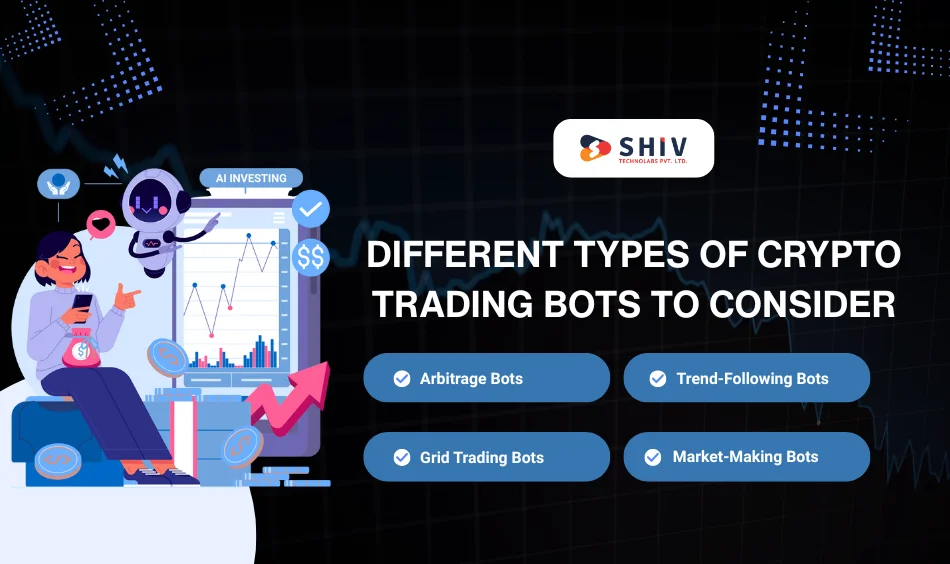
Before writing the first line of code, you must decide which strategy your bot will follow. Different market conditions require different approaches.
1. Arbitrage Bots
These bots look for price differences for the same asset on different exchanges. If Bitcoin is $95,000 on Exchange A and $95,100 on Exchange B, the bot buys on A and sells on B to pocket the difference.
2. Grid Trading Bots
Grid bots work best in sideways markets. They place a series of buy and sell orders at set intervals above and below a specific price. As the price fluctuates, the bot systematically buys low and sells high within that range.
3. Trend-Following Bots
These bots use technical indicators to identify a market direction. They buy when they see upward momentum upward and sell when a downward trend begins. Common tools used here include Moving Averages and the Relative Strength Index (RSI).
4. Market-Making Bots
Market-making bots provide liquidity by placing both buy and sell orders at the same time. They profit from the spread—the small difference between the buying and selling price.


Essential Features for a Modern Crypto Trading Bot
A basic bot might just buy and sell, but a professional-grade tool in 2026 needs a robust set of features to handle modern market demands.
1. High-Speed Data Processing
The bot must be able to ingest real-time data from multiple sources. This includes exchange APIs for price and order books, as well as on-chain data for DeFi-specific strategies.
2. Advanced Risk Management
Capital protection is the most important part of trading. Your bot should include:
- Stop-Loss and Take-Profit: Automated exit points to lock in gains or limit losses.
- Position Sizing: Calculating the right amount of capital for each trade based on your total balance.
- Kill Switches: A manual or automatic way to stop all trading if the market becomes too volatile or the bot behaves unexpectedly.
3. Backtesting and Simulation
You should never use real money on an unproven strategy. A backtesting engine allows you to run your bot against historical data to see how it would have performed in the past.
Additionally, paper trading modes allow the bot to trade in real-time using fake money.
4. AI and Machine Learning Integration
Modern bots in 2026 often use machine learning to adapt to changing market cycles. Instead of fixed rules, these bots can recognize patterns and adjust their own parameters over time.
Also Read: Cryptocurrency App Development
Technical Challenges and Security Measures
Building a bot comes with risks. Security must be a priority from the very beginning.
- API Key Security: Never hardcode your API keys into the software. Use environment variables or secure vault services. Ensure that withdrawal permissions are disabled on your exchange API settings.
- Handling Latency: Internet delays can cause slippage, where the price changes between the time the bot decides to trade and the time the order is filled.
- Error Handling: What happens if the exchange goes down? Or if your internet cuts out? Your code must include robust error-handling to prevent the bot from getting stuck in an open position.
- Regulatory Compliance: In 2026, rules around automated trading will be more defined. Ensure your bot follows the KYC (Know Your Customer) and AML (Anti-Money Laundering) requirements of the jurisdictions where you operate.
Why Choose Shiv Technolabs for Crypto Trading Bot Development?
At Shiv Technolabs, we specialize in creating sophisticated, high-performance automated digital transformation services. Our team understands that in the crypto space, precision and reliability are everything. We provide end-to-end development services tailored to your specific trading goals.
We focus on building secure, scalable bots that can handle the high volatility of the current market. From AI-driven trend predictors to complex arbitrage systems, we bring technical expertise to every project. We prioritize security and performance, ensuring that your trading system is built on a foundation of clean code and robust architecture.
Conclusion
Developing a crypto trading bot in 2026 is a powerful way to participate in the digital economy. By removing human error and increasing execution speed, these tools help traders manage their portfolios with much higher efficiency. While the development process requires careful planning and a focus on security, the long-term benefits of a well-built bot are substantial.
The most successful bots are those that are constantly monitored and refined. As the market changes, your automation must change with it. Starting with a clear strategy and a solid technical foundation is the best way to ensure your bot remains a valuable asset for years to come. Contact Shiv Technolabs today because we are the best digital transformation company!