Table of Contents
Artificial Intelligence (AI) is quickly transforming the nature of how the insurance industry functions, competes, and provides value to the policyholders. The previously paper-intensive, rules-based, and manually operated industry is transforming into a data-driven, predictive, and automated ecosystem.
Insurance companies entering the advanced insurance software development space are increasingly relying on AI to automate claims, detect fraud, and manage policies faster and more accurately.
Reports state that insurers using AI in claims and underwriting processes could cut operating expenses by up to 30% and significantly shorten settlement times.
Artificial intelligence in insurance software offers a middle ground between ad hoc decisions and real-time information processing. AI helps insurers minimize risk, improve accuracy, and build customer trust by performing instant document validation and predictive policy pricing, among other capabilities.
The article discusses how AI is changing claims automation, policy management, and operational workflows, and how insurers can leverage current AI-based platforms to remain competitive.
Why AI Integration Has Become Essential for Modern Insurance Software?
The insurance business has evolved to adopt intelligent systems rather than stagnant rule-based systems. The growth in the number of claims, the complexity of fraud, regulatory pressures and customer demands have elevated AI in insurance software to a strategic requirement rather than an innovation experiment.
Conventional insurance platforms were primarily based on manual data entry, human judgment and reactive processes. The introduction of artificial intelligence into insurance software enables machine learning models to interpret large datasets in real time, find patterns and support proactive decision-making. This change enables insurers to expand operations without necessarily staffing up or incurring corresponding costs.
The main factors driving the rapid adoption of AI are:
- Raising the complexity and frequency of claims.
- Expressed speed of settlement and transparency.
- Increasing fraud threats in the digital context.
- Demand greater efficiency and profitability.
- Conventional vs AI-Based Insurance Business.
Traditional vs AI-Enabled Insurance Operations
| Function | Traditional Process | AI-Enabled Process |
|---|---|---|
| Claim Review | Manual data entry | Automated document recognition |
| Fraud Detection | Reactive audits | Predictive anomaly detection |
| Policy Renewal | Manual workflow | AI-based recommendations |
AI-powered insurance systems are no longer optional—they are foundational to modern operations.
How AI Improves Speed and Accuracy in Claims Automation?
One of the insurance functions that requires the most resources is claims processing. Automating insurance claims with AI makes the process faster and more accurate, rather than slower and error-prone.
Smarter Data Extraction and Validation
OCR and Natural Language Processing (NLP) systems powered by AI can automatically read claim forms, invoices, medical records, and accident reports. These systems retrieve the structured data, validate it with policy terms, and indicate the missing or inconsistent information in real time. Turnaround is also significantly reduced since what took a few hours to review manually can now be reviewed in seconds, reducing human error.
AI Models That Detect and Prevent Fraud
The concept of fraud detection has evolved to include proactive audits, rather than post-incident audits. When claims are being made, AI models continuously assess transaction behaviour and patterns to determine risk before payments are made.
The significant features of fraud detection are:
- Pattern recognition to indicate abnormal claims behavior.
- Predictive modeling to predict fraudulent submissions.
- Cross-data verification of claims, policies and third-party sources.
These models do not stop learning; therefore, over time, they become more accurate at detection.
Performance Outcomes of Automated Claims Systems
| Metric | Before AI | After AI |
|---|---|---|
| Processing Time | 5–7 days | 1 day |
| Fraud Detection Rate | 65% | 93% |
| Customer Retention | 72% | 90% |
How Artificial Intelligence Elevates Policy Management
The role of policy administration is no longer a back-office role. Insurance software powered by artificial intelligence enables dynamic policy management and data-driven business across the policy lifecycle.
Active Policy development and customization
AI compiles customer demographics, risk history, behavioral data and external signals to provide personalized coverage options. This leads to policies that are more aligned with the individual risk profiles as well as an increase in conversion rates and customer satisfaction.
Computerized Policy Renewals and Modifications
Machine learning platforms are used to assess claims history, risk exposure and market conditions and to automatically compute premium changes. There is a possibility of automatically renewing, modifying, or upselling policies, thereby enhancing efficiency and minimising churn at renewal.
Predictive Risk Assessment
AI re-evaluates risk signals to detect changes in exposure. This enables insurers to proactively modify the terms of cover rather than respond to losses after they occur.
Optimization of Usage Policies
AI assists in insurance models that are used on a usage-based platform by analyzing telematics, IoT data, or patterns of customer behavior. The premiums are set dynamically and in line with usage rather than on fixed assumptions.
Policy Compliance Auditing
The automation of compliance checks will provide alignment of policies with regulatory requirements in different regions, minimizing the administrative overhead and audit risk.
Intelligent Document Management
AI automates and categorizes, stores and retrieves policy documents, which enhances their accessibility and decreases manual processing.
Customer Self-Enablement
The use of AI-powered portals enables policyholders to access, update and manage policies without relying on a call centre, reducing call centre usage.


Leveraging Custom Insurance Software Solutions for Policy Efficiency
Automation of the insurance process is an application of AI to reduce repetitive work and enable people to concentrate on decision-making that brings high value.
How Insurance Process Automation Reduces Human Intervention?
Here are some of the most likely ways Insurance Process Automation Reduces Human Intervention:
Automation of Operational Workflows.
End-to-end insurance processes are streamlined using AI.
Key automated workflows include:
- Real-time claims tracking
- Automated document routing
- Triggers of approval and escalation.
- Generation of reports and monitoring compliance.
This helps minimize delays and enhance operational stability.
AI and RPA: A Synergized Approach
Robotic Process Automation (RPA) involves repetitive, rule-based data entry, while AI involves judgment-based decisions. They work together to develop scalable automation systems that can enhance speed without compromising quality.
Quantifiable Impact of Automation
The typical results of insurers who apply AI-driven automation are:
- 60% accelerated rate of settling claims.
- 40% reduction in manual reviews
- 35% lower operational costs
Why AI Development Services Are Driving Innovation in Insurance Software?
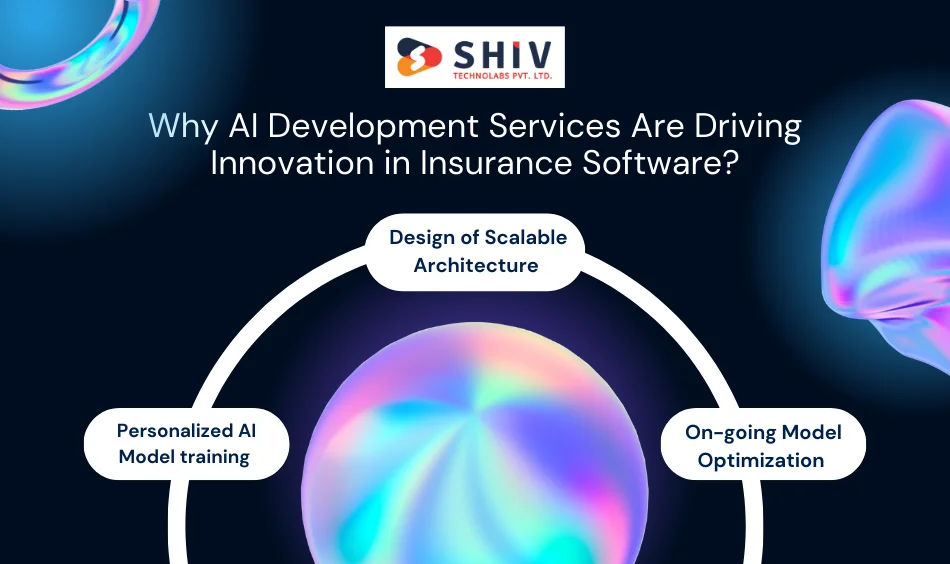
Professional AI development services enable insurers to implement advanced models without restructuring systems. Such services include data engineering, model training, integration and optimization.
Personalized AI Model training
Specialized AI models that were trained on insurance-specific data are more accurate compared to generic models.
Design of Scalable Architecture
AI solutions are designed to scale products, regions and claim volumes.
On-going Model Optimization
Continuous training will keep models up to date with changes in risk trends and fraud schemes.
How Insurance Software Development Services Enable Digital Reinvention?
Contemporary software development offers insurance services that provide formal ways for AI to be embraced.
Key Stages of AI Integration in Insurance Software
| Phase | Focus | Result |
|---|---|---|
| Phase 1 | Data modeling | Foundation for machine learning |
| Phase 2 | Claims automation | Reduced processing times |
| Phase 3 | Predictive analytics | Smarter policy pricing |
| Phase 4 | Customer interfaces | Enhanced satisfaction |
Cost and Timeline Insights
AI as a modular implementation saves money during the initial phases and enables insurers to expand capacities in the long run. The average ROI in most AI integrations is achieved in 6-12 months.
What Measurable Benefits Can Insurers Expect from AI-Powered Software?
Insurance software powered by AI provides real-world, quantifiable results in claims, policy management, operations and customer satisfaction. The adoption of AI also compares with conventional IT upgrades in that business impact is realized in months rather than years.
When effectively applied, insurers will be able to measure increases in speed, accuracy, cost efficiency and customer retention.
Faster Claim Turnaround Time
Among the most immediate advantages of AI, quicker claim processing should be mentioned. Document intake, instant validation and rule-based decision support eliminate delays caused by manual reviews. The standard enhancements are:
- 40-60% decrease in the mean time of settlement of claims.
- Claims for low-risk cases are approved the same day.
- Rapidly transfer the complicated claims to human adjudicators.
Reduced turnaround times will enhance customer satisfaction but also put pressure on the claim backlog.
Reduced Operational Costs
Automation through AI can significantly reduce the claim and per-policy costs. The reduction in manual intervention means insurers can expand their operations without increasing the number of employees to match their scale. Some of the common cost-related consequences are:
- 25-35% cut in claims handling expenses.
- Reduced reliance on huge back-office units.
- Data entry errors led to reduced rework.
In the long run, AI transforms operational costs from labor-intensive to streamlined digital operations.
Improved Fraud Detection and Loss Prevention
AI is effective at recognizing patterns that humans often overlook. Fraud models are advanced and analyse historical claims, behavioural signals and external data sources in real time.
Quantifiable benefits as a result of fraud are:
- Accuracy in scoring fraud risk up to 90%.
- Prevention of suspicious claims at a younger age.
- Low payout leakage because of false approvals.
This means that blocking even a small percentage of fraudulent claims will yield significant financial savings at scale.
Higher Customer Satisfaction and Retention
An AI-based insurance solution is faster, offers customised policies and clear communication, all of which enhance customer confidence.
The most common metrics of customer experience include:
- 15-25% growth in customer satisfaction scores
- Improved renewal rates because of the active policy recommendations
- Reduced the number of complaints on delays or errors.
More Accurate Risk Evaluation and Pricing
The AI models constantly evaluate risk using live data rather than assumptions. This leads to increased accuracy in the underwriting and pricing.
Key outcomes include:
- Better loss ratio with enhanced risk segmentation.
- Premium behavioural and exposure dynamism.
- Low underpricing and overpricing cases.
How to Choose a Reliable Partner for AI-Driven Insurance Solutions?
Below are quick tips to follow to find a reliable partner for AI-driven insurance solutions:
- An established history of AI and Automation: Seek partners that have practical insurance practices.
- Insurance Process Framework Experience: Domain knowledge is essential towards compliance and precision.
- Adherence and Information security expertise: They must include security, encryption and regulatory compliance.
- Capability of end-to-end delivery: From deployment to optimization.
Conclusion
The use of AI-based insurance services is transforming the way claims are handled, policies are distributed and clients are served. Intelligent workflows, automation and predictive analytics enable insurers to work faster, smarter and more securely.
Collaborating with a seasoned insurance software development company, Shiv Technolabs will facilitate the implementation of scalable, strategic and compliant AI. Shiv Technolabs assists insurers in upgrading legacy systems to intelligent platforms, including AI integration, automation and tailored platform development from planning through deployment.
Are you ready to modernise your insurance operations? Contact us today at Shiv Technolabs and let our team of experts deliver insurance software development services to accelerate claims, create more innovative policies and enable scalable AI-powered automation.
Frequently Asked Questions (FAQs)
1. What are the benefits of AI in automation of insurance claims?
AI verifies documents, identifies inconsistencies and minimises human error through predictive checks and real-time analysis.
2. Is it possible to incorporate AI into existing platforms?
Yes, Insurers can add AI layers to their core systems through expert AI development services.
3. How are personalized insurance software solutions advantageous?
They allow customized processes, scalable integrations and business-specific adaptable AI models.
4. Can AI be considered safe when handling policyholder information?
Contemporary systems are safeguarded with encryption, controls and compliance measures to hold sensitive data.
5. How much ROI: What can insurers get out of AI in insurance software?
Many insurers have realized up to 50% in claim resolution and significant operational cost savings.