Table of Contents
Today, companies operate in an ecosystem of platforms, tools, databases, cloud services, mobile applications, and third-party systems. In the absence of cross-platform integration, these systems become islands. The report indicates that 72%+ of enterprises report that poor system integration directly slows expansion, adds 30%+ to operational cost, and exposes the enterprise to data inconsistencies.
Python-based integration fills platform gaps, automates data flow, and eliminates manual dependencies. Frameworks such as Django, Flask, and FastAPI simplify background logic, facilitate secure API connections, and enhance system compatibility. Firms that have embraced Python integration solutions have reported reduced deployment cycles, lower maintenance costs, and greater scalability.
This blog will teach you how cross-platform integration is achieved, why Python frameworks lead in integration architecture, how it has been used in the real world, its advantages, and the successful implementation strategies proven to scale securely and efficiently.
What Is Cross-Platform Integration and How Does It Work?
Cross-platform integration is the process of linking two or more independent systems to enable them to share data, trigger actions and function as a single ecosystem. Integration is used instead of manual exports, duplication, or isolated workflows to ensure automated, real-time communication across platforms.
Companies use integration to integrate business ERPs, CRMs, cloud-based technologies, analytics software, payment gateways and mobile applications. The integration of the Python framework is essential, as it provides a lightweight, secure and scalable technology stack-independent API-driven communication between systems.
The best frameworks for integrating a Python API in the modern world are Flask and FastAPI, as they are REST-based, support asynchronous processing and have a modular architecture.
Live information synchronization
This is done through real-time data synchronization, so that changes made on one platform are reflected across all connected systems. Python supports event-driven and API-based synchronisation processes that remove delays and mismatched records, as well as minimise reconciliation errors. This is particularly significant for inventory, orders, customer profiles and financial data across cloud, mobile and back-end systems.
Back-end centralized control
Python-based integration provides a centralized layer of backend that processes logic, routing, validation and error management. Python frameworks provide a control hub instead of the communication between each platform. This enhances good governance, eases debugging and ensures that all integrated platforms follow similar rules. For the server-side layer, review our Backend Development services.
API-based communication
The majority of cross-platform integration is based on APIs. Python frameworks make API development, usage and coordination easier. Flask and FastAPI are particularly useful for creating lightweight microservices that link cloud services, mobile applications and enterprise software via standard API protocols.
Defended authentication levels
In integration architecture, there is no room to compromise on security. Python also has token-based authentication, OAuth, JWT, encryption libraries and role-based access control. These layers allow systems to share data only when required and sensitive business data across platforms.
Why Choose Python for Cross-Platform Integration Projects?
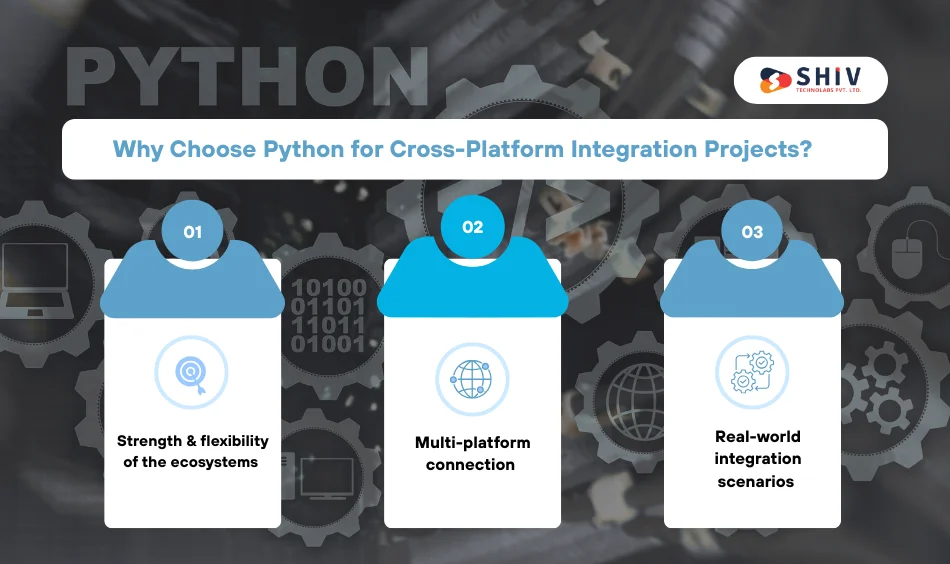
The simplicity, flexibility and extensive ecosystem have made Python the language of choice for integration work. It can be easily adjusted across various platforms, scaled with the business’s growth and integrated with both modern and legacy systems.
Strength and flexibility of the ecosystems
Thousands of libraries are available in Python for APIs, automation, data processing, authentication and cloud services. This enables developers to implement backend integration in Python without reinventing core parts. Its readability minimizes time taken in development and time taken in long-term maintenance.
Multi-platform connection
Python links the cloud platforms, web applications, mobile applications, desktop software, Internet of Things (IoT) devices and legacy systems. This suits well for businesses with mixed technology stacks that need integration across the environment. For app-facing layers, check our Mobile App Development.
Real-world integration scenarios
Python is widely used for CRM-ERP synchronization, ecommerce platform integration, payment gateway integration, analytics pipelines and SaaS automation. Such applications require performance, stability and scalability, which Python can deliver effectively.
Python integration with traditional methods.
Python integration vs traditional methods
| Feature | Python Integration | Traditional Methods |
|---|---|---|
| Code Reusability | High | Low |
| API Support | Extensive | Limited |
| Framework Options | Flask, FastAPI, Django | Varies |
| Scalability | Excellent | Moderate |
| Automation Capability | Built in | Manual |
How Python Frameworks Simplify Backend Integration?
Python frameworks encapsulate complex backend work and provide systematic means for easily assembling integration logic. They also handle routing, authentication, middleware and error handling with low overhead.
Python frameworks minimize human error and encourage modular code and scalable integration pipelines. Standard integrations include CRM-to-cloud syncs, ERP-to-payment gateways and analytics-to-data warehouses.
Popular Python frameworks for integration
- Django for enterprise-level integration: Django provides a powerful ORM, security and scalability. It is best suited for intricate integrations that require massive datasets and enterprise processes.
- Lightweight API connection Flask: Flask is sparse and adaptable. It is ideal with microservices, API gateways and lightweight integration layers.
- FastAPI for high-performance async tasks: FastAPI is asynchronous and an excellent fit for real-time systems, high-traffic APIs, or low-latency integration services.
- Tornado in real-time systems: Tornado supports long-lived connections and real-time messaging, which are typical of IoT and streaming integrations – Hire Dedicated Python Developers


Key Components of a Successful Cross-Platform Integration Strategy
Performance, security, scalability and maintainability is a strong integration strategy. Python enables this balance through a modular architecture and design that are friendly to automation.
Safe authentication and encryption
Authentication guarantees that the communicated systems with trustworthy. Python supports OAuth, JWT, API keys, email-based encryption and role-based access. These controls safeguard sensitive information and ensure adherence across combined platforms.
Automated API data handling
Repetitive manual processes are automated. Retries, validation and transformation and API calls are automatically performed using Python scripts. This lowers operational costs and enhances uniformity across systems.
Scalable architecture
Python frameworks support horizontal and vertical scaling. Integration services can be independently scaled as traffic increases and remain stable even during peak traffic.
Constant monitoring and updates
Failure, latency spikes and security intrusions are detected early on using Python-integrated monitoring tools. The continuous nature of updates ensures that the integrations remain compatible with third-party API changes.
Real-World Use Cases of Cross-Platform Integration Using Python
Python is perfect for real-world integration applications where reliability and flexibility are essential.
ERP integration in an ecommerce platform
Using the Python API, retail businesses combine Shopify with ERP systems. This guarantees real-time alignment of inventory, the order book and financial reconciliation. See our Odoo API Development.
Integration of CRM and cloud accounting
Python links Salesforce CRM and accounting solutions to automatically synchronize customer information, invoices and payments.
IoT communication and mobile application
Python APIs enable and secure real-time communication between mobile applications, IoT devices, dashboards and cloud services.
| Industry | Integration Type | Python Framework |
|---|---|---|
| Retail | ERP + Inventory | Django |
| SaaS | CRM + Cloud Storage | Flask |
| Healthcare | Data Exchange API | FastAPI |
| Logistics | IoT + Dashboard | Tornado |
Benefits of Cross-Platform Integration with Python Frameworks
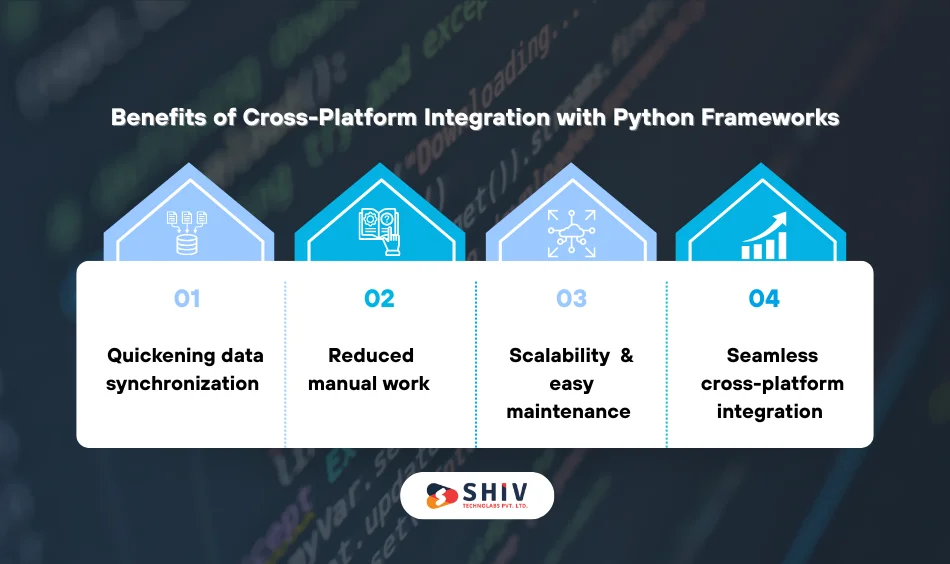
Python-powered integration provides quantifiable value to the business. Below are some of the potential benefits of cross-platform integration with Python frameworks:
Quickening data synchronization
Real-time data exchange is automated, maintaining systems up to date. This minimizes mistakes, time wastage and friction.
Reduced manual work
Manual data entry and reconciliation are replaced with automation. Teams are also strategy-oriented rather than maintenance-oriented.
Scalability and easy maintenance
Python code is modular and readable. This makes updating, debugging and subsequent enhancements easier.
Seamless cross-platform integration
Python is future-ready, as it adapts to APIs, databases, cloud services and legacy systems.
How a Python Development Agency Helps in Integration Projects?
Massive scale integration needs experience. A professional Python development agency like Shiv Technolabs will guarantee robust architecture, rapid deployment and stability.
Professional architecture and planning
Agencies develop an integration architecture based on business objectives, compliance requirements, and expansion strategies.
End-to-end integration services
It has services such as API development, middleware development, automation development, data normalization, and monitoring.
Continuous maintenance and streamlining
Post-launch support ensures integrations are secure, fast and compatible with evolving platforms.
Conclusion
Cross-platform integration is now not an option. The businesses that fail to bridge the systems lose efficiency, visibility, and competitive advantage. Python frameworks offer greater flexibility and enable secure, cost-effective integration by automating, scaling, and supporting API-driven architecture.
Shiv Technolabs, a renowned Python web development company, provides comprehensive integration solutions, API development, backend automation, and enterprise-grade architecture. Our team develops scalable cross-platform integration systems that minimize costs, enhance data accuracy, and drive long-term growth.
Now is the time, in case you are thinking of system integration or API modernization, or automation. Today, contact Shiv Technolabs for a consultation and to merge the disconnected platforms into a single, high-performance ecosystem.
Frequently Asked Questions (FAQs)
What is Python cross-platform integration?
Integration with Python enables cross-platform integration between two or more systems via APIs and middleware. Python frameworks facilitate secure data transmission, automated and real-time synchronization between cloud, mobile, and enterprise platforms.
What are the most suitable Python frameworks to use on integration projects?
Django, Flask, and FastAPI are popular for integration. Django is well-suited to enterprise workflows, Flask is better for lightweight APIs, and FastAPI is better for high-performance and real-time integration.
Is Python capable of real-time integration?
Yes, Python supports asynchronous systems such as FastAPI and Tornado, enabling real-time data processing, event-driven communication, and low-latency API responses.
Is Python secure for back-end integration?
Python has a strong security posture, including encryption libraries, token-based authentication, OAuth, and secure API management, and can therefore be trusted in an enterprise-controlled setup.
What are the ways of starting businesses in Python integration?
When collaborating with a professional Python development agency like Shiv Technolabs, it helps design the architecture, create APIs, automate workflows, and maintain system performance after deployment.