Table of Contents
We deliver Odoo ERP projects across the UAE and treat data as the core of daily work. As Odoo partners in UAE, we protect sensitive information from the first database setup to the final cloud rollout. Our teams design clear roles, protected transfer paths, and steady backups that keep operations moving without surprise gaps.
Security in Odoo connects directly to PDPL duties in the UAE. We plan access rules, retention timelines, and audit trails so actions remain traceable and rights remain respected. That approach reduces guesswork during checks and gives leaders confidence when they review systems or field customer requests.
This guide shares practical steps for Odoo ERP Data Security across planning, migration, and post-go-live care. We outline key risks, show built-in controls, and present methods that match local rules. By applying proven Data Security in Odoo practices, we help your team cut exposure and keep trust high with clients, partners, and regulators.

Why Is Data Security Crucial During Odoo ERP Implementation?
We migrate large data sets during an Odoo rollout: finance entries, HR records, inventory levels, and sales histories. Each export and import pass can open gaps if we leave temporary accounts active or skip access checks. The transition period adds pressure, which increases the chance of mistakes without a firm routine.
We reduce that risk with role-based access, encrypted transfer channels, and repeatable import playbooks. In the UAE, ERP Data Security in UAE also includes PDPL duties such as purpose limits, traceable handling, and timely responses to subject requests. Our setup for Odoo ERP Data Protection supports those duties with strict privileges, activity logs, and resilient backups across environments. (See our broader ERP & CRM development approach.)
Key Reasons Businesses Must Prioritize ERP Data Protection
- ERP systems store sensitive financial and personal information.
- Data breaches can cause significant business disruption.
- Regulatory non-compliance under UAE PDPL can lead to penalties.
Common ERP Security Weak Points
- Data leaks during migration
- Weak user credentials
- Insecure cloud storage
- Outdated modules
- Improper vendor access permissions
Major Data Security Risks in Odoo ERP Projects
We work with admins, developers, and external vendors during most implementations. Risk rises when default settings remain active, modules miss patches, or contractors keep access after go-live. Unreviewed integrations can also create quiet data paths that teams notice only after loss or delay, which hurts service levels and trust.
UAE firms face regional needs as well. Hosting choices affect residency expectations, while weak SSL settings expose traffic during sync jobs. We assign owners, write down each step, and run staged tests before production imports. That routine aligns with Odoo Security Best Practices and supports Odoo ERP Data Security in UAE from day one through steady operations.
Common ERP Security Risks and Their Impact
| Risk Category | Example | Impact on UAE Businesses |
|---|---|---|
| Unauthorized Access | Poor access control | Breach of confidential data |
| Weak Encryption | No SSL or HTTPS | Data exposure during sync |
| Outdated Modules | Ignored patches | Exploitable vulnerabilities |
| Third-Party Apps | Unverified integrations | Data siphoning threats |
| No Backup Plan | No redundancy setup | Permanent loss after errors |
We close gaps with scheduled access reviews, validated modules, and visible change logs. That rhythm supports faster audits, steadier uptime, and clear records that show how the company protects critical business data.
How Odoo ERP Ensures Built-in Data Protection
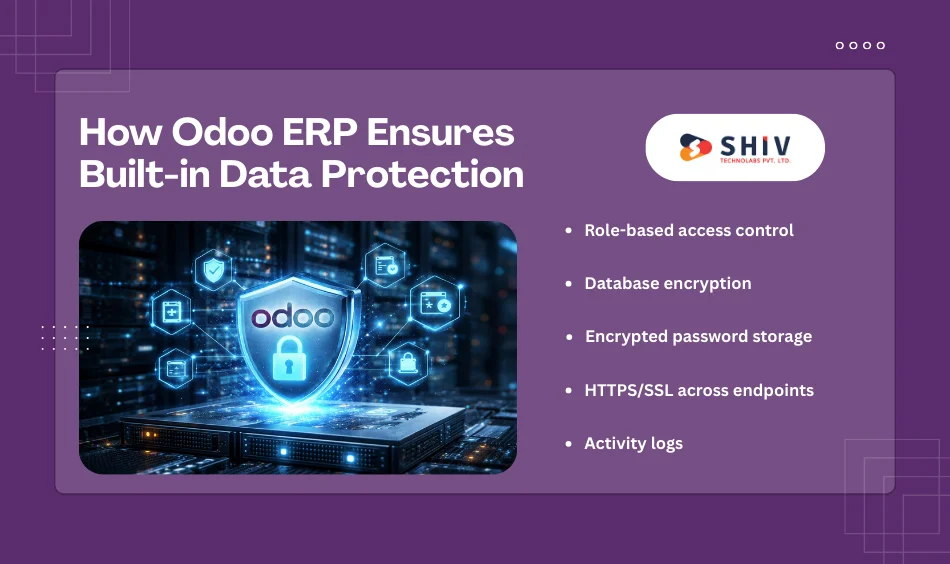
We set up Odoo with layered controls that guard data across modules, APIs, and daily workflows. We start with least-privilege roles, vetted modules, and encrypted transfer paths so teams work smoothly while sensitive records stay safe.
Odoo’s modular design lets us apply security fixes without breaking other parts of the system. We patch on a timetable, test in staging, and log every change, which supports PDPL audits and clear privacy records.
Core Security Features of Odoo ERP
- Role-based access control: We map job duties to groups and record rules, then review them quarterly.
- Database encryption: We protect sensitive fields and exported files; backup archives follow the same policy.
- Encrypted password storage: We rely on SHA and PBKDF2 so stored credentials resist offline attacks.
- HTTPS/SSL across endpoints: We run proxy mode with SSL, and force secure headers on every request.
- Activity logs: We retain admin and user trails, then alert on unusual locations or off-hours spikes.
Odoo Security Features Mapped to UAE Compliance Needs
| Security Feature | Odoo Functionality | Compliance Benefit (UAE PDPL) |
|---|---|---|
| Access Control | Users, groups, record rules | Limits unauthorized exposure |
| Encryption | AES-style field protection | Supports data security standards |
| Audit Logs | Action history and diffs | Aids transparency and traceability |
| Backup Management | Cloud or on-prem retention sets | Supports recoverability |
| SSL Certificates | Secured reverse proxy endpoints | Reduces interception risk |
This setup gives us a stable base for finance, sales, and HR teams. We keep the system tidy, we keep the logs useful, and we keep updates predictable.


How UAE Businesses Can Strengthen ERP Data Security
Default settings only go so far; we add steps that match the UAE context. We place ERP Data Security in UAE at the center of architecture, routines, and training, so protection holds after go-live.
We prefer hosting inside the UAE or GCC for data residency and faster legal response. We add two-factor login for admin and finance roles, review logs weekly, and work with cloud vendors that publish clear PDPL terms and incident timelines. That mix turns Business Data Protection in UAE into a daily habit, not a one-time task.
Implementing a Strong Security Framework
- Host data within the UAE or GCC; document residency and retention in plain language.
- Apply 2FA on admin and finance accounts; rotate app keys on a fixed schedule.
- Review access logs weekly; flag geographies outside GCC and off-hours spikes.
- Choose vendors that state PDPL alignment and share breach response playbooks.
Recommended Best Practices for ERP Security
- Encrypt data at rest and in transit, including backups and export routines.
- Scan after each major update; fix high-risk items before the next sprint. (Implementation checklist)
- Train teams on phishing, MFA, and safe handling of CSV exports.
- Keep configuration files versioned; record who changed what and why.
Field example: During one rollout, our alerts flagged late-night admin access from outside the region. We froze the account, rotated keys, and added an IP allowlist; the audit trail showed the full sequence within minutes.
By pairing technical controls with steady reviews, we cut both accidental exposure and targeted attempts. That approach supports the UAE Data Privacy Law (PDPL), keeps audits predictable, and gives leaders a clear view of how data stays protected.
Best Practices for Secure Odoo ERP Deployment
We treat every rollout as a gated process with named owners, clear checkpoints, and written sign-offs. That structure limits guesswork, reduces handoff surprises, and keeps access under control while teams move through staging and go-live.
We start by hardening the server and setting strict roles before anyone touches production. We validate each add-on, remove unused modules, and write down the reason for every change. Patches follow a timetable, with tests in staging and a simple rollback plan that the team can run without delay. See our Odoo implementation services for details.
In one UAE rollout, this checklist caught a leftover test user with broad rights. We closed the account, re-ran the review, and avoided a problem that would have surfaced during the first live import.
Key Steps for a Secure Odoo Rollout
- Harden the server first; close non-essential ports and disable default accounts.
- Map roles early; restrict admin rights and review them before go-live
- Verify add-ons and licenses; remove anything not required for day-one work.
- Apply security updates on a schedule after staging tests pass.
- Record each change with date, owner, purpose, and rollback notes.
Before vs After Applying Security Best Practices
| Implementation Stage | Without Security Protocols | With Security Best Practices |
|---|---|---|
| Installation | Open ports, default logins | Secured credentials, limited access |
| Migration | Manual imports | Encrypted transfer channels |
| Access Control | Shared admin rights | Restricted roles |
| Maintenance | Infrequent updates | Scheduled patch cycles |
| Compliance | Undefined | PDPL-aligned documentation |
This routine lowers risk and keeps teams productive. We keep configs tidy, track who changed what, and test recovery steps so fixes land quickly if something breaks.
Role of Odoo Partners in UAE in Maintaining ERP Security
Local context matters during audits, incident drills, and vendor reviews. As Odoo partners in UAE, we match platform controls with PDPL, DIFC, and ADGM needs, then keep the proof that auditors expect to see.
We connect Odoo ERP Privacy and Compliance with daily work by mapping roles to job duties, setting fixed update windows, and testing recovery steps on a live-like schedule. That rhythm supports Business Data Protection in UAE while keeping service levels steady for finance, sales, and HR teams.
How Certified Odoo Partners Strengthen ERP Security
- Set access policies with periodic role reviews and least-privilege groups.
- Run recurring vulnerability scans; track findings and retest fixes.
- Manage encrypted backups; rehearse restores and record timing results.
- Provide post-go-live monitoring, alert rules, and response playbooks.
Benefits of Partnering with Local Experts
- Faster help during audits, incidents, or regulator queries in the region.
- Working knowledge of PDPL terms, data residency needs, and sector guidance.
- Hands-on support for module upgrades, third-party reviews, and key rotation.
If you want a quick start, we can run a short security review that covers roles, logs, and backups against PDPL duties. When gaps appear, we assign owners and dates, write test steps, and move changes through staging so the rollout stays steady.
Maintaining Long-Term Odoo ERP Data Security
We treat security as routine care, not a one-off task. Teams change, vendors update terms, and threats shift, so we keep a calendar with owners and short status notes leaders can scan in minutes.
On the first Tuesday of each month, we patch Odoo and related services after staging tests pass. We publish a one-page change log, keep a simple rollback plan ready, and avoid late-night work windows unless a fix cannot wait.
Backups follow a 3-2-1 pattern: daily snapshots, weekly full copies, and a monthly archive. Copies stay in the UAE or GCC to respect residency needs; we rehearse restores on a timer, then record the real time to recovery so plans match reality.
Each quarter, we compare Odoo roles against the HR roster, remove idle accounts, and rotate shared keys. We also review sign-ins and API activity for off-hours spikes or new countries, then contact the user before closing the alert.
Long-Term Security Maintenance Plan
- Monthly patches with staging tests and a written rollback step.
- Daily backups, off-site copies, and timed restore drills.
- Quarterly access reviews tied to HR changes and contractor exits.
- Annual penetration test with tracked fixes and retests.
Conclusion
Strong routines turn an ERP rollout into a stable system people can trust. With clear roles, secure data transfers, and tested recovery plans, teams can work confidently while business records stay protected and audit-ready.
Our approach fits UAE projects and keeps PDPL duties aligned with daily operations. We document every change, test updates in staging, and monitor key risk signals after launch so issues stay rare and recovery stays fast.
If you want a secure and compliant Odoo setup, Shiv Technolabs is an experienced Odoo development company in UAE that can help you build a reliable ERP foundation for long-term business continuity.
FAQs
Q1. How does Odoo ERP protect sensitive business data?
We map roles to job duties, encrypt key fields, run SSL on endpoints, and keep activity logs. Backups follow the same policy, and we rehearse restores so recovery times are measured, not guessed.
Q2. Can Odoo align with the UAE’s Data Privacy Law (PDPL)?
Yes – when set up with the right roles, hosting choices, and audit records. We document settings, review them on a schedule, and keep evidence ready for regulator requests.
Q3. What steps keep ERP data safe in the UAE context?
Encrypt data at rest and in transit, restrict access by duty, verify integrations, and patch on a timetable. Add two-factor login for sensitive roles, and watch logs for off-hours spikes or unusual locations.
Q4. How do local Odoo partners strengthen security?
We run role reviews, manage backups, and test recovery steps on a fixed calendar. We also scan after major updates, track fixes, and share incident playbooks tied to PDPL so teams know what to do when something looks off.