Table of Contents
Many enterprises operate mission-critical systems on legacy systems built 10-20 years ago. Such systems would provide stability, but today they are stifling innovation, increasing maintenance costs and impeding integration with modern tools. Gartner reports that more than 70% of organizations continue to rely on legacy applications that hinder digital transformation and cloud adoption.
This is where the modernization of legacy systems becomes inevitable. Companies are migrating legacy systems to Python due to its flexibility, scalability and better integration with modern APIs, cloud computing and automation tools.
The right Python development services can modernize an organization without disrupting day-to-day operations. Modernization using Python lowers technical debt, enhances performance and delivers long-term ROI.
This guide will explain how companies update legacy systems to Python, what the migration process looks like, what it would cost and how to calculate actual business returns, in a clear, practical and hype-free way.

What Is Legacy System Modernization and Why Does It Matter?
The modernization of legacy systems is the process of refurbishing or replacing legacy applications to align with modern business, security and technology requirements. These systems are either outdated CRMs, ERPs, accounting software, or desktop applications developed in outdated languages or with inflexible architectures. They can continue to work, but they limit scalability, create security vulnerabilities and retard innovation.
The contemporary company needs a real-time data exchange, cloud preparedness, automation and API connectivity. Here, Python-based modernization solutions are very important. Python enables organizations to keep their legacy applications up to date without rewriting all the code simultaneously, reduce risk and continue upgrading.
Common Problems with Legacy Systems
- Slow performance and poor scalability: systems fail under growing user or data load
- Integration issues with modern tools: APIs, SaaS platforms and cloud services don’t connect easily
- Outdated security layers: increased vulnerability to breaches and compliance risks
- High maintenance and upgrade costs: specialized skills, manual fixes and vendor lock-ins
Why Choose Python to Modernize Legacy Applications?
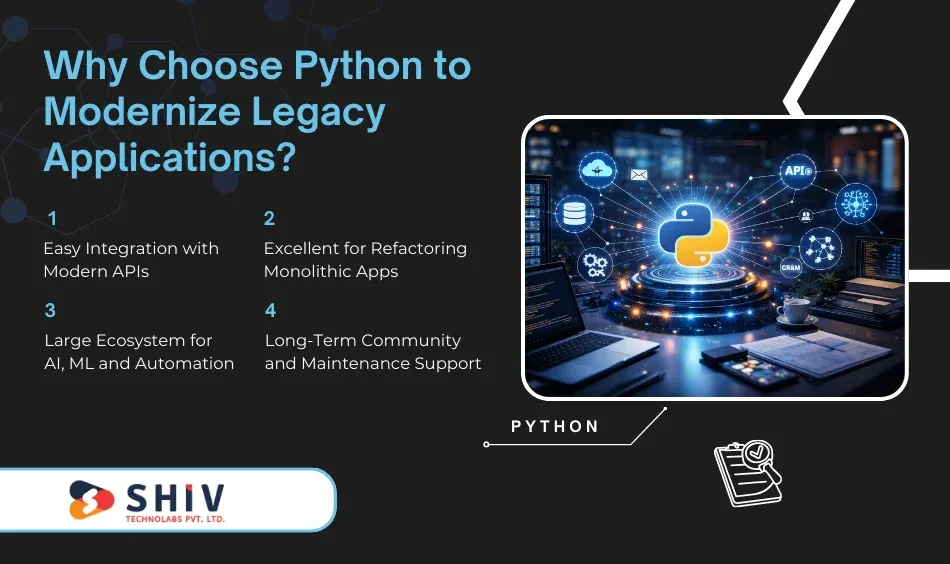
Because the language strikes a balance between simplicity and enterprise power, Python has gained favor in modernization projects. Companies that want to migrate from legacy systems to Python benefit from shorter development cycles, robust ecosystem support and sustainable maintenance.
Easy Integration with Modern APIs
Python is compatible with REST, GraphQL, SOAP and third-party API. It is therefore best to integrate legacy systems with current CRM, payment processors, analytics and cloud applications.
With Python frameworks, teams can uncover legacy logic in APIs, enabling gradual modernization without causing a system outage or undergoing a risky big-bang rewrite.
Excellent for Refactoring Monolithic Apps
Python also has a modular architecture, making it easy to divide large monolithic systems into manageable parts. Teams do not need to recode the entire system; they can refactor high-value modules, reduce technical debt and improve performance incrementally. This will reduce risk, minimize timelines and make modernization business-focused.
Large Ecosystem for AI, ML and Automation
The Python ecosystem also includes thousands of libraries for automation, data processing, AI and machine learning.
After modernizing legacy systems, predictive analytics, intelligent workflow and layers of automation can be added to the business without re-architecting the core. This makes systems future-proof and opens the door to innovation, not just to simple modernization.
Long-Term Community and Maintenance Support
Python is a widely adopted open-source language that is continually evolving. This guarantees long-term support, simplifies hiring and reduces reliance on niche expertise.
Python is also more stable, has strong community support and is expected to maintain its performance over time, unlike overloaded legacy stacks that are experiencing declining talent pools.
Rewriting legacy code in Python minimizes operational risk and enables continuous improvement.


Step-by-Step Python Migration Process
An effective Python migration process is based on a low-risk, structured process. The aim is modernization without disrupting business.
Step 1: Assessment and Audit
Assess the deployed system architecture, codebase, third-party dependencies and database schema. Identify outdated modules, performance bottlenecks and integration gaps. This action outlines what is to be refactored, rewritten, or retired – the basis of the migration plan.
Step 2: Scoping Scope and Business Objectives
Explain the reason why modernization is required. They can be cloud readiness, API exposure, UX improvements, or lower maintenance costs. The scope definition discourages over-engineering and ensures that modernization focuses on quantifiable business results rather than on technical investigation.
Step 3: Select the Right Python Stack
Choose frameworks and tools based on system needs:
- Django for full-stack enterprise apps
- FastAPI for high-performance APIs
- Flask for lightweight services
- PostgreSQL, Redis, Celery for data and async processing
Stack selection directly impacts scalability and ROI.
Step 4: Refactor or Rebuild
Refactor stable components where feasible to save time and cost. Scale-blocking modules Rebuild outdated or tightly coupled modules that block scalability. Maintain backward compatibility through staged releases so users can continue running their operations while modernization occurs. This incremental method lowers downtimes and risk.
Step 5: Testing, Deployment and Integration
Automate the testing, CI/CD pipelines and monitoring. Test API integrations, data consistency and performance at load. Incremental rollout and real-time measurement of the aspects of stability after the migration.
Python Migration Process Overview
| Phase | Description | Key Deliverables |
|---|---|---|
| Assessment | Analyze the current legacy environment | Migration strategy document |
| Planning | Define scope, timeline, priorities | Project roadmap |
| Development | Refactor / rewrite core modules | Secure Python codebase |
| Integration | Connect APIs + data systems | Cloud-ready platform |
| Testing & Launch | QA, UAT, performance checks | Stable deployment |
What Is the Cost of Legacy App Migration to Python?
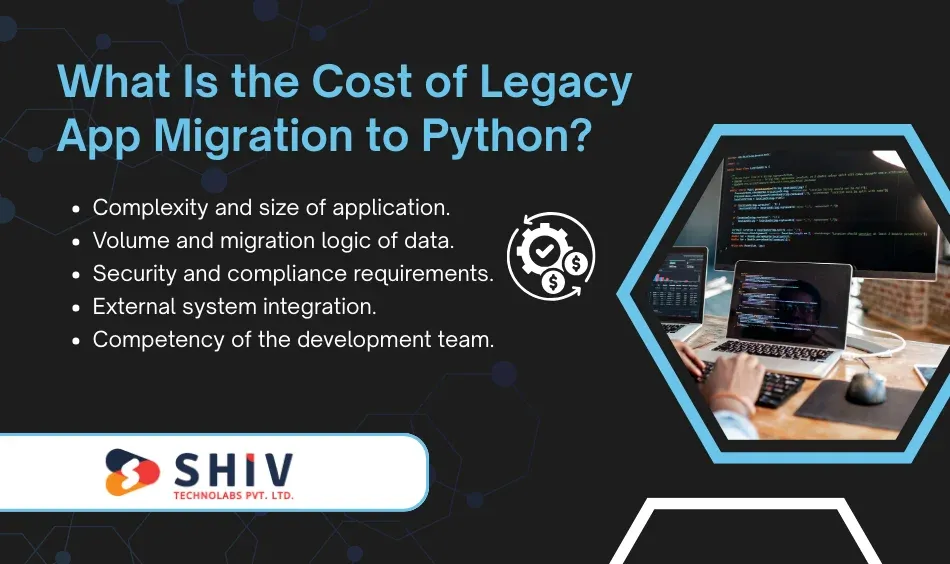
The cost of migration is determined by the size of the system, data volume, and security requirements. Collaborating with professionals prevents rework and hidden costs. To get the best value, you can hire dedicated Python developers who understand the nuances of system stability.
Key Cost Drivers
The cost of migration is determined by:
- Complexity and size of application.
- Volume and migration logic of data.
- Security and compliance requirements.
- External system integration.
- Competency of the development team.
Collaborating with professionals prevents rework, hidden costs and malfunctions.
Estimated Python Migration Cost Breakdown
| Project Type | Description | Approx Cost (USD) | Timeline |
|---|---|---|---|
| Small Upgrade | Minor refactor / API add-on | $5,000 – $15,000 | 2 – 4 weeks |
| Mid-Level App | Partial rebuild + DB migration | $20,000 – $60,000 | 6 – 10 weeks |
| Enterprise System | Full modernization + integrations | $70,000 – $150,000+ | 3 – 6 months |
To obtain the right numbers, outsource Python specialists to undertake the migration that will help determine the risks of the systems and long-term scalability.
How to Measure ROI After Python Modernization?
The ROI of a Python migration is measured by cost reduction, performance gains, and improved operational efficiency.
Key ROI Indicators
- Reduced maintenance effort and support cost
- Faster feature delivery and integrations
- Lower system downtime and outages
- Improved user experience and adoption
- Better scalability for future growth
ROI Comparison: Before vs After Python Migration
| Metric | Before Migration | After Migration with Python |
|---|---|---|
| Maintenance Cost | High (>25% IT budget) | Reduced by 40–60% |
| Integration Speed | Slow | Fast API connectivity |
| System Downtime | Frequent | Significantly lower |
| User Experience | Outdated UI | Modern, responsive |
| Overall ROI | Low | Recovered in 6–12 months |
What Is the Typical Timeline for Python Migration Projects?
The timeline for Python migration projects varies by scope and complexity.
Typical Timelines
| Migration Type | Duration | Example |
|---|---|---|
| Minor Module Refactor | 2 – 4 weeks | Utility app |
| Mid-Size Web App | 6 – 10 weeks | CRM / ERP module |
| Full Enterprise Suite | 3 – 6 months | Finance system |
Agile methodology ensures phased delivery, early value realization and reduced risk.
Common Challenges During Python Migration
Modernizing legacy systems is a complex process with foreseeable challenges.
Data Migration and Data Integrity Errors
Migration errors can be caused by data inconsistency, format incompatibility, and legacy limitations. Bad planning creates risks of data loss or corruption, and data validation and reconciliation must be taken seriously throughout the process.
Compatibility Gaps of API
The old system often lacks APIs or uses an outdated protocol. To address these gaps, API design, middleware layers, and backward compatibility must be considered to ensure that dependent systems are not disrupted.
Security and Compliance Risks
The current security requirements must be applied during the migration. Any vulnerabilities in authentication, data exposure, or compliance gaps may pose risks unless addressed proactively.
How to Overcome These Challenges
- Use sandbox environments and version control
- Create backup and rollback plans
- Maintain continuous QA and security reviews
How to Choose the Right Team for Python Migration
The success of migration depends on selecting the right partner.
What to Evaluate
- Experience in modernisation projects.
- Effective communication and open pricing.
- Quality assurance, development operations and after-sales.
By hiring reputable professionals for Python development services, one will find easier migration, lower costs and quantifiable results.
Conclusion
One of the most convenient ways to extend the life of legacy systems, keep costs down and deliver measurable ROI is to modernize them with Python. Companies investing in modernizing their legacy systems can gain greater flexibility, faster integrations and scalable systems ready to meet future requirements. Python can transform without interfering with central functions.
When you are willing to go modern with nothing to fear, Shiv Technolabs is your reliable Python development company. Our team of professionals provides full-service Python development solutions, including analysis, migration, optimization and maintenance. We are not about code, but about performance and security and ROI.
Frequently Asked Questions (FAQs)
1. What types of legacy systems can be migrated to Python?
Python can be used to migrate or modernize enterprise CRMs, ERPs, inventory systems, financial systems, reporting systems and internal applications, in whole or in part.
2. Is complete rewriting necessary for modernization?
No, Most projects are successful with selective refactoring. The stable modules remain in place, while old components are recreated, saving time and reducing costs.
3. What factors influence the cost of a Python migration?
The system complexity, integrations, data volume, compliance requirements and the migration team’s experience substantially affect cost.
4. How quickly can companies see ROI from Python migration?
In most cases, modernization investments can be recouped by the organization within 6-12 months through lower maintenance costs and increased speed.
5. Can small businesses benefit from Python modernization?
Yes, Partial modernization is also sufficient to enhance the speed, security and efficiency of maintenance; as a result, Python can be a good solution to use in small and middle-level businesses.