Table of Contents
Corporate websites no longer serve as web brochures but are working platforms that integrate marketing, sales, customer management, and product information. Reports predict that global digital transformation spending will grow by 9.1% by 2031, driven by businesses adopting integrated digital platforms rather than single tools.
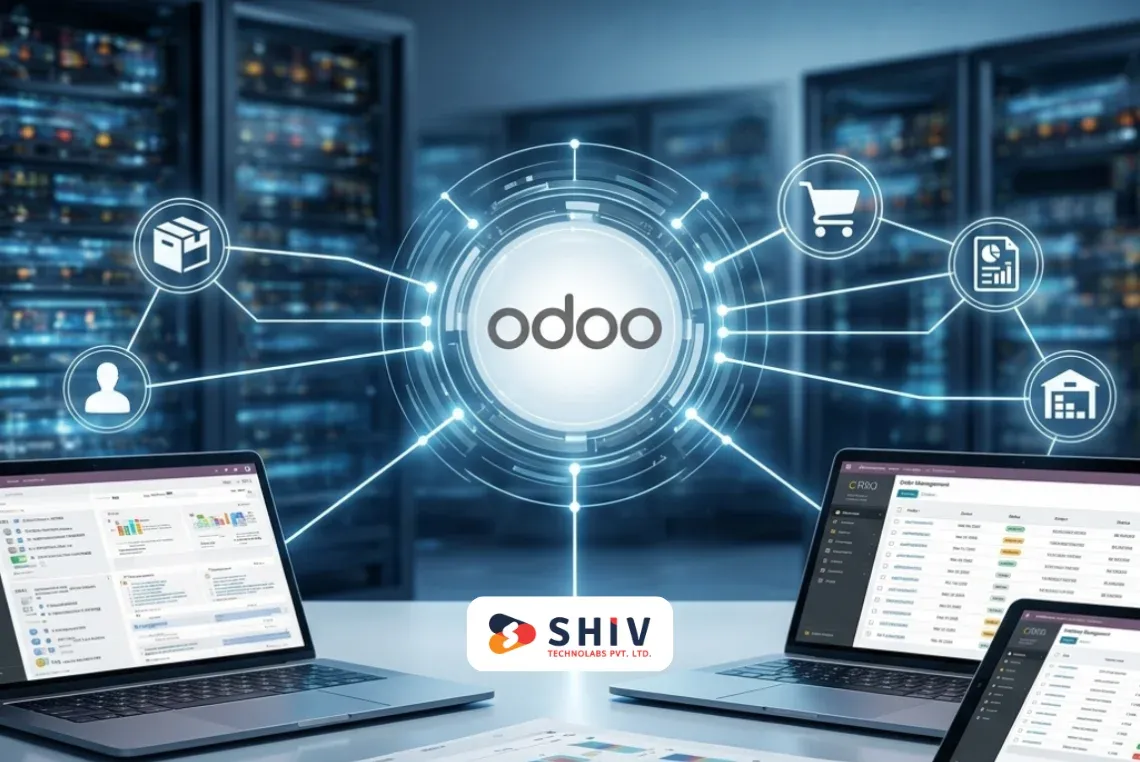
This change is why many companies are currently using Odoo website Development services to create an Odoo business site integrated with CRM, inventory, accounting, and sales workflows. Organizations can work on a single platform rather than using various disconnected systems. A business Odoo site is precisely that: a single digital platform where customer interactions, product databases, and business information remain aligned.
With the expansion of businesses, such a unified solution reduces operational friction, increases visibility, and automates cross-departmental processes, which is why Odoo is becoming an increasingly popular platform for building a modern corporate website.
Why Do Businesses Choose Odoo for Corporate Website Development?
Corporate websites should not simply post information. They should be able to relate business activities, data movement, and customer interactions. This is where Odoo is different; it is an integrated system for managing websites and enables organizations to run on a single platform.
Centralized Platform
A corporate site on Odoo operates as a part of the larger Odoo ecosystem; that is, the site is not independent of other systems in the company.
Benefits include:
- Single platform for website and ERP
- Centralised product, customer, and sales data
- Reduced need for multiple third-party integrations
This centralization enhances operational efficiency and removes data bottlenecks between the tools.
Integrated Business Modules
The Odoo system does not use any middlemen in its links with websites like traditional CMS systems.
Examples include:
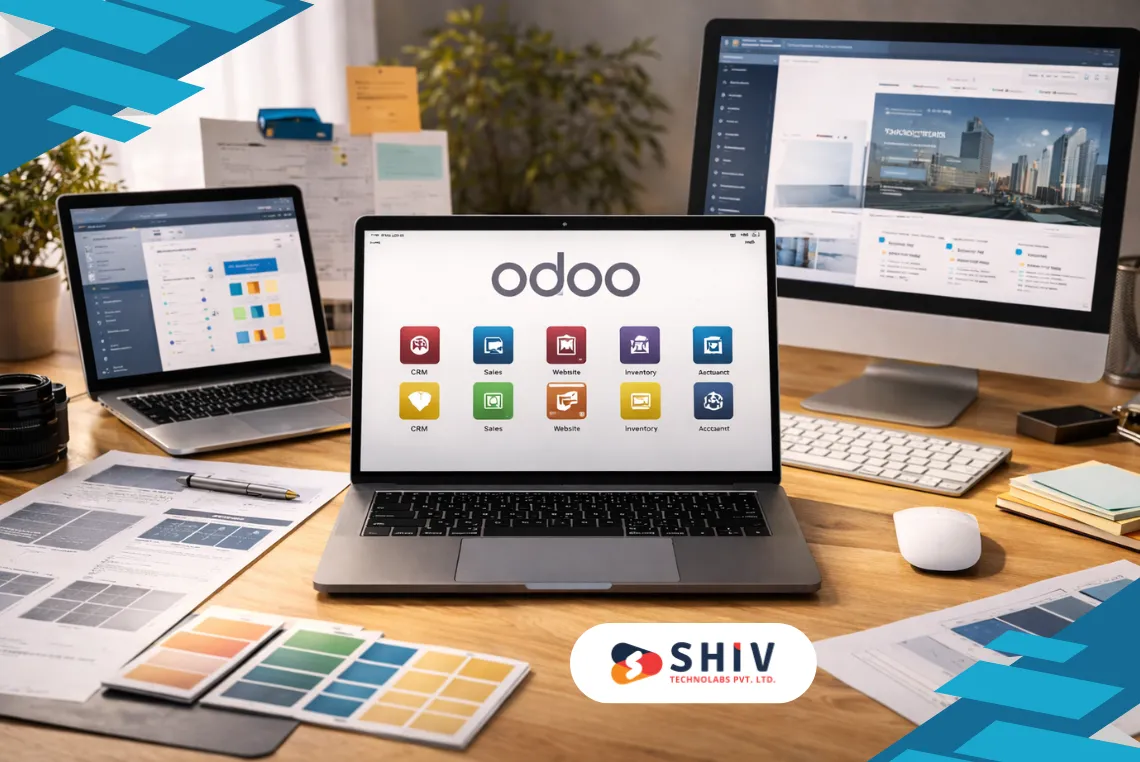
- CRM for lead tracking
- Sales for order management
- Inventory for product availability
- Accounting for billing processes
The integrations enable businesses to run a fully integrated ERP website.
Scalable Architecture
As businesses grow, their websites should scale without significant changes to the platform. Odoo offers:
- modular architecture
- scalable hosting infrastructure
- flexible module expansion through Odoo module development
The simple website can be used to begin with organizations and build up to a complete enterprise system.
Automation Capabilities
One advantage of the Odoo website for companies is its automation capabilities.
Examples include:
- Automated Lead Assignment
- Triggered Marketing Emails
- Automated Order Workflows
- Crm Updates From Website Forms
Simplified Data Management
The control of data between various systems is likely to create inconsistency.
Odoo gets around this by ensuring that all data is centralised:
- Customer Profiles
- Product Information
- Order Records
- Sales Interactions
How Is an Odoo Business Website Different from Traditional CMS Websites?
The traditional CMS, like WordPress or Joomla, is currently a website tool. Businesses have to rely on third-party plug-ins and integrations to connect them to operational systems. A business site on Odoo is, however, developed as a component of an integrated business platform.
Built-In ERP Integration
Odoo websites are communicating with the ERP environment.
This enables:
- automatic data synchronization
- real-time order processing
- seamless CRM updates
Most traditional CMS platforms require many plugins to accomplish the same task.
Unified Product Management
In an Odoo site, product information is linked to inventory.
This means:
- Inventory updates reflect instantly on the website
- Pricing changes sync automatically
- Stock availability remains accurate
Old CMS solutions usually need individual product management systems.
Native Customer Portal
The Odoo system has an in-built customer portal.
Customers can:
- view order history
- download invoices
- track shipments
Standard CMS systems usually require external plug-ins to develop similar portals.
Integrated CRM and Sales
All the forms that are filled in or queries are linked to the CRM system. Benefits include:
- Automatic Lead Creation
- Sales Pipeline Tracking
- Improved Follow-Up Processes
Workflow Automation
The Odoo websites have enabled companies to automate operational processes within the system.
Examples:
- Automated Quote Generation
- Email Marketing Triggers
- Follow-Up Reminders
Centralized Analytics
Since the site is located within the ERP system, analytics and reporting are incorporated.
This helps businesses track:
- Website Leads
- Customer Engagement
- Product Performance
Scalable Business Infrastructure
As companies grow, Odoo allows them to add modules such as HR, manufacturing, or accounting, all connected to the website through Odoo integration services.
Comparison: Odoo Website vs Traditional CMS Platforms
| Feature | Odoo Website Platform | Traditional CMS |
|---|---|---|
| ERP connection | Built-in integration | External plugins required |
| Product management | Linked with inventory | Separate system |
| Customer portal | Native feature | Plugin required |
| Sales integration | CRM integrated | Limited |
| Automation | Business automation available | Limited automation |


What Are the Benefits of an ERP-Integrated Website for Businesses?
The contemporary business environment is in great need of websites that integrate with operational systems. An ERP-integrated website removes data silos, reduces manual work, and improves productivity across departments.
Real-Time Product Updates
Product data stored in the ERP system automatically updates the website. Advantages include:
- Accurate Product Availability
- Real-Time Price Updates
- Consistent Catalog Information
This prevents outdated product listings and improves customer trust.
Centralized Customer Management
Customer interactions from the website feed directly into the CRM system. Businesses can:
- Track Customer Journeys
- Analyze Purchase History
- Personalize Communication
Faster Order Processing
When a website connects to ERP systems, orders automatically flow into sales and fulfillment modules.
Benefits include:
- Faster Order Confirmation
- Automated Invoicing
- Improved Fulfillment Speed
Simplified Inventory Tracking
Inventory updates instantly reflect on the website. This reduces:
- Overselling
- Manual Stock Updates
- Inventory Errors
Improved Operational Visibility
Managers gain complete visibility into operations:
- Website Performance
- Product Demand
- Sales Trends
What Features Do Businesses Get When They Build a Website with Odoo?
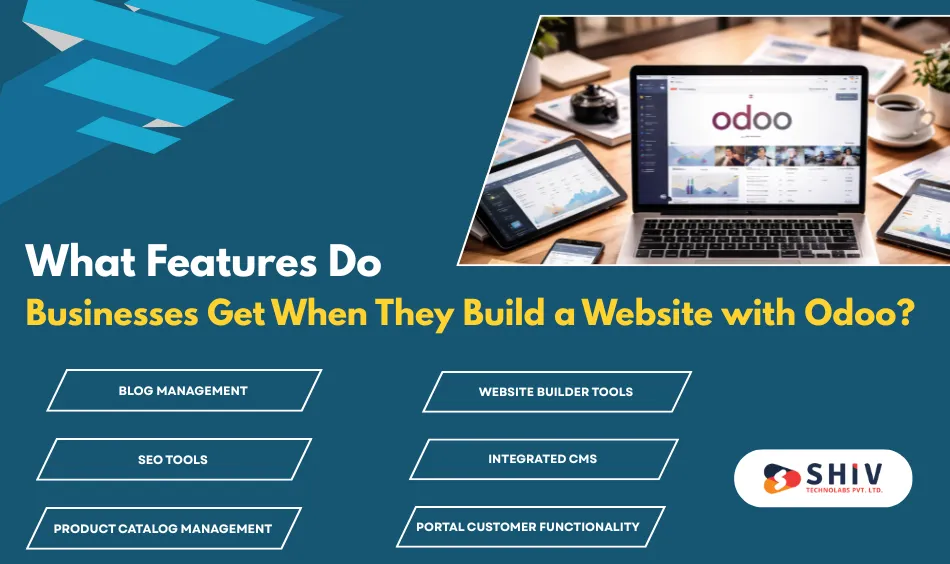
By developing a website with Odoo, firms gain a suite of features designed to support corporate operations and customer interactions.
Website Builder Tools
Odoo is a drag-and-drop website builder that enables teams to manage pages without writing any code. Key features:
- Visual Page Editor
- Responsive Templates
- Customizable Layouts
Integrated CMS
The Odoo CMS helps businesses to get control over the content of their websites with ease.
Features include:
- dynamic content management
- Many-page site designs.
- integrated media libraries
SEO Tools
Odoo also includes built-in SEO, which helps make a business more visible in search results. Capabilities include:
- Meta Tag Management
- URL optimization
- Sitemap Generation
Blog Management
Business organizations can write blogs to aid content marketing. Benefits include:
- Lead Generation
- Improved Seo Rankings
- Visibility Thought Leadership
Product Catalog Management
Companies can present merchandise through elaborate catalogues. Capabilities include:
- Product Filtering
- Variant Management
- Pricing Rules
Portal Customer Functionality
Customers can log in and use their personal dashboards. Portal features include:
- Order Tracking
- Invoice Access
- Account Management
Why Do Businesses Invest in Custom Odoo Development for Corporate Websites?
Although Odoo has strong default capabilities, many organizations need workflow-specific features. This is where custom Odoo development becomes important.
Custom development enables companies to develop specialized workflows, sophisticated integrations, and custom customer experiences.
Examples of Custom Odoo Website Development
| Custom Feature | Business Benefit |
|---|---|
| Custom Product Catalog | Structured Product Display |
| Customer Portal | Improved Customer Engagement |
| Workflow Automation | Faster Business Operations |
| External Integrations | Connected Software Ecosystem |
Conclusion
Corporate websites no longer need to be stand-alone marketing tools; they should be operational. The Odoo corporate website is a link that brings together marketing, sales, inventory, and customer management into a single ecosystem. This combined solution enhances business efficiency, reduces manual processes, and offers scalability for business growth.
The companies that intend to integrate corporate websites usually team with an agency specializing in Odoo websites that is familiar with the ERP systems and website architecture.
Shiv Technolabs is the best Odoo web development company, providing strong Odoo web development services, backed by enterprise ERP solutions and the latest web development practices. Our team assists organizations in developing scalable Odoo-based business websites according to their operations.
If your business plans to establish an ERP-integrated website, our specialists can create a solution that integrates your website, CRM, inventory, and business processes.
Frequently Asked Questions (FAQs)
1. Is Odoo a good platform for corporate websites?
Yes, Odoo is a great platform in that it bridges websites and business systems such as CRM, inventory, and sales. The integration enhances efficiency, lessens manual work, and enables businesses to operate on a centralized platform.
2. Can businesses connect their websites to their ERPs using Odoo?
Yes, Odoo websites are developed as part of the ERP platform, which integrates directly with CRM, inventory, sales, accounting, and other business modules.
3. Can an Odoo business website be customized?
Yes, Odoo is very customizable and has modules, APIs, and custom development. Businesses can design custom product lists, build customer websites, automate workflows, and integrate external software packages.
4. Do businesses need developers to build an Odoo website?
Odoo has a web builder that allows one to create basic websites. Nonetheless, companies frequently engage developers to implement integrations, automation flows, performance optimizations, and advanced features.
5. Can Odoo websites support product catalogs and online sales?
Yes, Odoo includes strong product management tools that enable businesses to fully control product catalogs, pricing, inventory synchronization, and online sales, with built-in eCommerce functionality.