Table of Contents
At some point, expanding companies become too complex in their operations for the tools supporting them to keep up. Report estimates that poor data quality alone may cost organisations 15-25% of annual revenue due to inefficiencies, rework, and poor decision-making. Another report indicates that 95% of organisations have experienced measurable improvements after implementing ERP.
This is precisely where businesses begin seeking ERP development services to add sanity and transparency to their operations. The inability to manage finance, human resources, inventory, customer information, and reporting in disconnected systems makes operations more expensive and growth constrained.
The Custom ERP System is a model that enables companies to build software that emulates actual working procedures rather than forcing them to adapt to fixed applications. This blog will discuss how to effectively identify the red flags that indicate your business can make a custom ERP investment today.
What is a Custom ERP System and Why Does It Matter?
A Custom ERP System is a single-dominating business platform that is tailored to your organizational workflows, data structures, report structure, and scalability objectives.
Custom ERP System development is the creation of an enterprise software that fits into the manner in which your business functions. The ERP fits you rather than requiring you to modify your processes to match the software’s restrictions.
It solves such crucial issues as
- Team reporting challenges are manual.
- Interdepartmental integration problems.
- Fragmented data ownership
- Process inefficiencies
- Scaling limitations
Compared with generic ERP tools, a tailor-made ERP is more dynamic in response to business development.
Also Read: ERP development process, cost, technologies, and stages.
Custom ERP vs. Off-the-Shelf ERP Software
Ready-to-use ERP solutions have standard modules that are not very flexible. Although they might be functional at first, they add friction to operations as they become more complex.
| Feature | Custom ERP | Off the Shelf ERP |
|---|---|---|
| Flexibility | Fully tailored workflows | Restricted customization |
| Integration | High compatibility | Limited connectors |
| Cost Model | Scalable investment | Fixed subscription |
| Data Ownership | Full control | Vendor controlled |
| Long Term ROI | High | Moderate |
When to Invest in ERP Software for Your Business?
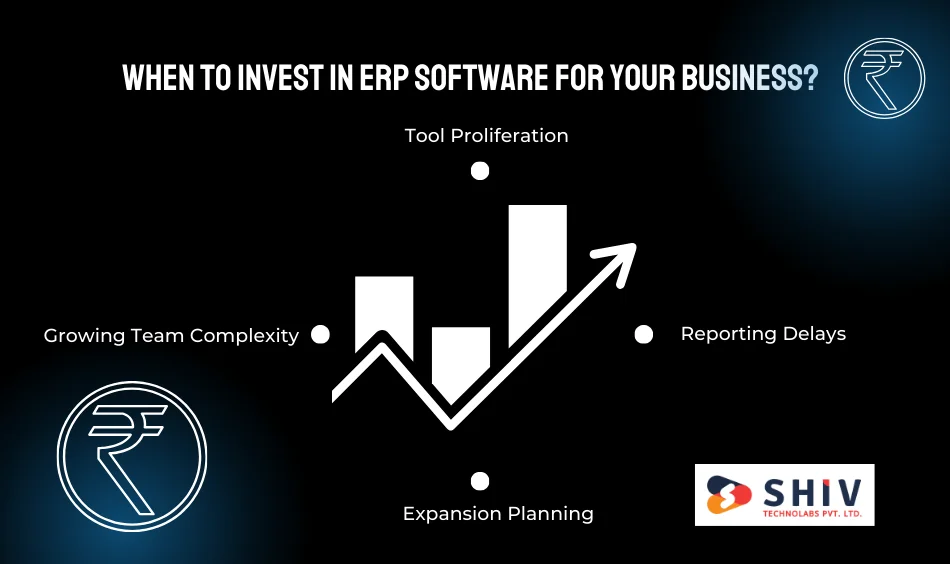
The decision on when to invest in ERP software should be based on operational strain rather than the age of the company.
Growing Team Complexity
The manual coordination is ineffective as the team size increases. ERP automates approvals, task movements, and interdepartmental communication. See Odoo implementation services for structured rollouts.
Tool Proliferation
Various CRM, accounting, HR, and inventory tools generate disjointed data and redundancy.
Reporting Delays
When the leadership uses the old reports, the decision-making process becomes reactive rather than being strategic.
Expansion Planning
A growing business ERP solution is also a better guarantee of automation that grows at a faster rate than people.


Top 10 Warning Signs Your Business Needs a Custom ERP System
All the signs below represent actual areas of operational pain encountered over scaling organizations.
1. Your Software Feels Outdated and Slows Down Work
One of the first signs that your business base is no longer sustainable is the use of outdated business software. Ancient systems tend to be inflexible, sluggish, and incapable of integrating with contemporary technology. Employees lose precious time using inefficient interfaces, manually exporting their data, or dealing with system errors.
With time, obsolete software develops.
- Reduced productivity
- Inconsistent workflows
- Higher error rates
- Employee frustration
- Limited scalability
Modernization of infrastructure and Custom ERP System development involve replacing fragmented tools with a single, performance-optimised platform that meets and will meet the needs of today and tomorrow. See custom software development for rebuild paths.
2. Manual Reporting Consumes Too Much Time
The creation of manual reports indicates that you have broken data architecture. The reports are also unreliable and time-consuming when the financial, sales, and operations teams use different spreadsheets.
This leads to
- There are several forms of the truth.
- The strong dependence on people.
- Days or week-long delays in reporting.
- Making a decision using obsolete information.
Custom ERP uses automated, real-time dashboards in place of spreadsheets, which draw data directly to the operating systems, thus being accurate and fast.
3. Departments Work in Isolation
The lack of communication between tools will create integration problems at the departmental level. CRM, HR, finance, and inventory systems tend to be silos.
The impact includes
- Delayed approvals
- Misaligned priorities
- Redundant data entry
- Communication breakdowns
One of the custom ERP practices is centralization of workflows and access to data such that all departments use the same information in real time.
4. Data Accuracy Is a Constant Struggle

Redundant and inconsistent data destroy credibility within the company. Teams are being used to justify numbers, rather than take action on insights.
Custom ERP establishes a single source of truth.
- Removing the redundancy of records.
- Standardizing data entry
- Enforcing validation rules
- Making real-time updates.
This enhances trust in the reporting and strategic decision-making.
5. You Are Managing Multiple Systems for Daily Tasks
Productivity is reduced when the employees constantly switch between CRM, billing, HR, and inventory systems.
This results in
- Context switching fatigue
- Higher training costs
- High costs of subscription.
- Manual data syncing
A custom ERP brings all the day-to-day operations together in a single platform, thereby enhancing efficiency and minimizing overheads.
6. Process Bottlenecks limit Growth
A growing business ERP solution eliminates bottlenecks caused by manual approvals, outdated business processes, and isolated systems.
Without ERP, growth leads to
- Delayed order fulfillment
- Slow onboarding
- Inefficient scaling
Automation guarantees growth without increasing costs or complexity.
7. Decision Making Lacks Real-Time Insights
Without live data, the leadership is unable to make informed decisions. When information is lagged, chances are lost.
Custom ERP provides
- Real-time dashboards
- KPI tracking
- Predictive analytics
- Performance alerts
This allows taking proactive decisions rather than solving problems reactively.
8. Compliance and Security Risks Are Increasing
The requirements of compliance increase as the amount of data increases. The absence of audit trails and the ineffectiveness of access controls put businesses at risk.
Custom ERP enhances security by means of
- Role-based access
- Activity logging
- Audit readiness
- Secure data storage
This is critical to controlled industries.
9. You Struggle to Integrate New Tools or Platforms
New business tools are always employed in modern business. Integrations are manual and prone to errors without the ERP implementation solutions.
Custom ERP supports
- API based integrations
- Third-party platforms
- Scalable architecture
A professional ERP consulting service provides flexibility in the future and the implementation process.
10. You Spend More on Workarounds Than Real Solutions
Fixing in the short term seems cheap at first, but it ends up being expensive in the long run. Long-term ROI is compromised when workarounds exceed the cost of the ERP solution.
| Business Size | Approximate ERP Cost |
|---|---|
| Small Business | $15,000 to $35,000 |
| Mid Size | $40,000 to $80,000 |
| Enterprise | $100,000+ |
Conclusion
Explicitly identifying these red flags in the early stages will avoid mayhem during operations and revenue loss. Tailor-made ERP System development integrates processes, concentrates data, and leads to sustainable expansion.
It is important to partner with an appropriate ERP development company. Shiv Technolabs is one of the leading ERP development companies, offering complete ERP solutions, from ERP consulting to full-scale ERP implementation. We have experience that will make your ERP investment pay off in terms of performance.
Frequently Asked Questions (FAQs)
1. What makes me know that it is time to transition to a custom ERP system?
If your business begins to experience manual reporting, data entry errors and integration issues across departments, it is a strong indication. If decision-making relies on old spreadsheets and workarounds, then Custom ERP System development is inevitable to regain control, accuracy, and operational efficiency.
2. Why is a custom ERP solution better than standard software?
A bespoke ERP aligns with your business processes rather than forcing process changes. It helps centralise operations, automate repetitive work, improve data accuracy, enhance security and provide real-time insights. It can easily be scaled as your business grows and evolves, unlike generic tools.
3. How expensive is it to develop a tailored ERP system?
The cost of the ERP solution construction vary depending on the size of the business, module and integration needs and scalability requirements. Small businesses can spend between $15,000 and $35,000; mid-size and enterprise systems cost between $ 40,000 and $ 100,000, or even more, for higher functionality.
4. Does it have the ability to integrate with already existing business tools through a custom ERP system?
Yes, the current ERP implementation solutions are integration-oriented. A tailored ERP is capable of integrating with CRM solutions, accounting systems, HR systems, eCommerce tools and analytics solutions via secure APIs, which forward the data without interruptions to the current operations.
5. Who is to take care of ERP planning, development and implementation?
ERP initiatives need planning and technical know-how. Co-operation with professionals who provide ERP consulting services would guarantee proper analysis of requirements, reduced risk, a scalable architecture, and a well-structured implementation process. A competent ERP development firm can ensure maximum ROI and prevent expensive implementation failures.