Table of Contents
The demand for designing smart AI assistants is increasing at a rate no one anticipated, and companies all over the world are looking to build AI assistants like Google Gemini to automate and personalise the user experience and enhance the customer experience.
As the generative AI development services become increasingly affordable, even medium-sized businesses can now afford assistants that listen to speech and convert it to text, perceive images, and perform intricate reasoning in real time.
Statista reports that the global market for AI assistants is set to grow by 45% by 2030. These figures are the perfect examples of AI exposure on the global stage and the growing importance of AI assistant development going forward.
The need for AI model integration has never been higher, as more organizations are entering the AI sector. They are used to facilitate automation, customer service recommendations, data processing, and internal productivity.
This article will take us through the features, technology stack, pricing, development process, and plans for building a smart system at the Gemini level.
What Makes an AI Assistant Like Google Gemini Different
Gemini is not just a chatbot. It is a multimodal intelligence system that can comprehend various input formats, interpret complex situations, and provide personalised, relevant feedback. To build AI assistant like Google Gemini, you should understand the attributes that enable it to achieve its immense capabilities.
Multimodal Inputs
Gemini is a multitasking tool for processing text, audio, images, video, and documents. This combination enables it to consider problems from angles that traditional bots cannot.
Real Context Awareness
The assistant can recall details of previous conversations, objectives, and feedback. This gives it more natural interactions rather than repetitive interrogations and reset conversations.
Advanced Reasoning
Gemini does not merely give answers to questions. It analyses circumstances and evaluates relationships and compares information, and directs the users through structured reasoning. For enterprise cases, refer to our post on integrating generative AI with enterprise applications.
Adaptive Learning
The assistant gets better with time as it learns the behavior and patterns of the user. This makes it more individual and useful.
High-Level Personalization
Recommendations and actions vary for each user. The assistant acts as if it truly knows the individual using it.
What Features Do You Need to Build an AI Assistant Like Google Gemini
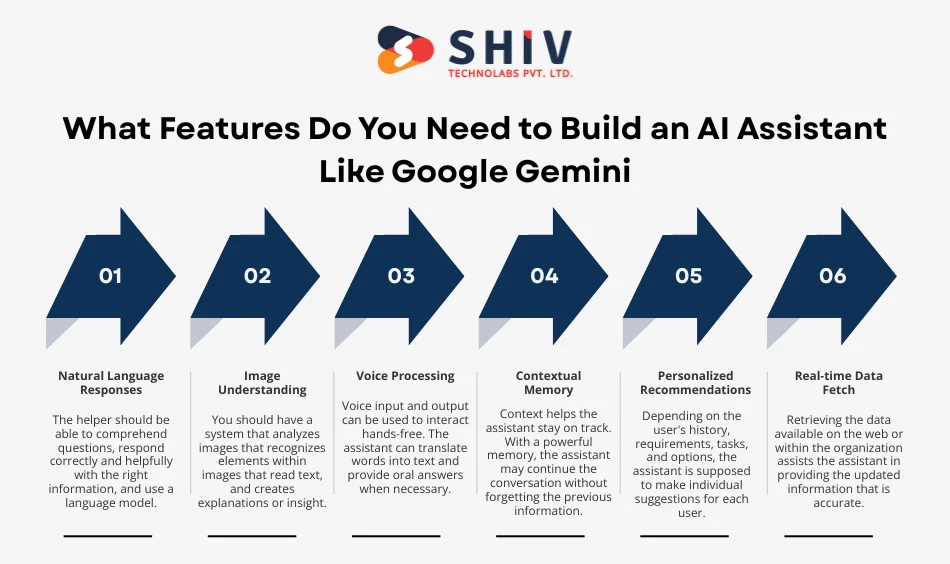
A feature set that enables your system to comprehend, interact, and make high-level decisions is needed to achieve a Gemini-level experience. These characteristics are the basis for generative AI app development.
- Natural Language Responses: The helper should be able to comprehend questions, respond correctly and helpfully with the right information, and use a language model.
- Image Understanding: You should have a system that analyzes images that recognizes elements within images that read text, and creates explanations or insight.
- Voice Processing: Voice input and output can be used to interact hands-free. The assistant can translate words into text and provide oral answers when necessary.
- Contextual Memory: Context helps the assistant stay on track. With a powerful memory, the assistant may continue the conversation without forgetting the previous information.
- Personalized Recommendations: Depending on the user’s history, requirements, tasks, and options, the assistant is supposed to make individual suggestions for each user.
- Real-time Data Fetch: Retrieving the data available on the web or within the organization assists the assistant in providing the updated information that is accurate.
Advanced AI Capabilities
These abilities make your system smart enough to develop high-level generative AI apps.
- Creation of Generative Response: Depending on the needs of the user, the assistant must be able to generate content, answer questions, summarize documents, generate stories, or write code.
- Multimodal Understanding: Combining voice text and images during a single process provides the assistant with deeper insight and stronger arguments.
- Rationality and Decision Support: The assistant should be able to analyze issues and break down situations, and provide meaningful solutions.
- Multiple Language Output: The user must be able to receive responses in the language they feel comfortable with.
For sector ideas, review our piece on AI for customer experience.


What Tech Stack Do You Need to Build an AI Assistant Like Google Gemini
A Gemini-style system requires a robust set of model tools and components that can interact efficiently with one another through effective AI model integration.
Large Language Models
Use strong LLMs for text understanding and generation. Options include GPT LLaMA Claude Falcon or custom-trained models.
Vision Models
Vision encoders are used to interpret visual information and objects via a read embedded text and analyze image information.
Voice Models
These read speech and result in a natural speech response.
Custom Embeddings
Embeddings encode semantic meaning and supply the memory system, which maintains previous discourse and knowledge.
Data Pipeline and Training Requirements
- Dataset Cleaning: You require clean well well-structured, and verified data before you can train any model you require. It is necessary to eliminate bias and errors.
- Fine Tuning: Fine-tuning will enable the assistant to be productive in healthcare finance, eCommerce, education, or any other specialized field.
- Prompt Engineering: Smart prompts are used to assist the model to ensure that answers remain truthful and relevant as well as free of hallucinations.
- Memory Storage: The system’s ability to store knowledge and respond in context is made possible by vector storage. See our end-to-end custom software development for clean data pipelines.
How Much Does It Cost to Develop an AI Assistant Like Gemini

Developing an AI assistant such as Gemini is expensive and depends on the level of advancement and multimodality you desire in the system. A text-only assistant is easy and inexpensive, whereas a Gemini-style assistant requires more powerful text-to-vision and text-to-voice models, as well as memory frameworks and advanced reasoning capabilities.
The greater the intelligence, the greater the effort in development. Here are key factors to consider when estimating the cost to develop AI assistant like Gemini.
Overall Feature Complexity
The cost is typically largely dependent on feature complexity. A Gemini-level assistant acts as a digital operator who can see, listen, think, and act across various formats. This will necessitate not a single model but multiple integrated systems.
- Text understanding
- Voice input and output
- Memory and context recall
- Reasoning and decision support.
- Real-time data interaction
- Image and document understanding
The more the assistant is brought to bear, the more work is done in engineering and the more investment is made.
Choice of Models and Intelligence Level
The quality and cost are determined by the models you choose. There are teams that apply open-source models and those that apply high-end commercial models. Enterprise-grade intelligence custom-trained models are the most successful, but they require higher budgets.
What influences this factor
- The choice of open source or commercial LLMs.
- Requirement of an image understanding vision model.
- Need of a voice model to deal with speech.
- Requirement of integrated pipelines incorporating various models.
- Custom fine-tuning required or complete model training required.
Greater intelligence requires further processing, which is more costly for infrastructure and development.
Training Data and Fine-Tuning Requirements
Powerful data learns a powerful assistant. Should you wish the system to carry out tasks in a similar way to a domain expert, you would need to provide clean, well-organised, fine-tuned datasets. The preparation itself is time-consuming and adds to the overall budget.
Charts and activities are used to prepare data.
- Gathering knowledge sources and content in the industry.
- Cleaning, formatting, and deleting errors.
- Fine-tuning by labeling examples.
- Developing timely based training sets.
The less generalized the project is, the more attention should be given to the data pipeline. For domain tuning, explore our predictive AI development.
Integration with Tools and External Systems
A Gemini-style assistant should not be one who simply answers questions. This refers to its association with database services for applications and business tools. Each integration introduces more development.
The typical integrations add costs.
- CRM systems
- Analytics platforms
- Payment systems
- Knowledge bases
- Search engines
- Internal business software
- Custom enterprise tools
The additional integrations imply additional APIs coordination and control mechanisms.
Deployment Method and Infrastructure
The number and location of the assistants deployments directly affect the overall cost. Cloud systems are easier, while on-premises deployments are costly and require significant infrastructure and management.
Factors that impact cost here
- Cloud computing and utilization of the computer.
- Logging memory and document storage.
- Requirements for private data hosting
- Monitoring tools and observability systems
- Enterprise environment security.
Autoscaling infrastructure is also necessary to make large-scale assistants responsive to peak usage.
Cost Breakdown Table
| Feature Type | Estimated Cost |
|---|---|
| Basic Assistant | $20,000 to $40,000 |
| Mid Level AI Assistant | $50,000 to $120,000 |
| Gemini Level Multimodal Assistant | $150,000 to $400,000 |
| Custom Training Pipelines | $30,000 to $100,000 |
How Do You Build an AI Assistant Like Gemini
Building and deploying an assistant like Gemini is not easy. You are developing a digital thinking system that can think, read, interpret images, reason, remember context, and draw conclusions. It is much easier when each layer is well thought out.
Step 1: Define the Use Cases
An undertaking of this magnitude has to start with clarity. Figure out the specific issues that will be resolved by your assistant and what the purpose of the assistance will be within the business.
High-value example use cases
- Online customer care and self-service.
- Team search in knowledge within the organization.
- Timely help and support in productivity.
- Process and workflow automation.
- Information interpretation and study back-up.
- Document answering and summaries.
An explicit use case can help you specify features, training requirements, and the depth and style of interaction.
Step 2: Choose the Models and Core Architecture
After defining the goal, the second thing is to choose the intelligence stack. An assistant like Gemini needs to have several models that operate as a unit.
Core components usually include
- Conversation and reasoning language model.
- Image and document understanding vision model.
- A speech recognition voice model and a voice response voice model.
- A vector-based context storage memory system.
This is also the stage at which you determine the architecture that connects these models and makes them act as a single intelligent system.
Step 3: Build the Interaction Layer
Users assess the assistant’s ease of use. The interface layer should be smooth, quick, and intuitive.
This layer usually includes
- A modern chat interface
- Voice input/ Voice output features.
- Image analysis and image upload capabilities.
- A web-friendly interface and a mobile-friendly interface.
- Easy shortcut buttons.
The more interaction design, the more persuasive your assistant will be to the end user.
Step 4: Implement Memory and Context Management
It is one of the greatest components of a Gemini-level assistant. Memory enables the system to store context, retain past queries, and have meaningful conversations.
Effective memory systems support
- Protracted conversations without needing to be paraphrased.
- Personal preferences and user history.
- Information on previous chat meetings.
- Latest files or documents shared.
- Long-term goals and task continuity.
A vector memory system will make the assistant give responses that are not individual but cognizant.
Step 5: Integrate APIs and External Tools
An actual AI assistant should act, fetch data, and connect to business systems: CRM, KBs, intranets, dashboards, and PM tools. For autonomous workflows, explore our AI agent development services.
Common integrations include
- CRM platforms
- Knowledge bases
- Search engines
- Company intranets
- Data dashboards
- Project management tools
Strong API integration will also provide the assistant with real world capabilities and not mere conversational skills.
Step 6: Test the System and Refine the Behavior
Professional testing is used to guarantee that the assistant can work in various situations. This stage enhances precision and removes errors prior to implementation.
Testing involves
- Response accuracy checks
- Reasoning validation
- Hallucination detection
- Voice and image recognition assessment.
- Stress and load testing
- Timely and response refinement.
This continues until the assistant acts consistently and provides dependable responses.
Step 7: Implement and Scale the Assistant.
Once the system is developed and tested, it is deployed. An assistant at the Gemini level should be prepared to escalate as usage increases.
This stage includes
- Cloud deployment setup
- Monitoring and observability tools
- Load balancing is order to support heavy traffic.
- Autoscaling policies on peak usage.
- New upgrades and additions.
Well-scaled deployments respond quickly, even when thousands of users interact simultaneously.
Why Partner With an AI Chatbot Development Company for a Gemini-like Project
Developing a multimodal intelligent assistant, as in the case of Gemini, is a very complex undertaking. Collaboration with experienced experts minimizes errors, accelerates delivery, and delivers enterprise-grade quality.
- Large Language Models Expertise: Experts are aware of model behavior training information, token use, and rational organization.
- Multimodal AI Systems Experience: It takes professionals to know how to combine Vision audio and text into a coherent reasoning engine.
- Advanced API Engineering: An effective partner delivers secure, efficient, and scalable API solutions.
- Data Privacy and Compliance: Professionals ensure that your AI adheres to the legal standards and user privacy ethics.
- Real Time System Engineering: Scalability, load management, and performance stability are handled by the engineering team.
When Should You Hire an AI Development Company for Your Project
Here are the top scenarios where it makes perfect sense to hire an AI development company to add value to your project:
- When You Do Not Have an In-House AI Team: Provided you do not have specialists in your organization, it is more efficient and quicker to contract a professional team.
- When You Need Fast Launch: A professional firm will accelerate development and minimise unwarranted trial-and-error.
- When You Need Enterprise-Grade Architecture: Multimodal, high-performance AI scaling requires a rich experience with complex systems.
- When Custom Fine-Tuning Is Required: If your assistant needs specific knowledge or domain expertise, you need professionals who can create custom models with high efficiency.
Conclusion
To develop sophisticated multimodal assistants like Gemini, one needs powerful models powerful architecture, real-time memory, a considered treatment of features, and a logical plan of action for functionality. With the right planning and support, companies can unlock next-generation digital intelligence to enable customer service automation, decision support, and internal productivity.
Shiv Technolabs is the best AI chatbot development company, specializing in offering top-of-the-line generative AI integration services. Our team of AI experts is well-versed in assisting companies with end-to-end development, deployment, and scaling for state-of-the-art assistants.
If you are looking for future-proof AI assistant development like Google Gemini, Shiv Technolabs is your way to go. Start turning your AI vision into reality with Shiv Technolabs.
Frequently Asked Questions (FAQs)
1. How long does it take to build an AI assistant similar to Google Gemini
The typical multimodal needs infrastructure and model tuning feature requirements of an AI assistant development are three to eight months. Further advanced assistants with multi-view memory, image comprehension, and voice technology are more time-consuming to implement.
2. What tech do I need to create an assistant like Gemini
To integrate these systems, you will require a large language model, a strong vector database and retrieval pipeline, voice models, vision encoders, and a fully integrated AI model. This combination results in a multimodal intelligent experience.
3. What affects the total cost of a Gemini-style assistant?
The cost to develop an AI assistant such as Gemini depends on a number of factors such as model selection, data quality, infrastructure requirements, feature complexity, and integration with third-party tools or company systems.
4. Can small businesses build an AI assistant like Google Gemini?
Small companies can build sophisticated assistants with the help of generative AI applications development and scalable cloud computing. With modular architecture and targeted use cases, small teams can embrace powerful conversational intelligence.
5. Do I need custom training to build a powerful AI assistant?
Yes, custom training is suggested in cases when you require domain expertise specialized information industry industry-specific terminologies, or advanced rationale that are unique to your business. It makes it more accurate and enables the assistant to complete some complicated professional problems.