Table of Contents
The dating app market in the USA is growing fast, and users expect smarter, more relevant matches. They want accurate suggestions, safer conversations, and features that feel personal from day one.
As a leading dating app development company in USA, we help startups and enterprises build smarter, AI-driven dating platforms that connect users more effectively. Our approach focuses on measurable results, intuitive flows, and fast product updates that match real user needs.
AI matchmaking in dating apps brings personalized, accurate matches that lift engagement and retention across iOS and Android. In this blog, you will get the cost, benefits, and timeline of adding AI to your product. We also explain how an AI-based matchmaking system in the USA adapts to local behavior and boosts match quality.

What Is AI Matchmaking in Dating Apps and How Does It Work?
AI matchmaking in dating apps means using machine learning to match people based on fit, intent, and context. The system studies behavior signals such as likes, swipes, time on profiles, and chat responses. It then predicts which profiles a person will find relevant today, not just “popular” overall.
The engine blends two data types to build better suggestions every week. First, it looks at explicit inputs like age range, distance, interests, and relationship goals. Second, it studies implicit cues such as dwell time, reply speed, and the tone of messages. Together, these signals create a live compatibility score for each pair.
An advanced AI-based matchmaking system in the USA helps analyze local dating behavior, regional interests, and cultural trends to improve accuracy. For example, the model can weigh weekend activity patterns differently for Miami and Seattle. It can also learn that certain hobbies or events trend in one city and not in another.
Here is a quick example that shows AI in action on a typical day. A user spends more time on profiles that mention hiking and animal rescue. The model spots that pattern, detects friendly chat tone, and raises similar matches during peak evening hours. The user then sees fewer random profiles and more people who share their routine and interests.
Core functions inside a modern engine include:
- Profile behavior analysis
- AI-driven compatibility scoring
- Natural language sentiment detection
- Location-based match refinement
- Continuous machine learning updates
These features adapt as your audience grows across cities and age groups. They also help new users get quality matches faster, which is critical for early retention. Product teams can start small and add deeper models later, as data volume and engagement increase. This approach keeps your roadmap flexible while improving match outcomes from week one. If you need experts to shape the plan, see our AI development services.
What Are the Key Benefits of Adding AI Matchmaking to Your Dating App?
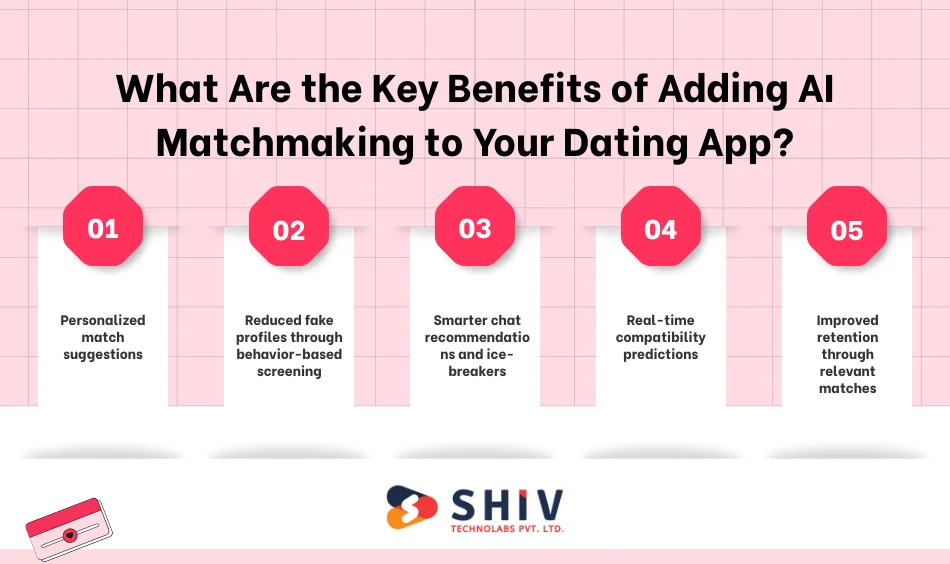
AI now sits at the heart of modern U.S. dating platforms because users demand relevant, safe, and timely matches. AI matchmaking in dating apps studies signals and returns suggestions that feel personal from the first session.
Teams see stronger engagement when recommendations match intent, location, and communication style across different user segments. Better personalization increases trust, which reduces churn and improves lifetime value for growth-focused product roadmaps.
A dating app with AI recommendations can surface hidden fits that traditional filters often miss during busy periods. The system detects changing preferences and updates compatibility scores as new signals arrive from chats and swipes.
Top Benefits of AI Matchmaking:
- Personalized match suggestions
- Reduced fake profiles through behavior-based screening
- Smarter chat recommendations and ice-breakers
- Real-time compatibility predictions
- Improved retention through relevant matches
Personalized match suggestions reduce random browsing and move users toward promising profiles within the first sessions. Behavior-based screening flags risky accounts by comparing patterns across message timing, content, and repeated profile changes.
Smarter chat suggestions create openers that reference shared interests, lowering anxiety and improving first response rates. Real-time compatibility predictions adjust recommendations during peak windows, which keeps sessions lively and conversations moving.
Whether upgrading an existing app or building new, our React Native app development delivers reliable cross-platform AI matchmaking integration. AI matchmaking in dating apps then benefits from native performance, consistent UI patterns, and faster shared code updates.
Trust also rises when models reward verified behavior, such as steady messaging, polite tone, and authentic photos. You can pair these signals with reports and community moderation to protect users without adding friction to onboarding.
For growth teams, better targeting lowers paid acquisition waste because engaged users convert at higher rates from recommendations. This compounding effect creates stronger cohorts and steadier revenue, especially during seasonal shifts across U.S. cities.


How Much Does It Cost to Integrate AI in Dating Apps in the USA?
How much does it cost to integrate AI matchmaking in dating apps, USA Today, for most teams? Pricing depends on feature depth, app scale, and data needs across model training and deployment.
Budgets vary by MVP scope, target cities, and the number of platforms you plan to support. Costs also shift based on data labeling, NLP features, and whether you add voice or video chat.
Key factors that influence total cost:
- App type (MVP vs full-scale)
- AI model complexity
- Chat or voice integration
- Server infrastructure
- Data privacy compliance
Estimated Pricing
| App Type | AI Complexity | Estimated Cost (USD) | Key Features Included |
|---|---|---|---|
| Basic Dating App | Low | $25,000 – $40,000 | AI-based profile scoring, simple recommendations |
| Mid-Level App | Medium | $40,000 – $70,000 | Behavioral AI, NLP chat suggestions |
| Advanced App | High | $70,000 – $120,000+ | Deep learning matchmaking, real-time analytics |
A basic build suits early validation with smaller user groups and limited matching signals across a few regions. Teams can start here, collect feedback, and add deeper models after reaching steady weekly activity.
A mid-level scope adds behavioral AI and NLP that detects tone, intent, and interests from chat content. This tier suits growth stages, where better match quality and safer conversations directly impact retention curves.
An advanced scope brings deep learning, richer embeddings, and real-time scoring for large U.S. audiences. Expect stronger compatibility predictions, faster iterations, and detailed analytics that support product decisions each sprint.
For more context, see our detailed guide on dating app development cost.
Remember hidden items that affect budgets across quarters and releases. Data cleaning, feature engineering, and ground-truth labeling add effort that pays off with higher model accuracy.
Third-party APIs also matter when you add verification, content safety, or voice transcription at scale. You will budget for monitoring, rollback plans, and ongoing model recalibration as user behavior shifts.
To forecast budgets, connect your growth goals with the right tier and rollout strategy first. Mention your target cities, seasonal peaks, and planned channels so we can tune AI matchmaking in dating apps for your roadmap.
The final pricing may vary depending on data volume, API integrations, and UI complexity across platforms. We scope clear milestones, define success metrics, and ship in phases that help reduce risk while moving fast.
If you want a precise quote, share your monthly active users, key features, and planned launch timeline. We will map costs to milestones, align stack choices with your goals, and recommend the best starting tier.
What Is the Timeline to Build an AI Matchmaking Feature for Dating Apps?
How long does it take to build an AI dating app feature in the USA? Most teams deliver a first release in twelve to twenty weeks, depending on scope and data readiness.
This timeline to build AI dating app feature works best when phases follow clear sprint checkpoints and metrics. We keep feedback loops short, reduce rework, and adjust priority based on beta insights from early cohorts.
Here is a practical schedule most founders use for a first rollout in the USA. Use it to plan budgets, target dates, and review gates upfront.
| Development Phase | Duration (Weeks) | Key Activities |
|---|---|---|
| Research & Planning | 2–3 | Market analysis, requirement gathering |
| Design & Architecture | 3–4 | UI/UX, backend structure |
| AI Model Training | 4–6 | Data labeling, machine learning setup |
| Integration & Testing | 4–5 | API linking, performance testing |
| Launch & Optimization | 2–3 | Beta release, feedback, final tuning |
Research and planning confirm goals, data sources, and launch markets for your first cohort within two to three weeks. Design and architecture map user flows, structure services, and prepare clean handoffs across mobile and backend.
AI model training builds a first-pass ranker from labeled signals and historical engagement data patterns observed during pilots. An AI-based matchmaking system in USA also captures city trends and regional interests for better ranking.
Integration and testing link scoring to feed, search, and chat behind feature flags and strict latency budgets. Launch and optimization start with a small audience, then scale as metrics improve week by week.
Why React Native Speeds Delivery
React Native uses one codebase across iOS and Android, which cuts duplicate work and speeds feature parity. Shared components reduce testing overhead, improve release cadence, and support faster fixes after beta feedback. This approach saves weeks across design, build, and QA, especially for teams targeting multiple U.S. cities.
Two-Wave Rollout Option
Wave one ships core scoring and simple recommendations for a measured market read in two target cities. Wave two adds deeper NLP, richer analytics, and stronger safety tools after early cohorts validate the approach.
Buffers, Reviews, and Compliance
Add a small buffer for app store reviews, holidays, and legal checks tied to privacy rules. This protection keeps dates stable without slowing training, testing, or phased releases across your roadmap.
City Pilots and Phase Gates
For city pilots, set phase gates for each market and adjust pacing after early results. This pattern builds strong first cohorts and helps models learn faster from real behavior collected during peak sessions.
With this timeline to build AI dating app feature, most teams ship a solid beta within one quarter. Share target cities and key features, and we will prepare a precise plan for your launch.
Which Tech Stack Is Best for AI Matchmaking in U.S. Dating Apps?
Choosing the right stack shapes speed, stability, and growth for U.S. dating products. AI matchmaking in dating apps needs tools that support training, scoring, and fast releases.
Your stack should balance time to market with reliable operations at scale. Pick frameworks with strong communities, clear documentation, and proven results in production.
Recommended Tech Stack
| Category | Technologies |
|---|---|
| AI & ML | TensorFlow, PyTorch, Scikit-learn |
| Backend | Node.js, Express.js |
| Frontend | React Native, Flutter |
| Database | PostgreSQL, MongoDB |
| Cloud & APIs | AWS, Firebase, OpenAI API |
| Analytics | BigQuery, Mixpanel |
As a trusted React Native app development company, we deliver shared components and consistent performance across iOS and Android. This approach cuts duplicate work and speeds parity for new features.
TensorFlow and PyTorch support model training, fine-tuning, and batch scoring. Scikit-learn helps with quick experiments, baseline models, and ranking features during early phases.
Node.js with Express.js gives lightweight APIs for feed ranking, chat cues, and scoring. It handles traffic spikes with caching and queues while meeting practical latency goals.
PostgreSQL fits transactions such as profiles, subscriptions, and payments. MongoDB works well for activity logs, feature flags, and flexible objects during growth.
AWS or Firebase covers hosting, storage, and authentication with mature tooling. OpenAI API supports NLP tasks like tone hints, safety checks, and message summarization.
BigQuery powers cohort analysis across cities and seasons. Mixpanel tracks funnels, event paths, and experiment outcomes for weekly product choices.
Add logging, tracing, and model monitoring to watch drift and quality. Map data flows to CCPA and GDPR, and maintain clear audit trails for sources and vendors.
Why Choose Experts to Add AI Matchmaking Features to Your Dating App?
Specialists help you plan models, protect data, and ship updates on a steady schedule. They also reduce guesswork by tying milestones to measurable match quality and retention.
An experienced dating app development company in USA understands U.S. privacy rules, release cycles, and regional usage patterns. That context supports safer rollouts and faster learning from real cohorts.
What you gain with expert teams
- Expertise in AI algorithm integration
- Scalable infrastructure and cloud rollout
- U.S.-compliant data privacy setup (CCPA, GDPR)
- Cross-platform compatibility using React Native
Experts design guardrails for ranking, safety, and chat experiences. They build dashboards that show model lift, cohort health, and the impact of feature changes.
Teams also set phase gates for pilots, then scale only when numbers look strong. This pattern delivers predictable progress without risky rewrites or rushed changes.
Conclusion
AI matchmaking raises match quality, improves conversations, and supports steady growth across U.S. cities. With the right scope, you can release a focused first version and expand depth as data grows. This guide covered benefits, pricing tiers, timelines, and a practical stack for production. If you plan a rebuild or a new feature, start with clear goals and simple early wins.
If you’re planning to upgrade your dating app with smart features, Shiv Technolabs offers mobile app development services in USA. We can integrate AI-driven matchmaking that engages users, lifts response rates, and significantly reduces churn.
Are you ready to discuss your launch window and budget with our team today in detail? Share your features, audience size, and target timeline, and we will prepare a tailored estimate.
FAQs
Q1. How does AI matchmaking in dating apps actually work?
AI matchmaking in dating apps studies profile actions, chat tone, and stated preferences. It predicts likely matches for today, not generic popularity, and updates scores as behavior shifts.
Q2. What is the Cost to integrate AI in dating apps USA for a first release?
Budgets usually fall between $25,000 and $120,000+, based on scope and data needs. Price moves with AI depth, safety tools, and traffic targets across cities.
Q3. What is the Timeline to build AI dating app feature for iOS and Android?
Most teams ship a focused beta in twelve to twenty weeks with phased milestones. Faster delivery depends on clean data, clear goals, and tight release cycles.
Q4. Can I add AI to an existing product without a full rebuild?
Yes, you can add modules through APIs and a service layer that handles scoring. A React Native app development company can keep feature parity while limiting duplicate effort.
Q5. What makes an AI-based matchmaking system in USA more accurate for local users?
It learns city patterns, seasonal habits, and regional interests from real usage data. This local context sharpens rankings and supports a dating app with AI recommendations that feel relevant.