Table of Contents
The healthcare industry is rapidly evolving, and companies currently require frameworks that provide security and performance. Over 95% of attacks target vulnerable health records. That is why it is important to have a healthcare platform that securely manages health information as online patient portals, telemedicine systems, and digital health applications evolve.
This is where Next.js patient portal development comes in as the leading choice for healthcare, as it builds a solid foundation for secure web application development. Next.js has become a strong option for fast, powerful development thanks to its robust architecture, making it suitable for HIPAA-compliant web development.
But you need experts to handle Next.js development, as it involves complex functionality. Therefore, many healthcare centres today rely on a trusted Next.js development company like Shiv Technolabs to handle HIPAA-compliant healthcare platform development.
The guide provides insights into how to create a HIPAA-compliant healthcare development with Next.js and why decision-makers are turning to it as a preferred web development platform for HIPAA compliance.
What is a HIPAA-compliant healthcare Platform?
A HIPAA-compliant healthcare platform is a digital platform that is specifically designed to collect patient data and comply with the regulations established by the Health Insurance Portability and Accountability Act. (see our primer on patient data security and HIPAA).
This entails managing protected health information with the utmost privacy, security, and administrative controls. The development of such platforms is not a trivial matter, as it must be planned and carried out in accordance with the rules.
HIPAA compliance involves:
- Securing transit and the remaining patient data.
- Reimbursing access control.
- Keeping audit trails and logs.
- Conducting the security review periodically.
- Avoiding access or disclosure of data.
The platforms must meet these standards by implementing strong encryption, secure APIs, robust identity management, and sustained monitoring. The use of any HIPAA-compliant healthcare platform must also adhere to stringent permissions, logging, device management, and communication guidelines.
Key HIPAA features include
- Patient data is transmitted through encryption.
- Role-based access control
- Data recording and audit trails.
- Periodic security evaluations.
These are the core elements of good web development of HIPAA compliance.
Why Are Healthcare Businesses Turning to Next.js

The demands on healthcare experiences have increased. Users are demanding quick-loading information, real-time information, clean interfaces, and mobile-compatible applications. All hospitals, clinics, laboratories, and telemedicine startups require powerful systems that can display information quickly and securely.
Next.js healthcare development meets these expectations by providing server-side rendering and static generation, helping healthcare applications be fast, efficient, and stable. There is a smooth feel to page transitions, optimal data flow, and the development team can maintain clarity and order without any problems.
Faster Page Loads for Patient Portals
Test results, appointment details, and reports are the most frequently used types by healthcare users. Patient portals must load very fast. Next.js supports server-side rendering, so every page is built and rendered on the server, resulting in instant load times.
SEO Medical Information Page Boost
Healthcare professionals post information to direct patients. Next.js enables such pages to perform better in search engines through server-side rendering and metadata control.
Simplified Maintenance for Enterprise Apps
Large-scale healthcare systems typically require dozens of pages, modules, and dashboards. Next.js has a clean architecture, which makes upkeeping, bug fixing, and feature rollouts easier.
Server Side Rendering for Better Compliance Monitoring
In server-side rendering, sensitive processes are executed on the server, thereby limiting exposure on the client. This enhances compliance posture to secure the development of healthcare web apps.
On the whole, Next.js healthcare development aligns with the growing demands of contemporary healthcare companies.


Is Next.js Secure for Healthcare Platforms?
Healthcare applications cannot do without security. The question many teams will ask when comparing the safety of a framework is: Is Next.js safe enough to use on healthcare platforms?
No question, as long as it is set up accordingly. Next.js provides several built-in security measures. It isolates environment variables, renders private logic on the server side, and provides API routes with controlled access and authentication, which can be integrated with it with ease. Next.js helps practice high-level security, including
- Custom security headers
- HTTPS enforcement
- Input sanitization
- Secure cookies
- Validation layers
Next.js can implement these features in line with the principles applied to HIPAA and GDPR compliance standards. When planning API flows, review our Next.js API routes guide.
Key security advantages
- Practices HTTPS and TLS to ensure secure management of secure health information.
- Works hand in hand with secure authentication and identity management.
- Compatible with HIPAA-compliant cloud hosts.
A combination of these features can help Next.js become a strong infrastructure for developing safe, healthy web applications.
The following table presents the alignment between Next.js and various compliance requirements.
HIPAA Compliance Support Table
| Compliance Feature | Supported by Next.js | Additional Setup Required |
|---|---|---|
| SSL Encryption | Yes | No |
| Data Encryption at Rest | Yes via database | Yes |
| Access Logging | Yes | Partial |
| HIPAA Documentation | No | Yes |
When set up correctly, Next.js can be a good candidate for developing a HIPAA-compliant healthcare platform.
How Does Next.js Improve Performance for Healthcare Applications?
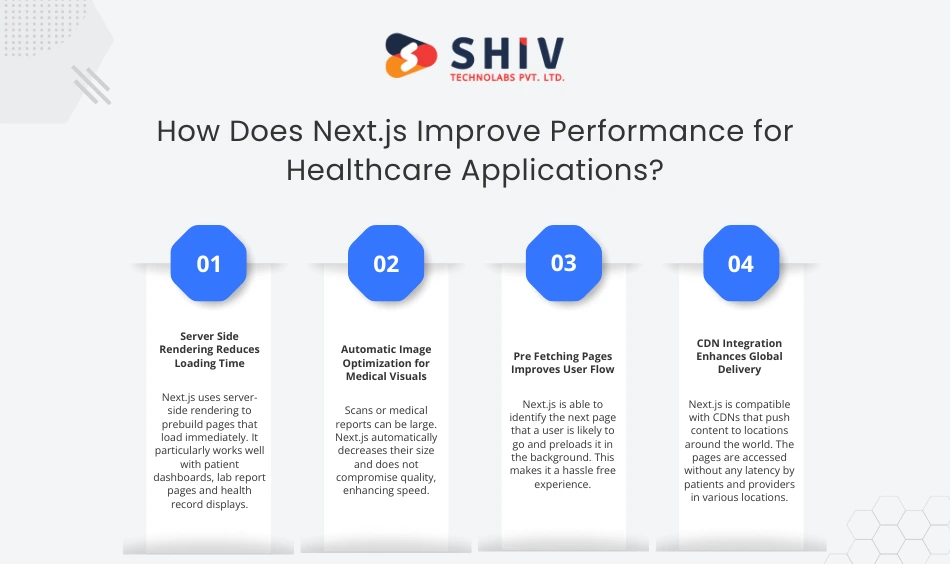
In healthcare systems, performance is necessary. Patients want information in real time, and doctors cannot afford to wait for a slow-loading dashboard to finish loading. That is why the development of the Next.js patient portal has become popular.
Server Side Rendering Reduces Loading Time
Next.js uses server-side rendering to prebuild pages that load immediately. It particularly works well with patient dashboards, lab report pages and health record displays.
Automatic Image Optimization for Medical Visuals
Scans or medical reports can be large. Next.js automatically decreases their size and does not compromise quality, enhancing speed.
Pre Fetching Pages Improves User Flow
Next.js is able to identify the next page that a user is likely to go and preloads it in the background. This makes it a hassle free experience.
CDN Integration Enhances Global Delivery
Next.js is compatible with CDNs that push content to locations around the world. The pages are accessed without any latency by patients and providers in various locations.
The characteristics help healthcare sites provide dependable, quick, and efficient services.
How Much Does It Cost to Build a HIPAA Compliant Platform?
To most organizations the initial feasible question would be how expensive it would be to construct a HIPAA-compliant platform. The price is dependent on design and features, integrations, server configuration, and compliance audits.
Factors that influence cost
- Design complexity and user interface.
- EMR and EHR integrations (see why EHR links matter in telemedicine solution planning).
- Telehealth modules and appointment scheduling.
- Compliance-associated records.
- Data security architecture
- Real-time data and analytics
- Cloud infrastructure setup
Healthcare sites usually have three different prices.
Fixed Price Model
Ideal for small- to medium-sized healthcare applications with predefined features.
Cost range: $10,000 to $25,000
Hourly Development Model
Suits flexible scope projects.
Cost range: $35 to $70/hour
Dedicated Team Model
Best suited to enterprise portals that require greater compliance and multi-integration.
Cost range: 50000 to 100000 plus USD
HIPAA Platform Cost Table
| Model | Description | Estimated Cost Range |
|---|---|---|
| Fixed Price | Good for smaller predictable healthcare apps | $10,000 – $25,000 |
| Hourly | Based on developer effort | $35 to $70/ hour |
| Dedicated Team | Full-scale enterprise HIPAA-compliant platforms | $50,000 – $1,00,000+ |
The price is higher with the addition of such modules as EMR integration, telemedicine systems, pharmacy tools, insurance processing, or AI-driven assistance.
What Features Should a HIPAA Compliant Next.js Platform Include?
The reason is that to develop a platform that is HIPAA-compliant the web development will require a combination of safety and usability. Healthcare users are looking for intelligent interfaces, yet the system under the hood must be able to authenticate all interactions.
Key features include
Role-Based Authentication
There should be restricted access. There must be doctor, nurse, administration, and patient levels.
Audit Trails and Activity Logs
Every activity should be adequately documented. This assists in tracking changes and keeping track of accountability.
PHI Encryption and Secure APIs
The encrypted data should be the stored health information and data sent through a computer. The secure tokens and controlled endpoints should be used by APIs.
Data Backup and Disaster Recovery
A healthcare system that is in compliance with HIPAA should be backed up continuously and have fast recovery mechanisms in the event of downtimes.
Two Factor Authentication and Session Control
The accounts of patients and staff must include multiple forms of verification. Sessions ought to be set to expire automatically in order to avoid unauthorized access. The mentioned features will guarantee the creation of secure healthcare web applications that comply with HIPAA and industry requirements.
What Are the Business Benefits of Next.js for Healthcare Companies?
Healthcare companies gain business strengths and technical benefits by implementing Next.js healthcare development. It enhances speed, increases readiness to comply, and eases the expansion.
Improved SEO for Patient Portals
Server-side rendering increases your visibility in the search engines, and your patient-facing pages are visible.
Reduced Bounce Rates Due to Faster Load Times
Quickly loaded web pages ensure that users remain active, enhancing conversion and satisfaction.
Easier Integration with HIPAA-Approved APIs
Next.js integrates with other systems, such as EMR, telehealth, pharmacy services, or insurance data. Our healthcare app development covers typical modules.
Future Ready for Telehealth and AI Expansion
Next.js can be easily scaled to work with video or real-time communication, or AI-assisted diagnostics as your system expands. These merits make it an influential framework for healthcare firms.
Why Choose a Professional Partner for HIPAA-Compliant Next.js Development?

A HIPAA-compliant system that is created does not only entail coding. It needs an understanding of regulatory requirements, safe working practices, and models for healthcare data. That is why the business collaborates with specialists and why it is important to address an experienced Next.js development company.
Below we have put together key reasons to hire experts for HIPAA-Compliant Next.js Development:
Knowledge of HIPAA Standards
Professional teams know how to build systems that comply with the rules.
Experience in Medical Data Systems
Specialists are aware of how to use EMRs and telehealth, make appointments, and manage insurance information.
Proven Track Record with Compliance-Driven Apps
The practice developers have previously provided secure, trustworthy healthcare applications.
Collaborating with experts at Shiv Technolabs will make sure that you do not make expensive mistakes and create a secure platform that will not raise doubts.
Conclusion
Next.js has gained popularity as a reliable framework among healthcare organisations that require robust performance, secure design, and compliant architecture. It provides server-side rendering, fast load times, robust security, and easy integration with HIPAA-compliant services. Next.js is a smart and future-proof platform in any organization intending to launch a HIPAA-compliant healthcare platform.
If you’re looking for experts in Next.js web development, Shiv Technolabs is the way to go. As a Next.js development company, we have a team of development experts with exceptional technical expertise, industry experience, and robust infrastructure planning, providing end-to-end Next.js web development services that meet all compliance requirements.
As one of the top technology partners and a trusted eCommerce site development company for healthcare solutions, Shiv Technolabs ensures your application will be secure, scalable, and ready to engage patients. Discuss your healthcare project and create a secure, high-performance platform with our professional Next.js web development services.
Frequently Asked Questions (FAQs)
1. Is Next.js secure for healthcare platforms
Yes, Next.js offers a good foundation to secure healthcare applications, as it offers server side rendering, encryption of communication, secure cookies and connection with authenticated APIs. It provides a secure space to process sensitive patient data when used with a compliant cloud provider.
2. Can Next.js support HIPAA compliance?
Next.js can support compliance when deployed on infrastructure that meets HIPAA compliance criteria, including encrypted databases, secure hosting, limited access controls, and rich audit logs. Developers may apply stringent security policies and address regulatory requirements using the framework.
3. How much does it cost to build a HIPAA-compliant platform
It is also priced differently depending on features and complexity. Minor platforms can take a range of 10000 to 25000 USD, and enterprise systems with EMR integration, telehealth, and enhanced security can be over 100000 USD.
4. Why choose Next.js for patient portals and telehealth apps
Next.js will suit patient portals as it is fast, reliable, mobile-ready, and can be scaled to a high level. Its server-side rendering enhances performance and assists in providing real-time accessibility to health records, appointments and telemedicine services.
5. What are the key advantages of using Next.js in healthcare
Next.js has better loading time, high-security background, search engine optimization, and simple integration with HIPAA-certified tools. It minimizes the long-term maintenance expenses and allows quick growth in apps, making it an excellent choice in the case of healthcare companies.