Table of Contents
Telemedicine changed how Americans access care, bringing doctors to patients on phones, tablets, and laptops. With trusted Web App Development Services in USA, clinics and founders launch secure portals for fast, private visits. Patients now expect quick sign-ups, clear schedules, and reliable video calls for first-time and follow-up care.
Hospitals, startups, and healthcare entrepreneurs plan to build to offer virtual care and a wider reach across states. They aim to build a web app like Teladoc to cut waiting rooms and extend practice hours. A web app supports rural families, busy workers, and seniors who prefer remote guidance for common health needs.
This blog explains how to develop a telemedicine app like Teladoc from idea to launch. You will see the features that matter, the tech stack to consider, and the cost drivers for telemedicine app development in USA. We also outline a clear process that lowers risk and speeds time to market.
If you want a partner, our team builds HIPAA-ready MVPs with secure video, smart scheduling, and fast payments. We craft accessible interfaces for all ages and support growth with analytics and automation. Book a free consultation to plan your roadmap and fit the build to your budget.


What Is Teladoc, and Why Are USA Healthcare Startups Trying to Build Similar Web Apps?
Teladoc stands as a telemedicine pioneer in the USA, offering fast access to licensed clinicians. The platform covers primary care, mental health, dermatology, and other specialties through browser-based visits. Patients book online, join private video calls, and receive e-prescriptions within one consistent flow.
Founders and clinics plan to develop a telemedicine app like Teladoc to match these expectations. They launch secure MVPs, validate demand, and expand services as adoption grows. A web app reduces waiting rooms, improves triage, and supports timely follow-ups without crowded lobbies.
Teams that build web apps like Teladoc also gain clear analytics, faster documentation, and better payer workflows. They measure session quality, resolution time, and care outcomes across states. Leaders use these insights to refine services and allocate staff where patient need is highest.
Interest in telemedicine app development keeps rising as patients request remote options for routine issues. With the right roadmap, startups can move from pilot to regional rollout on predictable budgets. Our experts guide strategy, compliance, and delivery so you can launch with confidence. See our Healthcare App Development services for telemedicine modules and eRX workflows.
How Does a Web App Like Teladoc Work?
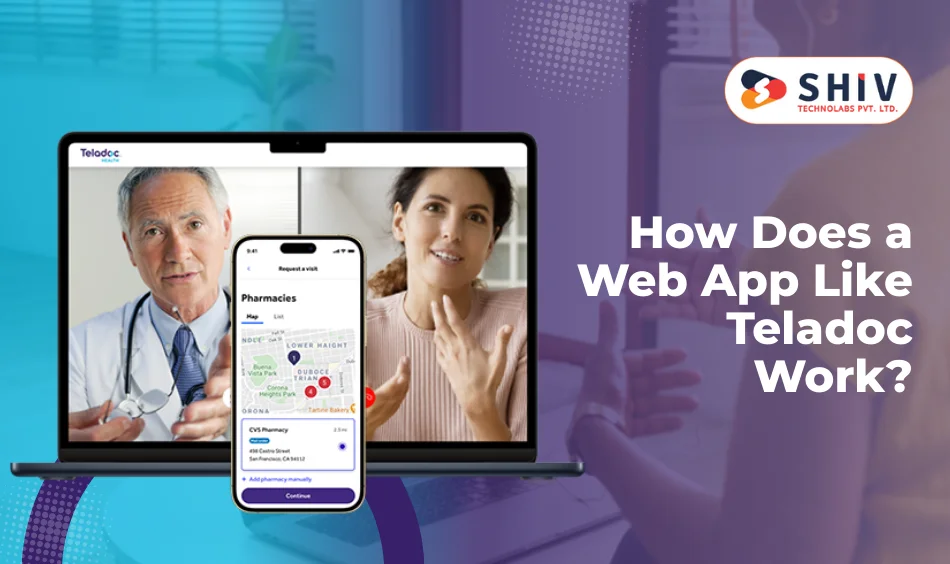
A Teladoc-style web app connects patients to licensed clinicians through a secure browser experience across the United States. Users create accounts, verify identity, share medical context, and add insurance details to support intake and billing. The system stores consents and preferences in an encrypted profile that meets strict healthcare standards (see IT consulting for patient data security).
Smart routing presents specialty options, insurance rules, and available time slots based on location and user preferences. Patients pick a doctor, confirm price, and receive email or SMS reminders before the visit. At visit time, the session opens with device checks for camera, mic, and bandwidth to support a stable call.
During the visit, doctors review history, capture notes, and place orders inside structured forms for accurate records. The app supports e-prescriptions, lab requests, and billing, then sends a visit summary to the patient portal and email. Analytics track wait times, first-contact resolution, and patient satisfaction across clinics and states.
Step-by-Step User Flow
- User registration and verification: Users enter contact details, insurance data, and government ID to create a private account online. The platform confirms email or phone with secure OTP verification and consent capture before access starts.
- Doctor discovery and appointment scheduling: Patients search by specialty, language, location, price, and condition tags to find the right doctor. Smart slots display real-time availability and timezone for accurate scheduling, with SMS and email reminders.
- Real-time video consultation: Patients join a browser video room that adapts to device, bandwidth, and browser type in seconds. Doctors review symptoms, share guidance, and record notes within structured fields and decision support prompts.
- Digital prescription and billing: The doctor issues an e-prescription and an optional lab request within minutes after approval from the session. The platform collects payment, applies insurance rules, and sends a digital receipt to the patient portal and email.
- Feedback and follow-up: The app requests ratings and comments to measure care quality and experience from every visit. It schedules follow-ups, shares care plans, and flags risks for outreach to improve outcomes across visits.
When you build a web app like Teladoc, consistent workflows shorten queues and raise first-visit resolution. We map the key features to build an app like Teladoc to your budget and specialty, then deliver a HIPAA-ready MVP fast. Request a free scoping call to plan timelines, milestones, and launch success metrics for your telemedicine program.


What Are the Key Features to Build an App Like Teladoc?
A strong telehealth product starts with patient-first basics that work on web and mobile. When planning the key features to build an app like Teladoc, focus on secure access, smart booking, reliable video, simple payments, and clear admin oversight. These pillars help you launch fast, gather feedback, and scale across clinics and states.
Add advanced layers to lift adoption and clinical value without adding friction for staff. Build care plans, remote monitoring, and eRX tools that fit each specialty. For telemedicine app development in USA, align features with HIPAA rules, payer workflows, and multi-state practice models from day one.
Our team maps features to your care model, budget, and growth goals. We craft MVPs that validate demand, then add modules as your traffic and service mix expand. If you want a quick demo or scoping call, we can share sample flows and admin dashboards.
Core feature matrix
| Feature | Type Example | Purpose |
|---|---|---|
| User Profiles | Doctor & patient login | Secure access |
| Appointment Booking | Smart scheduling | Simplified consultation flow |
| Video Calling | HD & real-time chat | Remote diagnosis |
| Payment System | Stripe/PayPal | Hassle-free billing |
| Notifications | SMS/Email alerts | Engagement |
| Admin Panel | Reports & analytics | Centralized control |
Advanced feature ideas to boost outcomes
- AI symptom intake with triage rules (see AI/ML development)
- ePrescription with pharmacy directory
- EMR/EHR integrations for visit summaries
- Remote patient monitoring device data
- Multilingual UI with time-zone smart slots
Want these features planned around your specialty? We’ll scope the MVP in days, agree on milestones, and launch with clear metrics.
What Tech Stack is Used to Build an App Like Teladoc?
Choosing the right stack keeps visits stable, private, and fast across devices. Teams that build web app like Teladoc favor proven frameworks, scalable clouds, and HIPAA-ready components for security.
Pick tools your team can maintain without friction or long learning curves. Favor libraries with active communities, strong docs, and long-term support windows. This approach reduces risk during upgrades and helps new developers contribute quickly.
Recommended stack overview
| Layer | Recommended Technologies |
|---|---|
| Frontend | React.js, Vue.js, Angular |
| Backend | Node.js, Django, Laravel |
| Database | MongoDB, PostgreSQL |
| Video API | Twilio, WebRTC |
| Cloud Hosting | AWS, Azure |
| Compliance | HIPAA-ready encryption and audits |
Use typed APIs, rate limiting, and audit logs for safety and traceability. Add feature flags to ship updates carefully and measure impact. This stack answers “what tech stack is used to build an app like Teladoc” while keeping room for future growth.
How to Build a Web App Like Teladoc in the USA (Step-By-Step Development Process)
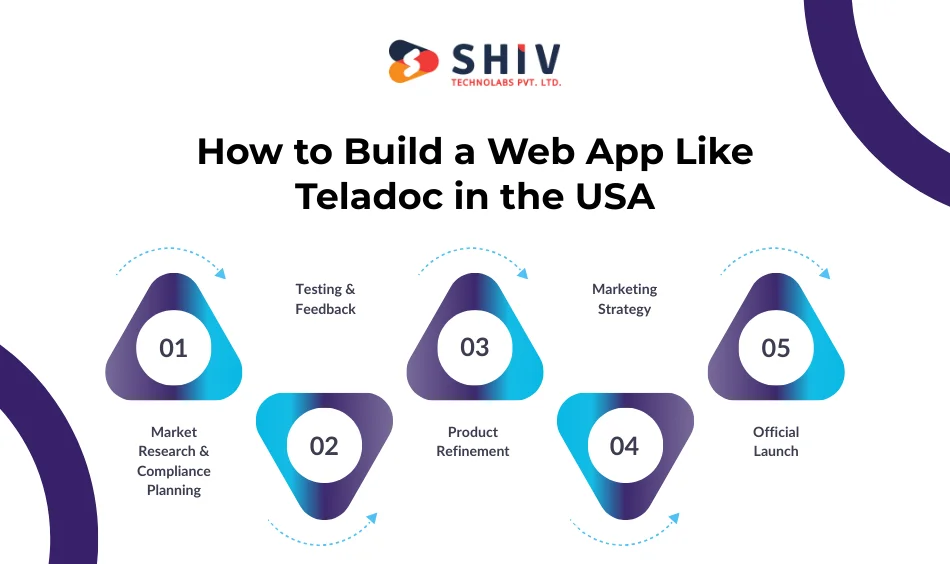
Building at speed requires a clear plan tied to US healthcare rules and patient privacy. Follow these steps to develop a telemedicine app like Teladoc with predictable timelines and costs.
Step 1 – Market Research & Compliance Planning
Study target states, visit types, and payer mix before you write a single line. Map HIPAA, consent flows, ePHI storage, breach policies, and BAAs with vendors early.
Step 2 – UI/UX Design & Prototype Creation
Design large, clear interfaces that work for all ages and abilities. Create interactive prototypes with visit booking, video entry checks, and simple forms that patients can finish quickly.
Step 3 – Development & API Integration
Code the core flows first: registration, scheduling, video, notes, and eRX. Integrate Twilio or WebRTC, add chat, connect insurance checks, and plan EMR bridges where needed.
Step 4 – Testing & Quality Assurance
Run functional tests for every visit path, including cancellations and no-shows. Add security tests, load tests, and device checks to confirm reliable calls on weak networks.
Step 5 – Deployment & Ongoing Maintenance
Stand up staging and production with CI/CD and controlled feature flags. Track uptime, call quality, and first-visit resolution; ship frequent updates guided by analytics. For combined booking + telemedicine patterns, see Zocdoc-like healthcare web app guide.
This sequence shows how to build a web app like Teladoc in the USA with guardrails. It matches the realities of telemedicine app development, where privacy, reliability, and patient clarity matter. Our team can handle research, design, build, and run, then hand off with clear playbooks.
What Is the Cost to Build an App Like Teladoc in USA?
Building costs vary by scope, compliance depth, and team structure, so plan before coding. The cost to build an app like Teladoc in USA depends on features, integrations, and target states. Teams investing in telemedicine app development in USA should budget for research, design, build, testing, and post-launch care.
Plan for secure video, eRX, payments, and basic EMR bridges in an MVP. Add multilingual UI, remote monitoring, or payer workflows once adoption grows. This staged path keeps your budget predictable while protecting care quality and performance across devices.
Estimated budget ranges
| Stage | Task Description | Estimated Cost (USD) |
|---|---|---|
| Planning | Market & feature research | $2,000 – $4,000 |
| Design | UI/UX wireframes | $3,000 – $6,000 |
| Development | Core features build | $10,000 – $20,000 |
| API Integration | Video, EMR, Payments | $5,000 – $8,000 |
| Testing | QA & bug fixing | $2,000 – $4,000 |
| Maintenance | Deployment & support | $1,000 – $3,000 |
Approximate Total Cost: $20,000 – $45,000 for an MVP built with standard flows. Complex builds with multi-state rules, advanced triage, or heavy analytics may exceed this range. We can scope a precise estimate in days after a short discovery call.
Why Choose Professional Developers to Build a Teladoc-Like Web App?
Telehealth touches protected data, clinical workflows, and payer rules, so experience matters from day one. Skilled teams build web app like Teladoc with strong security, clear UX, and reliable video under varied network conditions. They select stable components, write typed APIs, and set guardrails for audits and change control.
Specialists shorten timelines because they know common pitfalls and compliance patterns. They create clear prototypes, run device tests, and set up CI/CD for careful rollouts. With Web App Development Services in USA, you also gain local context on HIPAA, BAAs, and state practice models.
Shiv Technolabs ships HIPAA-ready MVPs with smart scheduling, secure calls, and fast payments. We add analytics, care plans, and pharmacy flows as traction grows. Book a free consultation to review milestones, stack choices, and a realistic launch window.
FAQs About Building a Web App Like Teladoc in the USA
Q1: How long does it take to build a Teladoc-like web app?
Most MVPs ship in 4–6 months, depending on features, integrations, and compliance steps.
Q2: What tech stack is ideal for telemedicine app development in USA?
A common stack pairs React.js, Node.js, Twilio, and AWS with HIPAA-ready encryption and audits.
Q3: How much does telemedicine app development cost in USA?
Budgets for MVPs often range from $20,000 to $45,000, based on scope and team size.
Q4: Is HIPAA compliance necessary?
Yes, any product handling patient data in the USA must follow HIPAA policies and security controls.
Q5: Can I hire local teams for this project?
Yes, several providers offer Web App Development Services in USA for full-cycle design and build.
Q6: What tech stack is used to build an app like Teladoc?
Teams often choose React or Vue, Node or Django, Twilio or WebRTC, and AWS or Azure.
Q7: How to build a web app like Teladoc in the USA with lower risk?
Run discovery, design prototypes, code core flows, test hard, and release with feature flags.
Conclusion
Teladoc’s model showed that fast, private visits can work at a national scale for common needs. Your product can deliver the same clarity with strong UX, secure video, and clean billing. Start with a focused MVP, track outcomes, and add specialties as demand grows across regions.
We plan roadmaps, craft HIPAA-ready builds, and guide measurable rollouts for clinics and startups. If you want speed with safety, our team can design, build, and support your next release. Tell us your service lines, states, and timeline, and we will present a precise plan.
If you’re seeking a reliable Web App Development Company in USA, our experts can help design, develop, and launch a HIPAA-compliant telemedicine solution.
Ready to move? Request a free scoping call, and get a detailed timeline, budget range, and feature plan.