Table of Contents
The digital revolution has transformed the travel sector, and consumers now demand a convenient online booking experience with the product available immediately, a clear price, and secure payment systems.
A sound travel portal system will enable customers to search, compare, and book flights, hotels, tours, and activities through a single platform. Modern travel web development services available to agencies and OTAs enable the automation of the booking process, real-time inventory, and individualised travel experiences for users around the world.
According to reports, 72% of travellers prefer online booking, underscoring the role of online platforms in the global travel industry. Portals in the travel industry can be scaled, improve operational efficiency, and increase conversion rates as more customers shift to digital-first travel.
What Makes a Travel Portal Solution Successful?
It is not just a website that creates a successful travel portal, but a system within an ecosystem that connects suppliers, customers, and travel operators on a single site. It enables travel agencies, tour operators, and OTAs to handle bookings, automate workflows, consolidate customer information, and streamline communication.
The professionally elaborated travel portal offers:
- Multi-service (flights, hotels, tours, transfer) integration.
- Integrated reservation and customer relationship management.
- Confirmations and notifications that are automated.
- Scalable traffic architecture
- Intuitive interface with high-frequency travel search capability.
In short, effective travel portal development will deliver a stable, easy-to-use, and performance-driven portal that facilitates rapid business growth.
Key Elements of a Custom Travel Portal Solution
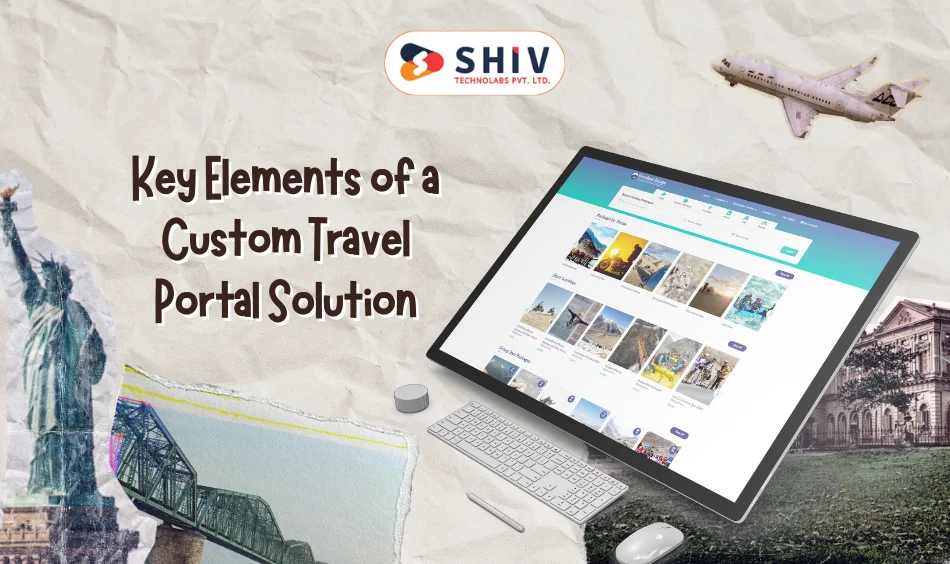
A well-performing travel portal must have three pillars: stunning design, real-time integrations, and automation. Let us break each down.
Responsive and User-Centric Design
A well-designed portal enhances engagement and increases the likelihood of converting bookings. Responsive travel portal design will also guarantee a seamless customer browsing experience across desktops, tablets, and mobile devices. If you need a front-end stack, consider Next.js development for fast, SEO-friendly interfaces.
The key principles of UX are:
- Clean homepage layout
- Mobile-first design
- Fast-loading booking pages
- Interactive destination images.
The easier the navigation is, the quicker the users can switch between search and booking- more sales.
Real-Time Booking and API Integration
Booking is available in real time only through strong API connections that link the portal to the world’s suppliers. These APIs will retrieve real-time capacity, price, and availability of flights, hotels, car rentals, and activities. Typical GDS and supplier APIs are:
- Amadeus
- Sabre
- Travelport
- Hotelbeds
- Expedia Partner API
The development of travel booking portals makes these APIs run smoothly with the following benefits:
- Accurate pricing
- Room and live seat availability.
- Quick booking of reservations.
- Reduced booking errors
A credible travel portal relies on real-time communication via APIs.
Booking Automation and Workflow Management
Automation speeds up operations in the travel industry and reduces employee workload. Intelligent workflow management allows a portal to process:
- Real-time confirmation of the booking.
- Automatic updates through email or SMS.
- Refund processes and cancellation.
- Customer notification of the changes in the itinerary.
CRM systems are also integrated with automation to aid in monitoring leads, making follow-up calls to customers, and assigning inquiries to travel agents. This enhances operational efficiency and fosters a uniform user experience. For end-to-end build-outs, see Web App Development Services.
Role of CRM Integration in a Travel Portal
The support operational engine, which facilitates personalization and customer lifecycle management, is represented by CRM. The integration of a travel CRM provides 100% visibility into customer relationships, preferences, and booking history.
A CRM based travel portal solution assists in helping a business:
- Communicate more efficiently.
- Divide and attract customers based on travel.
- Track leads, enquiries, and customer trails.
- Upsell/cross-sell packages according to previous activities.
CRM integration delivers:
- Centralized customer records.
- Automated email responses
- Improved lead handling and sales-tracking.
This translates into better customer relations and stronger revenue performance.


Features Every Travel Portal Solution Should Include
A quality travel portal should integrate design, functionality, automation, and data intelligence to deliver a hassle-free booking experience for users. Travellers today demand quick search results, accurate pricing, secure transactions, and a personalised experience across devices.
To provide this consistently, the travel portal solution you are providing must offer a powerful set of features that collaborate on a robust back-end architecture.
The key features are listed below.
1. Responsive and Device-Friendly Interface
A travel portal should suit desktops, tablets, and smartphones. A responsive interface is not an option, since over 60% of all travel searches worldwide start on mobile devices. It has a direct impact on the user interaction, booking uptake, and brand confidence.
Key capabilities:
- Fast loading mobile optimized pages.
- Responsive design on all devices.
- Ease of use through an intuitive design that minimizes drop-offs.
- Destination, packages and hotel high-quality visuals.
The interactive interface allows the traveler to compare, book and search anywhere – this is a unified platform experience.
2. Real-Time API Integration for Flights, Hotels, and Tours
Live bookings are driven by API integration. It integrates your portal with the global travel suppliers to enable users to access real-time information.
Common travel APIs include:
- Amadeu
- Sabre
- Travelport
- Hotelbeds
- Expedia Partner Solutions
The portal delivers:
- Live availability
- Accurate pricing
- Live seat and room occupancies.
- Real-time confirmation of the booking.
A well-designed travel portal development plan will ensure these API pipelines are stable, fast, and able to handle high volumes of search queries without delays.
3. Automated Booking and Confirmation Workflows
Automation helps improve the efficiency of the operations and get rid of repetitive efforts that tend to waste the time of the travel agency staff.
Automation handles:
- Auto generated reservations.
- Email and SMS notifications
- Ticket and voucher issuance
- Refund processes and cancelation.
- Booking status updates
The portal automates these steps, providing a transparent, smooth process for customers and agents. (See SaaS development for workflow-heavy modules.)
4. Multi-Language and Multi-Currency Support
Travel companies that cater to international markets should cater to many users. It is advisable to support several languages and currencies to build trust and eliminate booking obstacles.
Benefits include:
- Increased foreign conversion.
- More individual user experience.
- Ease the check-in of cross-border travelers.
This aspect is critical for OTAs and agencies seeking to attract customers across regions.
5. Secure Payment Gateway Integration
Travel websites need a secure payment environment because clients provide sensitive payment information at checkout.
Your portal should support:
- PCI-compliant gateways
- Various payment methods (cards, wallets, UPI, bank transfer)
- Encrypted transactions
- Fraud detection and prevention software.
Quality security creates trust and minimizes cart abandonment.
6. Admin Dashboard and Reporting Tools
A good admin panel will help agencies track business performance.
Key functions include:
- Booking insights and analytics
- Sales performance reports
- Supplier and inventory management.
- Customer behavior tracking
- Agent commission oversight
Analytics-driven decision-making enables businesses to change pricing, marketing, and sales strategies and become more profitable.
7. Integrated CRM for Customer Lifecycle Management
CRM is used to ensure that all leads and customer contacts are systematized and monitored.
A CRM integration in the travel sector offers:
- Lead acquisition and segmentation.
- Automated follow-ups and reminders.
- Tracking of customer preference.
- Managing group bookings
- Loyalty program management
- Start with ERP/CRM development.
This helps agencies make communication more personal and drive more conversions.
8. Search and Filter Engine with Advanced Options
The best option should be available to travelers in a short time. A good search engine will enhance user satisfaction and attract more bookings.
Features typically include:
- Intelligent searching with foretelling text.
- Price, date, rating, and location filters.
- Comparison tools side-by-side.
- Map view for hotels and tours
An effective search engine eliminates the aspect of decision fatigue and directs users on proper alternatives.
How Much Does It Cost to Build a Travel Portal?
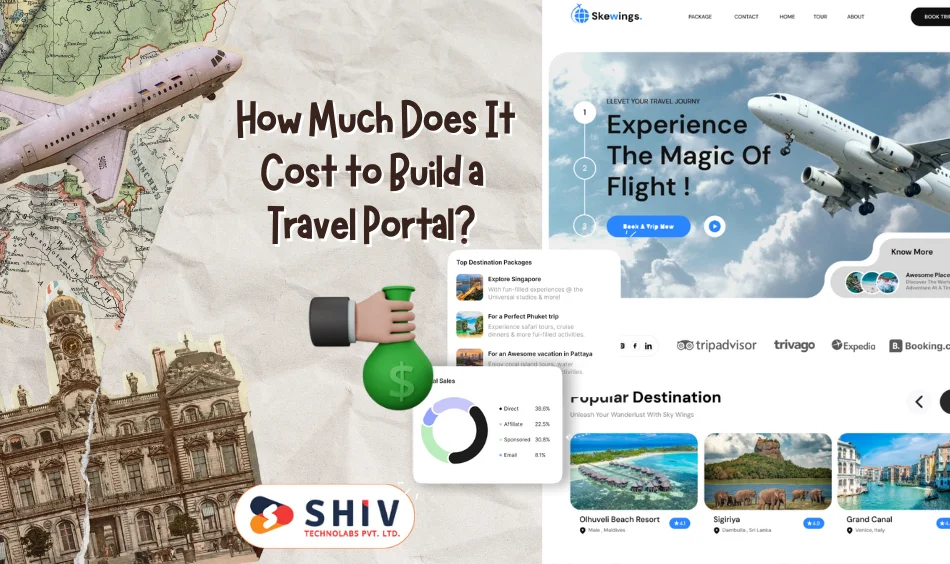
Travel portal construction costs can vary based on the complexity of the design, the number of APIs, automation processes, payment gateways, and other modules like CRM or analytics. The more features it contained, the more expensive development and integration became.
Cost Factors
The factors that determine pricing are:
- Number of booking modules (flights, hotels, activities, transfers).
- Types and quantity of API integrations.
- Degree of automation needed.
- UI UX design complexity
- CRM and third-party add-ons
- Hosting, security and maintenance requirements.
The following is a cost overview description.
Pricing
| Type | Features Included | Estimated Cost (USD) |
|---|---|---|
| Basic Portal | Manual booking, static listings | USD 3,000 – USD 6,000 |
| Standard Portal | API integration, basic CRM | USD 6,000 – USD 12,000 |
| Advanced Portal | Full automation, dashboards, analytics | USD 12,000 – USD 25,000+ |
Request a tailored quote for your travel portal solution, and have our team create a system tailored to your business size and future aspirations.
Why Choose Professional Travel Web Development Services?
Travel portal is an advanced project which requires technical precision, a high level of integration and strong knowledge of the travel industry processes. Professional web development services are needed to build scalable, secure, and feature-rich portals.
A professional team ensures:
- API connections are functional and safe.
- The backend responds to volumes of traffic.
- Booking engines have a smooth operation.
- Adherence to payment gateway is ensured.
- Standards of data privacy are achieved.
Expertise in Travel Specific APIs and Integrations
The APIs of GDS and suppliers demand rigorous technical implementation. This way, professionals ensure an easy flow of communication between your portal and suppliers worldwide.
Scalable Backend Structure
A proper backend ensures that thousands of parallel searches, bookings, and queries run without performance issues.
Secure and Optimized Booking Systems
Security is non-negotiable. A professional partner will guarantee compliance with PCI standards for payment card data, encrypted data storage, and secure authentication.
How to Choose the Right Travel Portal Solution for Your Business
Your business model and future growth plans determine which portal to choose.
Integration Flexibility
Your portal needs to support several GDS providers and hotel consolidators, as well as payment gateways, to enable you to grow inventory without any hassles.
Mobile Responsiveness
Over 60% of passengers plan to use their mobile devices. Mobile-ready portal increases engagement and reduces bounces.
Future Scalability
Your platform should be able to scale with additional modules, suppliers, and increased traffic without becoming sluggish.
Security and Compliance
User confidence is secured through security measures such as SSL certificates, PCI-ready gateways, GDPR compliance, and data encryption and decryption.
An effective development team should assist in selecting an appropriate travel portal solution that guarantees long-term development, stable operations, and strong customer confidence.
Conclusion
The current travel portal system is to be custom-designed with the necessary level of API integration and intelligent booking automation. As the travel industry becomes entirely digital, companies should consider implementing a platform that is fast, accurate, and easy to use. By engaging professional engineering and web development services in the travel sector, agencies and OTAs can build portals that will grow with demand and accommodate long-term growth.
Shiv Technolabs is a reputable travel web development company providing full-stack travel web development services, integration, automation, and maintenance solutions. Our team is the leader in GDS connectivity, booking engine development, customer relationship management integration, secure payment processing, and tailored travel software architecture.
Frequently Asked Questions (FAQs)
1. What does a travel portal solution include?
A travel portal solution is usually designed with a custom design, real-time booking engines, API integration with flights and hotels, CRM modules, secure payment and automated workflows. These elements guarantee a convenient booking process and travel management.
2. Can existing travel agencies upgrade to a custom travel portal solution?
Yes, it is possible to upgrade existing travel websites by adding new APIs, redesigning interfaces, improving booking engines, and integrating CRM tools. It does not mean you have to start your business afresh; upgrading only improves your digital infrastructure.
3. How much time does travel portal development take?
The development period will require 6 to 12 weeks, depending on the number of modules, the complexity of the UI, and the integration and testing cycles. More technologically advanced portals, automated and equipped with dashboards, might need more time.
4. Why is API integration important for travel websites?
Integration of APIs will allow real-time updates of planes, hotels, and activities. It eliminates duplicate bookings, displays real-time pricing, provides instant confirmation, and links your portal to global travel vendors.
5. What are the advantages of travel CRM integration?
CRM integration centralizes customer data, tracks leads, automates follow-ups, and delivers a personalized travel experience. It enhances the conversion rate, strengthens customer relationships, and makes communication management more effective in agencies.