Table of Contents
Enterprise software migration is the systematic process of moving an established system’s applications, data, and business logic to a new platform, architecture, or environment. This can involve migrating legacy systems to the cloud, transforming applications, or reengineering platforms to ensure scalability and security.
Migration budgeting is essential, as a small error can disrupt business continuity, system performance, and cost efficiency in the long run.
55% of enterprise migration projects exceed their original budget by 30% or more. According to reports, enterprises that invest in early planning mitigate the risk of migration failure by as much as 40%.
The costs associated with enterprise software migration and enterprise system migration pricing of the enterprise software development services require close insight by organizations to ensure that there is no downtime of operations, loss of data, and overruns when implementing the services.
What Does Enterprise Software Migration Involve?
Migration of the enterprise software is not a one-time task. It is a multi-stage change that influences application structure, data stores, infrastructure, integrations, security layers, and user processes. Enterprise migrations, as opposed to small-scale upgrades, may have an impact on several departments, third-party systems and mission-critical operations.
This usually involves system evaluation, dependency mapping, data preparation, re-development or refactoring, testing, deployment, and post-migration support. All the stages add to the overall schedule and cost. Moving enterprise software is even more expensive when legacy systems are undocumented or rely on outdated technology.
Here are various Types of Enterprise Software Migration:
Application Migration
It entails migrating existing applications to a new platform, such as cloud servers or a new operating system,s without losing the essential logic. The expenses are reasonable in case the applications are already designed.
Database Migration
Database migration focuses on migrating a substantial amount of structured and unstructured data without compromising integrity, compliance, or performance. Data validation and security controls have a significant impact on costs.
Cloud Migration or Infrastructure
This migration transfers on-premises server workloads to the cloud or hybrid environments. Although it lowers the long-term infrastructure cost, poor planning can raise the short-term costs.
Platform Reengineering
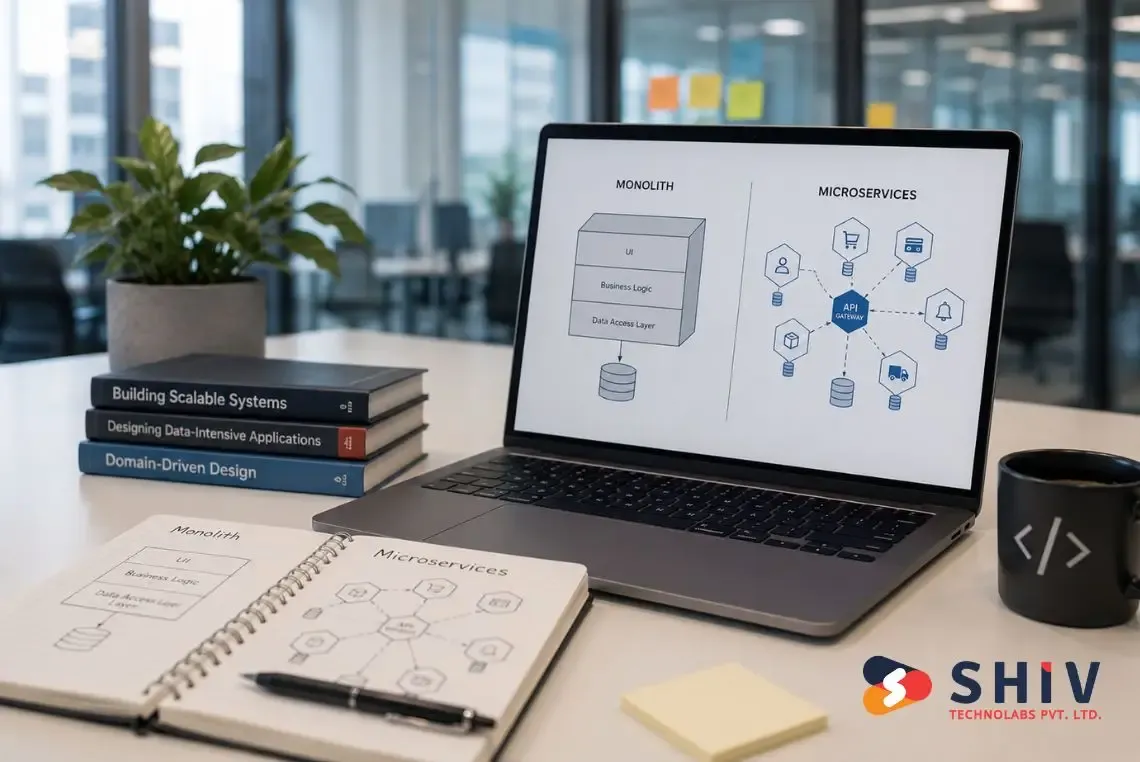
Platform reengineering is the rebuilding of applications in a new framework or microservice architecture. It is high-performance and scalable, but has the greatest initial investment. Build-new option: Custom Software Development.
Why Do Enterprises Need to Migrate Their Software?
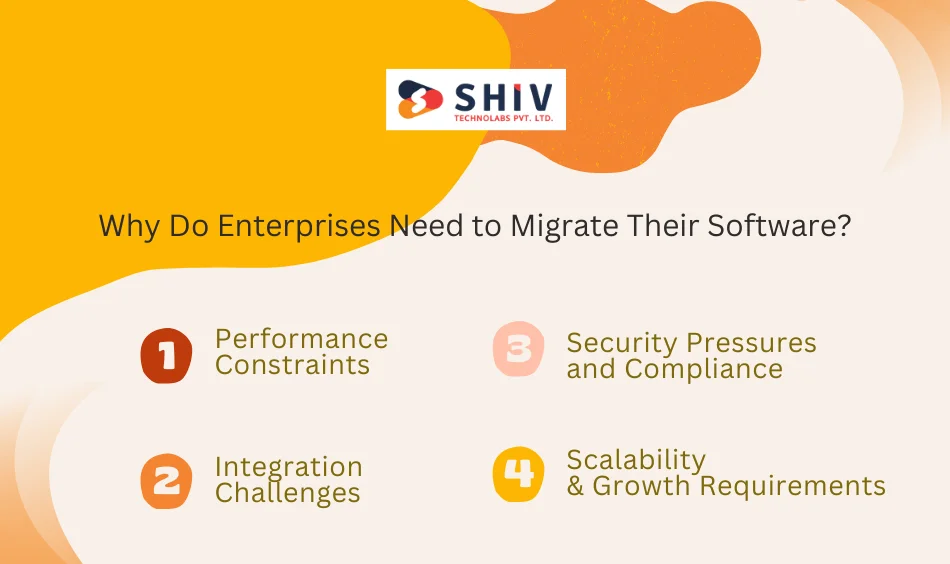
Business restrictions are more of an enterprise migration than a technology trend.
Performance Constraints
Legacy systems usually lack support for modern workloads, leading to slowness, system crashes and lost productivity.
Integration Challenges
Aging platforms are not easily compatible with new APIs, analytics apps and third-party applications, adding friction to operations.
Security Pressures and Compliance
Modern security architectures that cannot be supported by the legacy systems are necessary under regulations like the GDPR, the HIPAA and the ISO standards.
Scalability and Growth Requirements
Enterprises need to scale their operations with systems that remain elastic and do not degrade performance as the user base and data volume increase-robust backends: Backend Development Services.


What Are the Key Factors That Drive Enterprise Software Migration Cost?
The technical, operational and strategic variables determine enterprise migration budgets.
Migration Approach and Cost Impact
| Migration Type | Description | Cost Impact | Ideal For |
|---|---|---|---|
| Rehosting | Lift and shift with minimal changes | Low ($) | Simple applications |
| Refactoring | Structural improvements | Medium ($$) | Medium complexity systems |
| Rebuilding | Complete redevelopment | High ($$$) | Legacy platforms |
System Complexity
Extremely tailored systems with inbuilt business rules need to be rewritten.
Data Volume and Sensitivity
Big data and controlled information raise the expenses of validation and security.
Integrations and Dependencies
The greater the migration effort and risk, the more the external systems involved.
Testing and Compliance
Enterprise-grade testing can account for 20-30% of the overall migration cost.
By involving a software development consulting firm, it is possible to evaluate the cost of migrating enterprise software properly.
How Much Does Enterprise Software Migration Actually Cost?
The cost of enterprise software migration is dependent on the size of the organization, the complexity of the system, and risk tolerance.
Cost Estimates by Business Size
- Small-scale migrations: $15,000 to $25,000
- Mid-size enterprises: $40,000 to $80,000
- Large enterprises: $100,000 to $250,000+
Integrations, security layers, and availability requirements contribute to increased costs.
Detailed Pricing Breakdown
| Cost Component | Average Range (USD) | Description |
|---|---|---|
| Assessment and Planning | $5,000 to $15,000 | System audit and roadmap |
| Data Migration | $10,000 to $30,000 | Secure transfer and cleansing |
| Redevelopment | $25,000 to $80,000 | Refactoring or rebuilding |
| Testing and QA | $8,000 to $20,000 | Performance and security testing |
| Deployment and Integration | $5,000 to $15,000 | Go live setup |
| Support and Training | $3,000 to $10,000 | Post migration assistance |
Such numbers differ depending on the factors of cost of migration of business software like tolerance of downtime and the scope of compliance.
How Do Custom Software Development Solutions Affect Migration Cost?
The upgrade cost for custom software development solutions would normally add 15-25% to the initial migration expenditure. Nevertheless, they save a lot of long-term maintenance costs, operational inefficiencies and downtime.
Customized systems remove redundant modules, streamline processes and enhance system performance. Over 3 to 5 years, enterprises tend to recover the initial investment through reduced support costs and increased productivity.
How to Estimate the Cost to Migrate Enterprise Software
The pragmatically of estimating the cost to migrate enterprise software is much more than putting a single figure on a technical project. Enterprise migrations involve complex systems, interrelated applications, sensitive information and rigid uptime requirements.
A structured estimation process helps organizations manage the cost of enterprise software migration, preventing cost overruns and ensuring a smooth process. A clear professional breakdown, with well-defined paragraphs and bullet points, has been used to present the details and support well-made decisions.
1. Conduct a Comprehensive System Audit
The estimation starts with the full audit of the current software ecosystem. This step identifies technical debt, system dependencies and performance limitations that directly impact costs.
The usual types of items included in a system audit would be:
- Technology stack and application architecture review.
- Data sensitivity, database structure and data size analysis.
- API dependencies and third-party integrations.
- Vulnerabilities to security and compliance.
Migration effort can be 20-35 times more difficult when legacy issues discovered during audits are not addressed early. A proper audit is one way of enhancing the accuracy of estimation.
2. Define the Migration Scope Clearly
One of the most significant factors driving the increase in the cost of enterprise system migration is the unclear scope. Enterprises must specify what they will migrate and what they will not.
Key scope decisions include:
- Retirement, rebuilding, or replacement features.
- Integrations that should not be disabled during migration.
- Data sets that are needed in real-time business activities.
A clearly defined scope can reduce extraneous work in the development process and reduce migration costs by 10-25%.
3. Select the Appropriate Migration Strategy
The migration strategy adopted directly affects cost and schedule. All the strategies require varying degrees of engineering effort.
Common strategies include:
- Rehosting to make fast transitions at a reduced initial cost.
- Refactoring to better performance and scalability.
- Restructuring to complete the modernization of legacy systems.
Selecting the wrong method can easily cause rework, inflating the cost of enterprise software migration by 30% or more. Practical tips: Application Migration Best Practices.
4. Estimate Development and Testing Effort Accurately
The most significant part of the migration budget is typically comprised of development and testing. There should be an estimation of engineering hours and quality assurance cycles.
The cost drivers at this stage are:
- API and backend redevelopment.
- Information validation and updating of integration.
- Optimization of performance and security hardening.
- Regression testing and user acceptance testing.
Testing in itself can be 20-30% of the overall migration cost, but is required to eliminate post-deployment failures.
5. Calculate Data Migration and Security Costs
Application migration is not as complicated as data migration. Prices rise as data volume grows, the structure becomes more complex and regulatory requirements increase.
Other key considerations are:
- Data normalization and cleansing.
- Data encryption and transmission security.
- Processes of validation and reconciliation.
- Checks and audits on compliance and access.
Businesses that handle regulated data should invest more in mitigating security and compliance risks.
6. Include Support, Training and Contingency
The success of the long term will be impossible without including post-migration activities in the cost estimates.
These include:
- Monitoring and post-deployment support.
- Employee education and orientation.
- Post go-live performance tuning.
- Unintended difficulty buffer.
A contingent budget of 10-15% of the overall budget should be set aside to address unforeseen issues without derailing the schedule.
How Does a Software Development Consultancy Improve Migration Results?
A dedicated software development consultancy will mitigate migration risks by providing a formal planning process, technical audits, and time-tested implementation models. Consultants detect obscure dependencies during architecture development, streamline them, and enforce regulations.
Partnering with an established software development company like Shiv Technolabs enhances budgeting accuracy, minimizes downtime, and increases the predictability of results.
How to Choose the Right Partner for Migration Success?
The appropriate partner will reduce risks, improve business continuity and enhance the predictability of enterprise system pricing migration. The following are the significant considerations enterprises should make when selecting a migration partner.
Established Enterprise Migration Knowledge
Select a partner who has experience with enterprise migration that is not on a small scale. They are supposed to be aware of complicated architectures, legacy systems, compliance requirements and multi-system dependencies. Experience would reduce trial-and-error, decrease downtime and enhance delivery precision.
Good Technical and Architectural Knowledge
An ideal partner should be very well-versed in backend engineering, databases, cloud platforms and security architecture. This makes migrated systems optimized, scalable and future-ready as opposed to mere copies of the old-fashioned platforms.
Open Cost Schedule and Estimation
The right partner will offer transparent cost details, scope and realistic schedules. The transparent estimation eliminates hidden charges, scope creep and budget shocks. Easy-to-understand pricing builds trust and enables stakeholders to budget for enterprise software migration.
Organized Migration Process
Effective partners adhere to an established migration process that receives evaluation, planning, implementation, testing and optimization after deployment. The structured methodology minimizes the risk, quality control, making the prices of migrating the enterprise system predictable.
Concentration on Security and Compliance
Migration partners need to focus on data security, regulatory compliance and access controls. Good security practices ensure sensitive enterprise data is safeguarded, reduce compliance violations and reduce the cost of remediation after the migration.
Long-Term Support and Optimization
Migration success is reliant on post-launch support. Select a partner with monitoring, performance tuning, issue resolution and training. Long-term support guarantees stability, adoption and continuous improvement following go-live.
Conformity To Business Objectives
The best migration partners are those who are aware of business objectives, rather than technology. They align migration decisions with scalability, performance and cost efficiency, making migration a strategic investment rather than a technical cost.
Conclusion
To set achievable timeframes, budgets, and risk management, you need to know your enterprise software migration costs. Early planning, thorough system evaluation, and professional implementation will ensure a highly successful migration. Businesses that invest in the appropriate strategy avoid cost overruns, minimize downtime, and enhance system performance over the long run.
By collaborating with Shiv Technolabs, the migration can be a well-organized, safe, and affordable process. As a reliable enterprise software development company, Shiv Technolabs provides end-to-end migration services, custom engineering, and strategic consulting to safeguard your investment and accelerate digital transformation.
Frequently Asked Questions (FAQs)
1. How much does an average enterprise software migration cost?
The migration cost for an enterprise is most often $15,000 for small systems and $250,000 or more for large-scale platforms. Complexity, integrations and compliance requirements will determine the ultimate price.
2. What are the primary factors of the migration cost of enterprise software?
Some of the critical factors are: system architecture, data volume, security requirements, third-party integration and the scope of tests. Costs are also augmented by poor documentation and legacy dependencies.
3. Can enterprise migration be done without downtime?
Yes, the ability to roll out, implement a parallel environment and deploy in a hybrid manner enables enterprises to migrate systems without disrupting their operations.
4. Does moving to the cloud make it costly?
Migration to the cloud can lead to modest upfront costs, but, on average, long-term infrastructure costs are reduced by 20-40%.
5. What are some of the best ways that enterprises can estimate the cost of migrating enterprise software?
By contracting a reputable software development consultancy, accurate system examination, risk evaluation and feasible budget preparation can be done.