Table of Contents
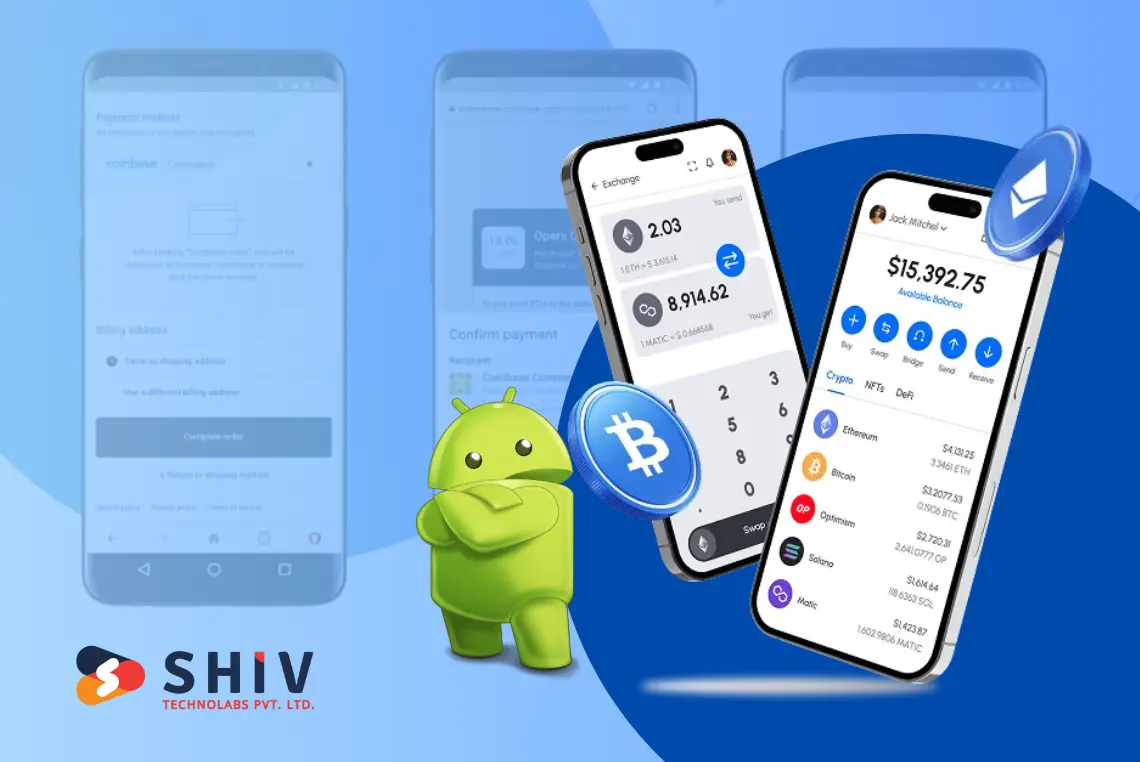
Android app integration with crypto wallets is reinventing the Android experience for identity, assets, high-value transactions, and digital payments. This change is driven by the world’s move towards greater use of digital currencies, with blockchain-based transactions already affecting eCommerce, gaming, finance, and mobile utilities.
This land is turning to the likes of custom Android app development services to serve the crypto-native users who demand safe transactions with real-time transparency. Report estimates that the crypto market has grown by 33% since 2024, a bold wave of decentralised financial activity.
As crypto emerges as a common form of payment and asset transfer, a wallet integrated into an Android app will provide businesses with a competitive advantage, lower fees, irreversible payments, and borderless transactions. This guide breaks down crypto wallet integration, pricing ranges, actual workflows, security layers, and the end-to-end process.
What Is Crypto Wallet Integration in Android Apps and Why Does It Matter?
Integrating the crypto wallet bridges the blockchain capabilities (wallet creation, sending/receiving tokens, signing transactions, generating addresses, balance views, and on-chain verification) with an Android application.
The wallet is an embedded, SDK- or API-driven component within the app, rather than redirecting to a third-party app.
Companies enjoy reduced friction in payments, real-time authentication, decentralized asset control, and privacy. Android is the platform of choice for Web3 transactions, which are dominated by mobile usage: it is more accessible, offers native device features, and reaches more users. For architecture options and patterns, see our blockchain app development services overview and this deep-dive on secure blockchain app practices.
Categories of industries that are embracing crypto wallet integration and Android crypto wallet development range far and wide, but they have one objective: secure, decentralized, and instant transactions.
Key sectors include:
- FinTech platforms provide swaps, withdrawals, staking, and digital asset management.
- E-commerce & retail accept USDT, BTC, and ETH as international checkout.
- Gaming and NFT apps allow users to own assets, trade them in the market, and earn income in the form of tokens.
- Travel/booking apps help make cross-border, borderless payments at low cost.
- DeFi and investment platforms control liquidity pools, tokens, and the flow of automation.
To companies, this change has been brought about by lower transaction charges, increased privacy, chargebacks of ¢0, global coverage, and the ability to make transactions using secure cryptography in Android applications that do not rely on conventional banking strategies. For a cost lens across crypto projects, see our guide on cryptocurrency app development: costs & features.
How Does Crypto Wallet Integration Work in Android Apps?
A crypto wallet integration combines a blockchain connection, API operations, SDK processes, and on-device encryption. Android applications can communicate with blockchain networks using Web3 libraries, wallet SDKs (MetaMask, Coinbase, WalletConnect, Binance), or using custom APIs.
The following is the workflow of crypto payment integration in Android:
- API selection: Choose blockchain provider (Web3 API, Ether.js, Web3j, Coinbase, Binance).
- Backend setup: Node infrastructure, RPC endpoints, smart contract gateway, transaction queues.
- SDK implementation: Sign wallet SDKs, address and multi-chain implementation.
- Layers of encryption: Add AES-256, hash operations, biometric authentication and secure storage of key stores.
- Sandbox testing: confirm wallet flows and gas fees using testnets ( Goerli, Mumbai, BSC Testnet).
- Launch & monitoring: Add analytics, automate alerts, track chain latency, and keep nodes online.
This process impacts the total cost of integrating the crypto wallet API and technical schedules.
What Factors Affect the Cost of Crypto Wallet Integration?
Prices are determined by the complexity of the blockchain and wallet, the size of the application, security, compliance, testing and third-party licensing fees. Each integration is special since there are varying wallet flows within industries.
Cost Breakdown for Crypto Wallet Integration in Android Apps
| Cost Component | Description | Estimated Cost Range (USD) |
|---|---|---|
| API / SDK Licensing | Wallet provider or blockchain API usage | $1,000 – $3,000 |
| Development Hours | Integration & testing | $4,000 – $8,000 |
| Security Enhancements | Encryption, 2FA, biometrics, KYC | $2,000 – $4,000 |
| UI / UX Customization | Wallet screens, dark mode, animations | $1,500 – $3,000 |
| Maintenance & Support | Post-launch updates | $500 – $1,500 / month |
Key Factors Influencing Final Cost
- Wallet type → hot, cold, custodial, non-custodial
- Supported blockchains → single-chain vs multi-chain (ETH, BNB, Polygon, Solana)
- UI complexity → number of flows, screens, custom animations
- Licensing fees → APIs, node providers, wallet SDKs
- Compliance scope → AML, KYC, KYB, region-based restrictions
These factors influence the overall cost of API integration for crypto wallets and define the level of security, scalability, and infrastructure complexity. Additional chains, additional tokens, and increased automation increase engineering time.


Step-by-Step Process for Android Crypto Wallet Development
The development of crypto wallets demands fine-tuned working and storage of blockchain data, stable APIs, and strict QA. Below are the steps.
Define Project Objectives
Identify user processes, payments, transfers, deposits, NFT storage, token swaps, and staking. Determine supported blockchains, compliance requirements, desired geographies, and the type of wallet. These choices influence architecture and API choice.
Choose Wallet API / SDK
Select MetaMask, Coinbase, WalletConnect, Binance SDKs, or Web3 APIs. Consider licensing fees, reliability, support for multiple chains, device compatibility, and transaction speed.
Backend/Blockchain Implementation
Install nodes, RPC endpoints, smart contract layers, and transaction queues. Add failover nodes to be stable. For a security-first mindset, review secure blockchain app practices.
Incorporate Transaction Features
Allow sending/receiving, signing, balance, token, and NFT support, and gas fee.
Apply Security Layers
AES-256 encryption, secure key store, biometric unlock, KYC, 2FA, hash functions, and anti-phishing layers.
Test & QA
Mimic latency, heavy load, API failures, wallet backups, and testnet transactions.
Deploy & Monitor
Monitor blockchain latency, node uptime, fraud attempts, and transaction failures. Push automated updates.
Professional developers are always reliable, not to be scared of working with them; crypto systems are easy to break without appropriate blockchain knowledge.
How to Ensure Secure Crypto Transactions in Android Apps?
Android applications rely on three foundations to support secure crypto transactions: device security, blockchain-level security and transport security. Being irreversible, each layer of the crypto payment should work perfectly to avoid unauthorized access or phishing, as well as key compromise.
Secure Key Storage
The Android Keystore must be used to store keys, encrypted with AES-256 and a salt and hash. It is strongly discouraged to store plaintext locally. Non-custodial wallets feature highly secure seed phrase backups, biometric unlock, and optional cloud-encrypted vaults.
Multi-Factor Authentication
Introduce 2FA, biometric authentication, device binding, signed transactions, and anti-swap warnings. These minimize the chances of illegal transfers and enhance the trust level of the high-value users.
Encrypted Layers of Transactions
All functions are supposed to use TLS 1.3 or later, HTTPS, secure RPCs, checksum validation, and MTM-resistant libraries.
Smart Contract Safety
In the case of DeFi apps, contracts need to be audited, gas limits enforced, exploits checked, and reentrancy mitigated. Android apps can provide banks with blockchain-based transaction security when implemented properly.
How to Choose the Right Development Partner for Crypto Wallet Integration
The following are the key criteria for selecting an appropriate development partner to integrate with the crypto wallet.
Blockchain Expertise
Select developers who have experience in multi-chain and node deployment, smart contract knowledge and on-hand API integration.
Transparent Pricing
Without clear estimates, there will be no surprises. Great teams disintegrate licensing, infrastructural and dev hours.
Ongoing Support
The crypto APIs keep on improving at a fast pace – long-term support is obligatory.
Data Security Focus
Find encryption-first development, audits and compliance.
Conclusion
Android applications with crypto wallet integration will offer faster payments, global access, decentralised authentication, and novel revenue models. The overall price will be based on wallet types, security levels, licensing, and the complexity of the blockchain. The workflow should be properly architected, securely stored, encrypted, and well-tested.
Shiv Technolabs is an established Android app development company that will help ensure all integration elements meet security, compliance, and scalability standards. As a reliable partner in enterprise-grade crypto, we provide wallet integrations that are fast, stable, and future-proof, backed by sophisticated blockchain expertise, secure architecture design, and extensive Android experience.
Frequently Asked Questions (FAQs)
1. What is the cost of integrating a crypto wallet into Android applications?
The majority of them are priced between $6,000 and $15,000, based on blockchain support, security modules, API license fees, and user interfaces. By requiring extra testing and encryption, more expensive, complex multi-chain integrations may be used.
2. Which APIs are most suitable for developing an Android crypto wallet?
Popular are MetaMask SDK, Coinbase Wallet SDK, Binance API, WalletConnect and Web3 providers. This option is determined by the support of the chain, transaction speed, and compliance requirements.
3. Will Android application crypto payment integration be secure?
Yes, with encryption, a keystore, biometric authentication and strong RPC security in place, Android applications can provide an extremely secure crypto transaction with bank-grade security.
4. Is it possible to add crypto wallet functionality to existing Android applications in the future?
Yes, developers can integrate wallet SDKs, APIs and blockchain modules into an existing application without necessarily rebuilding. Older architecture might need to be migrated and refactored.
5. What is the average cost of maintenance after integration?
Project API updates, node maintenance, security patches, SDK upgrades and performance monitoring will cost between $500 and $1,500/month, especially when they involve apps with multiple chains or tokens.