Table of Contents
Building a new software product is an exciting journey, but it comes with many risks. Many companies spend a lot of money building a full application only to find out that their main idea does not work. In fact, reports show that about 70% of new software projects fail because they did not test their technical ideas early enough. This is why a Proof of Concept (PoC) is a must-have step for any project.
A Proof of Concept is a simple test to see if an idea can actually be made. It is not about how the app looks or how many people will buy it. Instead, it asks one simple question: “Is this technically possible?” By answering this question early, you save yourself from making big mistakes later on.

What is a Proof of Concept?
A Proof of Concept (PoC) is a quick test to see if your main idea can actually be built. In software development, it helps you find out if a specific feature or bit of code will work in the real world. It is a simple way to see if your plan is solid before you spend too much money.
# PoC vs. Prototype vs. MVP
It is easy to mix these up, but they have different jobs:
- PoC: Tests if the technology works (Can we build this?).
- Prototype: Tests how the app looks and feels (How will it work?).
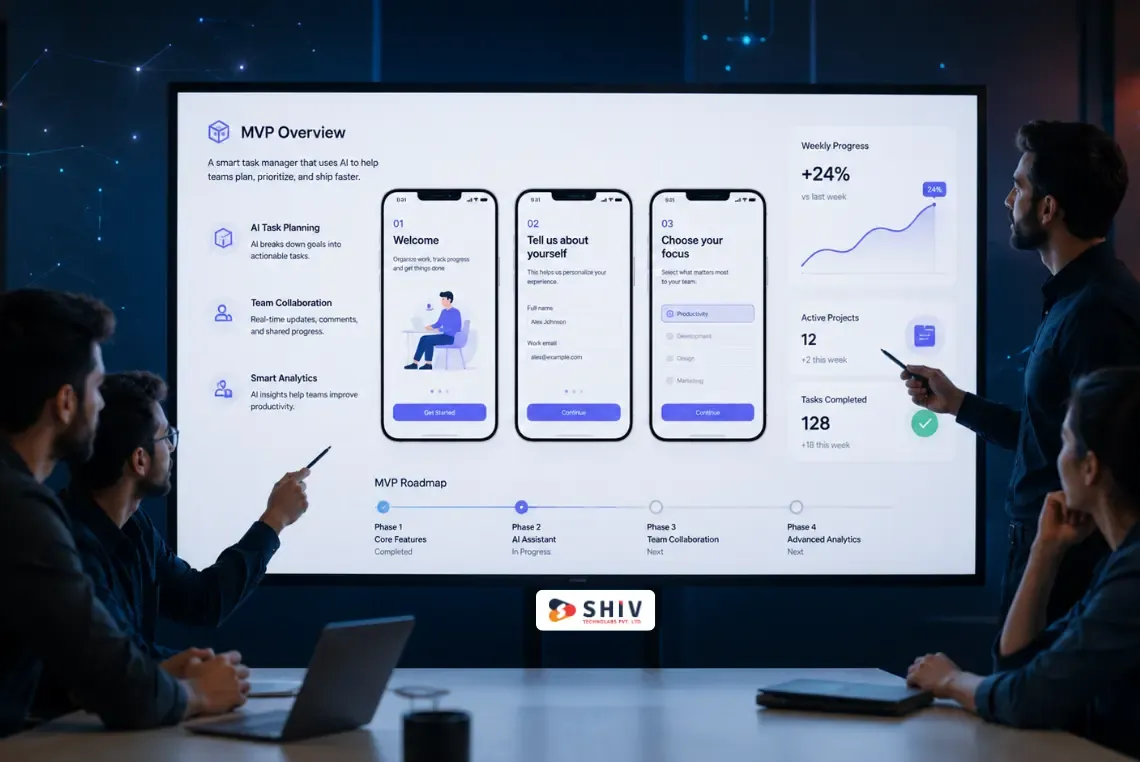
- MVP: A basic version for real users (Will people use this?).
# Why Start with a PoC?
Starting here is like testing a recipe before cooking for a hundred people. It helps you:
- Find Problems Early: You face the hardest parts of the project first.
- Save Money: It is cheaper to fix a mistake now than after the whole app is finished.
- Get Approval: Showing a working test makes it much easier to get others to support your project.
Planning the Proof of Concept Stage

Planning gives the Proof of Concept stage its direction. Without it, teams may complete a PoC and still struggle to explain what they learned. This stage is not about speed. It is about clarity before serious effort begins.
# Defining the Problem Clearly
Every PoC starts with a problem, but not every problem is ready for validation. Vague problem statements lead to vague outcomes. A Proof of Concept should focus on one specific issue that needs to be tested.
At this point, teams should clearly understand:
- Who is facing the problem
- Why the problem matters
- What changes if the problem is solved
When the problem is narrow and well defined, the PoC becomes easier to evaluate.
# Selecting the Right User for Validation
The PoC stage does not need to reflect all possible users of the final product. Planning works best when one primary user group is chosen. This helps teams avoid mixed signals during validation and keeps decisions consistent.
Focusing on one user allows teams to:
- Test realistic behavior
- Validate actual usage patterns
- Avoid assumptions based on edge cases
This clarity keeps the PoC grounded in real needs.
# Setting Clear Scope Boundaries
One of the most common PoC failures comes from an unclear scope. Without boundaries, teams keep adding small features that slowly turn the PoC into a partial product.
Before development begins, it should be clear:
- Which workflow is being tested
- Which features are excluded
- How much time should the PoC take
Clear limits protect the purpose of the PoC and keep learning focused.
# Identifying Risky Technical Assumptions
Every product idea depends on assumptions about technology. Some of these assumptions are safe, while others carry risk. The Proof of Concept should focus on the risky ones first.
These often relate to:
- System behavior under real data
- Integration limits
- Performance expectations
Testing these early prevents surprises later in development.
# Deciding How Success Will Be Measured
A Proof of Concept must have a clear definition of success. Without it, teams may debate outcomes instead of acting on them. Success criteria do not need to be complex, but they must be agreed upon in advance.
This usually answers:
- Did the idea behave as expected?
- Did it expose any blocking issues?
- Is it sensible to move forward?
When these answers are clear, the PoC has served its purpose.
A well-planned Proof of Concept does not guarantee that an idea will move ahead. What it guarantees is clarity. And clarity is what makes the next decision—whether to continue, adjust, or stop—much easier.
Also Read: Steps and Benefits of Building an MVP


What does the Proof of Concept Validate?
The Proof of Concept stage is not meant to confirm everything about a product. Its purpose is to test the areas where uncertainty is highest. Validation during this stage should focus on facts that influence major decisions later.
# Validating Technical Feasibility
One of the main goals of a PoC is to check whether the idea can work from a technical point of view. Many ideas fail here, not because they lack value, but because the technical approach cannot support them.
During this validation, teams usually check:
- Whether the core logic works with real data
- Whether the chosen architecture supports the main workflow
- Whether key dependencies behave as expected
The outcome should clearly show if the idea is technically workable or needs changes.
# Validating Core Function Logic
A PoC must confirm that the most important function behaves correctly. This is not about edge features or future upgrades. It is at the heart of the idea.
This validation focuses on:
- Whether the main action completes successfully
- How the system behaves when inputs vary
- Whether basic error handling makes sense
If the core logic struggles at this stage, it signals deeper issues ahead.
# Validating User Flow Understanding
Even without polished screens, users should understand what to do. The PoC stage helps teams see whether the flow feels natural or confusing.
This validation often answers:
- Can users complete the task without guidance?
- Do the steps follow a clear order?
- Where do users hesitate or make mistakes?
Early confusion is a strong signal that changes are needed before scaling.
# Validating Performance Expectations
A Proof of Concept does not need full performance testing, but it should reveal obvious limits. Slow responses or unstable behavior during basic usage are warning signs.
Teams often validate:
- Response time for the main action
- Stability during repeated use
- Behavior under simple load conditions
These findings help avoid later redesigns.
# Validating Business Direction
Technical success alone is not enough. A PoC must also support the business goal behind the idea. If it does not, moving forward may not be justified.
This validation usually checks:
- Whether the idea supports the intended revenue or efficiency goal
- Whether it aligns with internal priorities
- Whether the value justifies further investment
When business and technical signals align, the PoC delivers real confidence.
# What Validation Should Lead To
Validation at the PoC stage should result in clear outcomes, not open-ended discussions. Teams should be able to decide whether to continue, revise the idea, or stop.
A strong PoC replaces assumptions with evidence and turns uncertainty into informed decision-making.
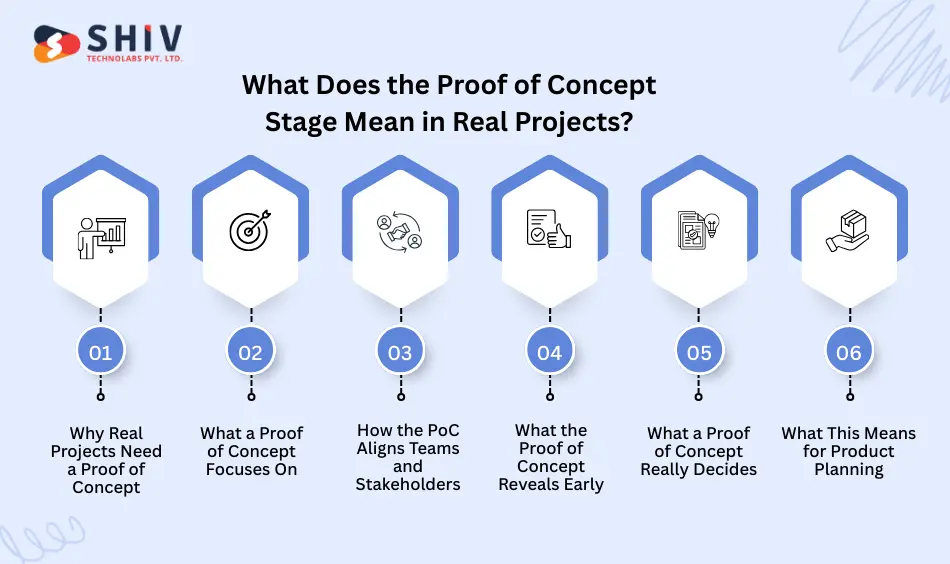
What Does the Proof of Concept Stage Mean in Real Projects?
In real software projects, ideas often change once teams start working on them. What feels clear during planning meetings can become uncertain when technical limits, data behavior, or user actions enter the picture. The Proof of Concept stage exists to surface these realities early.
Instead of aiming for completeness, this stage focuses on clarity. It helps teams understand whether the idea stands on solid ground before time and money are committed at scale.
# Why Real Projects Need a Proof of Concept
A Proof of Concept becomes necessary when assumptions carry risk. Many product ideas rely on beliefs that have not yet been tested. The PoC stage allows teams to verify those
beliefs before they turn into expensive mistakes.
In real projects, this usually includes questions such as:
- Can the core logic work with real data?
- Do chosen systems support the expected behavior?
- Does the idea still make sense once constraints appear?
By addressing these questions early, teams avoid surprises later in development.
# What a Proof of Concept Focuses On
The PoC stage narrows attention to the most critical part of the idea. It avoids building side features and focuses only on what proves the concept.
Most real-world PoCs focus on:
- A single key workflow
- One primary technical approach
- Basic user interaction without visual polish
This limited scope keeps the effort controlled while still producing meaningful results.
# How the PoC Aligns Teams and Stakeholders
One overlooked benefit of a Proof of Concept is alignment. Different people involved in a project often have different expectations. The PoC creates a shared reference that everyone can see and discuss.
Instead of abstract conversations, teams can:
- Review actual behavior
- Discuss real limitations
- Make decisions based on evidence
This reduces misunderstandings and keeps discussions grounded.
# What the Proof of Concept Reveals Early
Some risks stay hidden until an idea is tested. The PoC stage helps uncover them while changes are still manageable.
These risks often include:
- Technical complexity that was underestimated
- Dependency limits from external services
- Workflow gaps that confuse users
Finding these early is one of the main reasons this stage matters.
# What a Proof of Concept Really Decides
A Proof of Concept does not exist to prove that an idea must move forward. Its real value lies in helping teams decide the right next step.
After a PoC, teams usually reach one of three outcomes:
- Move forward with confidence
- Adjust the idea based on findings
- Stop before deeper investment
In all cases, the decision is clearer than it would have been without this stage.
# What This Means for Product Planning
In real projects, the Proof of Concept stage acts as a filter. It separates ideas that are ready for further work from those that need rethinking. This clarity protects both budgets and timelines and helps teams move forward with fewer unknowns.
Must Read: What Is a Proof of Concept (PoC) Development and Why It Matters?
When is a Proof of Concept the Right Step?
A Proof of Concept (PoC) is not mandatory for every product. If you’re building something common with a clear pattern—like a standard web app with known features—you can often start development without a PoC. But when uncertainty is high, a PoC becomes the safer first step because it helps you test what could go wrong before it becomes expensive.
Think of a PoC as a short phase that answers one main question: should we move forward, change the plan, or stop? It is most useful when you are not fully sure about the technology, the workflow, the integration, or the real value for users.
To make the decision easier, here’s a practical table that shows when a PoC fits best.
| Situation | Why a PoC Helps | What You Validate |
|---|---|---|
| The idea is new or untested | User needs and workflows are based on assumptions | Whether the core idea solves a real problem |
| The technical approach is uncertain | Hidden limits appear only during real testing | Feasibility of the chosen technology and logic |
| Multiple systems must work together | Integrations often introduce delays and failures | Data flow, API behavior, and error handling |
| Stakeholder approval is required | Decisions depend on proof, not assumptions | A working concept that shows real behavior |
| Development cost is high | Wrong decisions lead to rework and wasted spend | Early go / no-go clarity |
| The first version’s scope is unclear | Teams struggle to decide what to build first | Smallest workable scope for the next phase |
How Shiv Technolabs Supports the Proof of Concept Stage?
At Shiv Technolabs, the Proof of Concept stage focuses on clarity before commitment. The aim is to help teams test ideas early and reduce uncertainty before full development begins.
The team works closely with founders and product owners to define what needs validation and what can wait. Each PoC is planned with a clear scope so that only the most critical risks are tested.
Key focus areas include:
- Clear problem definition
- One primary use case for validation
- Early identification of technical and logic risks
After the PoC, teams receive honest direction on next steps—whether to move forward, refine the idea, or pause. This approach helps businesses make informed decisions based on real outcomes rather than assumptions.
Conclusion
The Proof of Concept stage plays a critical role in early product decisions. It helps teams test ideas before time, budget, and effort are deeply invested. By focusing on what truly needs validation, businesses can avoid building on weak assumptions.
A well-planned Proof of Concept brings clarity. It shows whether an idea can work, where risks exist, and what changes may be required before moving ahead. Even when the outcome is not positive, the insight gained helps teams avoid costly mistakes.
For startups and enterprises alike, the Proof of Concept stage supports better decision-making and sets a stronger foundation for the next phase of development.
Contact Shiv Technolabs today!
Frequently Asked Questions
What is the Proof of Concept stage in software development?
The Proof of Concept stage is an early step where teams test whether an idea can work in real conditions. It helps validate feasibility before full development begins.
What is the main goal of a Proof of Concept?
The main goal is to reduce uncertainty. A PoC helps teams check technical feasibility, core logic, and direction before investing more time and budget.
How is a Proof of Concept different from an MVP?
A Proof of Concept tests whether an idea can work. An MVP is built to be used by real users. A PoC comes first and focuses only on validation, not usability or scale.
How long does a typical Proof of Concept take?
Most Proof of Concepts take a few weeks, depending on complexity. The focus stays on speed and learning, not feature depth.
What should be included in a Proof of Concept?
A PoC should include only what proves the core idea. This usually means one main workflow, basic logic, and limited user interaction.
What should not be included in a Proof of Concept?
A Proof of Concept should not include full design, advanced features, or production-ready code. These belong to later stages.
Is a Proof of Concept required for every project?
No. A PoC is useful when the idea is new, technically uncertain, or risky. Projects with known patterns may skip this stage.
What happens if a Proof of Concept fails?
A failed PoC is still valuable. It helps teams avoid building the wrong product and saves time and money in the long run.
Who should be involved during the Proof of Concept stage?
Usually, founders, product owners, and technical team members are involved. Early alignment helps make better decisions later.
Can a Proof of Concept help with investor or stakeholder approval?
Yes. A PoC provides visible proof that an idea can work, which helps stakeholders make informed decisions.