Table of Contents
Most startup founders walk into their first investor meeting with a slide deck, a clear vision, and very little proof. Investors have seen thousands of decks. What actually moves them is a working product, real user data, and evidence that someone has already validated the idea in the field.
That is where a startup app development company changes everything. When you work with a team that understands how investor-ready MVP development works, your product stops being a prototype and becomes your strongest pitch asset. It carries user engagement data, technical credibility, and a growth story that no slide can replace.
This guide covers how the MVP development process works, what it costs across different markets, which metrics matter most to investors, and how to choose the right MVP development company for your funding stage.
Quick Answer:
A startup app development company builds an investor-ready MVP by validating the idea, prioritizing core features, building in short sprint cycles, and embedding analytics from day one. The result is a working minimum viable product backed by real user data. Most startup MVPs take 8 to 16 weeks and cost between $8,000 and $90,000, depending on complexity and team location.
What Is an MVP and Why Do Investors Care About It?
A minimum viable product, or MVP, is a fully functional app built with only the core features needed to solve one specific problem for your target users. It is not a mockup or a prototype. It is a live, testable product that generates real behavioral data from actual users.
Investors care about MVPs because they reduce uncertainty. A working product proves technical feasibility, confirms that real users engage, and shows that the founding team can execute. This converts your pitch from a concept into a data-backed investment case, which is what early-stage investors need before committing capital.
# Why Proof Outperforms Pitch Decks at the Seed Stage
A well-crafted pitch deck can get you a meeting. An MVP with traction closes the round. Investors at seed and pre-Series A want proof that you have tested your core assumption with real people, received feedback, and made product decisions based on evidence rather than opinion.
When a startup development company builds your MVP correctly, you walk into investor meetings with three things they want to see: evidence of market demand through user engagement, proof of technical viability through live deployment, and a product foundation that can scale without rebuilding from scratch.
# Why Investors See Less Risk With an MVP
Every investment carries risk. An investor’s job is to reduce that risk before writing a check. A minimum viable product does this by showing that the founding team already understands who they are building for, what problem they are solving, and what early traction looks like in practice.
Startups with working MVPs and usage data raise at higher valuations and close rounds faster than those pitching concepts alone. The MVP is not just a development milestone. It is a fundraising tool.
Steps to Build an Investor-Ready MVP for Funding
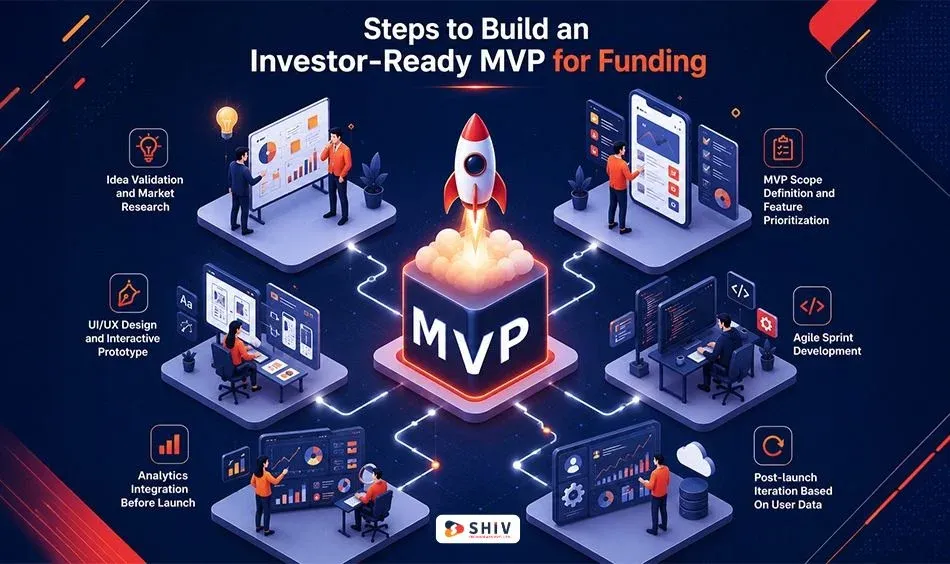
The difference between an MVP that attracts funding and one that gets ignored usually comes down to the development process behind it. A startup app development company does not just write code. They run a structured build process designed to produce results that matter at a pitch meeting.
Phase 1: Idea Validation and Market Research
Before a single line of code is written, the team works with you to pressure-test the idea through user interviews, competitor analysis, and a clear problem-solution mapping. This phase confirms that the product solves a problem that exists at scale, not just one that sounds good in theory.
Skipping validation is one of the most expensive mistakes in early-stage app development for startups. Building for a problem that real users do not face burns budget, delays your launch, and damages investor confidence when the usage data comes back flat.
Phase 2: MVP Scope Definition and Feature Prioritization
This is where experienced startup app developers earn their value. Not every feature you want belongs in the first version. The team works with you to define the core user journey, remove everything that does not serve it directly, and fix a launch scope that proves the idea without overbuilding.
Focused MVPs impress investors because they signal strategic thinking. A cluttered MVP with too many features tells investors that the founding team has not yet decided what the product is actually for.
Phase 3: UI/UX Design and Interactive Prototype
Before development begins, the design team creates wireframes and interactive prototypes. Founders can walk investors through the full product flow before a single feature is built. This step also catches usability problems early, long before they become expensive to fix during development.
Good UX in a startup MVP is not just about aesthetics. Investors read design quality as a signal of how well the founding team understands their users. A polished interface communicates product thinking, and product thinking is what investors fund.
Phase 4: Agile Sprint Development
Development runs in short two-week sprints. Each sprint delivers working, testable functionality. This keeps the project moving, catches problems before they compound, and gives founders full visibility into progress throughout the build cycle.
A company that builds MVPs for startups uses sprint reviews as decision checkpoints. Plans adapt based on what testing reveals, rather than committing to a full build before discovering that something needs to change.
Phase 5: Analytics Integration Before Launch
This is the step that separates investor-ready MVPs from ordinary ones. Behavior tracking tools are set up before the product goes live, not after. Every key user action is measured from day one, so that by the time you pitch, you have weeks or months of real engagement data to present.
Founders who launch without analytics cannot answer the questions investors ask. How many users returned after seven days? What was your activation rate? Where did users drop off? These numbers only exist if someone planned for them from the start.
Phase 6: Post-launch Iteration Based On User Data
The MVP launch is the beginning of a learning cycle, not the finish line. The best startup app development teams collect user feedback, analyze drop-off points, and run rapid iterations to improve the product before the next investor conversation.
This cycle of build, measure, and improve is exactly what investors want to see in action. It shows that the founding team responds to evidence and knows how to run a product in real conditions, which is a stronger signal than any feature list.
What Technology Stack Works Best for Startup MVPs?
The technology behind your MVP affects how fast it ships, how it performs under load, and how easily it scales after funding. A knowledgeable startup app development company selects a stack that fits your timeline, budget, and long-term product roadmap, not just what is easiest to build with.
| Layer | Technologies Used | Why It Matters for Investors |
|---|---|---|
| Frontend | React Native, Flutter | A single codebase for iOS and Android reduces build time and cost. |
| Backend | Node.js, Django, Laravel | Reliable API architecture with fast iteration cycles. |
| Database | PostgreSQL, MongoDB | Scalable data models that grow without structural rebuilds. |
| Cloud | AWS, Google Cloud | Elastic infrastructure that handles traffic spikes without downtime. |
| Analytics | Mixpanel, Amplitude | Real-time user behavior tracking is required for investor-facing data. |
# Why Cross-Platform Development Makes Sense for MVP App Development
Building separate native apps for iOS and Android doubles development time and cost. Cross-platform development lets a startup ship to both platforms from one codebase. For most early-stage MVPs, this is the right call. It saves budget, accelerates launch, and generates data from both user bases at once.
# Why Cloud-Native Infrastructure Signals Scale Readiness to Investors
Investors ask about scale. They want to know that if the product takes off, the infrastructure handles it without a full rebuild. Cloud-native setups on AWS or Google Cloud provide elastic compute, managed databases, and enterprise-grade reliability. Building on a scalable foundation from the start tells investors the team is thinking past launch day.
What Metrics Make a Startup MVP Investor-Ready?
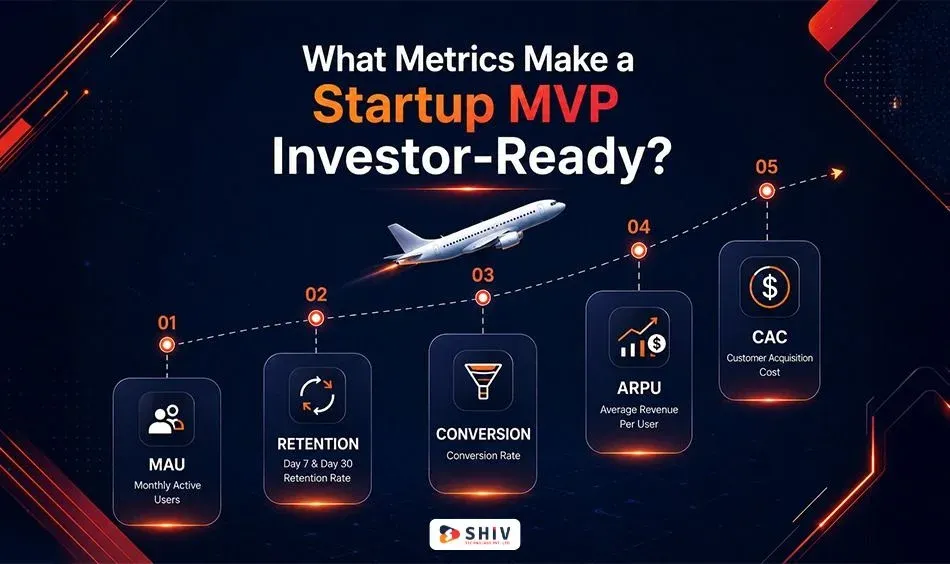
A working product is only part of the story investors need. The behavioral data it generates is the other part. When you sit across from an investor, they will ask about numbers. The right MVP development company for startups sets up tracking before launch, so you have direct, honest answers.
These are the metrics that move early-stage investors at seed and pre-series A rounds.
- Monthly Active Users (MAU): This tells investors how many people are actively using the product, not just how many downloaded it or signed up once. A growing MAU curve over 8 to 12 weeks shows the product retains users, which is a stronger signal than raw acquisition numbers. Investors use MAU to model future growth and estimate total addressable engagement at scale.
- Day 7 and Day 30 retention rate: Retention is one of the clearest signals of product-market fit available in early-stage investor-ready MVP data. If users return after one week and again after one month, the product is solving a problem worth returning for. Investors weigh retention more heavily than acquisition because it shows the product has lasting value, not just novelty appeal.
- Conversion rate: Whether your product asks users to pay, subscribe, or complete an onboarding step, the conversion rate shows how well the value proposition lands in practice. A strong trial-to-paid conversion rate is one of the most persuasive data points you can bring to a startup funding meeting, because it proves real willingness to pay.
- Average Revenue Per User (ARPU): ARPU tells investors how much each active user is worth in revenue terms. Even at an early stage, it creates a basis for revenue forecasting and unit economics. It shows the founding team understands monetization, not just user growth, which matters significantly in current funding conditions.
- Customer Acquisition Cost (CAC): If you have run any paid acquisition, CAC shows what it costs to bring one user in. Investors compare CAC against ARPU and lifetime value to assess whether the business model makes economic sense at scale. A favorable CAC-to-LTV ratio signals a fundable growth model, not just an interesting product.
What Does MVP Development Cost for a Startup?
Cost is one of the first questions founders ask, and the honest answer depends on what you are building, where your team is based, and how complex your feature set is. The table below reflects current global industry standards for a focused MVP with 5 to 8 core features, analytics integration, cloud deployment, and QA coverage.
| Region | Hourly Rate | Typical MVP Cost | Timeline |
|---|---|---|---|
| North America | $80–$150/hour | $30,000–$90,000 | 10–16 weeks |
| Western Europe | $50–$90/hour | $20,000–$50,000 | 10–14 weeks |
| Eastern Europe | $35–$65/hour | $12,000–$35,000 | 10–14 weeks |
| India / South Asia | $25–$50/hour | $8,000–$25,000 | 12–16 weeks |
# What Drives the MVP Development Cost Higher
The biggest cost drivers in startup app development for early-stage founders are scope creep, late-stage design changes, and poor feature prioritization at the start. A development partner that runs thorough discovery before writing code saves money throughout the build by reducing rework, revision cycles, and mid-sprint scope additions.
AI-assisted development workflows have shortened average timelines across the industry. Well-run teams deliver focused MVPs faster than was typical in earlier cycles, which improves cost efficiency when working with an experienced startup app development company.
# How to Measure Value, Not Just Cost
An MVP built for $8,000 that lacks analytics, has poor UX, and cannot be demonstrated cleanly under investor meeting conditions is worth far less to your fundraise than an $18,000 MVP that tracks user behavior, performs reliably in demos, and is built on architecture investors trust.
The right measure is investor readiness per dollar spent, not total spend.
What Mistakes Do Startup Founders Make During MVP Development?
Most first-time founders make the same set of mistakes during their first MVP build. Knowing them before you start is one of the most practical things a startup app development company can offer.
- Building Too Many Features Before Validating the Core: Every feature added to a startup MVP is a week of development time, a layer of complexity, and a potential failure point during a live investor demo. The most common feedback early-stage founders receive is that they built too much before validating the one thing the product is for. Pick the core problem. Solve it well. Measure the result. Add features after you have proof, not before.
- Skipping User Testing Before Launch: Usability problems that feel invisible to a founder who has lived inside the product for three months are obvious to a first-time user. A round of structured user testing before launch catches the friction points that would surface during a live demo in front of investors. Discovering that the sign-up flow breaks on a specific device during a pitch is not the time to learn about it.
- Launching Without Analytics in Place: Many founders launch their minimum viable product and then spend weeks trying to reconstruct user behavior data retroactively. This is entirely avoidable. Analytics setup during development takes one to two days. Without it, you walk into investor meetings with estimates and assumptions instead of actual behavioral evidence, which is a significant credibility gap.
- Treating the MVP as the Finished Product: An MVP is version one of a learning process, not the version you will eventually ship to millions of users. Founders who stop iterating after launch miss the feedback window that early adopters provide. They arrive at their next funding conversation with no evidence that the team responds to data, which is exactly what investors want to see most.
How Do You Choose the Right MVP Development Company for Your Startup?
Not all development agencies understand the difference between building a product and building a fundable product. These are the criteria that matter when evaluating a startup app development company for MVP work.
- A Startup-focused Portfolio: Ask to see work from companies at pre-seed or seed stage, not just enterprise clients or large-scale apps. The constraints, priorities, and delivery style for a first-time MVP build are different from a funded scale-up, and your development partner should understand that distinction from experience.
- Discovery as a Standard Part of the Process: Any agency that quotes a fixed price before asking about your users, your core problem, and your validation assumptions has skipped the most important phase. A reliable MVP development company for startups starts with structured discovery before scoping, because the scope depends on what you are trying to prove, not just what you want to build.
- Post-launch Support: The weeks after your MVP launches are often when the most valuable learning happens. A development partner that disappears after delivery is not useful to a startup that needs to iterate quickly based on what real users reveal. Confirm that ongoing support, bug fixes, and iteration cycles are included.
- Analytics and Investor Documentation as Standard Outputs: The best startup development teams build usage tracking and investor-facing documentation into every project because they understand that behavioral data is part of what the founder is paying for. Ask directly whether analytics setup, a performance dashboard, and post-launch metrics reporting are included as defaults.
- Transparent Sprint-based Project Management: You should see progress, give feedback, and raise concerns throughout the build. Weekly sprint reviews, a shared project board, and a named point of contact are baseline expectations for any professional app development for a startup team.
How Shiv Technolabs Helps Startup Founders Build Investor-Ready MVPs
Shiv Technolabs is a startup app development company with experience across mobile apps, SaaS platforms, and custom web products for early-stage founders. Our MVP development process covers discovery, UI/UX prototyping, agile development, cloud deployment, analytics integration, and post-launch iteration support.
We work across React Native, Flutter, Node.js, Django, AWS, and Google Cloud, so the technology stack is matched to your product and your growth path. As an ISO 27001:2022 certified company, we meet the data security and delivery standards that matter to investors who conduct technical due diligence before funding.
Our teams have delivered investor-ready MVPs in 8 to 14 weeks for founders in the US, UK, Canada, and Australia. We include analytics setup, investor-facing metrics dashboards, and post-launch documentation as part of every MVP engagement, not as extras.
If you are building your first product and preparing to raise, talk to our team about what an investor-ready MVP build looks like for your idea.

Conclusion
Building a minimum viable product is a strategic move, not just a technical one. The right startup app development company helps you build a proof of concept, gather real user evidence, and present a product that gives investors concrete answers before they commit. When the process is right, what comes out of it is not just an app. It is your most credible funding asset.
FAQs
What is a startup app development company?
A startup app development company builds digital products for early-stage ventures. They handle idea validation, product design, agile development, and analytics integration. Their process is shaped around fast delivery, budget efficiency, and investor readiness.
How long does it take to build a startup MVP?
Most startup MVPs take 8 to 16 weeks from discovery to launch. The timeline depends on feature complexity, the number of third-party integrations, and team size. AI-assisted development workflows have shortened average timelines across the industry.
How much does MVP development cost for a startup?
MVP development costs range from $8,000 for a simple app built by a South Asian team to $90,000 for a complex product built by a North American agency. The final cost depends on feature scope, technology stack, and what investor documentation is included alongside the build.
Why do investors prefer startups that have an MVP?
An MVP provides concrete evidence that the idea works, that users engage with the product, and that the team can execute. It converts a pitch from a concept into a data-backed investment case and reduces the risk investors take on before committing capital.
What metrics should my MVP track for investor meetings?
The most important metrics are Monthly Active Users, Day 7 and Day 30 retention rates, conversion rate, Average Revenue Per User, and Customer Acquisition Cost. These numbers give investors the behavioral evidence they need to evaluate a funding decision with confidence.
What is the difference between an MVP and a prototype?
MVP vs Prototype is simple to understand when you compare their purpose. A prototype is an interactive mockup used to test design, layout, and user flows before development begins. An MVP is a working product built for real users in real conditions. An MVP gives measurable user behavior, product feedback, and market signals. A prototype only helps validate the idea visually and functionally before the actual build.
Can the same startup app development company scale my product after funding?
Yes. Development companies that build with post-funding scale in mind use cloud-native infrastructure, modular architecture, and scalable databases from the start. The product can grow without a full rebuild after your funding round closes.
How do I know if a development company understands startup MVP work?
Ask to see case studies from companies at your funding stage. Ask whether discovery is included before scoping. Ask how analytics setup and investor documentation are handled. A startup-focused development company will have direct, specific answers to all three questions.