Table of Contents
Real-time digital experiences are no longer optional; they are expected. Since chat support is preferred within seconds and video is streamed in real time, consumers are looking for systems that respond within seconds, not seconds. Statista predicted that the global real-time communication market is set to grow by 40%, driven by messaging services, live content, and connected devices.
In the wake of this change, organizations are turning to Node.js development services to create apps that can offer data in real time, scale with ease, and handle thousands, or even millions, of simultaneous connections. Node.js is designed to support high concurrency, low latency, and cost-effective infrastructure.
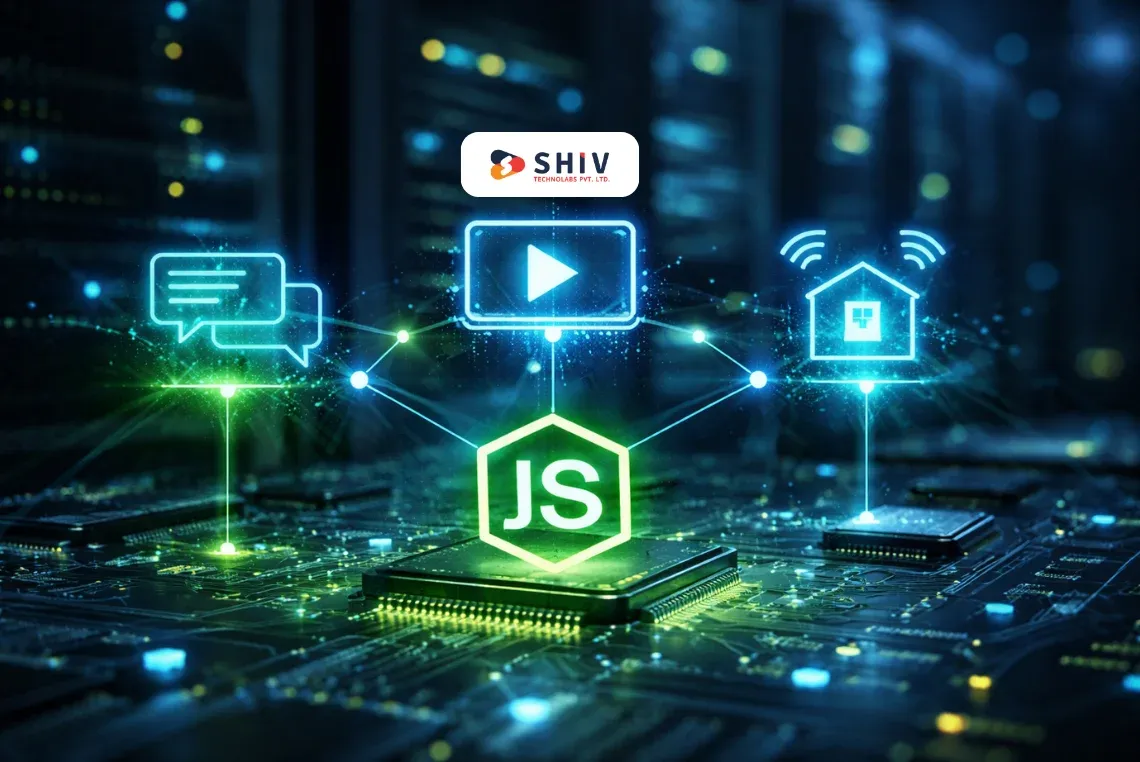
This blog discusses the use of Node.js for real-time applications in chat solutions, live streaming, and the Internet of Things ecosystem.
What Makes Node.js Ideal for Real-Time Applications?
Node.js is designed to be fast, concurrent, and capable of handling continuous data streams, which real-time systems require. Node.js handles thousands of events concurrently within a single event loop, unlike traditional back-end technologies that use blocking threads. This architecture ensures that real-time application development using Node.js becomes scalable and cost-effective.
Unlike waiting until requests are processed, Node.js is data-streaming and persistently connected, so spikes in traffic do not increase costs linearly. This has made it a default option for modernizing legacy applications on modern platforms, particularly when combined with Python modernization solutions for hybrid stacks.
Event-Driven Architecture Processes Multiple Requests in Parallel
Node.js is event-driven, with all incoming requests processed asynchronously. Each event is processed independently of the main thread, enabling the server to support thousands of simultaneous users. The methodology underpins Node.js real-time applications that require continuous responsiveness.
Persistent Connections Through WebSockets
Real-time systems rely on continuous connectivity. Node.js is a WebSocket technology, which offers persistent, two-way communication between a client and a server. This eliminates repetitive polling and delivers data immediately, which is essential for chat, notifications, and IoT telemetry.
Non-Blocking I/O Boosts Response Speed
Node.js does not block execution when performing I/O operations, such as database queries, API calls, and file access. One task is pending, and the others are being processed. This I/O model is non-blocking, enabling significant throughput and latency reduction under high load.
Low-Latency Communication Across Platforms
It can be web, mobile, or connected devices, but Node.js enables low-latency communication across platforms. It has a lightweight runtime, meaning it has a shorter response time and is best used in systems where milliseconds directly affect user experience.
Why Use Node.js for Chat Applications?
The use of real-time chat systems requires near-instant delivery of messages, precise presence tracking, and device-to-device synchronization. Here, the Node.js chat application is effective because it manages multiple connections simultaneously without losing any messages or compromising reliability.
With its asynchronous architecture, Node.js ensures that a user does not wait for another user to process a message. It can be used with WebSockets to provide an actual real-time connection with Node.js – not fake updates.
What Features Make Node.js Perfect for Chat App Development?
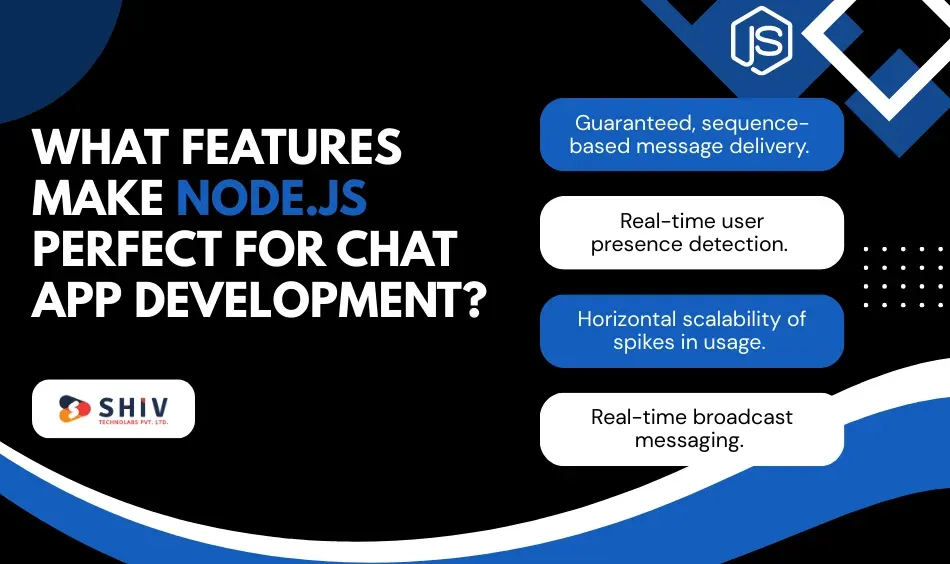
The fundamental features needed to support chat systems on an enterprise scale are found in Node.js:
- Guaranteed, sequence-based message delivery.
- Real-time user presence detection.
- Horizontal scalability of spikes in usage.
- Real-time broadcast messaging.
Numerous web chat layers based on Node.js are used in large-scale platforms.
Comparison of Real-Time Chat Features
| Feature | Node.js Advantage | Example Applications |
|---|---|---|
| Instant Message Delivery | Event loop avoids blocking | Slack, Discord |
| User Presence Detection | WebSockets keep live connections | Microsoft Teams |
| Scalability | Thousands of sockets handled concurrently | WhatsApp Web |
| Real-Time Notifications | Events emitted instantly | Live chat support tools |
How Does Node.js Power Live Streaming Platforms?
Live streaming platforms require continuous data delivery, consistent buffering and scalability when faced with unpredictable traffic bursts. It works best with Node.js for live streaming platforms because it uses Stream APIs to process data in chunks, enabling continuous playback.
Node.js is compatible with Express.js for use as an API layer and integrates with AWS Media Services, Cloudflare Streams, or custom CDN pipelines with ease. For planning, this live streaming app development guide is a useful internal reference.
Supports Millions of Concurrent Viewers
Node.js is capable of doing high concurrency without creating a new thread each time a connection is made. This enables streaming sites to deliver large volumes of traffic at predictable, stable server costs.
Processes Data Chunks in Real Time
Stream-based processing enables Node.js to read and write data in small chunks rather than loading the entire data set into memory. This ensures effective bandwidth use and seamless playback, even during live broadcasting.
Ensures Low-Latency Buffering
Live events depend on low-latency buffering. The low latency between a broadcaster and a viewer is ensured by Node.js, which processes events instantly, further reducing buffering delays to near-real-time.
Integrates Easily with Cloud-Based CDNs
Node.js can work with any CDN, load balancer, and media pipeline. It is flexible, enabling teams to scale internationally without compromising performance or uptime.
Node.js Real-Time Project Cost Estimate
| Component | Description | Estimated Range (USD) |
|---|---|---|
| Chat or Streaming Core | Real-time communication + sync | $6,000 – $15,000 |
| API & Backend Setup | REST + WebSocket layers | $1,500 – $4,000 |
| Cloud Infrastructure | AWS / GCP / Azure | $800 – $3,000 |
| Maintenance & Monitoring | Updates, uptime, analytics | $1,000 – $2,500/month |


How Node.js Connects and Controls IoT Systems
IoT setups include many devices sending constant data. IoT app development services built with Node.js can process this load with modest resource use and stable device-to-cloud communication.
Real-Time Sensor Data Transmission
The sensor data are also processed in real time by Node.js and sent to dashboards or analytics engines. This allows real-time monitoring and control.
Low CPU Usage on Edge Devices
Because Node.js is lightweight, it requires minimal hardware and power, enabling it to run on edge devices and gateways and reducing hardware and energy costs.
Fast API Integrations with IoT Dashboards
Node.js makes it possible to communicate with various devices fast and to the dashboards, so that when you are in the control room, all real-time visualizations and control interfaces will be updated.
Support for Microservices Architecture
The IoT architecture is based on microservices and uses Node.js, enabling independent scaling, updates, and fault isolation.
Examples of Node.js in IoT Applications
| Industry | Application | Benefit |
|---|---|---|
| Smart Home | Device automation | Real-time control |
| Logistics | GPS + fleet tracking | Instant updates |
| Healthcare | Wearables monitoring | Continuous data |
| Manufacturing | Predictive maintenance | Reduced downtime |
How to Build Scalable Real-Time Apps Using Node.js
Scalability is non-negotiable for real-time systems. Node.js scalability and performance are achieved through clustering, load balancing and microservices-based design.
What Tech Stack Works Best with Node.js for Real-Time Apps?
- Redis → active session + pub/sub management
- MongoDB → flexible, fast data retrieval
- Docker → containerized scaling
- Nginx → traffic distribution and load balancing
This stack is high throughput and has no bottlenecks.
How to Maintain Node.js App Performance
The PM2 monitoring, asynchronous job queues, memory optimization and event-loop tuning are used to maintain performance. Continuous monitoring aims to prevent bottlenecks before they affect users.
When Should Businesses Hire Node.js Developers?

When applications require instant data exchange and a high level of concurrency, as well as cost-effective scalability, companies should engage Node.js developers, as traditional stacks cannot meet these requirements.
Key Scenarios to Hire Node.js Developers
- You will develop chat, streaming, or IoT platforms.
- You need real time Dashboards with analytics.
- You want to modernize old applications.
- You require comprehensive Node.js development solutions for architecture and deployment.
Involve specialists at the outset to prevent future utilization and performance problems.
How Node.js Compares with Other Back-End Technologies for Real-Time Systems
Node.js competes with Python and Go, but offers a balanced advantage across performance, cost, and ecosystem maturity.
| Parameter | Node.js | Python | Go |
|---|---|---|---|
| Real-Time Performance | Excellent | Moderate | High |
| Scalability | High | Limited | High |
| Community Support | Massive | Strong | Moderate |
| Development Speed | Fast | Slower | Fast |
Node.js offers the optimal combination of scalability, responsiveness and development-time efficiency for real-time applications.
Conclusion
Node.js has proven effective as the backbone of real-time applications across chat, live streaming, and IoT environments. Its event-based architecture, non-blocking I/O, and ability to scale effectively make it cost-effective and performance-oriented for modern businesses.
As a reputable Node.js development company, we deliver comprehensive solutions for startups and businesses seeking to build strong, real-time digital experiences.
Shiv Technolabs focuses on creating secure, high-performance, scalable Node.js solutions for real-time chat systems and enterprise IoT platforms. Our specialists assist with planning, development, implementation, and scaling without technical debt.
Frequently Asked Questions (FAQs)
1. How does Node.js handle real-time requests efficiently?
Node.js is asynchronous and handles multiple requests simultaneously using an event loop. This eliminates blocking and enables data flow even under high concurrency.
2. Is Node.js suitable for large-scale streaming and IoT systems?
Yes, Node.js enables hundreds of concurrent connections with minimal resource consumption, making it suitable for scalable streaming systems and IoT solutions.
3. What are the advantages of using Node.js for chat applications?
WebSockets and Socket.IO provide low latency for delivering instant messages, live user presence and real-time notifications, enabled by Node.js.
4. What is the cost of Node.js real-time apps development?
The price is usually between $6,000 and $25,000, depending on scope, integrations and infrastructure needs.
5. Is it possible to move my current system to Node.js?
Yes, Migrating applications to Node.js enhances scalability, response times and performance for applications that require real-time communication.