Table of Contents
There is an acceleration in enterprise AI projects, but so are failures. Today, 50% of AI projects fail to reach production due to poor architectural choices, disjointed systems, and inadequate estimates of operational complexity.
That is why AI development services are insufficient. For CTOs, Founders, Product Heads, and COOs, the real issue is understanding the elements of enterprise AI architecture before allocating budgets, selecting vendors, or setting timeframes.
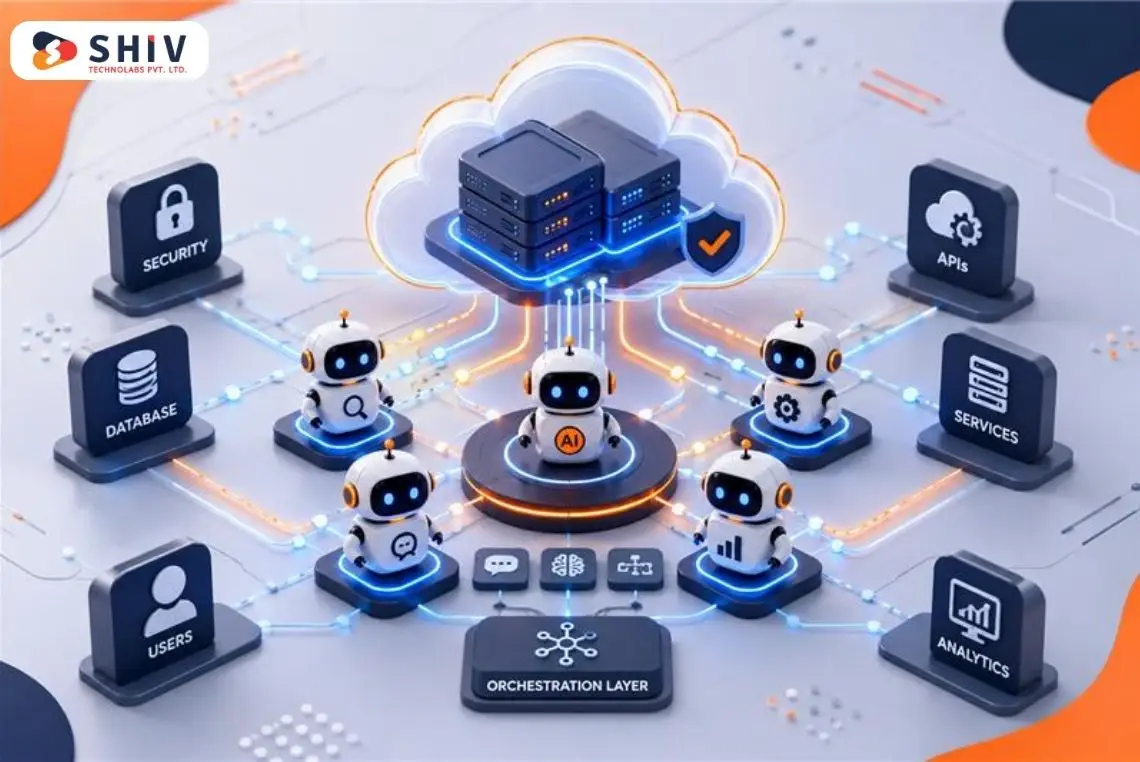
Enterprise AI is not a model but an interconnected system comprising data, infrastructure, deployment, governance, and scale. The lack of a clear enterprise AI system architecture results in organizations incurring increased costs, greater compliance exposure, and rolled-out deployments.
What Is Enterprise AI Architecture and Why Is It Important for Business Leaders?
Enterprise AI architecture is the system design fundamentals that enable AI solutions to be deployed reliably at scale within an organization. It links pipelines for data, model building, infrastructure, deployment, and governance controls to a unified, production-ready framework.
For business leaders, an enterprise AI architecture will make AI either a scalable asset or a persistent liability.
Enterprise AI Architecture as a Business System
Enterprise AI architecture is meant to be used in:
- Multi-team usage
- Continuous operation
- High data volume
- Regulatory compliance
- ERP, CRM and core platform integration.
Enterprise AI System Architecture vs Isolated AI Projects
Isolated AI pilots can produce short-term wins. A structured enterprise software foundation creates repeatable results by standardizing how AI is built, released, monitored, and governed across teams.
Why Leadership Must Understand the Architecture
Allowing AI budgets to be approved without architecture will result in:
- Cost overruns
- Vendor lock-in
- Security gaps
- Scaling failures
Architecture as a Risk-Reduction Layer
A powerful enterprise AI architecture reduces operational, regulatory and financial risk through consistency and control.
Architecture as an Enabler of Scale
Proper architecture enables AI to grow across departments, geographies and applications without requiring rewrites.
What Are the Core Enterprise AI Architecture Components?

Enterprise AI should be viewed as a layered system, rather than a technology decision. Weak or missing components cause poor performance, increased costs, and compliance exposure.
The following are the core elements of enterprise AI architecture that business leaders should be familiar with.
Data Ingestion and Data Management Components
Any enterprise AI system architecture is based on data. Low-quality data leads to a loss of business trust and model accuracy. Key components include:
- Input data pipelines, batch, and real-time data flows.
- Data cleaning and verification, elimination of noise, duplicates, and bias.
- Formatted and unformatted storage databases, data lakes, and object stores.
Model Development and Training Components
At the level of an enterprise AI solution’s intelligence, model development is. This is where experimentation is a functioning capability. Core elements include:
- Coupled experiments, Single environment experiments
- Automated training pipelines.
- Versioning of models + rollback facility.
- Testing and validation systems.
Many teams combine model work with AI/ML engineering practices and a release-ready workflow that includes drift checks and model health tracking.
Infrastructure and Compute Components for Enterprise AI
Infrastructure providers enable scalable AI architectures. It should be able to handle growth without reducing service levels.
Infrastructure critical components:
- Elastic compute (CPU / GPU / TPU)
- High-performance storage
- Availability + failover
- Resource allocation that is cost-conscious.


How Do Enterprise AI Architecture Components Work Together?
Enterprise AI delivers value only when components operate as one unified system, not silos.
Data → Models → Decisions
Clean data feeds reliable models, enabling accurate automation and insights.
Models → Infrastructure
Infrastructure ensures models perform consistently under real-world load.
MLOps → Reliability
Deployment and monitoring keep AI systems live, accurate, and responsive.
Governance → Trust
Governance ensures compliance, transparency, and executive confidence.
Enterprise AI Architecture Components and Business Impact
| Component | Primary Purpose | Business Impact |
|---|---|---|
| Data Management | Reliable AI inputs | Accurate insights |
| Model Development | Intelligence layer | Automation + decisions |
| Infrastructure | Scalability + uptime | Cost efficiency |
| MLOps | Reliability | Faster releases |
| Governance | Compliance + trust | Risk reduction |
How Do Enterprise AI Architecture Components Enable Scalability Across the Organization?
A key requirement of enterprise AI architecture is scalability.
Horizontal Scaling between Teams.
- Shared pipelines
- Reusable models
- Standardized tooling
Enterprise-Wide AI Adoption
- Several processes of AI at the same time.
- Local flexibility in a central governance.
- Reduced duplication
Performance at Scale
- Predictable latency
- Load balancing
- Cost optimization
That is the way AI is moving from pilot projects to enterprise capability.
What Is the Cost of Enterprise AI Implementation Based on Architecture Components?
The cost of enterprise AI implementation is driven by architectural decisions, not just model complexity.
Enterprise AI Architecture Cost Breakdown
| Architecture Component | Typical Cost Range (USD) | What Drives the Cost |
|---|---|---|
| Data Engineering & Pipelines | $40,000–$120,000 | Data volume + sources |
| Model Development & Training | $30,000–$100,000 | Model complexity |
| Infrastructure & Compute | $25,000–$80,000 | Usage + scale |
| Deployment & MLOps | $20,000–$60,000 | Automation depth |
| Security & Governance | $15,000–$50,000 | Compliance scope |
| System Integration | $20,000–$70,000 | ERP/CRM links |
Leaders who consider AI architecture a long-term system, as opposed to a single build, are always in a position to waste less, increase utilization, and secure ROI as the system scales. Four cost-optimization levers are currently in use at enterprise scale, as listed below.
1. Design Modular Architecture Instead of One-Off Pipelines
Monolithic AI systems incur costs. The enterprise’s modular AI architecture is designed to make components reusable, replaceable, and scalable.
Cost impact:
- Multi-use data pipelines.
- Store share features and model services.
- Do not recreate workflows of each AI project.
A modular system can lower the incremental expenses of rolling out AI by 25%40 percent if new applications are introduced without the need to replicate infrastructure.
2. Use Phased Rollouts to Control Capital Burn
Enterprise AI cannot be implemented at scale on day one. Staged releases help executives select expenditures that demonstrate value.
Best practices:
- Begin with 1-2 high-impact AI use cases.
- Verify performance, cost and adoption.
- Architecture should be expanded when ROI manifests itself.
This will help avoid excessive provisioning of compute and infrastructure, typically reducing initial AI costs by 30%+ without compromising scale readiness.
3. Actively Monitor Infrastructure and MLOps Utilization
Unmonitored AI systems are silent money eaters. Idle compute, idle models and pipe-weaknesses add to the cost of enterprise AI implementation.
Optimization tactics:
- Monitor model compute consumption.
- Workloads: Auto-scale inference.
- Discontinue inactive experiments.
- Trend retraining frequency vs value.
Companies that implement cost monitoring typically recoup AI infrastructure costs within 1 year, with 15-25% ROI.
4. Build Reusable Governance and Security Controls Early
Compliance and security are costly to retrofit. Incorporation of governance as part of the enterprise AI architecture minimizes the cost and risk over the long term.
Cost benefits include:
- Access controls that are implemented once.
- Audit and logging are centralized.
- The collaboration of compliance between teams.
Security policy design and audit structure are often shaped during IT architecture consulting.
How Should Business Leaders Evaluate Enterprise AI Architecture Components Before Implementation?
Leaders should consider the architecture before accepting vendors or schedules.
Scalability Readiness
- Can it support 10× growth?
- Multi-team usage?
Security and Compliance Alignment
- Regulatory coverage
- Audit readiness
Connectivity with Existing Systems
- ERP, CRM, data warehouses
- API-first design
Cost Transparency
- Clear pricing drivers
- No hidden infra costs
Long-Term Maintainability
- Upgrade paths
- Vendor independence
Conclusion
Knowledge of the components of enterprise AI architectures is no longer a luxury for business leaders. It has direct effects on budgeting accuracy, risk exposure, scalability, and the long-term success of AI.
Companies that invest in the right enterprise AI system architecture will reduce failures, manage costs, and accelerate AI growth. We designed and developed production-ready enterprise AI architectures, not models, at Shiv Technolabs.
Our AI development services include architecture planning, system integration, MLOps, security, and scalable deployment, delivered by a reliable AI development company.
Frequently Asked Questions (FAQs)
1. Which enterprise AI architecture elements are the most significant?
The most essential ones are data management, model development, scalable infrastructure, MLOps and governance. Their combination guarantees the reliability, compliance and readiness of AI systems at enterprise-scale implementation.
2. What are the impacts of enterprise AI architecture on scalability and performance?
A robust architecture enables horizontal scaling, maintains performance under load and supports multi-team work without system degradation or runaway infrastructure costs.
3. What drives the price of the AI implementation in the enterprise?
Prices vary based on the complexity of the data, the size of the infrastructure, the maturity of MLOps, compliance requirements and the degree of integration with the existing enterprise platforms.
4. Is it possible to combine enterprise AI architecture with legacy?
Yes, Enterprise AI architectures rely on APIs, middleware and event-driven systems to integrate with ERP, CRM and other legacy systems.
5. How long does it take to design an Enterprise AI architecture?
Building a resilient AI structure typically takes 4-8 weeks, depending on data readiness, regulatory compliance and the intention to scale.