Table of Contents
Every founder starts with an idea that feels ready to build. The gap between a strong idea and a fundable product sits in the planning you finish before development starts. A clear MVP checklist for founders gives you that planning structure, so you invest in the right build and avoid building the wrong one.
Many founders move into design and code before they confirm the problem, the first users, and the core workflow. That rush commits budget to features users never requested.
This guide gives you a 12-point pre-build checklist and a practical scope template you can copy right now. Pair it with focused MVP development services when you want technical clarity on scope, timeline, and delivery priorities. By the end, you will know what belongs in version one and what should wait.
What Does a Pre-Build MVP Checklist Cover?
A pre-build checklist turns a vague idea into clear build decisions. It forces you to confirm demand, scope, and risk before any code gets written.
An MVP checklist for founders should confirm the user problem, target audience, core workflow, must-have features, validation goal, budget, timeline, technical risks, and launch metrics before development begins. When each item has a clear answer, your build scope becomes specific and far easier to price.
Here is the full checklist at a glance. Work through every item and write a short answer for each one before you brief a build team.
- Define the exact problem in one sentence.
- Identify your first user group.
- Write the core user journey.
- Separate must-have features from later features.
- Define the main assumption to validate.
- Decide your success metric.
- List the non-goals for version one.
- Check technical complexity.
- Estimate budget and timeline.
- Plan the first feedback loop.
- Choose the right build approach.
- Prepare your MVP scope template.
The MVP idea comes from Eric Ries and the Lean Startup method. As described in Agile Alliance’s MVP definition, an MVP is the version of a new product that lets a team gather the most validated insight about customers with the least effort. The goal is evidence, not feature volume.
Scope clarity matters as much as the build itself. A short product requirements document or scope template reduces delivery confusion and keeps the team aligned. Define your goals and your non-goals first, then let those choices shape every feature decision.
The 12-Point Pre-Build MVP Checklist Explained
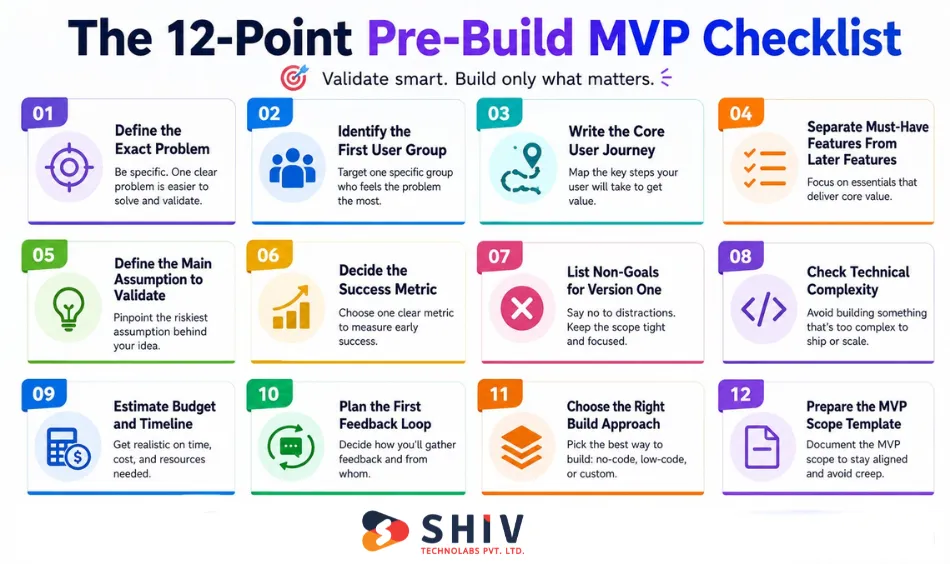
This is the core of your pre-build planning, so give it the most attention. Each point below has four parts: what to check, why it matters, an example, and the action to take. A complete MVP checklist for founders gives you a build scope a development team can price with confidence.
# 1. Define the Exact Problem
What to check: Write the one problem your product solves in a single sentence.
Why it matters: A sharp problem statement keeps the scope tight and stops feature creep early. A blurry problem invites extra features that delay launch and raise cost.
Example: “Freelancers lose hours each week chasing unpaid invoices” is sharper than “freelancers need better finance tools.”
Founder action: State the problem in one line and name who feels it most.
# 2. Identify the First User Group
What to check: Name the first user group that feels this problem most strongly.
Why it matters: A narrow audience gives you sharper feedback than a broad one. A focused group also lowers the cost of reaching early users for tests.
Example: Target solo freelancers who bill clients monthly, rather than every small business at once.
Founder action: Describe your first 50 users by role, context, and pain point.
# 3. Write the Core User Journey
What to check: Map the main path a user takes from entry to a finished task.
Why it matters: One clean workflow gives more value than ten partially built features in a first release. A clear journey also shows developers exactly what to build first.
Example: Sign up, add a client, send an invoice, and mark it paid is one tight journey.
Founder action: Draw the core journey in five to seven steps.
# 4. Separate Must-Have Features From Later Features
What to check: Split your feature ideas into must-have items and later items.
Why it matters: Must-have features support the core workflow, and everything else can wait in a parking lot. A short must-have list keeps the build small, fast, and affordable.
Example: Invoicing is must-have, while custom report themes can wait for a later version.
Founder action: Keep only the features the core journey cannot work without.
# 5. Define the Main Assumption to Validate
What to check: Pick the single riskiest assumption your product depends on.
Why it matters: Your MVP exists to test that assumption with real users and limited spend. A focused test gives a clear signal instead of a vague sense of progress.
Example: You might assume freelancers will pay a monthly fee to get paid faster.
Founder action: Write one assumption that, if wrong, breaks the whole idea.
# 6. Decide Your Success Metric
What to check: Choose the metric that tells you the MVP worked.
Why it matters: A metric set before development keeps the keep-or-pivot decision objective. A vague goal lets everyone read the same result in different ways.
Example: “40 percent of signups send an invoice in week one” is a clear success metric.
Founder action: Pick one metric, such as activation rate or repeat use, with a target.
# 7. List the Non-Goals for Version One
What to check: Write down what your MVP will leave out in version one.
Why it matters: Clear non-goals protect the timeline and stop scope from expanding midway. Written non-goals also give you a calm answer when new feature ideas appear.
Example: Multi-currency billing and a native mobile app can be explicit non-goals for version one.
Founder action: List five things your MVP will exclude on purpose.
# 8. Check Technical Complexity
What to check: Review the technical parts that carry the most risk, such as integrations, data, or AI.
Why it matters: Complex pieces affect timeline and budget far more than simple screens, and a blocked integration found late can stall the whole build. Founders who want a clear view of build effort can use custom software development to size technical scope before committing. For model-heavy features, AI development services help confirm output quality early.
Example: A payment gateway or a bank-sync feature usually carries more risk than a settings page.
Founder action: Flag every feature that needs an integration, custom logic, or model.
# 9. Estimate Budget and Timeline
What to check: Set a planning range for budget and a realistic timeline before version one.
Why it matters: Most basic app or web MVPs plan within a $10,000 to $30,000+ band and ship in 8 to 16 weeks. Scope, platform, integrations, and QA depth move these numbers the most.
Example: A single-platform invoicing MVP costs less than one that syncs with three accounting tools.
Founder action: Agree on a budget band and a target launch window with your team.
# 10. Plan the First Feedback Loop
What to check: Decide how you will collect feedback the week your MVP goes live.
Why it matters: A planned loop turns early users into a steady source of product signal. Feedback gathered early stops you from building the wrong thing for weeks.
Example: A short in-app survey plus five user calls gives strong signal in the first week.
Founder action: Set up interviews, analytics, and a simple feedback channel before launch.
# 11. Choose the Right Build Approach
What to check: Match your build approach to your budget, timeline, and technical risk.
Why it matters: A clickable prototype, a no-code build, and a custom build serve different goals, and the right pick saves both money and weeks of effort. For subscription products, SaaS development services shape multi-user scope and billing. When the core workflow lives on a phone, mobile app development services help plan store-ready scope.
Example: A clickable prototype suits an unproven idea, while a custom build suits unique logic.
Founder action: Pick the lightest approach that still tests your main assumption.
# 12. Prepare Your MVP Scope Template
What to check: Collect every answer above into one scope template.
Why it matters: A single document keeps founders, designers, and developers aligned from day one. A shared scope also makes quotes faster and more accurate.
Example: One page with the problem, users, workflow, features, and budget is enough to brief a team.
Founder action: Fill the scope template in the next section before you request any quote.
MVP Scope Template You Can Copy
This scope template turns your checklist answers into a build-ready brief. Fill every field in plain language, even the rough ones. A finished MVP checklist for founders pairs perfectly with the template below.
| Scope Field | What to Write |
|---|---|
| Product idea in one sentence | Your product in a single, plain line. |
| Problem statement | The exact problem and who feels it. |
| Target user group | The first audience for version one. |
| User pain point | The cost of the problem today. |
| Core workflow | The main path from entry to finished task. |
| Must-have features | Only features the core workflow needs. |
| Out-of-scope features | Items parked for later versions. |
| Assumptions to test | The riskiest beliefs your product depends on. |
| Success metric | The number that proves the MVP worked. |
| Platforms needed | Web, mobile, or both for version one. |
| Integrations needed | Payments, data, or third-party services. |
| Admin needs | Internal tools or dashboards required. |
| Timeline range | Your target window for launch. |
| Budget range | Your planning band for version one. |
| Launch feedback plan | How you will collect early user signal. |
MVP Readiness Check: Ready to Build vs Not Ready Yet
This table marks the line between a build-ready idea and one that needs more preparation. Use it as a quick self-assessment before you request a quote. Each row in your MVP checklist for founders should sit in the ready column first.
| Area | Ready to Build | Not Ready Yet |
|---|---|---|
| Problem clarity | One-line problem statement set | Problem still broad or vague |
| User group | First 50 users described | Audience undefined |
| Feature scope | Must-have list locked | Feature list keeps expanding |
| Validation goal | One assumption chosen to test | No clear assumption named |
| Budget | Planning band agreed | Budget open-ended |
| Timeline | Target launch window set | Timeline undecided |
| Technical risk | Risky parts flagged | Complexity unchecked |
| Feedback plan | Loop ready for launch week | No plan to collect feedback |
| Launch metric | Success number defined | Success undefined |
| Founder involvement | Owner available for decisions | Decisions stall without input |
How Much Does MVP Development Cost and How Long Does It Take?
Cost depends on scope, yet planning ranges help you budget with confidence. The figures below are planning examples, not fixed quotes. Treat them as starting bands while you shape your scope.
| Build Type | Planning Range |
|---|---|
| Simple MVP or clickable prototype | $3,000 to $10,000+ |
| Basic app or web MVP | $10,000 to $30,000+ |
| Multi-vendor, SaaS, or workflow-heavy MVP | $30,000 to $80,000+ |
| AI-enabled or integration-heavy MVP | $40,000 to $100,000+ |
Timelines follow the same pattern as cost. Planning and scoping usually take 1 to 3 weeks, while design and development run 8 to 16 weeks. Complex MVPs with heavy integrations or AI can cross 4 to 6 months.
Disclaimer: These are planning ranges, not fixed quotes. Final pricing depends on features, platform, integrations, design depth, team model, AI requirements, QA depth, and timeline. Use these bands to plan, then confirm a real quote against your finished scope.
How the Right Partner Helps Founders Plan an MVP
Shiv Technolabs works with founders to shape MVP scope, size technical complexity, and plan features for a first release. The team helps you separate must-have features from later ones, and a finished MVP checklist for founders becomes the brief they build from.
You bring the idea and the audience, and the planning support fills the gaps in scope and feasibility. When your scope is ready, Shiv Technolabs can turn it into a custom MVP with a clear delivery plan. Ready to move from idea to build? Plan your MVP with a partner who keeps scope tight and validation first.
Your Next Step Before Building
A clear scope is the difference between a build that validates your idea and one that exhausts your budget. Work through the 12 checkpoints, fill the scope template, and confirm each row sits in the ready column. A finished MVP checklist for founders gives your build team a brief they can price and deliver with confidence.
Strong pre-build planning protects your money, your timeline, and your first impression with users. Once your scope, assumptions, and metric are clear, you are ready to move. Plan your MVP with a tight scope, a tested assumption, and a defined first feedback loop.
Frequently Asked Questions
These answers cover the questions founders ask most before MVP development. Each one stays short and practical for fast planning.
# What Should an MVP Checklist for Founders Include?
An MVP checklist for founders should confirm the problem, first user group, core workflow, must-have features, main assumption, success metric, non-goals, technical risks, budget, timeline, feedback plan, and build approach. Each item turns a vague idea into a build-ready scope a team can price.
# How Many Features Should an MVP Include?
An MVP should include only the features the core workflow needs to function. Most first releases run on three to five core features tied to one main user journey. Everything else moves to a later version backlog until users prove demand.
# How Much Does It Cost to Build an MVP?
MVP cost depends on scope, yet planning ranges help. A simple prototype runs $3,000 to $10,000+, a basic app or web MVP $10,000 to $30,000+, and a SaaS or AI-heavy MVP $40,000 to $100,000+. Final pricing follows features, integrations, and QA depth.
# How Long Does MVP Development Take?
Most MVPs take 1 to 3 weeks for planning and 8 to 16 weeks for design and development. Complex builds with integrations or AI can run 4 to 6 months. Scope, team size, and feature depth set the real timeline.
# What Should Founders Prepare Before MVP Development?
Founders should prepare a one-line problem, a first user group, a core workflow, a must-have feature list, a main assumption, a success metric, and a budget band. A filled scope template ties these together and gives the build team a clear brief.
# What Is an MVP Scope Template?
An MVP scope template is a one-page brief that captures the product idea, problem, users, core workflow, must-have features, non-goals, assumptions, metric, platforms, integrations, timeline, and budget. It keeps founders and developers aligned and reduces confusion before development starts.