
Table of Contents
Technology leaders often justify IT staff augmentation by comparing hourly rates. A lower hourly rate may reduce project costs on paper, but it does not automatically improve business outcomes.
From a CFO’s perspective, the bigger questions are different. How much revenue is lost while critical positions remain vacant? Will hiring permanent employees increase long-term payroll commitments? Can the business scale resources without affecting cash flow or runway?
These questions shift the conversation from hourly pricing to financial impact.
The real value of IT staff augmentation comes from accelerating delivery, reducing recruitment delays, accessing specialized skills when needed, and converting fixed hiring costs into flexible project spending. When evaluated correctly, the return extends beyond developer rates to include faster releases, lower vacancy costs, better resource utilization, and reduced delivery risk.
This guide explains how CFOs and technology leaders can calculate staff augmentation ROI using financial metrics that matter. You’ll learn how to compare augmentation with full-time hiring, understand the hidden costs behind each model, calculate return on investment, and identify situations where augmentation creates measurable business value.
# Direct Answer: What Is the Real ROI of IT Staff Augmentation?
IT staff augmentation ROI is the financial value created by faster delivery, reduced hiring delays, improved utilization, and flexible staffing compared with the total cost of engaging external specialists. While hourly rates influence cost, the strongest return usually comes from accelerating delivery, reducing vacancy costs, lowering recruitment overhead, and accessing skills that would otherwise take months to hire.
Unlike traditional hiring comparisons, CFOs should evaluate:
- Fully loaded employee cost instead of salary alone
- Cost of project delays
- Recruitment and onboarding expenses
- Productivity during ramp-up
- Cash flow impact
- Utilization of engineering capacity
- Long-term hiring commitments
- Delivery risk
Looking at these factors provides a much clearer business case than comparing hourly rates alone.
Why Rate Savings Are the Weakest Business Case
Many discussions about staff augmentation begin with hourly rates. That comparison is easy to understand, but it rarely tells the full financial story. For finance leaders, the focus should shift from hourly pricing to business outcomes. The question is not, “Who charges less?” It is, “Which delivery model creates more value for the business?”
# Pay for Expertise, Not Just Hours
A rate of $25 across 200 hours costs more than $40 across 100 hours. The relevant unit of measure is the deliverable, not the hour. Rate alone provides no information about throughput.
From a CFO’s perspective, the real comparison is cost per completed outcome, not cost per hour.
# Every Fix Adds to the Real Project Cost
Every hour spent fixing defects, reviewing poor-quality code, or rewriting features increases project costs without creating additional business value. Correction costs rarely stop at bug fixes. They often include senior developer review, repeated QA testing, customer support overhead, delayed feature releases, and lost engineering productivity. That is why experienced finance teams evaluate delivery quality alongside pricing.
# Prioritize ROI Over Hourly Rates
Finance leaders regularly measure operational efficiency through outcomes than cost per hour. It represents speed, quality, and rework in a single metric. Instead of asking, “How much does one developer cost?” they should ask, “Are you measuring delivered features, launch speed, hiring savings, revenue protected, and management effort instead of hourly rates?” These questions provide a stronger basis for evaluating staff augmentation ROI.
# ROI Depends on Speed, Structure, and Risk Management
Organizations usually achieve the highest return from staff augmentation because it improves business flexibility rather than reducing hourly rates.
The strongest ROI drivers include:
| ROI Driver | Business Impact |
| Faster access to experienced developers | Reduces vacancy costs and accelerates delivery |
| Flexible project-based staffing | Avoids unnecessary long-term payroll commitments |
| Access to specialized skills | Eliminates lengthy recruitment cycles |
| Reduced recruitment effort | Saves HR and management time |
| Faster product launches | Protects revenue and competitive advantage |
| Lower hiring risk | Reduces replacement and attrition costs |
When combined, these factors often create significantly more financial value than negotiating a lower hourly rate.
What Involves in In-House Developer Really Costs
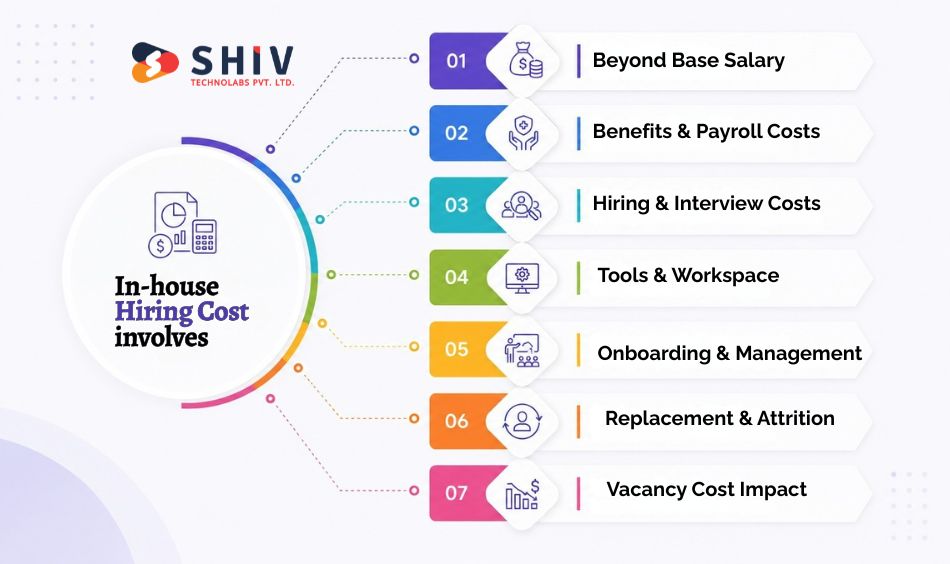
The most effective way to evaluate vendor pricing is by measuring the business value and outcomes delivered, rather than comparing it directly with employee salaries. The actual investment includes recruitment, benefits, equipment, management time, training, payroll taxes, office costs, software licenses, and the financial impact of vacant positions.
# Salary Is Only the Starting Point
Salary represents the largest visible expense, but it is only one part of the total investment. Before a new developer contributes work, the business has already invested time and money into recruiting, interviewing, onboarding, and equipping that employee. For senior technical roles, these indirect costs can represent a substantial percentage of the total employment cost.
# Benefits, Payroll Taxes, and Insurance
Benefits represent the largest addition. Benefits account for 30.1% of total employer compensation costs for private-industry workers, according to the U.S. Bureau of Labor Statistics. This covers paid leave, insurance, retirement, and legally required benefits, including Social Security and Medicare.
# Recruitment Fees and Interview Time
Hiring technical talent is both expensive and time-consuming. SHRM reports an average cost per hire close to $4,700, with approximately 60% of total hiring cost attributable to soft costs such as manager and interviewer time. The total hiring cost often extends beyond salary, including recruitment agency fees, job advertising, technical interviews, engineering reviews, background verification, and offer negotiations.
# Equipment, Software, and Workspace
Every in-house hire comes with recurring costs for hardware, software, and workspace that continue even when project demand decreases.
# Onboarding and Management Overhead
New hires typically take 1–2 weeks to become fully productive. During this time, senior engineers spend valuable hours on mentoring, code reviews, reducing overall team capacity and adding to the true cost of hiring. A CFO-ready cost model should include the time spent on technical onboarding, documentation, meetings, access setup, code reviews, and early-stage supervision.
# Attrition, Severance, and Replacement Cost
Turnover restarts the entire cycle. A poor hiring decision costs an estimated 30% to 50% of first-year salary, according to SHRM and Department of Labor benchmarks. Replacement adds recruitment expense, ramp-up time, and lost delivery momentum.
# Vacancy Cost While the Role Is Open
An unfilled role carries a daily cost. SHRM’s recent recruiting benchmarks report a median time-to-fill of roughly 39 days for nonexecutive roles. Specialist technology positions may take longer when the required skills are scarce or the hiring process includes several technical rounds. A vacant developer role may therefore create six or more weeks of lost capacity before onboarding begins. The financial effect becomes larger when the role supports a product launch, cloud migration, customer portal, or revenue-linked feature
What Does IT Staff Augmentation Actually Cost?
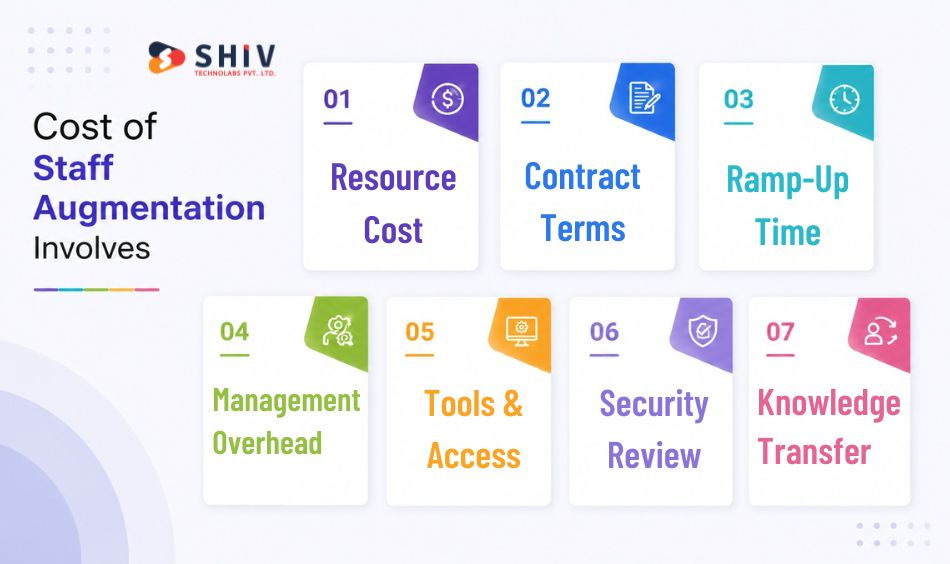
IT staff augmentation replaces permanent employment costs with a contracted resource or team cost. A fair IT staff augmentation cost benefit analysis should include provider fees, onboarding, management time, tools, access controls, compliance checks, and knowledge transfer. Ignoring these costs can overstate expected ROI.
# Provider Rate or Monthly Resource Cost
Staff augmentation pricing follows an hourly or monthly model. Rates begin near $25 per hour and increase with seniority and technology stack. CFOs should compare the total monthly cost with the expected productive output. IT staff augmentation helps businesses add developers without increasing permanent headcount.
# Contract Minimums and Notice Periods
Some vendors require a minimum engagement period, monthly hour commitment, or notice period before reducing capacity. These conditions affect flexibility and should appear in the financial model. Before approval, finance and technology leaders should confirm the engagement duration, billing terms, notice period, replacement policy, overtime rates, and tax treatment.
# Onboarding and Ramp-Up Time
Augmented developers also need onboarding. They must understand the codebase, business context, development standards, tools, access controls, and expected outcomes. The difference is usually speed. The advantage becomes valuable when the company already has clear documentation, a ready backlog, an internal product owner, and accessible technical leadership.
# Internal Management and Review Time
Staff augmentation does not remove internal management. Your company still needs to define priorities, review output, answer business questions, and approve technical decisions. CFOs should include product management, engineering oversight, code review, and meeting time within total augmentation cost.
# Tools, Licenses, and Access Setup
Typical expenses include cloud environments, source-control accounts, testing tools, project-management platforms, security software, virtual desktops, and licensed enterprise systems. These costs are usually lower than building a complete employee setup, but they should still appear in the project budget.
# Security and Compliance Review
Vendor security reviews required time from your internal team. Security teams should define access levels and verify requirements such as NDAs, role-based permissions, audit logs, secure devices, background checks, data processing terms, and compliance controls. While these reviews may extend onboarding, they help reduce far greater financial, legal, and reputational risks.
# Knowledge Transfer at Exit
The engagement should include documentation and handover when the engagement concludes. A good handover includes updated technical documents, architecture notes, deployment instructions, unresolved issues, credentials transfer, and walkthrough sessions. Finance leaders should treat knowledge transfer as part of the contracted deliverable rather than an optional final activity.
IT Staff Augmentation vs Full-Time Hiring: CFO-Level Cost Comparison
The correct comparison is not vendor rate versus employee salary. It is fully loaded augmentation cost versus fully loaded employment cost, adjusted for time-to-start, delivery value, flexibility, and risk.
| Factor | Full-Time Hire | Staff Augmentation |
| Direct cost | Salary plus ~30% benefits | Provider rate |
| Indirect cost | Recruitment, equipment, management | Management, access, security review |
| Fully loaded cost | 1.25x to 1.4x base salary | Rate plus internal overhead |
| Time to start | 44+ days average | Days to two weeks |
| Exit cost | Severance, lost knowledge | Notice period, handover |
| Cost behavior | Fixed | Variable |
| Opportunity cost | High during vacancy | Low, capacity starts sooner |
# Direct Cost Comparison
A full-time hire carries salary plus approximately 30% in benefits. IT staff augmentation carries a single provider rate. That rate often appears higher per hour and lower per outcome.
# Indirect Cost Comparison
Full-time hiring adds recruitment, equipment, and sustained management cost. Augmentation adds access provisioning, security review, and internal supervision. Both cost stacks are real and both belong in the model. CFOs should assign realistic values to both sides rather than treating indirect costs as zero.
# Time-to-Start Comparison
This dimension shows the clearest advantage for augmentation. A full-time hire averages 44 days to fill, plus ramp-up. Staff augmentation can reduce that gap when vetted developers are available and the internal team is ready to onboard them. Deloitte’s outsourcing research describes external sourcing as one way organizations access skills and capabilities with greater agility, although governance remains essential.
# Exit Cost Comparison
Permanent employment may involve notice, severance, legal requirements, unused leave, and replacement costs. Staff augmentation usually allows a simpler exit, subject to minimum terms and notice periods.
# Opportunity Cost Comparison
Opportunity cost is the value lost through slower delivery, delayed revenue, continued manual work, or missed market opportunities. Staff augmentation delivers the highest ROI when faster delivery outweighs higher monthly costs.
How Do You Calculate IT Staff Augmentation ROI?
IT staff augmentation ROI compares the financial value created by faster delivery, avoided hiring costs, improved productivity, and reduced talent risk against the full cost of the external engagement. A useful calculation must include management, onboarding, tools, and knowledge transfer rather than using the vendor invoice alone.
# CFO-Ready Staff Augmentation ROI Formula
Real ROI = Avoided Hiring Cost + Avoided Vacancy Cost + Delivery Acceleration Value + Productivity Gain + Risk Reduction Value − Total Augmentation Cost
The result can then be divided by the total augmentation cost and multiplied by 100 to calculate the percentage return.This model prevents hourly pricing from dominating the decision.
# Input 1: Fully Loaded Augmentation Cost
Begin with the provider rate, then add internal management, access provisioning, and security review time. This figure represents your true spend.
# Input 2: Avoided Vacancy Cost
Quantify the weeks you would have waited to complete a hire. Multiply by the weekly cost of the stalled roadmap. This represents value preserved.
The calculation can use this simple structure:
Weekly value of required capacity × weeks of delay = vacancy cost
# Input 3: Value of Earlier Delivery
Estimate the revenue or savings that arrive sooner. Delivering 12 weeks earlier produces 12 additional weeks of return. This input typically carries the greatest weight.
# Input 4: Avoided Rework and Risk Reduction
Strong QA and vetted developers reduce defect and rework cost. Add the value of a replacement clause that protects delivery continuity. Risk reduction has measurable financial value.
# Input 5: Management and Ramp-Up Overhead
Subtract internal supervision hours and the ramp-up period. Credible models include this deduction. Omitting it overstates the return.
What Are the Three Returns a CFO Can Defend?
A strong staff augmentation business case should focus on three defensible returns: faster access to capacity, a flexible cost structure, and controlled delivery risk. These benefits can be measured more credibly than broad claims about inexpensive talent.
# 1. Faster Access to Productive Capacity
Speed to capacity reduces the time between budget approval and productive delivery. Faster staffing creates value when it protects release dates, reduces operational bottlenecks, or allows internal employees to focus on core work. Companies requiring specific specialists can also hire dedicated developers without repeating a complete recruitment cycle for every project need.
# 2. Flexible Cost Structure
Staff augmentation converts fixed payroll into variable spend. Capacity scales to the roadmap rather than to a headcount plan. This reduces the chance of carrying underused payroll after a project finishes.
# 3. Risk Control Through Contract Terms
A well-structured agreement can reduce replacement, continuity, intellectual property, and exit risks. The contract should define resource replacement, notice periods, documentation, code ownership, security obligations, handover requirements, and performance reviews. The vendor does not remove delivery risk. However, clear contractual responsibilities can transfer part of the recruitment and replacement burden away from the client.
How Does Staff Augmentation Affect Cash Flow?
Staff augmentation can improve cash-flow flexibility by converting a long-term payroll commitment into project-aligned spending. The benefit is strongest when demand changes across quarters or projects.
# Payroll Becomes Project-Based Spending
A full-time hire adds salary, benefits, taxes, equipment, and employment obligations to the ongoing cost base. An augmented resource usually appears as a contracted monthly or hourly project expense. This makes spending easier to connect with a specific backlog, launch, migration, or business outcome.
# Lower Long-Term Commitment
Staff augmentation helps a company to fund the required capacity during the delivery period without committing to several years of payroll. Permanent hiring remains appropriate for roles that support continuous core operations, retain proprietary knowledge, or shape long-term technical architecture.
# Better Budget Control for Short-Term Needs
A clearly scoped agreement can make monthly delivery spending easier to forecast. Finance teams can set capacity limits, approval thresholds, billing controls, and review dates before work begins. Budget predictability improves when the contract states rates, expected hours, resource levels, overtime rules, and notice periods.
# Reduced Idle Capacity After Delivery
Internal teams sometimes carry hidden costs when projects end or priorities change. Salaries continue even when roadmap demand temporarily falls. Augmented capacity can be reduced according to the contract. This helps align technology spending with active business priorities.
# Better Runway Protection During Uncertain Demand
Startups and growth companies often need technical capacity before revenue becomes predictable. Staff augmentation can support a defined growth initiative while preserving flexibility. Finance leaders can approve capacity in stages and extend it only when business results justify the next investment.
Why Is Resource Utilization Important in the ROI Model?
Utilization measures how effectively paid capacity supports valuable roadmap work. It reveals costs that salary and hourly-rate comparisons often miss. The goal is to align available capacity with high-value delivery needs.
# Internal Teams Can Carry Hidden Bench Cost
Permanent teams remain on payroll when projects slow, pause, or change, which can raise the cost per delivered outcome. They still provide long-term value through knowledge, maintenance, architecture ownership, and quick internal support, but costs increase when headcount stays above predictable demand.
# Augmented Capacity Can Scale With Demand
Staff augmentation lets companies add QA engineers, cloud specialists, mobile developers, or other experts during busy project stages and reduce capacity when the work ends. This flexibility depends on suitable contract terms and enough planned work to use each resource effectively.
# Measure Output Instead of Headcount
A larger team does not always create more value because poor planning, technical debt, unclear priorities, and coordination demands can reduce output. CFOs should measure business outcomes, release frequency, cycle time, quality, and rework. McKinsey’s developer productivity research also supports using several delivery and business impact metrics instead of one activity measure.
# Track Capacity Against Roadmap Value
Finance and technology leaders should connect every augmented role to a specific roadmap need, expected result, delivery date, and performance measure. Monthly reviews should compare planned capacity with usage, committed work with completed deliverables, timeline improvements, defect and rework costs, and the continued need for each role.
What Can Reduce the ROI of IT Staff Augmentation?
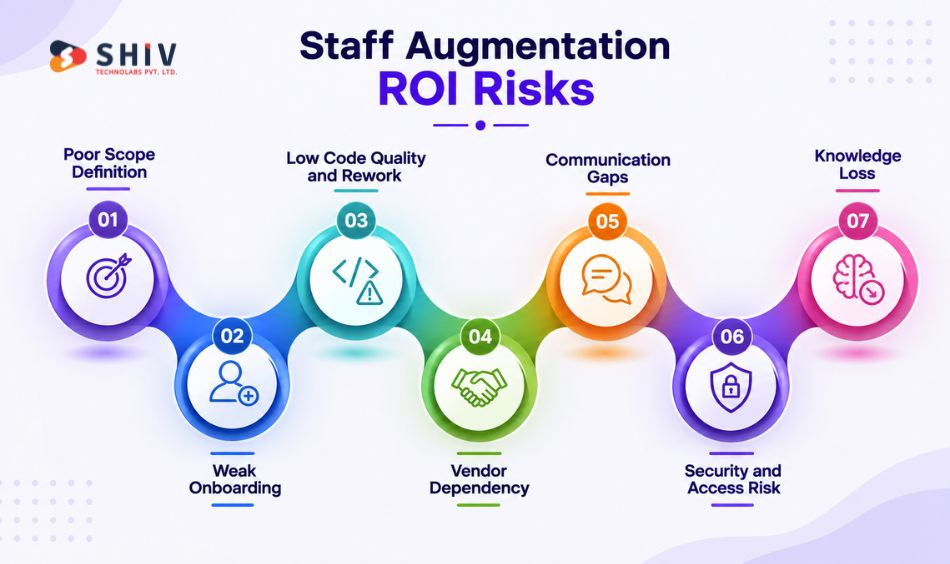
Staff augmentation ROI falls when external capacity is added without clear ownership, a ready backlog, strong onboarding, quality controls, or documented exit plans. A financially attractive contract can still produce poor results when delivery governance is weak CFOs should therefore treat expected return as risk-adjusted rather than guaranteed.
# Poor Scope Definition
External developers need clear priorities, goals, deliverables, ownership, acceptance criteria, and business direction to work effectively. When requirements remain unclear, repeated discussions, changing estimates, and rework can delay delivery, making a discovery engagement or project-based model more suitable than immediately adding developers.
# Weak Onboarding
Missing documentation, delayed access, unclear coding standards, and limited stakeholder support can slow augmented developers. A structured onboarding plan should cover the product, architecture, backlog, security requirements, development process, release workflow, and communication expectations so developers can become productive faster.
# Low Code Quality and Rework
A lower vendor rate offers limited value when defects, weak architecture, poor documentation, and repeated work increase delivery costs. Finance leaders should track defect rates, escaped issues, code review findings, and rework costs to identify hidden expenses. McKinseyrecommends measuring software productivity through business outcomes, quality, delivery performance, and developer experience rather than relying on single metric.
# Vendor Dependency
Long engagements can create dependency when one provider controls product knowledge, architecture context, repositories, or operational access. Companies can reduce this risk through shared repositories, internal technical ownership, regular documentation, code reviews, and planned knowledge transfer.
# Communication Gaps
Distributed teams need clear meeting schedules, response expectations, decision ownership, escalation paths, and reporting standards. Too many meetings reduce productive time, while limited communication creates misalignment, so the right balance should reflect project complexity and team maturity.
# Security and Access Risk
External developers may need access to code, cloud systems, databases, internal tools, or customer data. Implement least-privilege access, credential vaults, multifactor authentication, and audit logging. The NIST Secure Software Development Framework provides established practices for integrating security into software development. NIST also recommends evaluating software suppliers and managing third-party software risks throughout the acquisition lifecycle.
# Knowledge Loss After the Engagement
Knowledge can leave with external developers when documentation and handover are delayed. Contracts should require architecture notes, deployment steps, code comments, decision records, known issue logs, and regular transition sessions throughout the engagement rather than relying on a final-week handover.
# Risk-Adjusted ROI Checklist
| Risk Area | Question CFOs Should Ask | Financial Effect if Ignored |
| Scope | Is there a clear backlog and accountable owner? | Rework and billing without useful output |
| Onboarding | Are access, documentation, and environments ready? | Slower productive start |
| Quality | Who owns QA, reviews, and acceptance criteria? | Higher defect and correction cost |
| Security | Is access limited, monitored, and removable? | Compliance, operational, and reputation risk |
| Dependency | Will internal leaders retain technical visibility? | Higher switching and exit cost |
| Continuity | Does the vendor provide qualified replacements? | Delivery stalls after resource loss |
| Handover | Are documentation and knowledge transfer contractual? | Knowledge loss and maintenance delays |
When Does Staff Augmentation Deliver the Best ROI?
Staff augmentation creates the strongest return when the company has valuable work ready, but lacks enough capacity or specialized skills to deliver it on time.
# You Have a Clear Roadmap but Limited Capacity
A ready backlog helps external developers start faster. When priorities, acceptance criteria, dependencies, and release goals are clear, they can support product launches, migrations, seasonal releases, or customer commitments without delay.
# You Need Skills Faster Than Hiring Can Provide
Cloud architects, AI engineers, data specialists, mobile developers, QA automation engineers, and cybersecurity experts can take time to hire. Staff augmentation gives access to these skills for a defined need without adding permanent roles for every specialty.
# The Workload Is Project-Based
A six-month migration, modernization plan, or backlog push may not need several full-time hires. Augmentation keeps resource cost tied to the project period and reduces underused capacity after completion.
# Internal Teams Need Support
This model works well when internal leaders keep product ownership, architecture direction, and business context. External developers add delivery strength while internal teams keep control and long-term knowledge.
# You Want to Reduce Hiring and Attrition Risk
The provider usually handles sourcing and replacement support. If a resource leaves or does not meet expectations, a strong agreement can reduce the delay compared with restarting recruitment.
# You Need Specialized Delivery Support
Specialized initiatives often create high ROI because they need skills for a limited period.
Cloud consulting, data, mobile, QA automation, security, and legacy modernization work often need skills for a limited period. Staff augmentation fits well when expert support is required during a defined project phase.
When Does Staff Augmentation Not Save Money?
Staff augmentation may not give strong ROI when the need is permanent, the backlog is unclear, internal management is weak, or vendor quality causes repeated rework. In these cases, full-time hiring, a dedicated team, project outsourcing, or managed services may be a better choice.
# There Is No Ready Backlog or Internal Owner
Adding developers before defining clear work can create idle capacity. A product owner or technical lead should be ready to assign tasks, approve work, and make decisions.
# The Role Is Permanent and Predictable
Full-time hiring may be better when the company needs the same role for several years. Core architecture, product leadership, platform management, and proprietary work often need long-term internal ownership.
# Your Team Cannot Manage External Developers
The client still owns priorities, feedback, and task direction. When internal leadership is missing, a dedicated team or project outsourcing model may work better.
# Scope Changes Too Often
Agile work can change, but constant unplanned changes reduce productivity. A clear backlog and change process help protect cost, time, and delivery quality.
# Compliance Review Takes Too Much Time
Sensitive or regulated projects may need background checks, access approvals, legal reviews, and device controls. These steps can reduce the speed benefit and add extra cost.
# Vendor Quality Is Weak
Poor screening, frequent resource changes, weak communication, and low accountability can turn staff augmentation into costly rework. A good vendor should have strong technical checks, replacement terms, security practices, and clear documentation.
# Mobile App or Web App Development Needs Full Ownership
A company may use software development services or augmented specialists to accelerate a customer portal, mobile application, ecommerce experience, or internal platform.The right model depends on whether the client wants direct team control or full delivery ownership.
# Cybersecurity and Compliance Support Needs Strong Control
Security experts may be needed for audits, remediation, secure development, or compliance work. ROI comes from faster access to expert skills, but access rules and governance must be strict.
Staff Augmentation vs Dedicated Team vs Project Outsourcing
The lowest-cost engagement model depends on scope, management capacity, duration, and delivery ownership. Each option assigns responsibility differently.
| Model | CFO View | Best For | Main Financial Risk |
| Staff augmentation | Flexible capacity managed by the client | Extending an existing team | Internal management overhead |
| Dedicated team | Stable external capacity for a continuing roadmap | Long-term product development | Vendor dependency and monthly commitment |
| Project outsourcing | Vendor owns defined project delivery | Clear scope and outcome | Change requests and scope expansion |
| Managed services | Predictable external ownership of ongoing operations | Support, maintenance, and service delivery | Reduced direct control |
# Staff Augmentation Gives More Internal Control
The client assigns work, manages priorities, and remains responsible for delivery outcomes. This model fits businesses with established technical leadership and delivery processes. The financial advantage is flexibility, but management effort stays internal.
# Dedicated Teams Offer Stable Delivery Capacity
A dedicated team provides a consistent external group for a longer roadmap. You can hire a dedicated team when the work extends across months. This model offers stronger continuity than adding separate individuals, but it usually requires a larger monthly commitment.
# Project Outsourcing Transfers More Responsibility
Under project outsourcing, the vendor manages planning, execution, testing, and agreed delivery milestones. It works well for a defined project, but changing requirements may increase cost through formal change requests.
# Managed Services Fit Ongoing Operations
Managed services suit recurring support, infrastructure, maintenance, monitoring, or service-level commitments. They provide predictable operational spending but usually give the client less daily control over individual resources.
# Which Model Costs Less?
Staff augmentation often costs less when the client already has management and needs specific capacity. A dedicated team can provide better value for a long, evolving roadmap. Project outsourcing can be more predictable for a fixed outcome, while managed services fit steady operational responsibilities.
Hidden Costs CFOs Should Consider Before Signing
Several costs never appear on a rate card. Each can reduce the return materially. Review them before executing an agreement.
- Vague scope and undefined deliverables that generate rework.
- Unclear replacement terms that leave you exposed if a developer departs.
- Overlap cost during onboarding when two people cover a single role.
- Internal project management load that consumes senior engineering time.
- Rework from weak QA that eliminates any rate advantage.
- Knowledge transfer at exit that consumes time if it is not contracted.
- Access, compliance, and security controls that require internal review effort.
Contract Terms That Protect ROI of Businesses
| Contract Term | Why It Matters for ROI |
| Replacement Clause | Sets a clear replacement window if a developer leaves or underperforms. |
| Notice Period | Keeps the model flexible and helps control cost. |
| Billing Model | Confirms hourly, monthly, or milestone billing based on budget planning. |
| IP Ownership | Makes sure all code, designs, and assets belong to your company. |
| Security and Access Control | Limits access, protects data, and supports compliance needs. |
| Documentation and Handover | Reduces knowledge loss when the engagement ends. |
| Performance Review Cadence | Adds weekly or sprint-level checks for clear delivery tracking. |
| Replacement SLA | Defines how fast the provider must replace a resource and maintain continuity. |
KPIs CFOs Should Track to Measure Staff Augmentation ROI
Once the engagement begins, ROI should be reviewed using measurable business metrics instead of subjective feedback.
| KPI | Why It Matters |
| Time to productive start | Measures onboarding efficiency |
| Sprint completion rate | Indicates delivery consistency |
| Feature release velocity | Shows whether delivery has accelerated |
| Defect rate | Measures software quality |
| Cost per completed feature | Connects spending with outcomes |
| Budget variance | Tracks financial performance |
| Utilization rate | Shows whether purchased capacity is fully used |
| Delivery against roadmap | Measures business impact rather than activity |
Reviewing these KPIs monthly allows finance and technology leaders to make informed staffing decisions.
How Shiv Technolabs Helps Improve Staff Augmentation ROI
At Shiv Technolabs, we focus on helping businesses increase delivery capacity without adding unnecessary hiring overhead. We improve return by reducing time, risk, and rework. The value appears in the following areas.
- Faster access to vetted developers that removes weeks from the hiring cycle.
- Flexible team scaling that aligns capacity to the roadmap.
- Lower recruitment burden that preserves internal team capacity.
- Backup resource support that protects continuity if a developer departs.
- Skill matching for specific projects that avoids paying for an imprecise fit.
- Delivery support and governance with sprint-level reporting.
- Long-term technology partnership that compounds institutional context over time.
Final Thoughts
The strongest business case for IT staff augmentation is not lower hourly pricing. It is faster access to specialized talent, reduced recruitment delays, flexible staffing, and better alignment between technology spending and business priorities.
For CFOs, the right comparison is not vendor rates versus salaries. It is the total economic value created by each staffing model. That means evaluating hiring costs, vacancy costs, productivity, utilization, project timelines, operational flexibility, and long-term commitments together.
When used for the right projects and supported by clear governance, staff augmentation can improve delivery speed while keeping financial risk under control.
Frequently Asked Questions
# What is the ROI of IT staff augmentation?
IT staff augmentation ROI measures the financial value created by faster delivery, reduced hiring costs, improved productivity, and flexible staffing compared with the total engagement cost.
# How do CFOs calculate staff augmentation ROI?
CFOs compare avoided hiring expenses, delivery acceleration, productivity improvements, and risk reduction against the fully loaded cost of the engagement.
# Is staff augmentation cheaper than hiring employees?
Not always. The better comparison is the total cost of ownership, including recruitment, onboarding, benefits, utilization, and project delivery speed.
# When does staff augmentation provide the highest return?
It generally delivers the strongest ROI for project-based work, product launches, cloud migration, AI initiatives, legacy modernization, and situations requiring specialized skills quickly.
# What costs should businesses include in ROI calculations?
Include provider fees, onboarding, internal management, software licenses, security reviews, documentation, knowledge transfer, and ongoing support alongside any avoided hiring or vacancy costs.
# How long should a staff augmentation engagement last?
The ideal duration depends on project scope and business goals. Many organizations use staff augmentation for three to twelve months, then adjust capacity as delivery needs change.