
Table of Contents
Insurance companies in the UK are under pressure to handle claims faster, reduce fraud, and meet strict regulatory rules. Manual processes and rule-based systems often slow down daily operations and increase costs. AI-based insurance software helps insurers process large data sets, support better risk decisions, and improve customer response times without heavy manual effort.
From claims handling and underwriting to fraud detection and customer support, AI-driven systems are transforming the way insurance teams operate. This content explains how AI-based insurance software is developed in the UK, the key features, and the typical development costs involved.

What Is AI-Based Insurance Software?
AI-based insurance software is a digital system that uses data models and machine learning logic to support insurance operations. It helps insurance companies handle tasks such as claims review, risk checks, pricing decisions, and customer support with less manual work.
Instead of relying only on fixed rules, this software studies past data, customer behaviour, and claim patterns. Based on this, it can suggest actions, flag risks, and assist teams in making quicker and more accurate decisions.
# How It Is Different from Traditional Insurance Systems?
Traditional insurance systems depend heavily on manual input and preset rules. AI-based systems work more flexibly.
- Reads and processes large data sets in real time
- Reduces paperwork and manual review
- Improves accuracy in claims and risk checks
- Supports faster response for customers and agents
These differences make AI-based insurance software more suitable for modern UK insurance businesses that handle high volumes of data and strict compliance needs.
Types of AI Insurance Solutions Used in UK
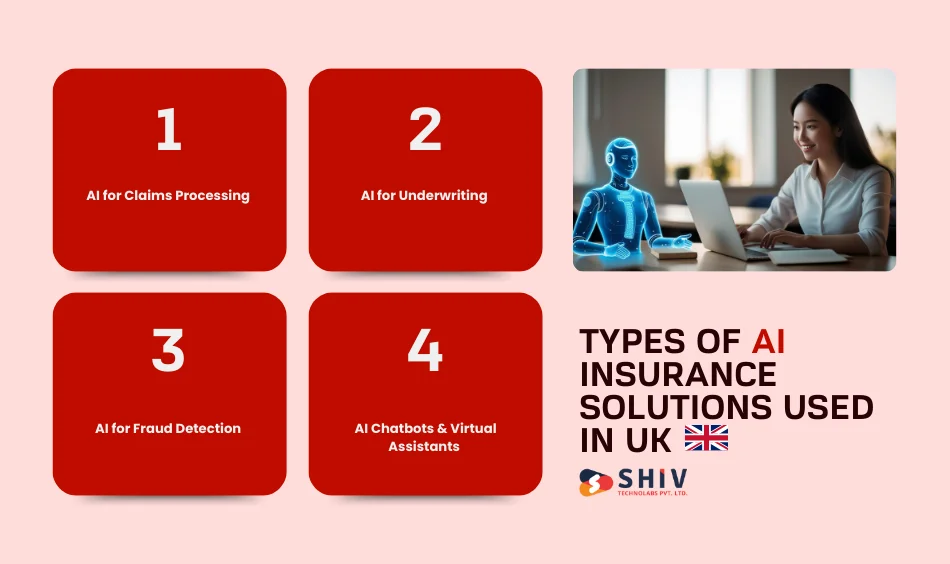
Insurance companies in the UK use AI in different areas based on their business goals, policy types, and customer base. Some focus on faster claims, while others focus on fraud checks or pricing accuracy. Below are the most common AI insurance solutions in use.
1. AI for Claims Processing
AI helps reduce claim handling time and manual review work.
- Reads claim documents and images
- Assesses vehicle or property damage
- Flags missing or incorrect details
- Speeds up claim approval decisions
2. AI for Underwriting
Underwriting teams use AI to study risk before issuing policies.
- Reviews customer history and behaviour
- Scores are risk-based on multiple data points
- Supports fair and data-based pricing
- Reduces human error in risk checks
3. AI for Fraud Detection
Fraud detection systems look for unusual patterns in claims and transactions.
- Detects repeat or abnormal claims
- Flags suspicious activities early
- Reduces false payouts
- Supports investigation teams with alerts
4. AI Chatbots and Virtual Assistants
Customer-facing AI tools support policyholders and agents.
- Answers policy and coverage questions
- Shares claim status updates
- Supports renewal and payment queries
- Works around the clock without delays
These AI solutions help UK insurers manage operations more efficiently while meeting customer expectations and regulatory requirements.
AI Insurance Software Development Process
Building AI-based insurance software in the UK needs a clear plan because it involves sensitive data, strict compliance, and accurate decision-making. Below is a step-by-step process that most teams follow.
1. Business Requirement Study
This step defines what the system must do and who will use it. The team gathers details like:
- Insurance type (life, motor, health, property, travel, etc.)
- User roles (customers, agents, admins, underwriters, claim managers)
- Key workflows (policy purchase, renewal, claim filing, claim approval)
- Compliance needs (data storage, access control, audit logs)
A clear requirement stage avoids rework later.
2. Data Collection and Preparation
AI needs good data to give correct results. This step includes:
- Collecting past claim records, customer details, and policy data
- Cleaning data to remove duplicates and missing values
- Structuring data so models can read it easily
- Setting data access rules to match UK privacy requirements
If data quality is poor, AI accuracy also drops, so this step matters a lot.
3. AI Model Selection and Training
Here, the team decides what AI models are needed and trains them using prepared data. Examples:
- Fraud detection models based on claim patterns
- Risk scoring models for underwriting
- Document reading models for forms and reports
- Text analysis models for emails and claim notes
Training also includes accuracy checks and improvement rounds before moving ahead.
4. Software Architecture Design
The system is planned as a complete product, not just an AI model. This includes:
- Database structure and storage plan
- API structure for internal and external systems
- Security layers and role-based access
- Cloud setup and scaling plan
- Logging and audit trail setup
This stage makes sure the platform can handle growth and stays stable.
5. Development and System Setup
Now the product is built with all parts connected:
- Frontend for customer portal and admin dashboard
- Backend for policy, claims, payments, and user management
- AI services connected via APIs
- Third-party integrations such as payment gateways, CRMs, and KYC tools
The goal is a smooth flow across all modules.
6. Testing and Validation
Insurance software needs strong testing because wrong results can cause legal and financial risk. Testing includes:
- Functional testing of policy and claim flows
- AI result validation with sample data
- Security testing and vulnerability checks
- Performance testing for high traffic
- Compliance checks for logging, access, and data handling
Only after this stage should the product move to launch.
7. Go-Live and Ongoing Improvements
After launch, the platform is monitored and improved based on real usage. This stage includes:
- Tracking AI accuracy and updating models when needed
- Fixing bugs and improving user experience
- Adding features based on business feedback
- Regular security updates and compliance reviews
AI-based insurance software improves over time, so ongoing updates are a normal part of the product lifecycle.


Key Features of AI-Based Insurance Software
The right features decide whether an AI insurance platform is truly useful or just “AI on paper.” In the UK, insurers also need strong security, clear audit trails, and stable workflows for policy and claims. Below are the key features most companies include.
# Core Features
1) Policy Management
- Create and manage policies, riders, renewals, and endorsements
- Track premium schedules, due dates, and coverage changes
- Support different policy types (motor, health, life, property, travel)
2) Claims Management
- Claim filing with document upload (web/mobile)
- Claim tracking for customers and internal teams
- Auto checks for missing details and mismatched data
- Faster internal routing based on claim type and priority
3) AI-Powered Underwriting Support
- Risk scoring based on customer profile and past data
- Rule + data-based underwriting suggestions
- Pricing support for standard and non-standard cases
- Alerts when key risk factors are detected
4) Fraud Detection and Risk Alerts
- Suspicious claim detection using pattern checks
- Duplicate claim and identity checks
- Alerts for unusual claim frequency or high-value claims
- Case tagging for investigation team review
5) Customer Portal and Agent Dashboard
- Customer self-service for policies, claims, documents, and payments
- Agent tools for policy issuance, updates, and customer support
- Role-based access so each user sees only what they should
6) Reporting and Analytics
- Claim turnaround time reports
- Fraud alerts summary and outcomes
- Underwriting performance and risk trends
- Business dashboards for leadership and compliance teams
# Advanced Features (Often Added in Mid/Enterprise Builds)
1) Document Reading (OCR + NLP)
- Reads forms, reports, invoices, IDs, and claim documents
- Extracts fields like name, dates, vehicle details, and diagnosis codes
- Reduces manual data entry for claims and underwriting
2) Image-Based Damage Assessment
- Helps assess vehicle or property damage from images
- Supports quicker claim estimation
- Works best with clear image guidelines and review steps
3) Smart Customer Support (Chatbot + Knowledge Base)
- Answers common policy and claim questions
- Shares claim status, payment info, and renewal details
- Escalates complex cases to human support
4) Real-Time Monitoring and Model Tracking
- Tracks model accuracy and error patterns
- Flags drift when real-world data changes
- Helps teams decide when model re-training is needed
5) Integrations (UK-Focused Needs)
- KYC/identity checks (based on the insurer’s chosen vendor)
- Payment gateways and bank transfer support
- CRM, accounting, and document storage systems
- External data sources for risk scoring (where allowed and approved)
# Features That Are Important for UK Compliance
Even if the platform has strong AI, it must also support compliance and audit readiness:
- Audit logs for key actions (policy edits, claim approvals, access changes)
- Consent and privacy controls for customer data
- Data encryption at rest and in transit
- Access control by role, team, and location
Compliance and Security Requirements in UK
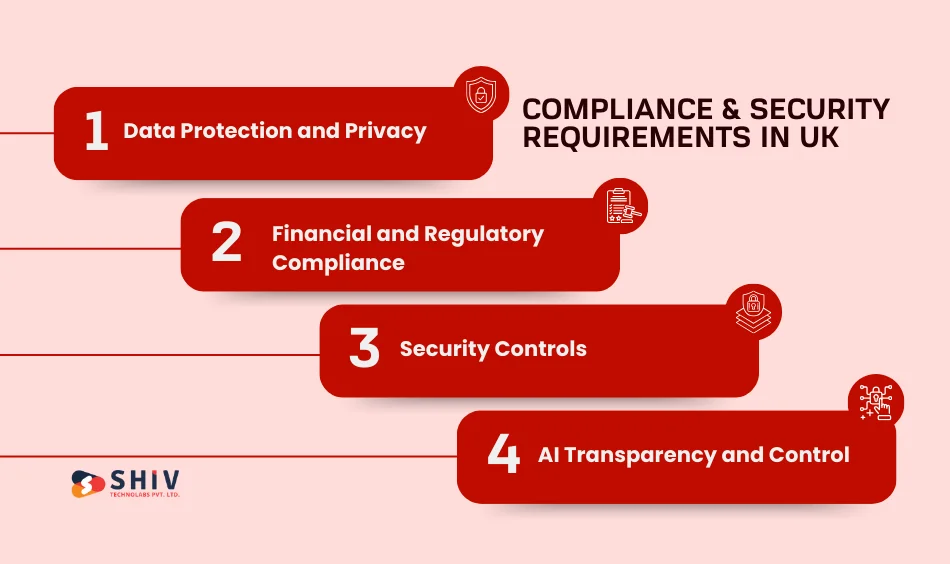
Insurance software in the UK must follow strict data protection and financial rules. AI adds another layer of responsibility because decisions are often data-driven. A well-built system must protect customer data, keep clear records, and support audits at any time.
1. Data Protection and Privacy
Insurance platforms must handle personal and financial data with care.
- Follow GDPR rules for data collection, storage, and access
- Store only required customer data
- Allow data access, correction, and removal when legally required
- Maintain clear consent records for data usage
2. Financial and Regulatory Compliance
UK insurers are monitored by regulatory bodies and must keep systems ready for review.
- Support FCA reporting needs
- Maintain logs for policy changes, claims, and approvals
- Track user activity across the system
- Keep records available for audits and inspections
3. Security Controls
Strong security protects both insurers and policyholders.
- Role-based access control for all users
- Encrypted data storage and secure data transfer
- Secure login and session handling
- Regular security testing and updates
4. AI Transparency and Control
AI systems must support human oversight.
- Clear reasoning for AI-driven suggestions
- Ability to override AI decisions when needed
- Monitoring of model accuracy and behaviour
- Records of model updates and changes
Meeting these compliance and security requirements is essential for operating AI-based insurance software safely and legally in the UK.
Technology Stack Used for AI Insurance Software
The technology stack for AI-based insurance software is selected based on security, data handling, system scale, and UK compliance needs. Below are the core technologies commonly used in production-ready insurance platforms.
1. Frontend (Web and Mobile Applications)
- React / Angular for customer portals, agent dashboards, and admin panels
- Flutter for cross-platform mobile apps, supporting claim filing and document upload
- Many insurers choose Flutter app development services UK to maintain a single mobile codebase for both iOS and Android
2. Backend and APIs
- Node.js or .NET Core for scalable and secure backend services
- REST APIs for connecting frontend, AI services, and third-party systems
- Workflow logic for claims routing, approvals, and policy management
3. AI and Data Layer
- Python for machine learning models used in fraud detection, underwriting, and claim classification
- Libraries such as scikit-learn and PyTorch for model training
- Accuracy monitoring to track model behaviour after launch
4. Databases and Storage
- PostgreSQL / MySQL for policy, claims, user, and transaction data
- Cloud storage for claim documents, images, and reports
- Redis for caching frequently used data
5. Cloud and Infrastructure
- AWS or Azure for secure hosting and scalability
- Docker-based deployment for controlled releases
- Monitoring and backup setup for system stability
6. Security and Compliance
- Role-based access control for all users
- Encrypted data storage and secure data transfer
- Audit logs for policy changes, claim approvals, and system access
This technology stack supports reliable AI insurance systems that handle sensitive data, meet UK regulatory needs, and scale with business growth.
Cost of AI-Based Insurance Software Development in the UK
The cost of AI-based insurance software in the UK depends on what you are building, how much data work is required, and how many systems must connect with it.
A simple tool that supports one use case (like fraud checks) will cost much less than a full insurance platform with customer portals, underwriting, claims, reporting, and multiple AI models.
Below are practical cost ranges that most UK-focused projects fall into.
# Estimated Cost Range
1) Basic AI Solution (Single Use Case)
£25,000 – £45,000
Best for insurers who want one focused module, such as:
- Fraud detection alerts
- Claim document reading
- Simple underwriting risk score support
2) Mid-Level Insurance Platform (Multiple Modules + AI)
£45,000 – £90,000
Best for companies that need:
- Claims + policy management
- AI support for underwriting or fraud
- Customer portal + admin dashboard
- Standard integrations (payments, CRM, notifications)
3) Enterprise-Grade System (High Scale + Strong Compliance + Advanced AI)
£90,000 – £180,000+
Best for larger insurers needing:
- Multiple AI models (fraud, risk, claim classification, document reading)
- Heavy integrations (legacy systems, data sources, reporting tools)
- High security, audit logs, and complex approval workflows
- Multi-region and high traffic support
# Cost-Influencing Factors
1) Scope and Number of Features
More modules (claims, underwriting, policy admin, portals) increase time and cost.
2) Data Work Required
AI needs clean data. If data is messy or spread across systems, effort increases due to:
- Data cleanup
- Data mapping
- Data validation rules
3) AI Model Complexity
Costs rise when you need:
- Multiple models for different tasks
- Higher accuracy targets
- Real-time decision support
4) Integrations and Legacy Systems
UK insurers often have older systems. Connecting them safely can take significant time.
5) Compliance and Security Requirements
Strong access controls, encryption, audit logs, and compliance testing add cost but are essential.
6) Hosting and Scaling Needs
Cloud setup, monitoring, backups, and disaster recovery planning can increase cost based on scale.
# Ongoing Costs to Plan For
AI insurance systems also have running costs after launch, such as:
- Maintenance and bug fixes
- Model monitoring and periodic re-training
- Security updates and compliance reviews
- Cloud hosting and storage charges
- Support and feature updates
Timeline for Development
The time needed to build AI-based insurance software in the UK depends on project size, data readiness, and compliance scope. A clear plan helps avoid delays, especially when AI models and regulatory checks are involved.
Below is a realistic timeline followed by most projects.
1. Planning and Requirement Finalisation (3–4 Weeks)
This phase focuses on clarity before development starts.
- Business goals and use cases are finalised
- User roles and workflows are mapped
- Data sources and data quality are reviewed
- Compliance and security needs are defined
- Technical architecture is planned
Clear planning at this stage reduces changes later.
2. Data Preparation and Model Training (4–8 Weeks)
This phase prepares the AI foundation.
- Data cleaning and structuring
- Feature selection for models
- Initial model training and testing
- Accuracy checks and tuning
- Validation using sample and historical data
Projects with poor data quality may take longer here.
3. Software Development and Integration (8–14 Weeks)
This is where the full product takes shape.
- Backend development for policies, claims, users, and workflows
- Frontend dashboards for customers, agents, and admins
- AI services connected via APIs
- Third-party system connections
- Logging and audit features added
Larger platforms may run parts of this phase in parallel.
4. Testing, Compliance Checks, and Launch (3–5 Weeks)
Final checks are done before live usage.
- Functional and performance testing
- Security testing and access checks
- Compliance validation
- User acceptance testing
- Production launch and monitoring setup
5. Post-Launch Improvements (Ongoing)
After launch, the system is refined using real data.
- AI model accuracy review
- Feature improvements based on usage
- Security patches and updates
- Compliance reviews and reports
Overall, most AI insurance software projects in the UK take 4 to 6 months from planning to live release, depending on complexity and readiness.
Common Challenges and How to Handle Them

AI-based insurance software brings clear benefits, but UK insurers often face practical challenges during development and after launch. Knowing these early helps avoid delays and unexpected costs.
1. Data Quality and Availability
AI depends on accurate and well-structured data. Many insurers have data spread across systems or stored in old formats.
How to handle it:
- Start with a data audit before development
- Clean and standardise data in phases
- Define clear data ownership and access rules
- Add validation checks at data entry points
2. Regulatory and Compliance Pressure
UK insurance rules are strict, and AI decisions must remain auditable.
How to handle it:
- Involve compliance teams from the planning stage
- Maintain detailed logs for claims, underwriting, and access
- Keep AI decisions reviewable by human teams
- Document model changes and approvals
3. AI Accuracy and Trust
If AI results are unclear or inconsistent, teams may hesitate to rely on them.
How to handle it:
- Set realistic accuracy targets
- Use AI as decision support, not full control
- Monitor model results after launch
- Schedule regular model reviews and updates
4. Integration with Existing Systems
Many insurers already use legacy policy or finance systems.
How to handle it:
- Use APIs for controlled data exchange
- Integrate step by step instead of all at once
- Keep fallback processes during transition
- Test integrations under real workloads
5. Change Management for Internal Teams
Staff may resist new systems due to learning effort or fear of automation.
How to handle it:
- Provide clear training and role-based access
- Introduce AI features gradually
- Share clear benefits for daily work
- Keep human control over key decisions
Handling these challenges early helps build AI insurance software that is reliable, compliant, and accepted by teams across the organisation.
Build Your AI Insurance System with Shiv Technolabs
Shiv Technolabs works with UK insurance companies to build AI-based insurance software that matches business goals, data structure, and regulatory needs. The focus stays on practical outcomes such as faster claims handling, better risk checks, and controlled automation.
Key strengths include:
- Experience with insurance workflows like claims, underwriting, and fraud checks
- Strong focus on data protection, audit logs, and access control
- AI used as decision support, with human review always available
- Clear project planning, updates, and documentation
- Ongoing support after launch for fixes, updates, and model review
This approach helps insurers build stable and future-ready systems without adding unnecessary complexity.
Ready to build AI-driven insurance software for your UK business? Let’s discuss your requirements and create a secure, scalable solution that fits your goals.
Conclusion
AI-based insurance software is becoming a practical requirement for insurance companies in the UK. From claims handling and underwriting to fraud checks and customer support, AI helps reduce manual effort, improve decision accuracy, and handle growing data volumes.
With the right development process, feature planning, and cost clarity, insurers can build systems that support compliance, protect customer data, and scale with business growth. Careful planning and the right technology partner make it possible to introduce AI in a controlled and reliable way that delivers long-term value.
Frequently Asked Questions (FAQs)
1. What is AI-based insurance software?
AI-based insurance software is a system that uses data models and machine learning to support insurance tasks such as claims review, risk scoring, fraud detection, and customer service. It assists teams by analysing data and suggesting actions instead of relying only on fixed rules.
2. How is AI used in insurance companies in the UK?
UK insurers use AI for claims processing, underwriting support, fraud detection, document reading, and customer support chat systems. AI helps manage high data volumes while meeting regulatory and data protection requirements.
3. Is AI-based insurance software compliant with UK regulations?
Yes, when built correctly. AI insurance systems must follow GDPR, FCA guidelines, and data security standards. This includes audit logs, access control, consent tracking, and human oversight of AI decisions.
4. How long does it take to develop AI insurance software?
Most projects take between 4 and 6 months. The timeline depends on feature scope, data readiness, number of AI models, integrations, and compliance checks.
5. What is the cost of AI-based insurance software development in the UK?
Costs usually range from £25,000 for basic AI modules to £180,000 or more for enterprise-level platforms. Pricing depends on system complexity, data work, compliance needs, and integrations.
6. Can AI replace human decision-making in insurance?
AI supports decision-making but does not fully replace humans. In the UK, insurers keep human review for critical decisions such as claim approvals, policy pricing exceptions, and fraud investigations.
7. What data is required for AI insurance software?
AI systems commonly use claim history, customer profiles, policy details, transaction records, and supporting documents. Clean and structured data improves accuracy and system reliability.
8. Is AI insurance software suitable for small and mid-sized insurers?
Yes. Many insurers start with one AI use case, such as fraud alerts or claim document reading, and expand later. Modular development helps control cost and risk.
9. How does AI help reduce insurance fraud?
AI detects unusual claim patterns, repeat submissions, and data mismatches. It flags suspicious cases early, allowing investigation teams to review them before payouts are made.
10. Can existing insurance systems be connected with AI software?
Yes. AI insurance platforms are commonly con nected with existing policy, finance, and CRM systems using secure APIs. Integration is usually done in phases to reduce disruption.