Table of Contents
Legacy tools slow decisions, hide data, and push teams to guess during peak seasons across Chicago. Leaders want clear signals, faster cycles, and systems that match how their operations actually work. That goal sits at the center of AI Integration for Chicago Enterprises, and it is achievable now.
Modern programs connect legacy platforms to real-time workflows that cut rework and guide action across departments. Modern enterprises depend on AI development services in USA to plan this change and reduce daily friction. With the right roadmap, teams use current systems while adding smart automation where it matters most.
Data flows from CRM, ERP, and service tools into models that spot risk and recommend next steps. Managers gain accurate views of sales, operations, and finance, which cuts delays and improves response times. Customers notice faster updates, consistent bills, and reliable delivery dates during busy periods across the city.
Many Chicago organizations now partner with an AI agent development company in Chicago to guide this shift. We phase delivery in weeks, set clear milestones, and show measurable wins before expanding to broader workflows. You get clarity on scope, budget, and impact from the start, without pausing critical operations.
What Makes AI Integration Crucial for Enterprises in Chicago?
Local industries run on thin margins and tight timelines, which makes reliable decisions and faster cycles vital. When core systems lack real-time data, teams work from spreadsheets and emails that hide critical signals. This is why businesses in Chicago need AI integration to turn scattered inputs into clear, actionable guidance.
AI Integration for Chicago Enterprises links ERP, CRM, and production tools to models that learn from history. Leaders see forecasts for demand, delays, and cash flow, then act before issues impact customers or margins. The result is measurable gains in throughput, accuracy, and service across plants, clinics, banks, and warehouses.
Short reasons:
- Outdated software limits scalability and decision-making.
- Real-time analytics are difficult without AI-enabled automation.
- Competitors are already adopting AI for faster workflows.
- Legacy tools increase maintenance costs and downtime.
Quick comparison:
| Aspect | Legacy Systems | After AI Integration |
|---|---|---|
| Data Handling | Manual entries | Automated, predictive |
| Decision-Making | Intuition-based | Data-driven |
| Efficiency | Slower processing | Real-time insights |
With modern analytics in place, leaders allocate budgets with confidence and replace rework with guided tasks. Teams process orders, service tickets, and approvals faster because key steps run through clear, automated rules. Chicago companies gain a practical path to growth without ripping out every legacy system at once. Consider linking forecasting and analytics to Predictive AI development and Data Analytics Services for deeper capability.
How to Integrate AI into Existing Business Systems?
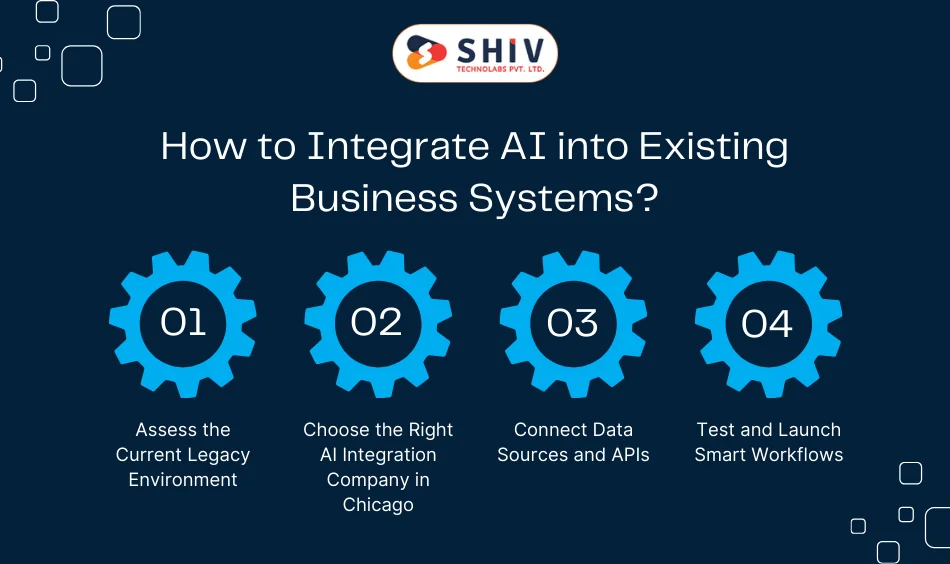
Chicago teams often ask how to integrate AI into existing business systems without slowing daily work. A phased plan helps leaders prove value fast and expand with confidence across functions in Chicago. Companies comparing AI integration solutions in Chicago can follow the steps below to move responsibly.
Step 1 – Assess the Current Legacy Environment
List every application, data source, interface, and dependency across teams and vendors across the business. Record formats, refresh rates, ownership, and known failure points that affect modeling, handoffs, and day-to-day reliability. Highlight pain points like duplicate entries, late approvals, and missing context during service or production.
Add quick wins to the audit so the first pilot shows visible gains within a short window. Score each process by impact, technical effort, and business risk to guide the first rollout.
Step 2 – Choose the Right AI Integration Company in Chicago
Shortlist partners with results in regulated and high-volume operations across manufacturing, healthcare, finance, and logistics. Request discovery workshops, reference architectures, and case studies tied to revenue, risk, or cycle time. Pick teams that publish milestones, transparent budgets, and measurable outcomes before any wider rollout in Chicago companies.
Confirm a shared playbook for security, uptime, and change control, including named owners. Align on success metrics before work begins so progress is clear to sponsors and teams.
Step 3 – Connect Data Sources and APIs
Connect CRM, ERP, finance, and service tools through secure pipelines with versioned schemas and role-based access. Add audit trails to maintain trust, traceability, and recovery during model changes or vendor updates. When platforms lack APIs, mirror data or publish events so that required fields appear without service disruption.
Plan change management early so users adopt new steps with clarity and less resistance across teams. Communicate timelines, expected gains, and support channels before pilots and broader rollouts to every stakeholder group. Define data governance early, covering retention, access tiers, and model monitoring across brands and business units. Agree on source-of-truth systems so reports, models, and audits match across departments and partners in Chicago.
Step 4 – Test and Launch Smart Workflows
Start with a pilot, compare results against baselines, and address gaps before a wider launch. Create runbooks with fallbacks, alert thresholds, and human review for sensitive or exception-heavy cases in production. Train teams through hands-on sessions and track adoption through cycle times, tickets, and surveys each month.
- Verify data accuracy
- Monitor performance metrics
- Schedule user training sessions
- Establish feedback cycles
Plan go-live support with a war room, clear owners, and rapid fixes for early production issues. Follow these patterns to limit risk while building reusable playbooks for additional departments across Chicago. For faster progress, consider AI integration solutions in Chicago with proven strengths in legacy modernization. Our team follows this path weekly with Chicago clients, delivering quick wins while protecting critical operations.


What Are the Common Challenges in AI Integration?
Chicago leaders often face recurring roadblocks when linking old platforms to modern models and data pipelines. Knowing the common challenges in AI integration helps teams plan realistic timelines and protect budgets. Addressing them early cuts rework and reduces costly surprises across departments in Chicago significantly.
1. Compatibility with Outdated Architecture
Many legacy systems lack stable APIs or consistent exports, which slows projects and strains teams. Add API bridges, message queues, or staged extractions that publish clean fields for training and workflows. Keep a phased cutover, so critical jobs continue while new events start feeding your model.
2. Data Security and Compliance
Sensitive records require strict controls that match GDPR, HIPAA, and Illinois privacy rules and practices. Apply encryption in transit and at rest, fine-grained access roles, and auditable logging across environments. Confirm vendor data residency and retention schedules, so audits move forward without last-minute exceptions or delays.
3. Lack of Skilled Talent
Programs stall when teams cannot build and maintain production data pipelines after launch at scale. Close the gap with a capable partner while upskilling staff through hands-on sessions and playbooks. Assign owners for data quality, model health, and support queues, with clear service targets and reviews. For more, see our IT Staff Augmentation page.
4. Cost and ROI Concerns
Finance leaders want proof that gains outweigh setup, licenses, and change management across key functions. Start with a focused pilot, then track cycle time, error rates, service levels, and payback. Share a simple executive dashboard that guides the next wave of use cases for scaling.
Clarity table
| Challenge | Impact | Solution |
|---|---|---|
| Legacy Compatibility | Integration delays | API bridge development |
| Security Risks | Data exposure | Encrypted data pipelines |
| Talent Gap | Poor results | Partner with AI experts |
What Are the Key Benefits of AI Integration for Enterprises in Chicago?
Chicago companies want clear, measurable gains from technology, not vague promises or long rewrites anymore. AI development for Chicago Enterprises delivers practical results by connecting daily tasks to data-driven guidance. With trusted AI integration solutions in Chicago, teams move faster and make fewer mistakes across departments.
Costs fall as repeat entry and status checks move to guided steps that run the same way every time. Managers compare before-and-after baselines inside dashboards, so conversations focus on proof during reviews and planning.
- Real-time reporting and predictive insights
- Improved accuracy and reduced manual work
- Automated workflows for sales, finance, and customer service
- Reduced operational costs and downtime
- Smarter decision-making with AI analytics
Leaders see early signals on demand, capacity, and risk, so action happens before problems spread. Customers notice faster replies, accurate billing, and reliable delivery dates, which strengthen trust and repeat sales.
How AI Integration Supports Industry-Specific Growth in Chicago
Chicago’s economy spans factories, clinics, banks, and busy retail corridors across the metro area today. The notes below show how AI lifts results in each space without tearing out core systems.
AI Integration in Manufacturing
Factories cut unplanned downtime with predictive maintenance tied to equipment readings and service history from critical assets. Quality checks and robotic steps reduce defects, while supervisors track throughput and bottlenecks in near real time. Procurement benefits as lead times update automatically, keeping critical parts available without excess stock during busy periods.
AI Integration in Finance
Banks and lenders spot fraud patterns earlier and rank investigations by potential loss, channel, and urgency. Cash forecasting improves as receivables, seasonality, and pricing feed models that refresh daily without spreadsheets or manual checks. Regulatory checks run in the background and highlight exceptions that need quick action from risk teams immediately.
AI Integration in Healthcare
Clinics speed documentation with coded entries, smart summaries, and prompts that reduce repeated clicks for staff. Scheduling and resource planning improve as risk flags surface earlier for patients who need timely follow-ups across locations. Administrators track capacity by unit and shift, so staffing plans match patient needs each day.
AI Integration in Retail and E-commerce
Merchants forecast demand by product, location, and channel, then plan inventory with fewer stockouts and write-offs each quarter. Customers receive relevant offers and reliable shipping dates, which increases conversion and repeat orders across seasons significantly. Marketing spends less to win the same revenue because creative targets segments with higher intent.
Also Read: AI/ML Model Integration – The Complete Guide by Shiv Technolabs
What’s the Future of AI Integration in Chicago Enterprises?
Adoption is accelerating as budgets move from pilots to platform work across the metro area. AI Integration for Chicago Enterprises now focuses on real-time signals, model governance, and plain dashboards. Leaders want upgrades that work with current systems, not full rewrites that pause daily work.
Machine learning APIs and event-driven data flows will shape the next phase across plants and offices. A capable AI integration company in Chicago will add guards for drift, bias, and audit needs. Teams will track model health besides uptime and service levels to keep decisions reliable during peaks.
Hybrid cloud patterns will help firms control costs while meeting security and residency needs in Illinois. Data fabrics will connect ERP, CRM, and service tools so updates appear quickly for staff. Human-in-the-loop checks will remain standard for high-risk steps, keeping accountability clear across functions.
Dashboards will highlight exceptions, forecasts, and next actions that managers can approve in minutes. This simple style will speed adoption because users understand why each suggestion appears daily. The future favors practical tools that cut time-to-action without breaking critical processes that already work.
Trend snapshot
| Trend | Description | Impact |
|---|---|---|
| Predictive Analytics | Forecast demand and risk across units | Faster decisions |
| AI Chatbots | Guided support across channels | 24/7 service |
| Workflow Automation | Rules move routine steps to machines | Lower costs |
How to Choose the Right Partner for AI Integration in Chicago?
Vendor choice determines speed, safety, and measurable outcomes during your audits and busy seasons across departments. Shortlist teams that deliver AI integration solutions in Chicago with results already in your industry. Consider Shiv Technolabs if you need proven work with legacy systems and AI programs. Ask for a clear plan that ties milestones to measurable gains in time, quality, and service.
- Check portfolio and case studies.
- Confirm data handling and security protocols.
- Review post-integration support.
- Compare timelines and cost transparency.
- Choose partners experienced in legacy modernization.
Look for a shared playbook covering access control, logging, rollback plans, and model monitoring. Ask for named owners, weekly reporting, and a dashboard that tracks wins against your baseline. A reliable AI integration company in Chicago will prove value in weeks, then expand safely.
Conclusion: Transform Your Legacy Systems with Expert AI Integration
Modernization does not require a risky replacement of every core system across your company. Practical AI connects current tools, adds real-time guidance, and reduces manual steps that slow teams. Gains appear in weeks when pilots target clear metrics that leaders and staff both trust.
With strong guidance from an experienced AI development Company in USA, your business can move from rigid tasks to smart, connected workflows. Our Chicago practice builds pilots, proves value, and scales programs with steady steps across functions. Contact our Chicago AI integration specialists to start your system transformation today.
FAQs: AI Integration for Chicago Enterprises
Q1. How does AI integration improve legacy system performance?
It links older software to models that automate steps, add analytics, and speed data movement across teams.
Q2. What is the typical cost for Chicago enterprises?
Budgets vary by interfaces, security needs, and scope. Many firms start small, then expand after clear wins.
Q3. How long does integration take?
A standard rollout takes six to twelve weeks, depending on audits, API access, testing depth, and training.
Q4. Can AI work with on-premise software?
Yes. Connectors and secure pipelines can bridge on-premise tools and cloud services without interrupting daily work.
Q5. Do we need to replace our legacy system?
Not always. Most programs add an AI layer that automates key steps while core platforms continue to run.