Table of Contents
The automotive sector worldwide is shifting towards intelligence-based maintenance rather than reactive servicing, facilitated by automotive software development services that integrate AI, IoT, and real-time analytics. Reports show that the automotive predictive maintenance market is expected to grow at 28.3% by 2030.
AI and IoT are no longer optional technologies. They are fundamental enablers that enable vehicles to monitor and analyse themselves, be proactive, and inform service systems of impending failures. With automotive predictive maintenance, vehicles can detect unusual vibrations, temperature increases, voltage drops, or component fatigue long before they break down.
OEMs, EV startups, and fleet operators can implement intelligent systems to significantly reduce downtime by 40%+, extend vehicle life by 20%-30% and improve driver safety. In AI-driven automotive predictive maintenance and IoT-driven automotive maintenance, vehicles become connected, self-aware systems rather than passive mechanical resources.
What Is Automotive Predictive Maintenance & Why It Matters?
Automotive predictive maintenance is a data-driven approach that uses real-time sensor data, connectivity layers, and AI algorithms to anticipate component failures before they trigger breakdowns. It is also not time-based but rather condition-based, unlike traditional servicing. This will reduce unnecessary servicing and increase vehicle uptime, reliability, and safety within the highly networked automotive ecosystem.
Predictive Maintenance vs Traditional Preventive Maintenance
Preventive maintenance adheres to time-based standards, such as servicing after 10,000 km or 6 months. Predictive maintenance relies on AI-powered car monitoring systems to predict failures by analysing live data streams with 85%- 90% accuracy. This change saves wastage, labor expenses, and unplanned downtime in the fleets. For enterprise-scale dashboards and APIs, our web app development teams support secure, high-throughput pipelines.
Comparison: Preventive vs Predictive Maintenance in Automotive Systems
| Feature | Preventive Maintenance | Predictive Maintenance |
|---|---|---|
| Maintenance Logic | Time-based scheduling | Data-driven intelligence |
| Data Source | Manual logs + inspections | IoT sensors + AI analytics |
| Cost Impact | Higher OPEX due to over-servicing | 25%–30% cost reduction |
| Downtime | Planned but frequent | Reduced by up to 45% |
| Accuracy | Reactive to visible wear | Predictive with AI precision |
| Scalability | Limited for large fleets | Highly scalable |
How AI + IoT Work Together in Automotive Predictive Maintenance
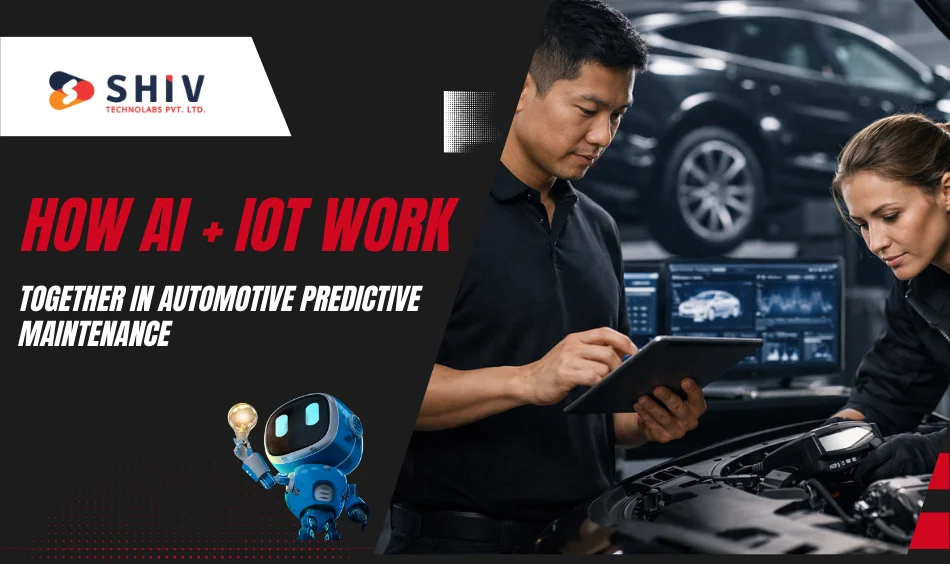
The dynamics between AI and IoT are that of a highly connected system, with the IoT providing sensing and connectivity and the AI providing intelligence and decision-making. This synergy enables real-time diagnostics, early fault detection and automated maintenance.
IoT Sensors – Continuous Vehicle Data Capture
The sensors used in IoT are incorporated into engines, transmissions, batteries, brakes and tyres and constantly record operational parameters such as temperature, pressure, vibration, voltage and wear rate. This is the foundation of IoT in car maintenance.
Data Transmission – Edge + Cloud Pipelines
LTE, 5G, vehicle-to-cloud gateways, or CAN bus are used to transmit sensor data. Edge nodes process time-critical events and big data is processed on cloud platforms through large-scale analytics, storage and model training.
AI Algorithms – Pattern Recognition + Failure Prediction
Machine learning models trained on past fault data are used in AI for automotive predictive maintenance. These models predict degradation, anomaly and failure patterns well before mechanical damage occurs. (See AI/ML services and Predictive AI development)
Automated Alerts + Maintenance Triggers
When risk levels are exceeded, the system will automatically issue warnings, set service events, or suggest replacing parts. This lessens man’s dependence and enhances response speed.
IoT Metrics Used in Predictive Maintenance
| Metric Type | Sensor Type | Typical Range | Predictive Insight |
|---|---|---|---|
| Engine Temperature | Thermocouple | 85°C–110°C | Overheating risk |
| Tire Pressure | TPMS | 32–36 PSI | Leak detection |
| Vibration | Accelerometer | < 2.5 mm/s RMS | Bearing wear |
| Battery Voltage | Hall Sensor | 11.8V–12.6V | Battery failure |
| Brake Wear | Linear Sensor | ≤ 3 mm | Brake servicing |


Key Components of an Automotive Predictive Maintenance System
Below are some of the critical components of the Automotive Predictive Maintenance System:
Data Acquisition and IoT Connectivity
The vehicles are equipped with in-built sensors that measure parameters such as oil viscosity, torque performance, fuel economy, and emissions. The IoT connectivity will ensure continuous information flow between vehicles and analytics platforms, enabling scalable automotive predictive maintenance at the fleet scale.
Artificial Intelligence and Machine Learning Intelligence
Vehicle monitoring systems based on AI process historical and real-time data to detect anomalies. Models are always self-learning as they get better at predicting each maintenance interval and failure.
Cloud + Edge Computing Architecture
Edge computing enables immediate decision-making in safety-critical situations, whereas cloud infrastructure supports extensive data processing, long-term storage, and cross-vehicle analytics.
How Automotive Predictive Maintenance Improves Operational Efficiency
Predictive maintenance changes the maintenance into a performance driver instead of a cost centre.
- Cuts unwanted car downtime by 40%+.
- Lowers maintenance cost by 25%–30%
- Enhances the utilization rate of the fleet by 20+.
- Improves driver safety by providing early warnings of faults.
- Prolongs the life of components with condition-based servicing.
For businesses that invest in the development of specialized automotive software, predictive systems open the door to long-term ROI, scalability, and functional resilience.
Use Cases of Automotive Predictive Maintenance
Some of the standard applications of automotive predictive maintenance are listed below;
Optimization of Fleet Management
Real-time fault detection by logistics and mobility companies helps prevent failures, increase route reliability and minimise SLA breaches. Centralised monitoring of thousands of vehicles simultaneously is enabled by predictive platforms.
Battery Health Monitoring in Electric Vehicles
AI models are used to examine charging trends, thermal behavior and voltage changes to forecast battery degradation and prevent unexpected EV crashes.
Commercial Vehicle Powertrain Monitoring
Vibration, torque and temperature are continuously monitored to detect gearbox and engine wear at its earliest stages, thereby preventing devastating failures.
How Shiv Technolabs Builds Predictive Maintenance Platforms?

Shiv Technolabs is one of the most successful development companies, with a team of developers skilled in predictive maintenance platforms and proud of their creation. The best methods through which Shiv Technolabs can develop a predictive maintainability platform are as follows:
Data Mapping and Requirement Analysis
The types of sensors, vehicle architectures, and data sources, as well as fleet size, are evaluated to develop specific predictive solutions.
System Architecture Design
Long-term expansion, Scalable architectures based on AI models, IoT systems, cloud computing and dashboards.
Development and Testing
With advanced AI development services, models are trained, validated and fine-tuned on real-world datasets.
Deployment and Monitoring
Constant performance monitoring is implemented with predictive dashboards, automated alerts and maintenance scheduling systems.
How to Choose the Right Partner for Predictive Maintenance Projects
The next difference between a predictive maintenance system that delivers actual ROI and one that remains at the pilot stage is the selection of an appropriate technology partner. Automotive predictive maintenance is not a plug-and-play solution based on AI and IoT. It involves extensive domain knowledge, architecture scalability and planning.
Automotive Domain Expertise over Generic Development Skills
Not all AI and IoT vendors know how vehicles work. Systems relating to automobiles include ECUs, CAN bus, telematics protocol, safety requirements and regulatory requirements. Your partner should have demonstrated experience in automotive software development services, not in generic AI development. Domain expertise has been found to minimise implementation risk by 30-40% and can also save time to deployment.
Powerful Artificial Intelligence and Data Engineering.
The success of predictive maintenance depends on the quality of the data and the accuracy of the model. Find teams with applied experience in AI-based vehicle monitoring systems, anomaly detection, time-series forecasting and model retraining pipelines. An effective automotive software development company like Shiv Technolabs must be able to explain how it can achieve more than 85% accuracy in predictions using actual vehicle statistics.
IoT Hardware Compatibility and Integration Readiness
The development partner should be able to work with various IoT sensors, gateways, and communication standards. This consists of temperature sensors, accelerometers, TPMS, battery sensors, LTE/5G modules and edge devices. If compatibility issues are not identified early in the process, the cost may increase by 20%+.
Scalable Fleet Expansion Architecture
A predictive maintenance system should be able to support 10 vehicles to 10,000 or more vehicles without impairment. Inquire about cloud architecture, edge processing plan, data storage designs and load management. Scalability will control all costs in the long term and ensure readiness for the future.
Security and Compliance First Approach
Vehicle data is sensitive. Encryption, access control, secure APIs, and adherence to automobile and data protection standards will be the priorities of the right partner. Poor security design poses significant operational and legal risks.
At Shiv Technolabs, we have extensive expertise in software development for predictive maintenance and AI in the automotive industry. Our team provides end-to-end predictive maintenance for OEMs, EV brands, and fleet operators.
Future of AI + IoT in Automotive Predictive Maintenance
The following are the main guidelines outlining the future of AI and IoT in automotive predictive maintenance over the next decade.
Digital Twins – Virtual Replicas of Physical Vehicles
Automobile predictive maintenance systems will have digital twin technology as a fundamental layer. A digital copy of each vehicle will be created in the cloud, and it will be run in real-time.
What this enables
- Continuous component behaviour simulation.
- Failure scenarios are tested before they occur.
- Accuracy of prediction increased by 90% +.
- Maintenance decisions are approved virtually in advance.
Digital twins + AI models will allow OEMs to answer questions like:
- “What happens if this battery continues at 42°C for 3 weeks?”
- “What is the probability of gearbox failure in the next 500 km?”
This moves maintenance from prediction → prevention → optimization.
5G + V2X Connectivity – Ultra-Low Latency Diagnostics
As 5G deployment worldwide continues to gain momentum, IoT will enable almost-zero-latency communication for automotive maintenance.
Effects of 5G on predictive maintenance.
- The time of data transmission decreased from seconds to milliseconds.
- Even high-speed highway diagnostics became possible.
- Vehicle-to-infrastructure + vehicle-to-cloud intelligence.
- On-the-fly warnings of safety-critical failures.
This also allows predictive maintenance systems to operate while vehicles are in motion, not only when they are not moving or parked.
Edge AI – On-Vehicle Intelligence (No Cloud Dependency)
Future vehicles will not rely entirely on cloud processing. Embedded ECUs will have edge AI chips.
- Analyze sensor data locally.
- Anticipate failures even without the Internet.
- Activate immediate safety measures.
- Favours: lower cloud processing costs by 30-40%.
This is particularly imperative among.
- Autonomous vehicles
- Defense fleets
- Construction vehicles + mining.
- Distributed logistics processes.
Vehicle monitoring systems, powered by AI, will be quicker, safer, and more robust.
Self-Healing Systems – Automated Maintenance Actions
The next evolution is self-healing vehicles.
Examples include
- Software recalibration was activated automatically.
- Redistribution of loads as a component failure.
- Dynamic driving behaviour to defend malfunctioning components.
- OTA updates corrective measures before service visits.
Predictive maintenance will cease to be alert-based. It will perform remedial measures independently.
AI-Driven Maintenance Forecasting at Fleet Scale
For fleet operators, predictive maintenance will shift to vehicle-level intelligence, bridging the gap between fleet-level data and optimisation.
Future systems will
- Anticipate failure in 10,000+ vehicles at once.
- AI forecasts to optimise spare parts inventory.
- Save on CAPEX due to maintenance, year over year, to the tune of millions.
- Plan maintenance in line with business demand.
This makes automotive predictive maintenance more of a strategic business intelligence tool rather than a technical system.
Regulation and Compliance Intelligence Built Into Systems
As regulations increase, AI + IoT platforms will incorporate compliance logic into predictive maintenance systems.
Capabilities will include
- Compliance tests as automated.
- Thresholds monitoring of emissions.
- Maintenance regulations of the region.
- Maintenance logs that are audit-ready.
This is essential to EV manufacturers, international OEMs and cross-border fleets.
Conclusion
The integration of AI and IoT has transformed automotive predictive maintenance into a mission-critical feature, driving reliability, cost-effectiveness, and safety. Predictive vehicles are better than reactive systems in terms of uptime, driver confidence, and ROI.
Shiv Technolabs, as one of the prominent automotive software development company, offers enterprise-level predictive maintenance solutions powered by AI, IoT, cloud, and data engineering. Our team supports intelligent, scalable, and future-ready systems for automotive businesses throughout the concept-to-deployment lifecycle.
Looking to reduce downtime, cut maintenance costs, and future-proof your vehicles? Connect with Shiv Technolabs today.
Frequently Asked Questions (FAQs)
1. What is predictive maintenance in automobiles?
Automotive predictive maintenance is an AI- and IoT-based software that continuously monitors a vehicle’s health, identifies early signs of impending failure and provides maintenance recommendations to prevent failures, increase vehicle reliability and lower operational costs.
2. What is the benefit of AI on the accuracy of maintenance?
AI can process high amounts of sensor data to discern hidden patterns and trends of degradation and predict failures with above 85% accuracy in practice in automotive settings.
3. Why is IoT important to predictive maintenance?
IoT continuously provides real-time device data from the vehicle, making it easy to monitor and diagnose remotely and to make AI-driven decisions, avoiding physical inspection.
4. What is the position of custom software?
Custom automotive software development ensures a seamless integration with car systems, telematics applications, analytics displays and business processes.
5. Where do we go with predictive maintenance?
There will be 5G connectivity, digital twins, embedded AI processors and entirely autonomous diagnostic systems built right into the cars.