Table of Contents
Backend decisions decide how far a product can go. The wrong choice hurts speed, cost, and trust. The right one keeps the product stable and ready to grow.
This guide compares backend development for startups and backend development for enterprises. It gives a clear view of startup vs enterprise backend needs, tech choices, and budget thinking. You will see how backend architecture differences between startups and enterprises come from stage, risk, and scale.
Founders often ask, “How much does backend development cost for startups?” Enterprise leaders ask, “How do we keep control without huge waste?” Both need a simple way to plan spending. That is where a good backend services pricing guide helps.

The sections below set the base. First, you understand the role of the backend. Then you see how startup teams think about MVP, speed, and cash flow. Later sections will go deeper into cost, security, and budget planning.
1. What Is Backend Development for Startups vs Enterprises?
1.1 Core Role of the Backend in Any Digital Product
The backend runs behind the screen. It talks to databases, checks rules, and serves data to the frontend. It also links with payment tools, email tools, and outside systems.
A strong backend helps you:
- Store and read data in a safe way
- Run business logic in a repeatable way
- Talk with mobile apps, web apps, and third-party tools
- Track events, logs, and errors
For a startup, backend development for startups often means “get core features live fast, with safe data and low waste.” The code must stay clear and flexible. The team knows they may change parts in a few months.
For a large company, backend development for enterprises focuses on scale, rules, and stability. Many systems talk to each other. Many teams share the same backend. Small changes need review, tests, and strong release steps.
When you plan backend API development cost, do not think only about code. Think about:
- Versioning and contracts
- Access rules
- Logging and tracing
- Error handling and support
These parts add time and spend. But they reduce risk for both startups and enterprises.
1.2 Key Differences: Startup vs Enterprise Backend at a Glance
You can see key backend architecture differences between startups and enterprises in daily work. The table below gives a simple view.
| Aspect | Startup Backend Needs | Enterprise Backend Requirements |
|---|---|---|
| Main goal | Ship fast, reach fit, survive | Stay stable, meet rules, scale across units |
| Scope | Narrow, focused on core use case | Wide, covers many products and flows |
| Team size | Small, multi-role developers | Many roles: architects, SRE, DB, security |
| Process | Light process, quick releases | Formal process, release gates, audits |
| Risk view | Takes more product risk | Low tolerance for downtime and data loss |
| Tech stack | Few tools, modern stack | Mix of new and legacy systems |
| Data rules | Simple rules at first | Strong rules, audits, and regional limits |
This view helps you frame startup vs enterprise backend choices. A startup trades control for speed. An enterprise trades speed for safety and alignment.
When you later compare backend development cost startups vs enterprise, this table also helps. Every row adds hidden cost on the enterprise side. More roles, more reviews, and more systems all need time.
2. Startup Backend Needs: MVP, Speed, and Cash Flow
2.1 Startup Backend MVP vs Full Platform
Most new products start as an MVP. The backend should do the same. A startup backend MVP vs full platform approach keeps risk low. You ship core value, then learn from users.
A good MVP backend:
- Serves one or two main user journeys
- Uses simple flows for auth, billing, and data
- Keeps code small and clear
- Avoids early “nice to have” features
This approach matches real startup backend needs. Investors care about traction and clear value. Users care about speed and trust. The backend should support both without heavy overbuild.
Over time, the same product may grow into a full platform. At that point you can split modules, add more services, and improve infra. Early choices should not block this path. So the team should keep clear boundaries around domains.
You do not need heavy microservices at the start. Many strong startups run on a simple monolith for years. What matters is discipline in design and tests.
2.2 Tech Choices for Startups: Custom Backend vs BaaS
Early teams face a key choice: custom backend vs BaaS.
With a custom backend, you write your own APIs, data layer, and logic. You pick the language and framework. You get full control. You can run backend development for startups in a way that matches your product perfectly.
With BaaS (Backend as a Service):
- Auth, database, and file store often come ready to use
- You work with SDKs instead of raw infra
- You move faster in the first months
For very early MVPs, BaaS fits when:
- Time to launch matters more than fine control
- The data model is simple
- The team has more frontend skills than backend skills
Custom backends fit when:
- You need special logic and flows
- You must meet strict data rules
- You aim for complex backend architecture differences startups enterprises in the future
This choice also affects backend development time comparison. BaaS may save months at the start. But deep custom changes later may feel harder. Custom builds take more time up front, but can help with long-term freedom.
The right answer depends on your product, runway, and skills.
2.3 Backend Database Choice for Startups: SQL vs NoSQL
Data design shapes the rest of the system. A clear backend database choice SQL NoSQL startups decision saves you pain later.
SQL databases (PostgreSQL, MySQL, and similar) work best when:
- Data has clear structure and relations
- You need strong consistency
- You run reports that join many tables
NoSQL databases (MongoDB, DynamoDB, and similar) work best when:
- Data has a flexible shape
- You store large event streams or logs
- You need very high write speed for simple records
For most early products, a single SQL database is enough. It keeps queries clear and data safe. Many teams only add NoSQL later for special needs such as logs or events.
The key rule for backend development for startups here is simple. Do not add two or three databases “just in case.” Each new store adds more work for backups, tests, and backend performance benchmarks.
Pick one main store. Shape your MVP around it. Add extra stores only when you see a strong, measured need.
3. Enterprise Backend Requirements: Scale, Compliance, and Control
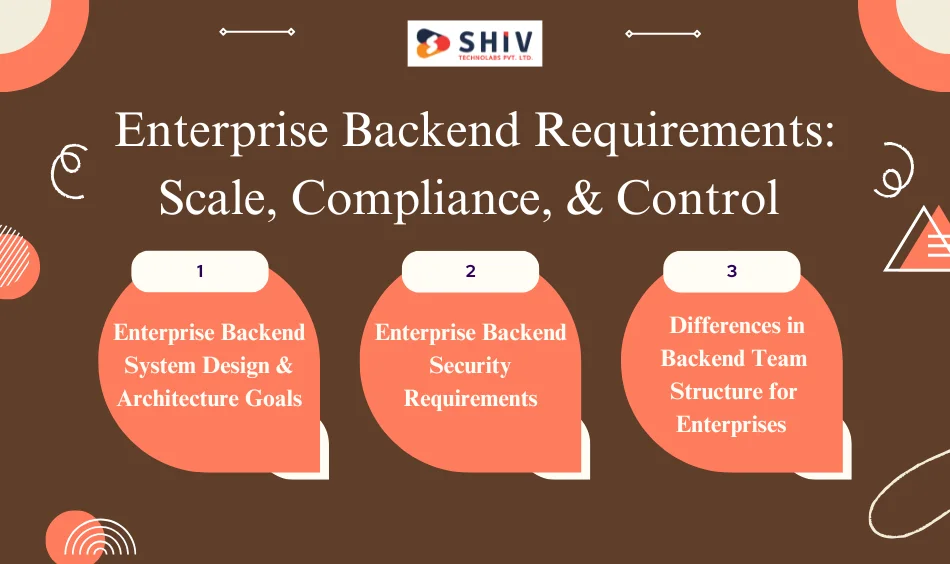
Enterprises treat backend systems as the foundation of the business. They cannot afford unstable flows or unclear data. Decisions move slower, but they avoid sudden failure. This shapes backend development for enterprises in every step.
3.1 Enterprise Backend System Design and Architecture Goals
Enterprises build systems that must support thousands or millions of events. They handle global users, regional rules, and multiple product teams. A clear enterprise backend system design helps teams ship without breaking shared parts.
Core goals in enterprise backends:
- Predictable performance under load
- Easy integration with internal tools
- Data consistency across multiple regions
- Traceable logs and audit trails
- Fast recovery after failures
- Support for legacy systems still in use
Enterprises connect with CRMs, ERPs, data warehouses, marketing tools, and reporting engines. Every new integration adds scope. This raises backend development cost startups vs enterprise because each contract with third-party systems needs tests, staging data, and review.
3.2 Enterprise Backend Security Requirements
Security is not optional. Legal teams, compliance officers, and auditors expect strict control. Enterprise backend security requirements cover access, privacy, and data location.
Security layers include:
- Role-based access control
- Encryption at rest and in transit
- Secrets rotation and storage rules
- IP rules for admin tools
- Data retention rules
- Region-based hosting policies
These controls protect the brand. They also protect teams from data leaks or loss of trust. They increase the cost of backend development for enterprises, but they cut long-term damage.
Compliance frameworks like GDPR, SOC 2, HIPAA, and PCI-DSS shape backend choices. They influence hosting location, database selection, and log retention. Startups rarely start with these rules. Enterprises must.
3.3 Differences in Backend Team Structure for Enterprises
A startup team might have three developers sharing tasks. An enterprise team may have ten roles before writing a single feature.
| Role | What They Focus On |
|---|---|
| Backend Engineer | Daily logic and API features |
| Solution Architect | System structure and integration plans |
| SRE (Reliability) | Uptime, logs, scaling automation |
| DBA | Indexes, queries, migrations |
| Security Engineer | Access, audits, secret handling |
| QA Lead | Test plans and automation |
| DevOps | CI/CD pipelines, infra automation |
This team structure explains why backend development costs startups vs enterprise can be 3x to 10x higher. More hands, more steps, more review. The result is lower risk and steadier operations.


Enterprises value consistency more than speed. Startups value speed more than consistency. This gap drives most backend architecture differences between startups and enterprises.
4. Backend Architecture Differences: Startups vs Enterprises
Architecture reflects business goals. Choice of architecture is not about trends. It is about user volume, compliance, and change frequency. This is why startup vs enterprise backend looks different even with similar tech stacks.
4.1 Monolithic vs Microservices for Startups and Enterprises
Startups often choose a monolith. It keeps code in one place. It keeps decisions simple. It pairs well with short funding cycles and fast pivots.
Enterprises often choose microservices. They split code into services by domain. Each team owns a part.
This keeps risk contained when making changes.
| Case | Best Fit | Why |
|---|---|---|
| Early product | Monolith | Faster build, cheaper to maintain |
| One team | Monolith | Less coordination effort |
| Many departments | Microservices | Clear ownership boundaries |
| Strict compliance | Microservices | Easier to isolate risky modules |
| Global traffic | Microservices | Scaling based on demand per area |
This connects back to real demand. Microservices vs monolithic for startups/enterprise is not a debate of right or wrong. It is a trade-off of speed vs control.
4.2 Backend Infrastructure Comparison: Hosting, Cloud, and Environments
Infrastructure choices shape budget and reliability. This is where backend infrastructure comparison helps teams pick the right path.
Startups may run:
- A single region cloud server
- One database cluster
- One staging and one production environment
Enterprises may run:
- Multi-region cloud footprints
- Load balancers with auto-scaling
- Container orchestration
- Multiple environments (dev, test, UAT, stage, prod)
Cloud providers bill per resource. This matters when planning spend. Cloud hosting for backend starts small for startups but grows fast for enterprise loads. Costs come from compute, storage, bandwidth, and support tiers.
4.3 Backend Scaling for Startups vs Enterprises
Scaling keeps the product alive under growth. Startups scale by reacting. Enterprises scale by planning.
Startup tactics:
- Vertical scaling first (add more CPU/RAM)
- Caching for hot routes
- Simple queue for heavy tasks
Enterprise tactics:
- Auto-scaling clusters
- Content delivery networks for global reach
- Event-driven queues for heavy flows
- Failover planning and disaster recovery
5. Backend Development Cost: Startups vs Enterprise Budgets

Money shapes backend choices. Scope, security, and team structure all push cost up or down. This section focuses on cost thinking, not exact numbers. You will see ranges in later sections.
5.1 How Much Does Backend Development Cost for Startups?
Founders search “how much does backend development cost for startups” because they want clarity before spending. They fear building the wrong thing. They fear spending all funds before reaching market fit.
Cost factors:
- MVP scope
- Tech stack complexity
- Third-party APIs
- Hosting needs
- Data rules
- Testing needs
Startups cut cost by limiting features and avoiding early overbuild. They often ship with a small team and fewer environments. They might accept temporary trade-offs to test demand first.
5.2 Backend Development Cost for Enterprises
For enterprises, cost comes from complexity. They plan multi-year roadmaps. They maintain old features while adding new ones. They pay for audits, compliance, and governance.
This makes backend development cost startups vs enterprise uneven by default. Enterprises spend more on planning than startups spend on coding. That planning protects revenue at scale.
6. Backend Services Pricing Guide: Models and Trade-Offs
Money flows through pricing models. You must pick the model that matches your product stage.
Common models:
| Model | Best For | Strength | Weakness |
|---|---|---|---|
| Fixed Price | Short MVPs | Clear budget | Limited scope |
| Hourly | Iterative builds | Flexible direction | Cost creep risk |
| Dedicated Team | Large roadmaps | Stable capacity | High monthly spend |
| Performance-Based | Specific modules | Results focus | Hard to define success |
7. Backend Outsourcing Cost vs In-House Teams
Team setup influences cost more than tech selection. Outsourcing and in-house models suit different stages. A startup may not afford full-time experts. An enterprise may not want outside dependency for core systems.
Outsourcing Model
- Fast access to skills
- Lower hiring and onboarding effort
- Works well for MVPs and pilot projects
- Good for add-on modules like billing or CRM sync
Hidden costs appear when:
- Requirements change often
- Time zone gaps slow reviews
- Code ownership is unclear
In-House Model
- Direct control on code and roadmap
- Easier to maintain standards
- Better alignment with business priorities
Costs rise when:
- Hiring takes months
- Training becomes a burden
- Retention is hard
How this ties to spend:
| Cost Factor | Startup Impact | Enterprise Impact |
|---|---|---|
| Salaries | Lower initial hiring power | High due to skill depth |
| Tools | Basic stack only | Enterprise license fees |
| Management Time | Founder-led in many cases | Project and department management |
| IP Ownership | Can be unclear in early outsourcing | Protected by contracts and structure |
8. Licensing, Cloud, and Ongoing Maintenance Costs
After launch, hosting, tools, and updates create a monthly cost floor. This affects backend development cost startups vs enterprise even without new features.
For Startups
- Single cloud region
- Shared hosting tiers
- Entry-level logging and analytics
- Simple CI/CD
For Enterprises
- Multi-region hosting
- Role-based access systems
- Dedicated CI/CD runners
- Observability platforms
Cloud hosting for backend becomes visible when traffic grows. For example, adding a second region doubles infra cost. Many enterprises spend more on cloud than development.
Costs that appear later:
- Database scaling costs
- Monitoring and alerting services
- Backup storage
- CDN traffic for global users
- Support retainers
This is where the backend budget planning checklist fits. It prevents surprise spend and supports long-term planning.
9. Backend Budget Planning Checklist for Startups and Enterprises
The checklist below guides both teams. It prevents guesses and supports data-backed decisions.
9.1 Budget Planning Checklist for Startups
Focus on stability without big commitments.
- Confirm MVP scope before hiring
- Decide custom build or custom backend vs BaaS
- Assign budgets to at least one staging environment
- Track backend infrastructure comparison to avoid overbuild
- Pick one main database (SQL unless proven otherwise)
- Estimate backend API development cost per integration
- Keep providers that allow switching later
- Plan for 6–12 months of hosting spend
This protects runway. It keeps the budget connected to real demand. It also keeps backend development for startups flexible without locking into early mistakes.
9.2 Budget Planning Checklist for Enterprises
Focus on structure, compliance, and redundancy.
- Confirm data governance rules
- Set regions based on regulatory needs
- Assign budgets for DevOps roles
- Plan CI/CD and artifact storage
- Set a support plan for legacy systems
- Track tool licenses and renewal dates
- Review security every quarter
- Measure against backend performance benchmarks
This ensures that enterprise backend system design supports growth. It cuts waste and reduces risk before scaling.
10. Measuring Backend Success: Performance Benchmarks and Business Impact
Without benchmarks, it is impossible to know if the backend works well. Benchmarks connect engineering with user experience.
Important backend performance benchmarks:
| Benchmark | What It Shows |
|---|---|
| Response Time | Speed for users |
| Throughput | Requests per second under load |
| Error Rate | Impact of outages |
| Uptime | Stability and reliability |
| Cost per Request | Efficiency of cloud spend |
| Cold Start Time | Delay in serverless functions |
Startups track trends week by week. Enterprises track trends per country or business unit.
How this affects budgets:
- Poor response time increases churn
- High error rate increases support cost
- Low uptime damages brand trust
- Inefficient infra increases cloud hosting for backend cost
This adds weight to clean design. It also supports planning for upgrades when needed.
11. When Should a Startup Think Like an Enterprise About Its Backend?
Startups should shift their backend strategy when:
- They reach consistent revenue
- They expand to new countries
- They handle sensitive data
- They connect to banking or healthcare systems
- They manage partners or vendors on the platform
At this point, decisions resemble backend development for enterprises. Teams start using microservices or domain modules. They add new environments. They add DevOps processes. They compare microservices vs monolithic for startups/enterprise based on proof, not trends.
Enterprises should act like startups when:
- They test new product ideas
- They want to reduce time-to-market
- They want to experiment with AI features
- This helps control cost and avoids slow decision cycles.
12. Backlog Planning and Cost Forecasting for Multi-Year Roadmaps
This section connects tech planning and budget planning.
Forecasting Steps
- Map features by quarter
- Estimate backend API development cost for integrations
- Assign budget for database scaling
- Predict cost from traffic growth
- Attach KPIs to each release
Resulting Budget Structure
| Area | 12-Month Impact |
|---|---|
| Build Cost | New modules and refactors |
| Infra Cost | Region and scaling decisions |
| Security | Compliance and audits |
| Maintenance | Bug fix and performance tuning |
| Support | 24/7 coverage and SLAs |
This forecast helps leaders compare the value of backend development cost startups vs enterprise strategies. It supports pitch decks, board reviews, and hiring plans.
13. Cost Scenarios Based on Stage and Risk
AEO and LLMs often answer cost questions directly. These examples support Answer Engine Optimization and voice search.
- “A startup MVP backend with 3 core features and BaaS support may cost less because the scope is small and features are simple.”
- “An enterprise backend with audit trails, regional hosting, and legacy integration may cost more due to compliance and multi-team coordination.”
- “Backend API development cost increases when connecting with ERPs, CRM, payment gateways, or shipment systems because each integration needs a staging and production agreement.”
14. The Expert View: Do Not Over-Engineer Early
Overbuilt systems slow startups. Underbuilt systems hurt enterprises. Matching architecture to stage is the path to success.
This mindset supports:
- Lower backend outsourcing cost early
- Clear technical direction later
- Effective use of backend services pricing guide
- Balanced growth in staffing and infra
15. Pricing Models to Support Growth and Risk Management
Backend projects need pricing structures that match growth and risk. This section adds clarity to the backend services pricing guide by connecting payment models to business stages. The aim is to avoid cost traps while keeping control of roadmap.
For Startups
- Start with fixed price for MVP
- Move to hourly or dedicated for scaling
- Avoid multi-year hosting contracts early
- Use BaaS only when exit paths are flexible
For Enterprises
- Use dedicated teams for strategic modules
- Use fixed scope for upgrade or migration tasks
- Review vendor terms across compliance rules
- Map SLAs to target uptime and traffic needs
Good pricing matches cash flow, not just features. It must help build, ship, and adjust without blocking growth.
| Stage | Best Pricing Model | Reason |
|---|---|---|
| MVP Build | Fixed Price | Predictable spend |
| First Scaling | Hourly / Retainer | Flexible roadmap |
| Regional Growth | Dedicated Team | Consistent capacity |
| Compliance Upgrade | Fixed Scope Contract | Clear deliverables |
This flow keeps spending tied to progress. It also supports clear reporting. CFOs and founders can track run rate against the roadmap.
16. Planning Backend Migration: When and Why to Rebuild
Migration happens when backend limits slow the business. Startups rebuild when MVP decisions block scale. Enterprises rebuild when legacy systems block compliance or new regions.
Triggers for Migration
- Latency increases as regions grow
- Product lines expand under a single monolith
- Security rules shift
- Database size hits performance walls
- New partners demand new API formats
These triggers show why comparing startup vs enterprise backend is helpful. They share pain points, but scale changes impact.
Migration checklist:
- Identify modules that need change first
- Confirm where backend architecture differences startups enterprises show limits
- Review backend performance benchmarks to pick upgrade priorities
- Confirm budget for downtime and rollback plans
- Set a path for multi-stage rollout
Migration is not a single event. It is a phased release. One module at a time.
17. Connecting Backend Spend to Revenue and Customer Trust
A backend is not only a technical asset. It is a revenue engine. Every performance shift impacts sales, retention, and onboarding.
Connections worth tracking:
- Faster response time → Higher conversion
- Fewer errors → Lower churn
- Clear logs → Faster support resolution
- Better data design → Cleaner personalization
- Secure systems → Higher compliance trust
This impact is why backend development for enterprises invests in observability. It is also why backend development for startups must avoid shortcuts that break user trust.
Teams should link backend KPIs to business KPIs:
| Backend Metric | Business Impact |
|---|---|
| Response Time | Checkout success rate |
| API Error Rate | Abandoned sessions |
| Uptime | Customer satisfaction |
| Time to Deploy | Speed of feature rollout |
| Infra Cost | Gross margin for tech |
If your roadmap includes MVP builds, scaling for new regions, legacy migrations, or compliance upgrades, our backend team can help. We support backend development for startups and backend development for enterprises with clear plans, transparent pricing, and hands-on implementation. Share your stage, tech stack, and goals. We will suggest a path that balances speed, cost, and long-term control.
FAQs
Q1. What is the main difference between backend development for startups and enterprises?
Backend at startups focuses on MVP, speed, and cash flow. Backend at enterprises focuses on stability, compliance, and controlled scaling.
Q2. How much does backend development cost for startups vs enterprises?
Startups spend based on MVP scope and hosting needs. Enterprises spend more due to compliance, audits, legacy systems, and multi-region infrastructure.
Q3. Should a startup choose monolithic or microservices architecture?
Most startups begin with a monolith to ship fast. Microservices fit when multiple teams need clean ownership or when compliance rules demand isolated modules.
Q4. What drives backend API development cost the most?
Integrations with external systems, database complexity, and environment setup drive cost more than basic API coding.
Q5. How should enterprises control cloud hosting costs?
Track usage per module, set auto-scaling rules, review tool licenses, and use performance benchmarks to plan capacity.
Conclusion
Backend choices shape product direction. The right approach supports stability, speed of releases, cost control, and future growth. Backend development for startups should focus on MVP, cash flow, and clear system boundaries. Backend development for enterprises should focus on scale, data rules, and controlled upgrades across regions and teams.
The goal is not to copy one model from the other. It is to match architecture and budget with stage, revenue goals, risk level, and compliance needs. The path that works at seed stage will not work at international scale, and a structure built for an enterprise will slow a small product team.
Shiv Technolabs supports both startups and enterprises with backend planning, development, architecture reviews, and migration support based on stage, KPIs, hiring capacity, and tech stack direction. The approach stays practical, cost-aware, and focused on long-term clarity rather than short-term patches.
A backend that fits the stage becomes a growth partner, not a burden. That is how teams protect budgets, maintain trust, and reach new markets with confidence.