
Table of Contents
Speed is no longer a luxury in eCommerce but a revenue lever. Studies have found that 53% of users leave a site after more than 3 seconds of page load time, and each additional second of latency can cost up to 20% of conversions.
This is why brands are increasingly investing in front-end development services beyond superficial UI work. The actual performance improvements begin at the architectural level – the structure of the components, the loading of the assets, the API interaction, and the layout response to the devices.
There is a consistent improvement in page load time, SEO ranking, and conversion rate in businesses that utilize professional front-end development services, not accidental, but intentional.
Having a robust front-end architecture is the foundation for rapid online stores, with a diverse set of modern structures, clean code, responsive layouts, and headless configurations. This article explains why.

What Is Front-End Architecture and Why Is It Crucial for Online Stores?
The front-end architecture refers to the underlying structure on which an online store’s user interface is designed and implemented, and it is also optimized for performance. It specifies the interaction among HTML, CSS, JavaScript, frameworks, APIs, and assets to produce not only a pleasant appearance but also a fast load time, a scalable user experience that performs well, and long-term maintainability.
Poor front-end architecture in eCommerce includes bloated pages, weak updates, loss of search engine optimization, and unexploratory customer experiences. Good architecture, however, guarantees that product pages load immediately, filters act quickly, and design changes do not disrupt functionality.
In larger stores with increased traffic, larger catalogs, and frequent updates, front-end architecture is where sustainability performance lies and where technical debt runs deep. For many stores, pairing this with the right eCommerce development plan prevents regressions as catalogs grow.
Key Components of a Strong Front-End Setup
A front-end high-performance environment is constructed using the following pillars:
- Separated codebase – clear separation of HTML, CSS and JS.
- Reuse and consistency Component-based structure. (See React tips in our React best practices guide.)
- High data flow between APIs and UI.
- Minimally blocked resource loading.
- Expandable folder + file structure to scale to the long-term.
These elements guarantee rapidity now and consistency tomorrow.
How Does Front-End Architecture Affect Store Speed and SEO?
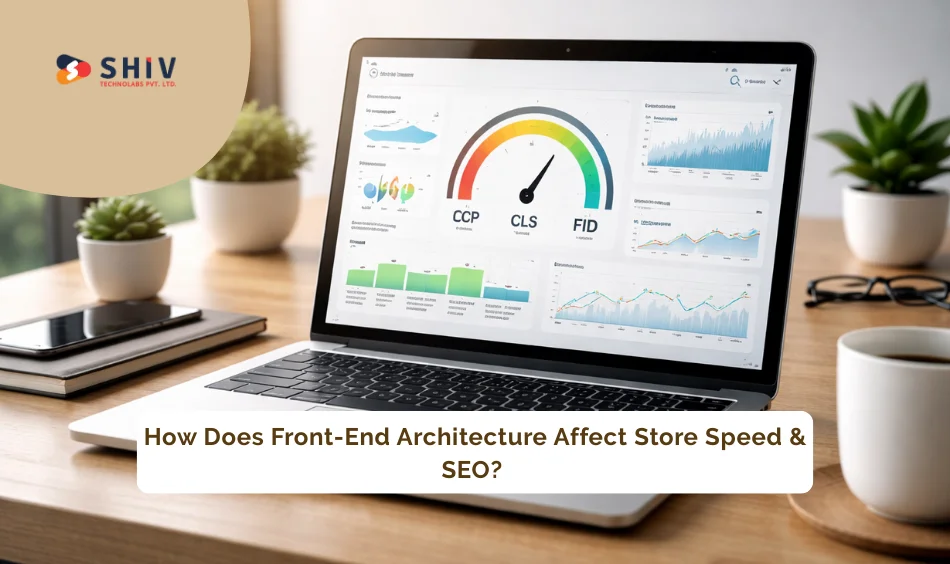
The front-end architecture directly affects page load optimization, search engine optimization and user retention. Each architecture option (e.g., a framework) or script-loading sequence affects how quickly browsers render content.
The stores are now ranked by search engines based on Core Web Vitals, including LCP (Largest Contentful Paint), CLS (Cumulative Layout Shift) and FID (First Input Delay). Poor architectural design (e.g., script blocking or inefficient client-side rendering) is detrimental to all three measures, making it less visible and lowering traffic. For a practical take, see how Next.js supports strong Core Web Vitals in our write-up on Next.js and performance.
Front-End Factors That Influence Page Speed
| Performance Factor | Front-End Impact | Effect on Online Store Speed |
|---|---|---|
| Code structure | Clean, modular logic | Reduces rendering time |
| Asset management | Smaller, optimized files | Faster page load |
| API integration | Async & cached calls | Smooth product loading |
| Framework efficiency | Modular rendering | Less UI blocking |
| Image handling | Lazy loading + compression | Boosts mobile speed |
Well-optimized front-end procedures will always result in quantifiable search engine optimization, increased crawl rates, and increased time per session.


Which Modern Front-End Frameworks Deliver the Best Performance?
Front-end choice of eCommerce involves a strategy for front-end development. The misdirected structure retards development; the correct one expedites it.
Comparing Popular Frameworks
| Framework | Ideal Use Case | Speed Advantage | Scalability |
|---|---|---|---|
| React | Dynamic online stores | Virtual DOM improves rendering | Excellent |
| Vue.js | Mid-scale eCommerce | Lightweight runtime | Good |
| Angular | Enterprise platforms | Built-in optimization | Excellent |
| Next.js | SEO-driven stores | Server-side rendering (SSR) | High |
No universal structure exists. React and Next.js are prevalent in performance-oriented stores, Vue is popular among lean development teams, and Angular is adapted to enterprise ecosystems. The most suitable option will be based on the size of the catalog, the level of search optimization, and the level of integration.
How Does Headless eCommerce Architecture Improve Store Speed?
Headless eCommerce architecture separates the front-end and back-end so that each layer can be executed independently. This type of architectural change offers significant performance benefits.
Front-end systems only request the necessary data, precisely where it is needed, via APIs rather than loading an entire page. This minimizes payload size, enhances caching and enables dynamic rendering at an accelerated rate across channels.
Benefits of Headless Architecture
| Benefit | Description | Result |
|---|---|---|
| Decoupled system | Front-end + backend operate independently | Faster updates |
| API-driven content | On-demand data fetching | Reduced latency |
| Multi-channel support | Unified web + mobile UX | Consistency |
| Easier scaling | Independent upgrades | Better stability |
Headless structures have been found to increase page load times by 20-40% and to improve checkout experiences in businesses that have adopted them.
For practical approaches, see our guides on Shopify headless commerce and Next.js + Headless CMS for eCommerce.
What Role Does Front-End Code Optimization Play in Performance?
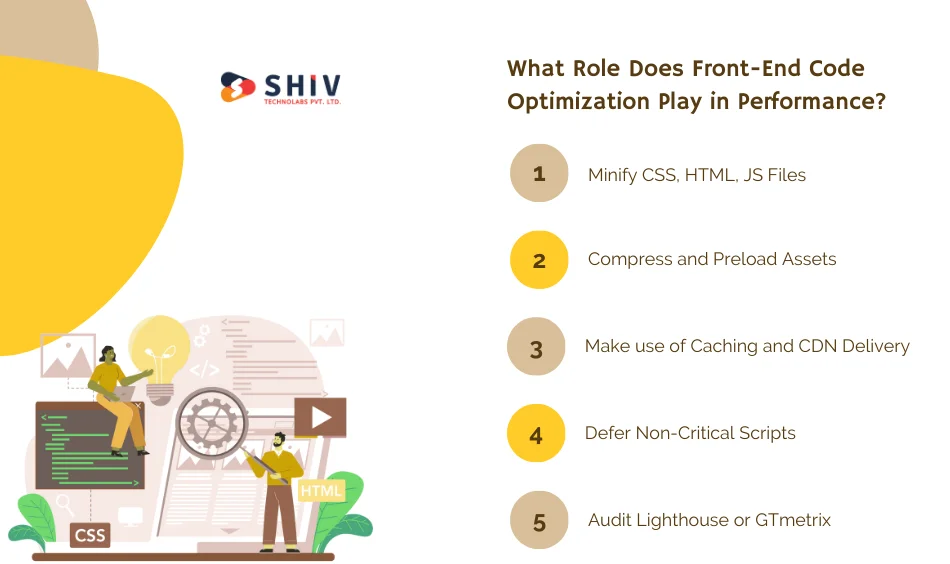
Architecture provides the background, while front-end code optimization adds the final touch. Faster code optimization reduces HTTP requests, improves rendering and stabilizes performance during traffic surges.
Minify CSS, HTML, JS Files
Minification removes extraneous characters, spaces and comments from files. The smaller the files, the quicker the download and the quicker rendering. This in itself can reduce page weight by 2030 without altering functionality.
Compress and Preload Assets
Compression (GZIP, Brotli) minimizes asset size and preloading critical files prioritizes the assets browsers need. This reduces Time-to-First-Paint and enhances subjective speed.
Make use of Caching and CDN Delivery
Caching eliminates duplicate requests, and CDN further translates assets to users based on their location. Together, they will have a decisive impact on reducing latency and server load.
Defer Non-Critical Scripts
Render blocking is avoided by deferring analytics, chat scripts and third-party scripts. The pages load quickly without compromising features.
Audit Lighthouse or GTmetrix
Frequent audits reveal bottlenecks, unused code and render delays, facilitating continuous improvement.
Google data shows that every second of the load time can boost conversion rates by 27%. If you need help, our front-end team runs audits and fixes alongside release cycles.
Why Does Responsive Online Store Design Affect Performance and Conversions?
Online stores’ design is no longer a choice to be made responsive as it directly affects speed, search engine optimization and conversion, particularly on mobile platforms.
Google’s mobile-first indexing implies mobile performance as a ranking factor. Reactive designs minimize asset redundancy and enhance UX consistency across devices.
Device Performance vs Conversion Rate
| Device Type | Avg Load Time (Optimized) | Conversion Rate |
|---|---|---|
| Desktop | 2.8s | 3.4% |
| Mobile | 1.9s | 5.2% |
| Tablet | 2.4s | 4.0% |
Mobile buyers and increased engagement are always attracted to responsive, optimized front-ends.
What Are the Business Benefits of Investing in Strong Front-End Architecture?
Powerful, performance-based front-end systems not only enhance speed but also improve business performance.
Tangible Business Gains
- Less maintenance through modular code
- Reduced server congestion + better availability
- Enhanced SEO visibility
- Cross-platform consistency
- Quick product development and additions
Good architecture provides a foundation to expand gradually as traffic, SKUs and customer expectations increase.
When Should You Hire Front-End Developers for Your Store?
Front-end problems compound with time. Delay is a cost and risk.
Situations That Demand Expert Help
- Page load exceeds 3 seconds
- Poor mobile responsiveness
- UI bugs after every update
- Migration between legacy systems
- Problems with API/CMs integration
When your store experiences all of that, it is time to bring in front-end developers who can rebuild performance at the architectural level.
How to Select the Right Partner for Front-End Development Services?
The choice of a front-end development company is as crucial as the technology itself.
Look for teams with:
- Proven eCommerce portfolio
- Mastery of React, Vue, Angular
- Powerful QA + performance testing
- Effective communication + speedy delivery
Assess partners based on technical proficiency and business knowledge, not on hourly rates.
Conclusion
Fast online stores are not built by accident, but rather designed. Good front-end architecture will make it faster, scalable, strong in search engines, and increase conversion on all the devices and channels. Since the frameworks and the headless models of the modern world, the performance begins with the front-end base.
Shiv Technolabs provides an enterprise-level front-end development company for eCommerce applications designed to perform well in large businesses. We are experts in React, Vue, Angular, headless architecture, and performance architecture that transforms slow stores into revenue generators.
When you are serious about having fast-loading online stores that convert, scale and rank, Shiv Technolabs is your partner today.
Frequently Asked Questions (FAQs)
1. What is front end architecture of eCommerce?
It is the architectural design of the interaction between UI elements, code and data to provide online store experiences that are fast, stable and scalable.
2. What is the benefit of optimization of front-end code in an online store?
Through file size reduction, file request minimization, script deferral and asset caching all of which enhance rendering and Core Web Vitals.
3. What is the reason why headless architecture can work faster in eCommerce?
Since it separates presentation and backend logic, it enables APIs to deliver only required data and minimizes rendering overhead.
4. What are the indicators of required front-end redevelopment?
Long loading times, poor mobile user experience, frequent user interface bugs, or an inability to add new features are signs that the architecture is constrained.
5. What is the price to recruit front-end programmers?
Projects can be performed in a variety of scopes and frameworks, ranging from $5,000 to $25,000, with ROI performance-based.