Table of Contents
The mobile applications are now earning billions of dollars per year, with in-app monetization becoming one of the surest ways to transform an application into a cash cow. As more people are ready to spend on premium content, digital goods, and subscriptions, businesses are considering Flutter as a powerful platform to deliver revenue-generating experiences.
The demand for developing Flutter apps is increasing because companies are increasingly preferring solutions that enable payments, subscriptions, and user management globally as simply as possible, with a cross-platform stack. According to reports, Flutter has 42% of the market share.
The in-app purchase ecosystem available in Flutter enables developers to add secure IAP flows, recurring billing, and build scalable monetization patterns on both iOS and Android using a single codebase. In-app purchases implemented properly are more than a revenue instrument; they generate loyalty among users, allow foreseeable monthly revenues, and have a retention potential in the long run.
This guide covers setup, strategy, monetization techniques, and optimization structures to assist the business in getting the most revenue with the help of Flutter.
What Are In-App Purchases and Subscriptions in Flutter?
In-app purchases (IAP) and subscriptions are a way for apps to generate revenue by selling digital content, premium access, or recurring services. Flutter is the single platform that supports the Android and iOS billing systems, which allows developers and businesses to generate monetization without having to maintain two codebases.
Flutter also allows consumable goods, one-time unlocks, and recurring subscriptions, so that businesses can flexibly develop the same revenue strategies that suit their product category, which could be gaming, health, education, productivity, streaming, or SaaS.
The in-app purchase and third-party SDKs provided by Flutter have a robust foundation for payment, receipt verification, user entitlement, and subscription control. For add-ons around payments/auth/analytics, see our quick guide to top Flutter plugins.
| Type | Description | Example | Renewal | Ideal Use Case |
|---|---|---|---|---|
| Consumable | One-time digital goods used repeatedly | Game coins, hints | No | Games, entertainment |
| Non-Consumable | Permanent unlock | Ad-free version | No | Utilities, productivity |
| Subscription | Recurring billing model | Monthly fitness plan | Yes | SaaS, OTT, education |
Why Should Businesses Integrate In-App Purchases in Flutter Apps?
In-app purchases transform apps into profit-making products that are likely to generate predictable revenue. For businesses developing with Flutter, IAP is a competitive advantage because it is compatible with both dominant mobile platforms. For a service partner, review our Flutter app development page.
Below are the seven core reasons IAP is essential for revenue expansion.
1. New Monetization Stream Without Ads
Advertisements can be obtrusive, less satisfying, and less engaging. In-app purchases allow monetization without interfering with the UX. The user is happy to pay to be valued over adverts with consumables, premium upgrades, or unlock features. It results in user retention and satisfaction.
2. Predictable Monthly Revenue
Subscriptions generate predictable, consistent revenue that grows each month. Multiple pricing levels, such as monthly, quarterly, or annual plans, contribute to the expansion of user adoption and increase MRR ($). Flutter uses RevenueCat or Firebase validation to manage payouts, renewals, grace periods and subscription status.
3. Enhanced Retention Through Continuous Value
Subscriptions or unlocks at different levels can keep users with the service longer, since they have already invested their money. Applications that provide ongoing value, such as fitness, meditation, productivity and education, are well off with subscription plans. Flutter has a highly responsive rendering engine and built-in animations, which make UX faster and enhance the perceived value.
4. Easier Customer Segmentation for Offers
IAP allows unlocking user segmentation for free users, first-time buyers, recurrent subscribers, churned subscribers and high-LTV buyers. You can submit personalised discounts, onboarding processes, or time-bound trial offers.
When done right, Flutter in-app purchases are a potential growth engine not a one-time revenue experiment.
Step-by-Step Flutter In-App Purchases Integration Guide
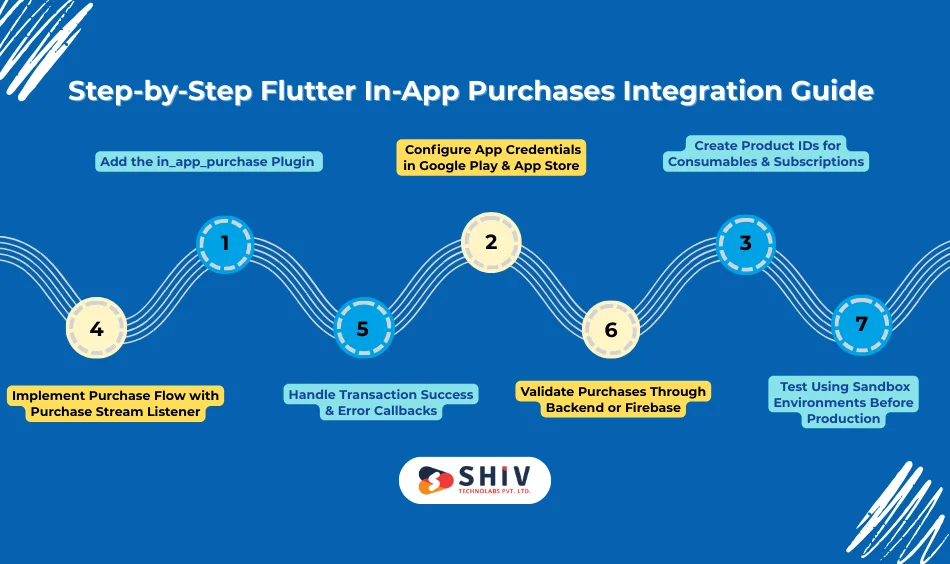
Below is a 7-step Flutter In-App Purchases integration guide:
1. Add the in_app_purchase Plugin
Install the billing and the plugin in pubspec.yaml. This is a plug-in that links Flutter to Google Play Billing + StoreKit. Check the appropriate permissions and bills. Perform platform checks using the provided APIs.
2. Configure App Credentials in Google Play & App Store
Log in to either console and turn on in-app products. Enter tax, payout information and review. Compile the uploaded app and enable billing in settings.
3. Create Product IDs for Consumables & Subscriptions
Determine the SKUs for consumables and non-consumables and the subscription levels. Determine costs, localities and time. Flutter also scans these IDs in real-time.
4. Implement Purchase Flow with Purchase Stream Listener
Track purchase endeavors, pending status and purchase successes using purchase streams. Offer a responsive user interface and communication.
5. Handle Transaction Success & Error Callbacks
Check payment status, display confirmation pages, open features and process canceled or failed purchases gracefully.
6. Validate Purchases Through Backend or Firebase
Fraud verification is performed on the server. Check receipts and save entitlement in Firebase Functions or a custom backend.
7. Test Using Sandbox Environments Before Production
iOS Test (TestFlight) and Android (Internal Testing). Verify and cross-verify all flows such as renewals, refunds and cancellation conditions.
Plugin Comparison for Flutter IAP
| Plugin | Features | Ideal Use Case | Platforms |
|---|---|---|---|
| in_app_purchase | Native billing | General apps | Android/iOS |
| RevenueCat | Unified dashboard, analytics | SaaS & subscriptions | Android/iOS/Web |
| Qonversion | A/B testing, experiments | Growth-focused apps | Android/iOS |
If you’re unsure about validation or multi-platform setup, partnering with experts prevents costly mistakes.


How to Boost App Revenue With Flutter Subscriptions?
Here are easy ways to boost app revenue after subscription:
Create Tiered Pricing Models
Provide Basic/Pro/Enterprise levels to grow ARPU. Different tiers are expected to contribute value-added features or unlimited access. Tiering enhances the possibility of upsell by 25-40%.
Use Limited-Time Trials to Hook Users
Free trials reduce friction. 7-, 14-, or 30-day trials help users understand value before paying. Trials increase conversions by up to 70%.
Bundle Complementary Services
Bundling training, templates or digital assets to create a sense of perceived value and higher prices.
Introduce Localized Pricing
Currencies vary, $4.99 in the US might convert poorly elsewhere. Localization improves global conversions 25–60%.
Reward Renewals with Loyalty Bonuses
Give points and gifts or unlock features at the end of every renewal period. Encourages retention.
Subscription Pricing Models and ROI
| Model | Price | Conversion Rate | ROI Growth |
|---|---|---|---|
| Single Tier | $4.99/mo | 4% | 15% |
| Tiered Plan | $4.99 / $9.99 | 7% | 28% |
| Annual Plan | $79/year | 9% | 35% |
How to Track and Optimize Flutter App Revenue Performance
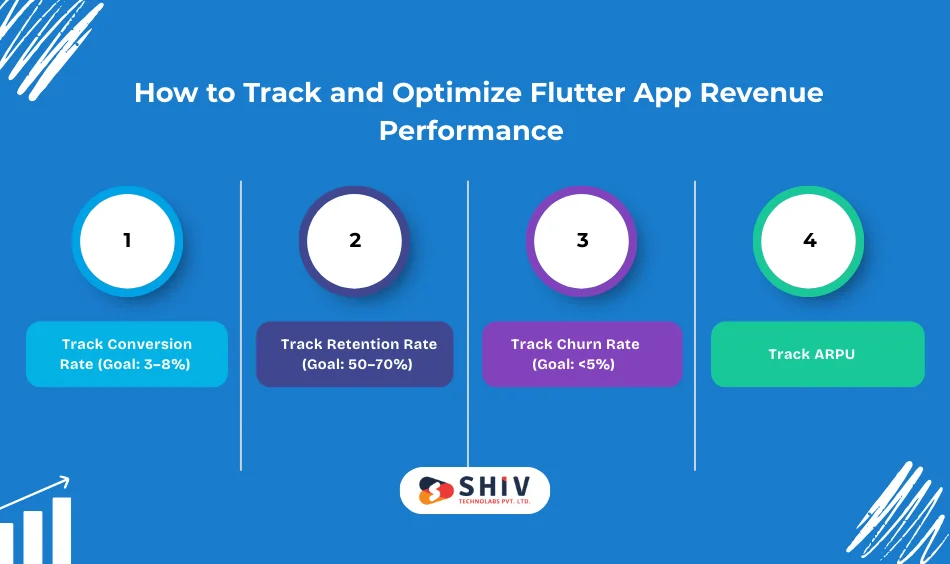
The foundation of an app that can make a profit on Flutter is revenue tracking. The growth will rely on watching funnels, improving conversions, reducing churn and increasing LTV once subscriptions go live.
Track Conversion Rate (Goal: 3–8%)
Indicates the number of users who pay past paywall. Optimize with better onboarding, better benefits, less friction, trial packages and paywall designs.
Track Retention Rate (Goal: 50–70%)
Determines whether or not users remain long enough to warrant subscription fees. Promote it with loyalty bonuses, monthly features, prompts, customized content and achievement systems.
Track Churn Rate (Goal: <5%)
Demonstrates the number of subscribers that cancel each month. Minimize churn through renewal, pause, win-back, usage summaries and cancellation feedback.
Track ARPU
The program has shown potential incomes per user. Grow ARPU by tier pricing, annual plans, consumables and premium bundling.
Key Performance Metrics
| Metric | Description | Ideal Range | Optimization Tip |
|---|---|---|---|
| Conversion Rate | Users → paid | 3–8% | Improve onboarding |
| Retention Rate | After 30 days | 50–70% | Add value loops |
| Churn Rate | Canceling users | <5% | Renewal reminders |
| ARPU | Revenue per user | Contextual | Test pricing |
What Common Problems Occur in Flutter In-App Purchases and How to Fix Them?
Some of the most widespread issues with Flutter In-App purchases and how to overcome them have been discussed:
Problem: Payment Not Completing on iOS
Fix: Check StoreKit settings, sandboxes, and entitlements.
Problem: Duplicate Transactions
Fix: Server-side validation of receipts and deduplication of IDs.
Problem: Subscriptions Not Renewing
Fix: Choose the auto-renewal flag and subscription setting.
Problem: Refunds Not Syncing
Fix: Turn on webhooks with either RevenueCat or Firebase Cloud Functions.
Facing recurring billing issues? Request a free Flutter monetization audit.
When Should Businesses Hire Experts for Flutter IAP Integration?
Contract individuals when your needs will require more than merely that.
Multi-Tier Subscription Structures
High-level logic entails architecture planning.
Enterprise Payment Validation Systems
The businesses require secure and scalable validation stacks.
Custom Analytics Dashboards
Combine churn prediction, funnels, and segmentations.
Global Multi-Currency Support
Tax management, domestic pricing, and FX adjustment.
Post-Launch Optimization Needs
Ongoing enhancements demand the services of professionals. Our Flutter experts assist in setting up safe and scalable monetization platforms that produce steady growth.
Conclusion
One of the most stable models of monetizing mobile applications is in-app purchases and subscriptions. Flutter simplifies it with cohesive APIs, ecosystems, validation mechanisms, and a common codebase that can run on both iOS and Android. When designed properly, IAP systems can become long-term revenue drivers, and retention, ARPU, and LTV will rise, creating significant value for users.
When you have a next-level project, you need Shiv Technolabs, the most experienced Flutter app development company, to deliver a profitable, future-ready solution.
Shiv Technolabs is one of the best experts in Flutter development and monetization strategy. You can be offered subscription flows, enterprise payment validation, an analytics dashboard, or global pricing systems that our specialists can deliver at scale, with a security and revenue orientation.
Frequently Asked Questions (FAQs)
1. How do in-app purchases work in Flutter?
Flutter supports Google Play billing and StoreKit using in-app purchase type plugins. The product retrieval, purchase flow, callback and user entitlement updates are processed through these plugins and enable safe transactions to be synchronized between devices.
2. Can I use both in-app purchases and subscriptions in one Flutter app?
Yes, Flutter has mixed monetization, which enables apps to mix both one-time purchases and recurring subscriptions. Such elasticity assists the companies in attracting the casual purchasers and the long-term subscribers.
3. What’s the best way to test Flutter in-app purchases?
Android and iOS Sandbox testing. Google play internal testing and Apple TestFlight can be used to simulate purchase, renewal, refund and cancellation flows before going into production.
4. Which plugins are best for Flutter subscription analytics?
Entitlements, churn tracking, cohort analysis and revenue prediction dashboards are available in RevenueCat, Qonversion and Firebase Analytics. These applications make it easier to track subscriptions without developing internal analytics.
5. How can I increase retention for Flutter subscription apps?
To the extent possible, offer renewal rewards, reminders, frequent introduction of new features and maintain high value proposition. Localized pricing and personalization is also used to sustain user engagement in the long term.