Table of Contents
What if one AI assistant could not only answer your team’s questions but also finish the whole task behind them? Picture a busy operations lead on a Monday morning. One customer request touches the helpdesk, the order system, and the finance tool at once. A single AI assistant can draft a reply, yet it cannot finish the rest alone.
This is the gap that multi-agent systems close. A team of focused AI agents each takes one job, then passes the work along. A coordinating layer keeps the order, timing, and handoffs in check, so the full task finishes from start to end.
The shift is already moving fast. Gartner predicts that by 2028, networks of specialized agents will collaborate across many applications and business functions. For leaders, the real question is no longer whether agents matter, but how several of them work as one team.
What Are Multi-Agent Systems, and Why Do They Matter?
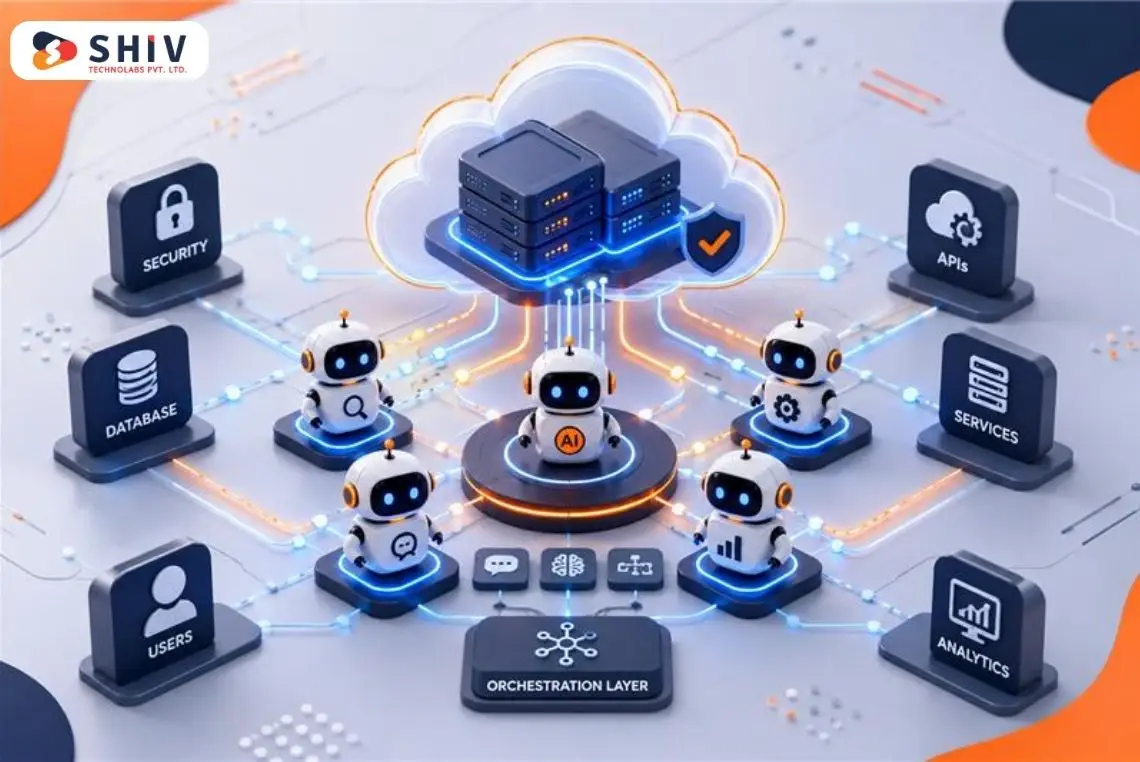
A multi-agent system uses several specialized AI agents that work together under an orchestration layer to finish a larger task. Each agent owns one clear role, while the orchestration layer routes work, manages handoffs, and checks results. They matter because this setup carries complex, multi-step workflows that a single general assistant often cannot complete alone.
Companies want AI that does more than answer one question at a time. They want AI that can carry out a full task from start to finish across many tools. Most coverage of multi-agent systems focuses on engineering, while leaders need the business view first.
# A Simple Definition for Business Leaders
A multi-agent system is a group of AI agents, where each agent owns a specific job, skill, or data access level. The agents share information and pass work between them to reach one business goal. Google Cloud describes this as splitting a complex process into discrete tasks that specialized agents in a multi-agent AI reference architecture complete together.
This approach is part of the wider move toward agentic AI, where software plans and acts with limited supervision. Large teams now use enterprise AI agents for support, sales, and operations work. Companies that plan this shift often start with AI development services to set the right foundation.
# Single-Agent vs Multi-Agent AI
| Aspect | Single-Agent AI | Multi-Agent AI |
|---|---|---|
| Best for | Narrow, focused tasks with one clear goal | Complex workflows that span many steps and tools |
| How it works | One AI model handles the full request | Several specialized agents share the work |
| Roles | One role and skill set | Many roles, each with a defined job |
| Coordination | No handoffs needed | An orchestration layer manages handoffs and timing |
| Tools and data | A few tools and one main data source | Many tools and data sources across systems |
| Human approval | Often a single check | Built-in approval steps at key moments |
| Setup effort | Faster to build and test | More planning and higher build effort |
| Speed | Quick replies with little wait | Slower per task, but carries far more work |
| Oversight needs | Light monitoring | Strong governance, logging, and access control |
| Example | Drafting an email reply | Resolving a support case across helpdesk, orders, and finance |
Single-agent AI works well for narrow, focused tasks, such as drafting an email or answering one common question. Multi-agent AI makes more sense when work needs several roles, tools, decisions, and handoffs in one flow.
Teams building role-based AI workflows often begin with AI agent development services before they design the wider system. Single-agent AI still has a place, so the goal is the right tool for the job, not the most complex one.
How the Orchestra Analogy Gets Multi-Agent Systems
An orchestra gives a clear picture of how these systems run. Each part has a job, and the music only works when every part stays in sync.
# The Musicians, the Conductor, and the Score
Picture each AI agent as a musician with one instrument and one part to play. The orchestration layer acts as the conductor, who sets timing, cues each player, and keeps the tempo. Tools and data work like instruments and sheet music, while the business goal is the final performance the audience hears.
A human reviewer acts as the producer, who approves the big moments before the show goes live. With the orchestra picture in mind, you now have the core of multi-agent systems explained. The table below maps each part to its orchestra role and business role.
| System Part | Orchestra Analogy | Business Role | Why It Matters |
|---|---|---|---|
| Specialized agents | Musicians with one instrument | Handle one task, skill, or data area | Focused work raises accuracy and speed |
| Orchestration layer | The conductor | Routes tasks, manages handoffs, and sets timing | Turns separate agents into one reliable system |
| Tools and APIs | Instruments | Let agents act inside real systems | Agents can read data and complete real actions |
| Business data | The sheet music | Guides every agent’s decision | Accurate data keeps outputs grounded and useful |
| Human reviewer | The producer | Approves key actions before they go live | Adds oversight and keeps risk under control |
| Monitoring layer | The sound engineer | Tracks performance and logs each step | Makes the system easy to audit and improve |
The pattern holds across most setups, even as the number of agents grows. When agents sit on top of trained models, those models often come from AI/ML development services built around your data.
Why Does the Orchestration Layer Create Business Value?
The orchestration layer is the part that turns separate agents into one reliable system. It decides who does what, when, and with which data. This coordination is where most of the business value comes from, which is why AI agent orchestration gets so much attention.
# What the Orchestration Layer Handles
The orchestration layer manages task routing, agent handoffs, shared context, tool access, and timing across the workflow. It also covers error handling, monitoring, human approval, and governance for sensitive actions. IBM, in its AI agent orchestration guide, notes that orchestration coordinates the order agents run in, the data they share, and the decisions they hand off.
Task Routing and Agent Handoffs
Task routing sends each step to the agent best suited for it, based on role and skill. Agent handoffs pass context from one agent to the next, so nothing gets lost between steps. Clean routing and clear handoffs keep the workflow accurate, fast, and easy to audit.
| Orchestration Function | What It Does | Business Value |
|---|---|---|
| Task routing | Sends each step to the right agent | Faster, more accurate workflows |
| Agent coordination | Manages the order agents run in | Steady, predictable end-to-end flow |
| Context sharing | Passes information between agents | Nothing gets lost between steps |
| Tool permissions | Controls which tools each agent uses | Tighter security and access control |
| Quality checks | Reviews outputs before they move on | Fewer errors reach customers |
| Human approval | Pauses for sign-off on key actions | Safe decisions on sensitive tasks |
| Monitoring and logs | Records every action and result | Full accountability and easy audits |
Strong governance and monitoring matter most when agents touch customer data or money. Access control, human approval, and clear logs keep the system safe and accountable. Connecting agents to your internal systems usually needs custom software development around your existing stack.
Where Do Multi-Agent Systems Fit in Daily Operations?
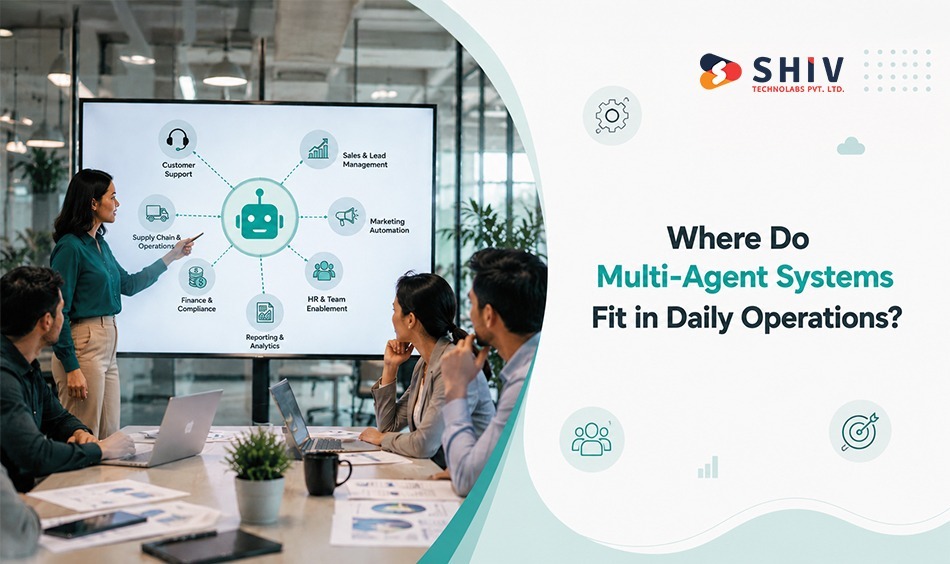
These systems shine when a task spans several steps, tools, and teams. They suit work that one assistant cannot carry end-to-end. You want multi-agent systems explained against real workflows before you commit budget, so the table below shows practical examples.
| Use Case | Agents Involved | What the System Can Do |
|---|---|---|
| Customer support | Intake, knowledge, escalation agents | Answers questions, pulls records, and routes hard cases to staff |
| Sales qualification | Research, scoring, outreach agents | Gathers lead data, scores fit, and drafts the first reply |
| Document review | Reader, checker, summary agents | Reads files, flags issues, and returns a summary |
| Operations reporting | Data, analysis, report agents | Pulls metrics, finds trends, and builds a clear report |
| Internal knowledge search | Search, ranking, and answer agents | Finds the right document and gives a direct answer |
| Invoice or order handling | Intake, validation, and posting agents | Reads details, checks rules, and updates the right system |
Each example uses everyday business automation that touches more than one system. Operations teams that want forecasts can add predictive AI development to the agent mix for sharper reports. The same pattern supports AI workflow automation across support, sales, and finance with custom AI solutions.
Should Your Company Consider Multi-Agent AI?
Multi-agent systems pay off when a workflow has many moving parts. The right question is whether your process has enough steps, tools, and decisions to justify one. The checklist below helps you decide before you book a vendor call.
# A Decision-Maker Checklist
Use this checklist as a quick gut check during planning. Each point that matches your situation makes multi-agent AI worth a conversation. Three or more matches usually mean the topic deserves a deeper look.
✓ You run workflows that cross several tools and systems.
✓ Your team repeats the same multi-step tasks every week.
✓ One AI assistant cannot carry the full process alone.
✓ You need approvals before the system takes final actions.
✓ Your data lives across different systems and apps.
✓ You need monitoring and accountability for every step.
✓ Your workflow has clear business outcomes you can measure.
When several points match, multi-agent AI likely fits your roadmap. Leaders who want multi-agent systems explained clearly can ask vendors to map agent roles first. A short discovery phase shows whether the value covers the added cost and effort.
How Do You Plan a Multi-Agent System with the Right Partner?
Shiv Technolabs helps companies assess multi-agent needs, plan the orchestration layer, map workflows, and define agent roles. The team also builds custom AI agent solutions that fit your existing tools and data.
A good partner keeps the plan grounded and avoids overbuilding the system. With clear roadmaps and steady oversight, Shiv Technolabs turns a complex idea into a practical, staged build. Ready to take the next step? Explore AI agent services. A focused round of generative AI consulting can map which tasks suit agents and which do not.
Conclusion
Multi-agent systems turn complex, multi-step work into coordinated performance. The agents play their parts, while the orchestration layer keeps timing, handoffs, and quality in check. That picture gives you multi-agent systems explained in plain business terms, not just technical ones.
With the right plan, your business gains a reliable system that scales as your workflows grow. Start with one clear process, prove the value, and add agents from there.
# Frequently Asked Questions
What Is a Multi-Agent System in Simple Words?
A multi-agent system is a team of AI agents, where each agent handles one job. The agents share data and pass tasks between them under an orchestration layer. Together, they finish larger workflows that a single AI assistant cannot complete on its own.
How Do Multi-Agent Systems Work?
Each AI agent takes one role, skill, or data access level. The orchestration layer routes tasks, manages handoffs, and shares context between agents. It also handles timing, quality checks, and human approval, so the full workflow runs in the correct order from start to finish.
What Is an Orchestration Layer in Multi-Agent AI?
The orchestration layer is the conductor of the system. It decides which agent runs next, passes context between agents, and controls tool access and timing. It also adds monitoring, error handling, and human approval, which keep the workflow reliable and easy to audit.
Are Multi-Agent Systems Only for Large Companies?
Multi-agent systems suit any company with multi-step workflows across several tools. Small and mid-sized teams use them for support, sales, and operations tasks. The right size depends on the workflow, not the company, so start with one clear process and grow from there.
How Are Multi-Agent Systems Different from Chatbots?
A chatbot answers questions in a single conversation. A multi-agent system carries out a full task across many steps, tools, and roles. It can route work, pass handoffs, check quality, and request human approval, which a standard chatbot cannot do on its own.
When Should a Company Consider Multi-Agent AI?
Consider multi-agent AI when one assistant cannot finish a process that spans several tools and decisions. Strong signals include repeated multi-step tasks, approval steps, and data spread across many systems. A short discovery phase shows whether the value covers the added cost and effort.