Table of Contents
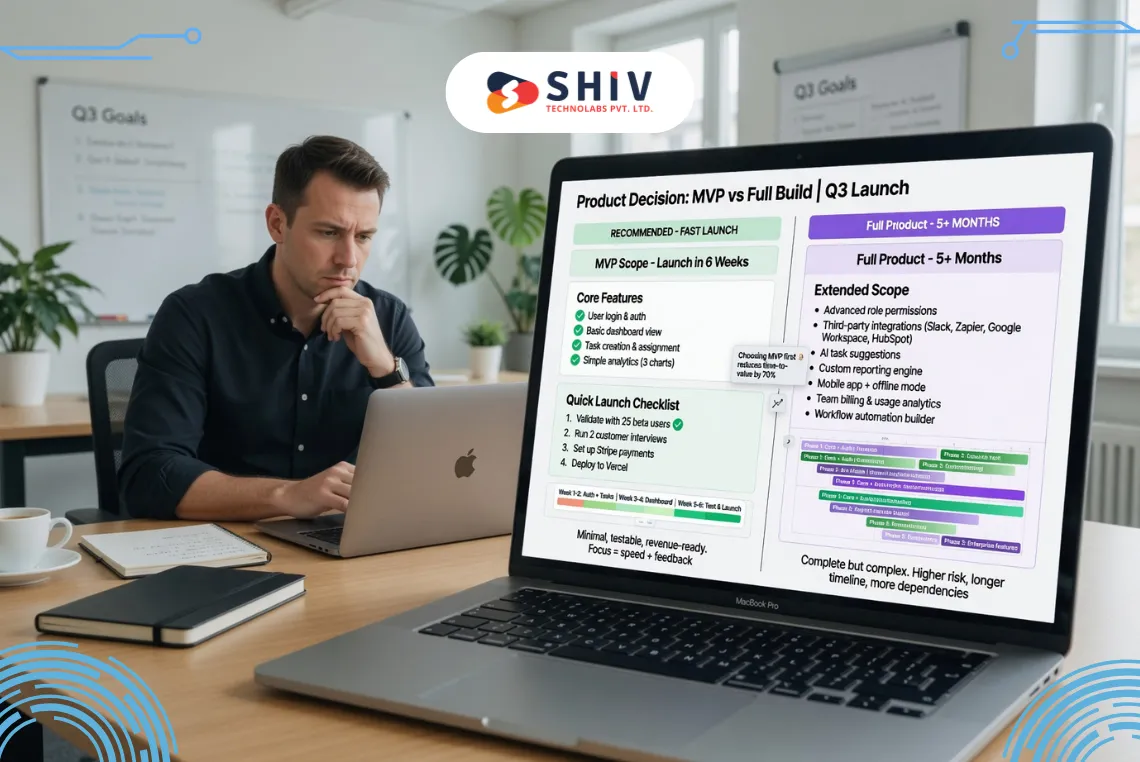
MVP App Development is probably the first actual choice that founders make when transforming an idea into a product. Start small at first or spend a lot to build a full one from the start? That’s the core question.
When businesses aim to launch sooner, test demand, and avoid paying to develop features that may not be critical in the initial version, they usually compare MVP Development services with the full build. Reports suggest that 42% of startups fail due to a lack of market need.
This is where the distinction between MVP and full product comes in as a strategic rather than just technical decision. Speed, cost, and feedback loops can help reduce risk by 60% or more, or increase it.


When should an MVP be built, and when should a company commit to developing a complete product? This guide gives you that answer in a straightforward way to understand so that you can make a decision and proceed with the proper development model.
What is the difference between MVP App Development and full product development?
MVP App Development is the development of a simplified version of your product that has just the essential functionality necessary to address a key user issue. On the contrary, full product development delivers a market-ready, fully functional solution with advanced functionality, integrations, and scalability on day one.
Simply, minimum viable product development = validate first, and full product development = scale from day one.
MVP vs Full Product Comparison
| Factor | MVP | Full Product |
|---|---|---|
| Main goal | Validate idea | Launch full market-ready version |
| Feature scope | Core features only | Wider feature set |
| Time to launch | Shorter (4–12 weeks) | Longer (4–9 months) |
| Upfront budget | Lower ($) | Higher ($$$) |
| Risk level | Lower early-stage risk | Higher initial investment |
| Best use case | Testing demand | Scaling proven demand |
When should you build an MVP instead of a full product?
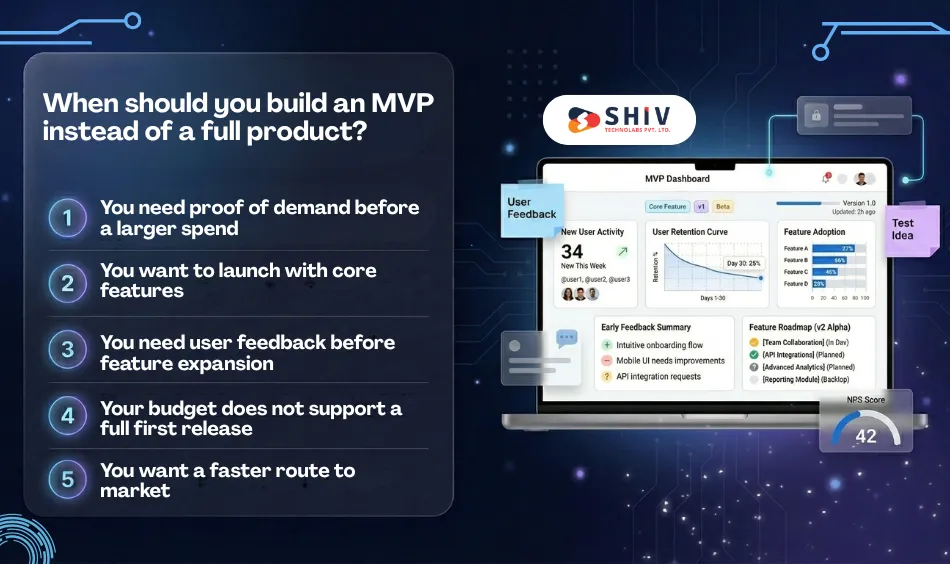
MVP App Development is typically the wiser place to start if you aim to minimize risk, contain costs, and get things done quickly. And here is where the obvious answer is:
Before a greater expenditure, you must have evidence of demand.
When you have doubts as to whether users will actually pay, do not invest $100K+ upfront.
An MVP allows you to verify demand at something like 30-50% of the aggregate cost of a full build.
1. You need proof of demand before a larger spend
If you’re unsure whether users will actually pay, don’t invest $100K+ upfront. An MVP lets you validate demand with 30%–50% of the cost of a full build.
2. You want to launch with core features
Trying to build everything at once often delays launch by 3–6 months. An MVP focuses on:
- Core value proposition
- Primary workflow
- Essential user journey
3. You need user feedback before feature expansion
Real users’ feedback leaves no room for assumptions. An MVP gives:
Live usage data
Feedback loops
Early retention signals
This reduces wasted development effort by up to 40%+.
4. Your budget does not support a full first release
Startups and early-stage teams rarely have unlimited capital. MVP approach:
Lower initial burn rate
Higher iteration flexibility
5. You want a faster route to market
Speed matters. Launching in 6–10 weeks vs 6+ months can mean:
- Faster traction
- Early revenue
- Competitive advantage
# When is full product development a better investment than an MVP?
Although MVPs are effective, they are not necessarily the correct step. In some cases, it is smarter to invest fully in the product’s development in the first place.
Existing customer demand is already proven
If you already have:
- Pre-orders
- Paying customers
- Strong market validation
A limited MVP can even be counterproductive to growth.
Enterprise buyers need more functionality at launch
Enterprise clients expect:
- Full workflows
- Reporting dashboards
- Role-based access
MVP can be perceived as half-baked and cause a lack of trust.
The product depends on heavy integrations from day one
Some products rely on:
- Payment systems
- APIs
- ERP/CRM integrations
Stripping these down can break core functionality, making MVP ineffective.
Compliance or workflow complexity leaves little room for simplification
There is not much that can be simplified due to compliance or workflow complexity. Industries like:
- Healthcare
- Fintech
- Logistics
Frequently also need conformity, security, and process to support process flow, i.e., MVP vs full product leans towards a full build.
How much does MVP app development cost compared with a full product?
The cost of developing the MVP is considerably lower than developing the entire product. However, it is not only the price that differs. It is a question of the degree of risk in the upfront vs the validation in the first place.
# MVP Cost vs Full Product Budget Range
| Build Type | Typical Scope | Budget Direction | Best For |
|---|---|---|---|
| Basic MVP | Core workflow only | Lower ($5K–$20K) | Early validation |
| Mid-level MVP | Core workflow + limited extras | Moderate ($20K–$50K) | Market testing |
| Full Product | Wider feature set + integrations | Higher ($50K–$300K+) | Proven demand & scaling |
How long does MVP app development take before launch?
The MVP app development plan will be structured to be fast and clear. It is not only that they want to launch fast, but they also need to launch something usable, testable, and aligned with actual business objectives.
MVP App Development can complete a project within 6-12 weeks, compared to full product development, which typically takes 4-9 months or longer. The actual time will depend on the features, platform selection, integrations, and the level of efficiency of decision-making throughout the process.
Below is a realistic breakdown of each phase and what it involves.
1. Discovery and planning (1–2 weeks)
The realistic breakdown of each phase and what it entails is provided below.
It includes:
- Setting up business objectives and intended users.
- Determining the problem of the core that the product resolves.
- Competitor and market analysis.
Established success metrics, like engagement by users or conversion rate.
When this stage is not taken seriously, the projects tend to encounter scope modification in the future, extending the schedule by 20-40 %.
2. Feature prioritization (3–5 days)
This is the place whereby scope is narrowed down, and redundant features are eliminated. The aim is to maintain the product’s efficiency and focus.
The features of the team are classified into:
- Core attributes that are necessary in the product.
- Waiting for secondary features.
- Further improvements are to be made in subsequent releases.
A well-defined prioritization process can save up to 25-35% of development time and keep the MVP on track with the business requirements.
3. UI/UX design (1–2 weeks)
MVP App Development is all about usability-driven design, not visual sophistication. This is done to enable users to comprehend and navigate the product without difficulty during the initial encounter.
This stage includes:
- Structure defined by wireframes.
- User journey mapping
- Basic interface design
Rather than spending so much money on fancy graphics, clarity, speed, and functionality are prioritized.
4. Development (3–6 weeks)
This is the implementation stage in which the product is assembled. The schedule in this case is very much based on the features and technicality. Typical activities include:
- Database setup and APIs Backend development.
- Mobile or web frontend development.
- Integration of basic capabilities.
- Simple integrations were necessary.
The more features or complex integrations, the more time will be required to develop it, which is why a controlled scope is necessary.
5. Testing and quality assurance (1–2 weeks)
Even the simplest product has to be stable and dependable. The product’s performance and usability will be the two criteria by which early users judge it.
Testing includes:
- Functional testing to make sure that everything is operating properly.
- Speed and responsiveness testing, Performance testing.
- Identifying and fixing bugs
A formalized quality assurance program is capable of eliminating post launch problems by over half, enhancing initial user experience.
6. Launch and initial feedback (3–7 days)
After making it stable, the product is rolled out to actual users. This stage is very important, as it is a period when emphasis is placed on learning rather than development.
It includes:
- Movement to servers or app stores.
- Observation of performance and use statistics.
- Collecting user feedback
The data collected here feeds directly into future decision-making for development and feature expansion.
Conclusion
The choice between MVP App Development and a full build comes down to one simple principle: validate first or scale now. When speed, cost management, and market validation are the most important considerations, an MVP is a good choice. And when demand has been proven, and expectations are high, go on a full product. The true MVP vs full product equation.
It is about this point that collaboration with the appropriate team transforms all. Shiv Technolabs assists businesses in establishing the appropriate scope, reducing avoidable expenditure, and cutting launch surges by 40% through tested MVP development services.
Whether it is testing an idea or scaling an already existing one, their team will make sure that your product is developed with clarity, strategy, and performance in mind.
Frequently Asked Questions (FAQs)
What is the difference between MVP App Development and full product development?
MVP App Development focuses on releasing a product with basic functionality to test demand quickly, whereas full product development provides a complete solution with sophisticated functionality and scalability.
When should you build an MVP instead of a full product?
The timing of building an MVP should be determined by uncertainty about demand, a limited budget, or the need to launch faster.
How much does MVP app development cost?
The cost of MVP app Development often depends on features, platform, and complexity and ranges from $5K to $50K.