
Table of Contents
Checkout is where the e-commerce revenue is secured or not. Industry statistics reveal that 70% or more of online carts are abandoned, and the most common reasons include slow response times, broken UX, intricate forms, and unreliable payment flows. Baymard Institute reports that a 1-second delay at checkout can reduce conversions by 7%.
This is precisely why Next.js Commerce has become the architecture of choice for modern e-commerce brands. The existing frontend stacks suffer from performance bottlenecks, client-side rendering, and API inefficiencies, all of which are lethal in the checkout phase.
Businesses have now adopted Next.js development services to deliver server-rendered, API-first, high-performance checkout experiences that minimize friction and maximize order completion. Today, e-commerce requires speed, reliability, and ROI.
This blog covers how Next.js Commerce transforms checkout performance and reveals the real sources of revenue improvements, rather than theory alone.

What Is Next.js Commerce and Why Are Modern Brands Adopting It?
Next.js Commerce is a performance-first e-commerce architecture, not merely a frontend framework, built on the principles of headless (Shopify headless guide), server-side rendering, and modular components. The reason brands pick it is that checkout performance is directly related to revenue, and Next.js eliminates the friction posed by traditional JS stacks.
On the business side, Next.js Commerce isolates issues well:
- Frontend → blazing, SSR-driven Frontend.
- Backend API-based commerce engines.
- Checkout → optimized, validated, and reliable
It is an architecture that enables brands to optimize checkout performance without re-platforming their commerce system.
Core Principles That Power Next.js Commerce
Next.js Commerce is built on the latest rendering techniques tailored for fast, sensitive transactions such as checkout.
Key architectural elements:
- Server-Side Rendering (SSR) → Checkout pages are loaded immediately with HTML that has been rendered in advance.
- Static Generation + ISR → Product + cart data updates without complete rebates.
- API-First Design → Checkout logic: this is directly connected to payment, shipping, and tax services. (build APIs with Next.js)
Why this matters:
- Rendered pages on the server = checkout loads faster.
- Customizable carts = simple modules.
- Headless API architecture = malleable integrations.
These tenets remove the gap that kills conversions.
How Next.js Commerce Transforms User Experience
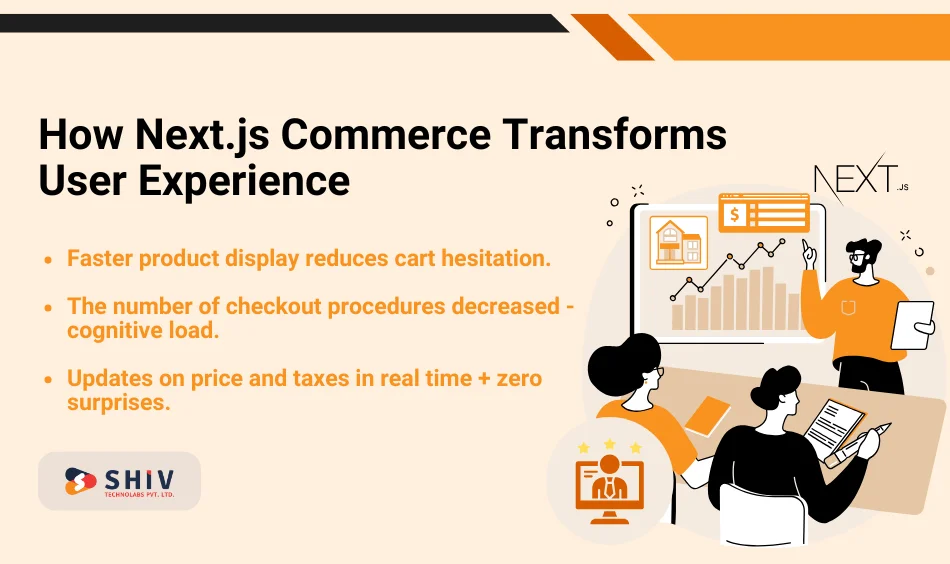
Checkout UX does not concern design; it concerns flow. Next.js Commerce eliminates reloads, invalid validation, and slow UI updates.
Real-world impact:
- Faster product display reduces cart hesitation.
- The number of checkout procedures decreased – cognitive load.
- Updates on price and taxes in real time + zero surprises.
For broader store speed wins, see front-end architecture for faster stores.
Example:
A medium-sized ecommerce brand that had moved off a traditional JS stack to Next.js Commerce increased its 90-day reduction of cart abandonment by 18% simply by making improvements to checkout performance.
How Does Next.js Commerce Improve the Checkout Flow Experience?
Checkout is a process: cart, shipping, and payment confirmation. Any drop-off risk is enhanced by any drop-off delay, error, or reload. Optimization of the checkout flow aims to remove friction at each stage.
Next.js enhances checkout by using smart caching, dynamic data fetching, and accurate error management – without blocking the interface.
Next.js Checkout Flow Enhancements
| Checkout Stage | Next.js Feature | Performance Benefit |
|---|---|---|
| Cart Review | Incremental Static Regeneration | Instant quantity + price updates |
| Payment Form | API-based Validation | Prevents incomplete submissions |
| Address Field | Lazy Loading + Caching | Faster form rendering |
| Order Confirmation | SSR Rendering | Instant post-purchase display |
All of the optimizations minimize latency, remove entire page loads and work to increase the checkout rate – directly affecting the revenue.


How Next.js Commerce Drives E-commerce Performance Metrics?
A performance improvement is meaningful only when it impacts business KPIs. Next.js ecommerce performance directly impacts conversion rate, revenue per session, and operational stability.
Faster Page Speed
Google Analytics data show that checkout speed is strongly correlated with conversion rate. Next.js SSR has checkout pages under 1.5s even during traffic spikes. The shorter load time will lead to less bouncing, greater trust and continued buying behavior, not to reconsideration of purchases. For broader impact on speed and UX, see eCommerce design strategies.
Reduced Errors
Client-side checkout errors cost a lot. Next.js performs fewer re-renders and supports API-level validation, which minimizes failed payments and form errors. This stability enhances the checkout success rate and reduces customer support tickets.
Better UX
Customers form repeat customers when they have a smooth checkout experience. Next.js enables custom processes, saved preferences and predictable performance across sessions, driving retention and long-term revenue.
How Next.js Shopping Cart Optimization Boosts Average Order Value
The performance of checkout not only leads to a higher conversion, but also a higher average order value (AOV). Next.js optimization of the shopping cart allows cart smartness.
Cart Manner is More about Discounts
Carts that are optimized minimize friction and promote upsells without pushy promotion.
Next.js allows:
- Dynamic pricing rules
- Conditional cart logic
- Real-time recommendations
- Persistent session data
These are improvements that boost buyer confidence and size.
Top 4 Cart Optimization Tactics with Next.js Commerce
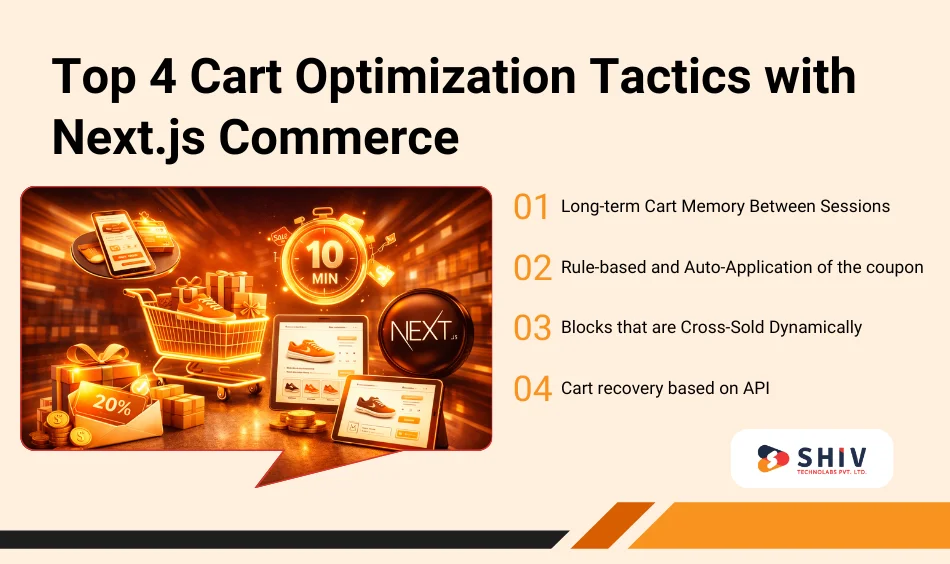
Below are Cart Optimization Tactics with Next.js Commerce
Long-term Cart Memory Between Sessions
Next.js maintains cart state via APIs and cookies, allowing users to continue their checkout without difficulty across devices. This decreases the abandonment due to loss of sessions and increases return conversion by 10-15%.
Rule-based and Auto-Application of the coupon
Coupons are dynamically derived according to cart value, type of user or campaign reasoning and do not require human intervention. This eliminates friction, enhances intended value, and accelerates checkout.
Blocks that are Cross-Sold Dynamically
Related products, bundles, or even add-ons are rendered instantly via server-side logic. Cross-sells maximize AOV because they do not block checkout, which would otherwise slow conversion.
Cart recovery based on API
Next.js captures email, SMS, and CRM systems (APIs). Abandoned carts trigger automated recovery processes that can recover up to 20%+ in revenue.
Also Read: Next.js vs React
Why Businesses Choose Next.js for Scalable E-commerce Stores
Scalability in e-commerce does not only mean increasing traffic volume. It concerns maintaining speed, stability, and conversion performance as the number of products increases, campaigns peak, and the complexity of the checkout process rises. It is precisely at this point that traditional e-commerce builds begin to collapse and Next.js becomes the choice for modern, growth-oriented businesses.
Scaling Performance With Traffic and Not Against It.
Next.js is built for scalability. Server-side rendering (SSR), incremental static regeneration (ISR), and smart caching can guarantee that ecommerce pages can always be loaded quickly even during peak traffic periods, such as flash sales, seasonal promotions or paid traffic events.
Key advantages:
- Bureaucratic pages are on full load.
- Smaller Time-to-First-Byte (TTFB)
- Good checkout performance even with many users connected.
This eliminates conversion losses during traffic spikes, a common issue with server-light platforms.
Serverless Architecture = Elastic Scaling + Cost Control.
Next.js is compatible with serverless infrastructure. Resources are automatically scaled on demand, rather than with fixed servers. The implication of this on businesses is:
- No manual capacity planning
- No savings in over-provisioning costs ($$ saved)
- Automatic scaling of the traffic peak.
- Pay-as-you-drive infrastructure model.
This is what makes Next.js the best fit for e-commerce brands seeking aggressive expansion without unpredictable infrastructure costs.
Continuous Feature Expansion Component-Based UI
Expanding stores are constantly changing – checkout processes, loyalty logic, cross-sell blocks, or regional configurations. Next.js has a component-based design that enables teams to add or modify functionality without rewriting entire flows.
Benefits include:
- Faster feature rollouts
- Single testing and deployments.
- Reduced regression risk
- Cleaner long-term codebase
This is important due to the flexibility required by the businesses, which complete the iteration not once a year.
Enterprise Commerce Ecosystems API-First Integration.
The modern e-commerce is not independent. The businesses use ERPs, CRMs, payment gateways, analytics tools, WMS, and marketing automation platforms.
Next.js is API-first by design:
- Natural integrations with commerce backends.
- Tax API connections and easy payment.
- Live inventory and price adjustment.
- Shopify, Magento, BigCommerce, or custom compatibility – Headless compatibility.
This makes Next.js future-proof, given changes in tech stacks.
SEO + UX Without Trade-Offs
Conventional e-commerce platforms force a trade-off: SEO or UX. Next.js does away with that tradeoff. With SSR:
- Full or complete rendered pages are submitted to the search engines.
- Core Web Vitals improve
- Dynamically constructed pages are not crawlable.
- UX is still responsive and quick.
This combination will improve organic traffic and conversion efficiency, not just rankings.
Reduced Long-term Technical Debt.
Scalable ecommerce is also concerned with the 12-24 months later. Next.js minimizes technical debt by enforcing a modern standard, modular code, and upgrades.
Businesses benefit from:
- Cleaner maintenance cycles
- Easier framework upgrades
- Less reliance on bulky extensions.
- Additional control of performance tuning.
Next.js Commerce vs Traditional E-commerce Platforms
| Feature | Traditional Stack | Next.js Commerce |
|---|---|---|
| Rendering | Client-side | Server-side (SSR) |
| SEO | Limited | Dynamic SSR SEO |
| Scalability | Fixed servers | Serverless scaling |
| Customization | Theme-locked | Component-based UI |
| Integration | Plugin-heavy | API-driven lightweight |
Next.js is faster and has more control: The two things enterprise ecommerce teams need.
How does Next.js Development Enhance Checkout and Conversions?
Frameworks do not produce results in themselves. Execution does. This is where the Next.js development is relevant.
Checkout A/B Testing and Analytics Set-up.
Developers conduct A/B testing at the component level; they test checkout layouts, button placement, and form flows without full redeployments. This allows optimization of data.
Payment API Error Tracking
Monitoring advanced errors follows payments, API timeouts and gateway problems. The companies address issues before revenue leak holes become unmanageable.
Live Field Check + Fewer Renders.
Next.js reduces unnecessary re-renders, so fields are validated instantly with no UI flicker, enhancing trust and turnaround.
Google Analytics conversion funnel monitoring
Checkout funnels are monitored step by step, including cart abandonment and payment confirmation, enabling accurate customization based on drop-off data.
Conclusion
Checkout performance is ceasing to be a technicality – it forms a revenue driver. Next.js Commerce is designed to deliver faster load times, a smoother checkout process, fewer errors, and a higher conversion rate. Companies that embrace performance-first checkout systems consistently outperform those that use legacy stacks.
To unlock these benefits, it is important to work with Shiv Technolabs, an established Next.js development company. At Shiv Technolabs, we focus on developing high-performance e-commerce applications based on Next.js, checkout optimization, and API integrations, frontend architectures that are scalable to production, and generating revenue from traffic.
Frequently Asked Questions (FAQs)
1. What does Next.js Commerce do to enhance customer checkout?
Next.js Commerce provides faster checkout pages, accelerated by server-side rendering, real-time validation and API-driven updates. The customers will feel that there are fewer delays, easier interactions with forms and immediate confirmations, which will decrease frustration and maximize the number of purchases made.
2. Is Next.js Commerce able to minimize cart abandonment?
Yes, Accelerated load times, fewer checkout processes and immediate responses play a significant role in reducing abandonment rates. It is common to see 20%- 30% improvements in brand performance after optimizing checkout with Next.js Commerce.
3. What is the significance of Next.js development services?
They tailor-made checkout processes, add a payment API, establish performance and make the architecture scalable. The benefits of Next.js are not fully realized without expert implementation.
4. Can Next.js be used in enterprise-scale ecommerce?
Absolutely, Next.js supports global deployments, scales serverless and handles high traffic and offers robust security capabilities, making it suitable for a large ecommerce enterprise.
5. What is the revenue performance of Next.js Commerce?
Increasing checkout speed, minimizing errors, maximizing conversions and increasing AOV directly affect revenue metrics.