Table of Contents
A supply chain manager at a mid-size manufacturing firm in the US was manually reviewing spreadsheets every Monday morning to plan the week. Half the time, the forecasts were off, and the team scrambled to catch up. Within six months of deploying a predictive AI system, that same firm cut forecast errors by over 30% and reduced emergency procurement costs significantly.
That kind of shift is no longer reserved for global enterprises with large data science teams. Predictive AI solutions for business are now accessible to companies of any size, and the gap between organizations that use them and those that still rely on intuition is growing fast.
This guide covers how predictive AI works, where it delivers the strongest results, and what enterprise decision-makers need to know before investing in a custom solution.
Quick Answer
Predictive AI solutions are systems that use machine learning and historical data to forecast future business outcomes. They help companies plan inventory, detect risks, and make faster decisions. Enterprises across retail, finance, healthcare, and manufacturing use these systems to cut decision errors and gain a measurable edge over competitors.
What Are Predictive AI Solutions and How Do They Work for Business?
Predictive AI solutions are software systems that use machine learning algorithms, statistical models, and historical data to forecast what is likely to happen next in a business context. Unlike traditional reporting tools that describe what happened in the past, predictive AI tells you what is coming and gives your team time to act before a problem becomes expensive.
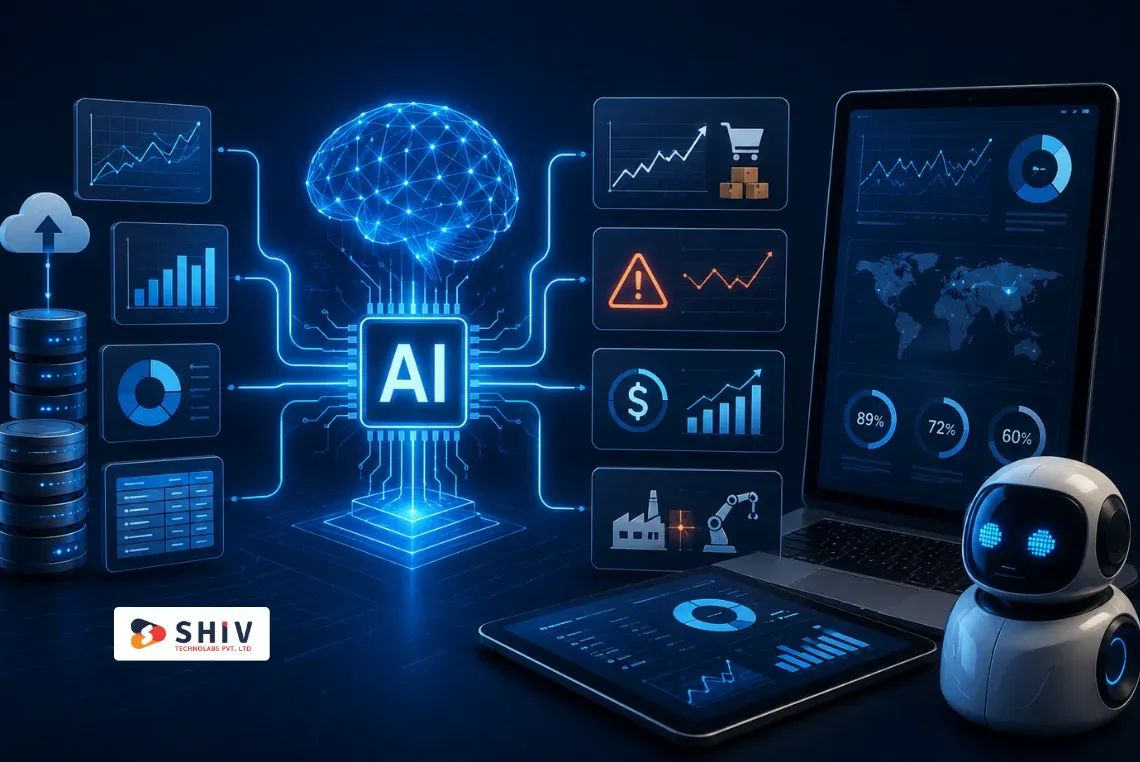
At the core of every predictive AI system are three components: a data pipeline that collects and cleans input data, a model that learns from patterns in that data, and an output layer that delivers forecasts in a usable format, whether through a dashboard, an alert, or a direct integration with your ERP or CRM.
1. How Predictive AI Compares to Traditional Analytics
The distinction matters when making a technology investment decision. Both tools serve a purpose, but they serve it at different stages of your decision-making process.
| Dimension | Traditional Analytics | Predictive AI Solutions |
|---|---|---|
| Primary focus | What happened in the past | What is likely to happen next |
| Decision type | Reactive – you act after the fact | Proactive – you act before the issue |
| Data processing | Structured, historical data sets | Live, multi-source, and unstructured data |
| Core tools | BI dashboards, Excel, SQL reports | Machine learning, neural networks, NLP |
| Output | Charts and reports | Forecasts, recommendations, and alerts |
| Update frequency | Scheduled or manual | Continuous and real-time |
| Typical users | Analysts and reporting teams | Operations, finance, supply chain, sales leads |
How Do Predictive AI Solutions Help Enterprises Make Better Decisions?
For enterprise teams, the value of predictive AI is not just speed. It is the ability to remove human bias from high-stakes decisions, act on signals that spreadsheets cannot detect, and maintain consistency across departments that are handling thousands of data points every day.
The following areas represent where enterprise clients consistently report the strongest measurable returns from predictive AI implementation.
1. Demand Forecasting and Inventory Planning
Predicting customer demand is one of the oldest business challenges and one of the most expensive when it goes wrong. Predictive AI systems pull in sales history, seasonality patterns, promotional data, and external signals like market conditions to produce rolling demand forecasts that update automatically.
- What this prevents – Overstocking ties up working capital in product that doesn’t move. Understocking means missed sales and frustrated customers. Predictive AI finds the balance automatically, adjusting forecasts as conditions change rather than waiting for the next planning cycle.
- Enterprise application – Large retailers use predictive demand models to manage thousands of SKUs across multiple distribution centers, reducing carrying costs and improving service levels simultaneously.
- Integration point – These systems connect with ERP platforms and supplier portals, so reorder triggers can fire automatically when forecast thresholds are crossed, cutting manual procurement time.
2. Financial Risk Detection and Credit Scoring
Predictive AI models trained on transaction data, payment history, and market indicators can flag financial risk signals weeks before a traditional review cycle would catch them. For finance teams, this changes risk management from a monthly audit function into a live monitoring capability.
- Credit risk – Lenders and B2B finance teams use predictive models to score creditworthiness in real time, factoring in behavioral data and market signals rather than relying on static credit reports alone.
- Fraud detection – Predictive systems flag transactions that deviate from expected patterns, triggering review workflows or automatic holds before losses occur. The model learns over time, which means false positive rates drop as it processes more data.
- Portfolio management – Investment teams use predictive analytics to model portfolio risk under different market scenarios, giving decision-makers a clearer picture of downside exposure before committing capital.
3. Workforce and Capacity Planning
Enterprises with large or distributed teams face the challenge of matching labor supply to operational demand. Predictive AI models built on historical workforce data, seasonal patterns, and project pipelines give HR and operations teams a planning advantage that manual forecasting cannot match.
- Shift and capacity planning – Retail chains, logistics firms, and contact centers use predictive models to set staffing levels across locations and time periods, reducing overtime costs while maintaining service standards.
- Attrition risk scoring – HR teams use predictive models to identify employees at high risk of leaving, enabling targeted retention actions before positions become vacant and recruitment costs mount.
- Skills gap forecasting – As business strategy shifts, predictive AI maps current skills distribution against projected future needs, helping learning and development teams allocate training budgets where they will have the most impact.
4. Customer Behavior and Churn Prediction
Knowing which customers are about to disengage, and why, gives revenue teams a window to act. Predictive AI models trained on behavioral data, purchase history, support interactions, and engagement signals can score churn risk at the individual account level.
- Churn intervention – When a high-value customer’s engagement drops below a threshold, the system flags the account and triggers an outreach workflow, allowing account managers to step in while there is still time to retain the relationship.
- Cross-sell and upsell timing – Predictive models identify when a customer is most likely to be receptive to an additional product or tier upgrade, giving sales teams a relevant reason to reach out rather than cold-pitching on a cycle schedule.
- Lifetime value modeling – Marketing teams use predictive scoring to allocate acquisition budgets toward customer segments with higher predicted lifetime value, improving ROI on paid channels over time.
How to Apply Predictive AI for Operational Decision-Making Implementation
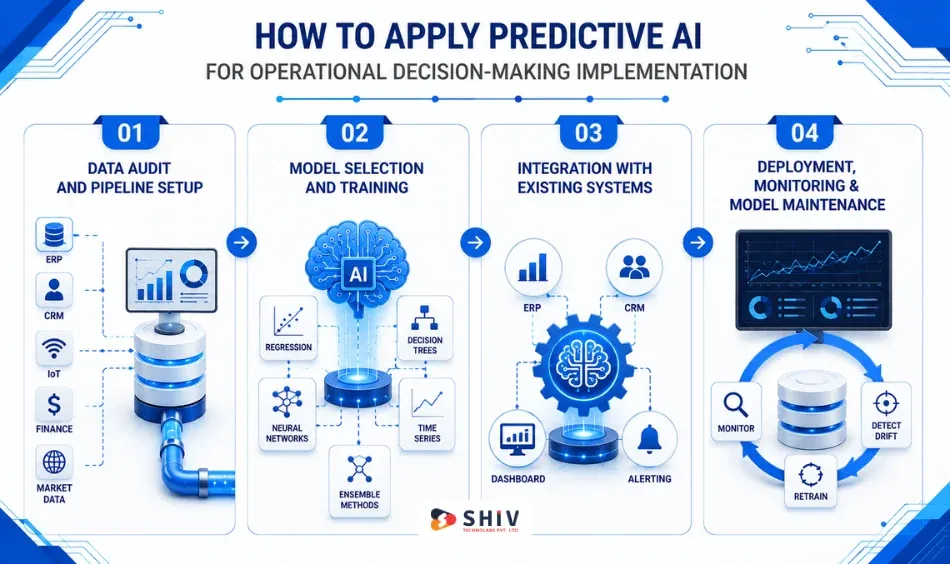
The question most enterprise technology teams ask is not whether predictive AI works, but how to implement it without disrupting existing operations. A structured implementation process addresses the data readiness, model selection, and integration challenges that tend to delay or derail projects.
Below is the process that we follow while building predictive AI systems for enterprise clients, covering the stages from raw data to production deployment.
Stage 1: Data Audit and Pipeline Setup
Every predictive AI project starts with the data that exists in the business today, not the ideal dataset. The audit phase maps available data sources, identifies gaps and quality issues, and defines what needs to be collected or cleaned before modeling can begin. Common sources include ERP transaction records, CRM data, IoT sensor outputs, financial systems, and third-party market feeds.
A clean, consistent data pipeline is the foundation. Without it, even the most sophisticated model produces unreliable forecasts. This stage typically takes 2-4 weeks depending on the number of source systems and the state of existing data infrastructure.
Stage 2: Model Selection and Training
The right algorithm depends on what you are trying to predict and what data you have available. Different business problems require different model architectures, and selecting the wrong one early adds cost and delays results.
| Model Type | Best Used For | Example Business Application |
|---|---|---|
| Regression models | Predicting numerical outcomes | Revenue forecasting, price elasticity modeling |
| Decision trees | Classification and rule-based decisions | Credit risk scoring, lead qualification |
| Neural networks | Complex pattern recognition at scale | Demand forecasting, fraud detection |
| Time series models | Sequential data with temporal patterns | Inventory planning, capacity scheduling |
| Ensemble methods | High-accuracy predictions from multiple models | Customer churn scoring, maintenance prediction |
Once the model type is selected, it is trained on historical data, validated on a held-out test set, and tuned to minimize forecast error before deployment.
Stage 3: Integration With Existing Enterprise Systems
A predictive model that lives in isolation has limited business value. The output needs to connect directly with the tools your teams already use, whether that is an ERP like Odoo or SAP, a CRM like Salesforce or HubSpot, a BI dashboard, or a custom operations platform.
- ERP integration – Predictive demand signals feed directly into procurement and production planning modules, triggering automated workflows when forecast thresholds are crossed. This removes the manual step that typically introduces lag and error.
- CRM integration – Churn scores and cross-sell propensity scores update in the CRM automatically, so sales and account management teams see current risk and opportunity signals without logging into a separate analytics tool.
- Dashboard and alerting – Real-time forecast dashboards give operations and finance leaders current visibility without waiting for weekly reports. Alert systems notify relevant teams when forecasts cross defined risk thresholds.
Stage 4: Deployment, Monitoring, and Model Maintenance
Predictive models do not stay accurate on their own. Business conditions change, customer behavior shifts, and data distributions evolve. A production predictive AI system needs ongoing monitoring to catch model drift before it affects decision quality.
Monitoring frameworks track prediction accuracy against actual outcomes on a rolling basis. When accuracy drops below acceptable thresholds, the model is retrained on updated data. This maintenance cycle is what separates a system that delivers sustained value from one that performs well at launch and degrades quietly afterward.
What Business Results Can You Expect from Predictive AI?
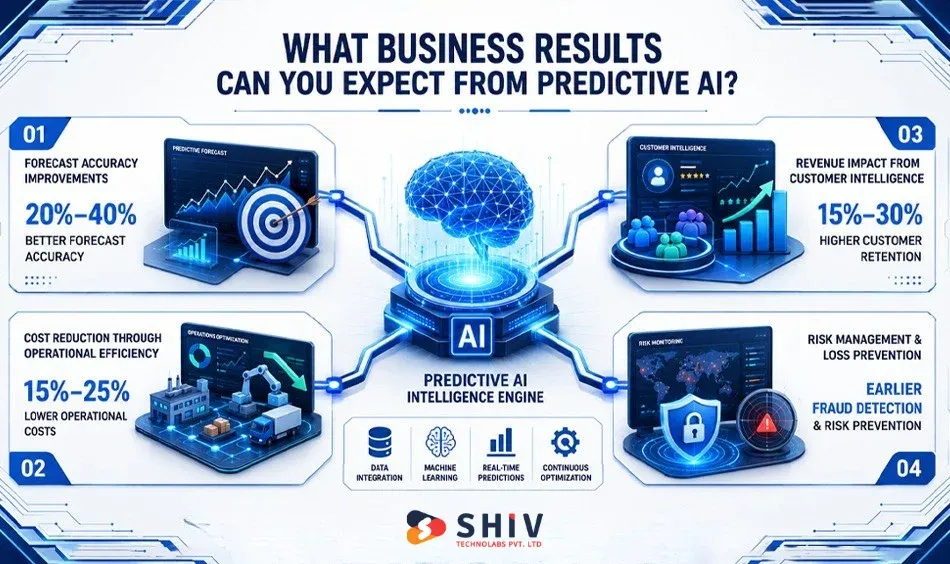
Results vary by industry, data maturity, and implementation scope, but certain outcomes appear consistently across enterprise deployments. The following figures reflect realistic ranges based on industry research and client outcomes reported in published case studies.
1. Forecast Accuracy Improvements
Enterprises moving from manual or rules-based forecasting to machine learning-driven models typically see forecast error rates drop by 20-40% within the first year of production use. Supply chain teams often report the strongest gains in this area because demand signals are high-frequency and the cost of error is direct and measurable.
2. Cost Reduction Through Operational Efficiency
When forecasting drives procurement, staffing, and production decisions, organizations reduce the cost of over-preparation and the penalty of under-preparation simultaneously. Inventory carrying cost reductions of 15-25% are common in retail and manufacturing deployments. Workforce management improvements typically reduce overtime spend by 10-20% in high-variability environments.
3. Revenue Impact From Customer Intelligence
Predictive churn models that trigger timely retention actions have demonstrated customer retention rate improvements of 15-30% in B2B SaaS and subscription businesses. Cross-sell and upsell models that deliver relevant recommendations at the right moment consistently outperform generic outreach by a significant margin on conversion rate.
4. Risk Management and Loss Prevention
In financial services, predictive fraud detection models catch fraud attempts earlier in the transaction lifecycle, reducing losses compared to rule-based systems. The advantage grows over time as the model continues learning from new fraud patterns that static rules would miss entirely.
Why Do Enterprises Invest in Custom Predictive AI Development?
Off-the-shelf analytics platforms can answer basic forecasting questions for companies with standard data structures and uncomplicated use cases. Enterprises with complex data environments, proprietary data advantages, or specific operational requirements need something different.
Custom predictive AI development gives enterprises a model architecture designed around their data, their workflows, and their specific forecast targets. The system integrates with the tools the team already uses, produces outputs in the format decision-makers actually need, and can be retrained as business conditions evolve without depending on a vendor’s release schedule.
1. Long-term Scalability and Data Ownership
A custom solution built on your data stays with your organization. The model improves as you feed it more data, and the intellectual property remains internal rather than embedded in a vendor’s proprietary platform. As your business grows into new markets or product lines, the model can be extended to cover new forecast targets without rebuilding from scratch.
2. Compliance and Data Security Requirements
Enterprises in regulated industries, including finance, healthcare, and insurance, often cannot pass sensitive customer data through third-party SaaS analytics platforms without specific contractual and technical controls. Custom solutions built within the enterprise’s own infrastructure or a controlled cloud environment address data residency and compliance requirements that off-the-shelf tools cannot always accommodate.
How Shiv Technolabs Builds Predictive AI Systems for Enterprise Clients
Shiv Technolabs has built predictive AI systems for enterprise clients across manufacturing, retail, finance, and logistics. The team handles the full implementation lifecycle, from data audit and model selection through integration and post-deployment monitoring, so internal teams can focus on using the outputs rather than managing the infrastructure.
Every project starts with a discovery session to map your existing data assets, define the forecast targets that matter most to your business, and identify the integration points where model outputs will create the most operational value. From there, the team proposes a model architecture, delivery timeline, and maintenance plan before development begins.
Building a predictive AI system for your enterprise? Share your requirements with Shiv Technolabs and get a custom implementation roadmap tailored to your data, your tools, and your specific decision-making needs.
Conclusion
Predictive AI solutions for business decision-making give enterprise teams the ability to act on what is coming rather than react to what has already happened. The technology is mature enough to deliver measurable results across demand forecasting, risk management, customer retention, and operational planning. The difference between organizations seeing those results and those still waiting is not the technology itself. It is the quality of implementation.
A well-built predictive AI system, integrated with the tools your team uses daily and maintained to stay accurate over time, becomes a permanent operational advantage. The companies building that advantage now are not waiting for a better time to start.
Shiv Technolabs builds custom predictive AI systems for enterprises that want to move from data collection to data-driven decisions. The team handles the technical build end-to-end, including data pipeline setup, model development, ERP and CRM integration, and ongoing performance monitoring.
Share your requirements with Shiv Technolabs and get a custom predictive AI roadmap for your business. Connect with the team.
FAQs
What are predictive AI solutions for business?
Predictive AI solutions are software systems that use machine learning and historical data to forecast future business outcomes. They help companies plan inventory, detect financial risk, anticipate customer behavior, and make faster operational decisions without relying on manual analysis or intuition.
How accurate are predictive AI models in real enterprise use?
Accuracy depends on data quality, model selection, and the consistency of ongoing monitoring and retraining. Well-maintained enterprise-grade predictive AI systems typically achieve forecast accuracy in the 85-95% range. Accuracy improves further over time as the model processes more real-world data and is periodically retrained on updated inputs.
Which industries benefit most from predictive AI solutions?
Retail, manufacturing, financial services, healthcare, and logistics consistently report the strongest measurable returns. These industries deal with high data volumes, frequent forecasting requirements, and significant costs attached to poor decisions, which makes predictive AI a direct performance multiplier in each case.
How long does predictive AI implementation take for an enterprise?
A focused project with clearly defined forecast targets and reasonably clean data can reach production in 8-12 weeks. A full enterprise deployment covering multiple use cases, complex data pipelines, and deep ERP or CRM integration typically takes 14-20 weeks. Timeline depends on data readiness, system complexity, and integration scope.
What is the difference between predictive analytics and predictive AI?
Predictive analytics uses fixed statistical models to analyze historical data and produce forecasts. Predictive AI adds machine learning, meaning the system learns from new data continuously and updates its predictions without manual reprogramming. AI-based systems handle larger data volumes, adapt to changing conditions, and improve their accuracy over time in ways that static analytics models cannot.
What data does a predictive AI system need to work effectively?
Predictive AI performs best with a combination of structured data, including transaction records, CRM data, and financial history, and unstructured signals like customer feedback, market data, and operational logs. Data quality and volume matter more than data variety. A system trained on two years of clean transaction data will outperform one trained on five years of inconsistent records.
Can a mid-size business afford custom predictive AI development?
Yes. Cloud-based machine learning infrastructure has reduced the cost of building and hosting predictive AI systems significantly. Custom solutions for mid-size businesses with focused use cases typically range from $15,000 to $50,000 depending on model complexity, the number of integrated data sources, and the deployment environment. Enterprise multi-use case systems with deep integration scope range higher.
How does Shiv Technolabs approach a predictive AI project?
The process starts with a data audit to assess what exists and what needs to be cleaned or collected. From there, the team defines the forecast targets, selects the right model architecture, trains and validates the system, and integrates the outputs with your existing ERP, CRM, or dashboard tools. Post-deployment, the team monitors prediction accuracy and handles retraining when performance drops below defined thresholds.