Table of Contents
Companies that buy Python development services in Saudi Arabia want clear numbers and predictable delivery. Finance teams ask for firm ranges; product leads ask for realistic schedules and a hiring plan that fits the scope. A direct view of price and time helps both sides agree faster and cut waste.
This guide explains what you should budget, how long building projects usually take, and which hiring choices fit different goals. You will see where costs rise, when senior talent pays off, and how support affects total spend. I keep the points practical, with Saudi market context and common use cases.
You can use these ranges to brief stakeholders and shortlist vendors with confidence. Share the tables during planning sessions and keep them close during sprint reviews. If you already have a scope or RFP, ask for a tailored quote against the same structure used here.
Knowing the cost of Python development and key hiring factors builds a stronger plan. It also helps teams avoid vague proposals and late surprises. Let’s start with price bands you can take to your next approval meeting.
How Much Does Python Development Cost in Saudi Arabia?
Prices change with scope, feature depth, and developer experience. A brochure site costs less than a data-heavy platform with role control and third-party links. Security checks, reporting, and workflow logic add time and increase total spend.
Average Python Development Cost Estimates in Saudi Arabia
| Project Type | Estimated Cost (SAR) | Timeline (Weeks) | Team Size |
|---|---|---|---|
| Small Business Website | 18,000 – 35,000 | 3 – 5 | 1–2 developers |
| Custom Web Application | 40,000 – 85,000 | 6 – 10 | 2–3 developers |
| Enterprise Software | 100,000 – 200,000+ | 12 – 20+ | 4–6 developers |
Here is a quick way to get python app development cost by scope and duration. If you ask how much does python development costs in Saudi Arabia, lock core features early. The cost of Python development climbs when the scope grows mid-build.
What Affects Python Development Cost in Saudi Arabia?
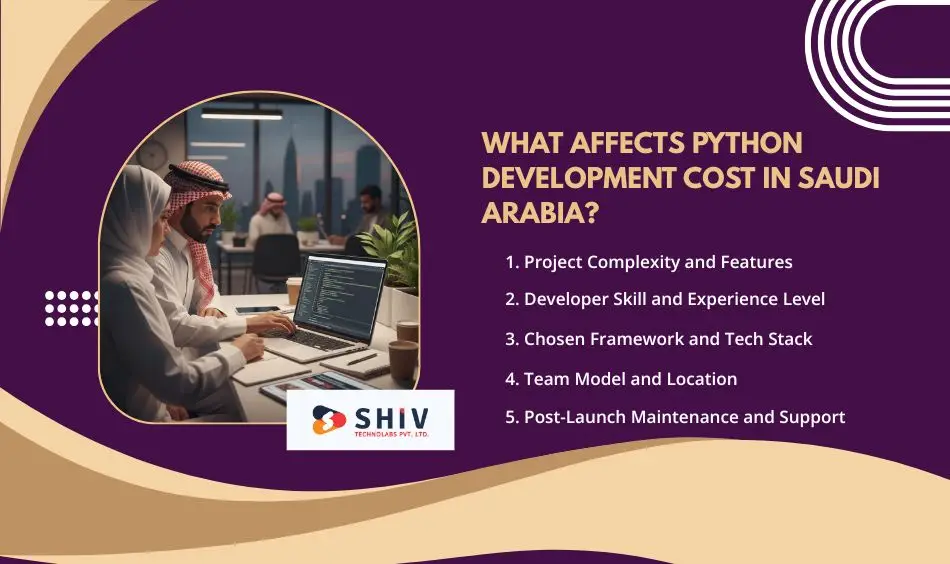
Every budget reflects a few measurable drivers. Address these items during scoping to keep spend aligned with outcomes.
1. Project Complexity and Features
Scope drives price more than any other input. Advanced dashboards, workflow engines, and role-based access require extra engineering and thorough testing. Payment links, ERP connectors, or live analytics add tasks for retries, staging checks, and hardening before launch.
Well-written user stories cut wasted effort and speed up feedback. Clear acceptance criteria also reduce back-and-forth during QA and UAT sprints.
2. Developer Skill and Experience Level
Team mix shapes both quality and total hours. Juniors deliver well-defined tasks under close review. Seniors design architecture, prevent defects, and clear production issues faster.
For Python developer hiring factors, compare throughput, review depth, and defect rates. The senior vs junior Python developer cost gap is normal, yet seniors often lower total hours by getting key parts right the first time.
3. Chosen Framework and Tech Stack
Framework choice affects build speed, plugin needs, and hosting bills. Django fits admin panels, permissions, and rapid CRUD work with batteries included. Flask suits lightweight APIs and microservices with more custom parts.
If you want an admin, ORM, and auth from day one, Django saves build time. If you prefer small services with fine control, Flask is a solid pick. Add Celery and Redis when background jobs or queues become part of the plan.
4. Team Model and Location
Your delivery model changes price, speed, and oversight. Local teams in Saudi Arabia make reviews faster and support Arabic sessions. Remote teams reduce rates but add extra hours for calls and clarifications.
Typical cost variations (guide ranges):
- Local senior engineer (KSA): SAR 220–300 per hour
- Local mid-level engineer (KSA): SAR 150–220 per hour
- Remote nearshore: SAR 120–200 per hour
- Remote offshore: SAR 80–160 per hour
Pick a model per module. Keep core features with a local lead who owns quality and release gates. Send well-defined work to remote talent with tight user stories and clear acceptance tests. If you need flexible capacity, consider a hire dedicated team model.
5. Post-Launch Maintenance and Support
Real work continues after launch. You will ship patches, version bumps, and small features as feedback lands. Plan a monthly retainer so that fixes, security updates, and backlog items move without delay.
Vendors offering Python development services in Saudi Arabia can bundle SLAs, release notes, and uptime targets. Ask for response windows, escalation steps, and a patch calendar. A steady support plan protects user trust and reduces costly fire drills.


Python Development Timeline in Saudi Arabia – How Long Does It Take?
Timelines depend on scope, approval speed, and test depth. A simple site ships quickly, while platforms with SSO, payments, and analytics need extra cycles. Use the guide below to plan a realistic Python development timeline saudi arabia teams can follow and manage across sprints.
Standard Python Development Timeline by Project Phase
| Development Phase | Typical Duration | Key Deliverables |
|---|---|---|
| Requirement Analysis | 1 – 2 weeks | SRS document, feature list |
| UI/UX Design | 1 – 3 weeks | Wireframes, mockups |
| Development & Integration | 4 – 8 weeks | Core feature coding |
| Testing & QA | 2 weeks | Debugging, performance tuning |
| Deployment & Support | 1 week+ | Hosting setup, updates |
These ranges represent an average path and shift with complexity. Add buffer for vendor APIs, security sign-offs, and data migration. Fast stakeholder feedback shortens loops and cuts rework.
Budget Planning for Python Development Projects in Saudi Arabia

A clear budget links people, tools, and milestones. Split costs into parts, map them to phases, and review against goals. Finance sees where money goes, while product tracks when value lands.
Key Budget Components for Python Development Projects
| Cost Component | Description | Budget Impact |
|---|---|---|
| Developer Hourly Rate | Experience level and engagement model | High |
| Project Management | Planning, coordination, status, and reviews | Medium |
| QA and Testing | Test cases, automation, and bug fixes | Medium |
| Hosting & Infrastructure | Servers, cloud services, backups, monitoring | Variable |
| Maintenance | Post-launch updates, patches, and support | Medium–High |
Many firms hire Python developers in Saudi Arabia on fixed-bid phases or time-and-materials. Fixed bids suit a stable scope with defined acceptance tests. Time-and-materials fits roadmaps with frequent releases and evolving features.
Accurate estimates depend on structure. Ask for a line-item quote mapped to epics, assumptions, and risk buffers. This format supports faster approvals and simpler change control.
How to Choose the Right Team for Python Development in Saudi Arabia
Picking the right team affects cost, speed, and outcomes. Match the hiring model to scope, release plan, and support needs. Set clear roles and review cycles before you start.
Comparison of Python Developer Hiring Models
| Hiring Model | Ideal For | Approx. Cost (SAR/hr) | Flexibility Level |
|---|---|---|---|
| Freelancers | Short tasks, PoCs | 70 – 150 | Low |
| In-House Developers | Ongoing products | 120 – 250 | Medium |
| Dedicated Team | Mid–large builds | 150 – 300 | High |
| Outsourced Agency | End-to-end delivery | Project-based | Very High |
Use Python developer hiring factors to score options during vendor calls. Ask about architecture depth, QA methods, and SLOs for production issues. If you plan frequent releases, lock a lead who owns code reviews and release gates.
Many firms hire Python developers in Saudi Arabia to keep meetings, language, and sign-offs simple. You can still add remote talent for well-defined modules. Write tight user stories, list acceptance tests, and time-box reviews to keep pace.
Cost Comparison – Local vs Offshore Python Development
Local teams give faster meetings and a clear legal footing. Offshore teams reduce rates but add extra hours for calls and handoffs. Balance price with risk and the need for on-site sessions.
Use these notes when you assess Python development cost in KSA and run an offshore Python development cost comparison.
Local vs Offshore Python Development Comparison
| Factor | Local (Saudi Arabia) | Offshore (Global) |
|---|---|---|
| Communication | Easy and timezone-aligned | Timezone gaps and delays |
| Data Compliance | Saudi data rules by default | Varies by region |
| Cost | Moderate to High | Low to Moderate |
| Control & Quality | High | Variable |
| On-site Collaboration | Possible | Not feasible |
Choose local talent for discovery, security reviews, and launch steps. Add offshore talent for back-office modules with stable specs and clear test cases.
Conclusion
You now have a clear view of cost bands, schedule ranges, and hiring choices. Use the tables to brief finance and product, then align the scope with the right team plan. Keep change control tight, ship in small batches, and track time per epic. For tailored planning, Shiv Technolabs can scope options and align budgets with release goals.
Working with an experienced Python development company in Saudi Arabia helps manage costs and keep delivery on track. If you want a quick estimate, share your scope, target date, and any third-party links. We will map your scope into clear phases and send a focused quote with timelines and assumptions.
FAQs: Python Development Cost in Saudi Arabia
Q1. How much does Python development cost in Saudi Arabia?
Budgets usually fall between SAR 20,000 and 200,000+. A brochure site with a few forms sits near 20k–35k. A portal with Arabic/English, roles, and Mada or Sadad lands around 50k–85k; enterprise builds pass 100k.
Q2. What factors change the price the most?
Scope drives price first. Payments, ERP/CRM links, and data migration add hours. Arabic–English (RTL), security checks, and senior talent also move the number.
Q3. How long does a typical build take?
Most projects finish in 4–12 weeks. Plan 1–2 weeks discovery, 1–3 design, 4–8 build, and ~2 QA. Keep a small buffer for gateways, SSO, or vendor approvals.
Q4. Freelancer or dedicated team – what fits best?
Choose based on risk and roadmap. Freelancers suit short, tidy tasks or proofs of concept. A dedicated team fits ongoing products that need steady releases, stronger QA, and a lead for reviews.
Q5. How do we get a precise estimate?
Share goals, key features, user roles, expected traffic, and your integration list. Add data rules, uptime targets, and any Arabic–English needs. You’ll get a phased quote with assumptions, risks, and dates.