Table of Contents
Enterprise mobility is growing fast, and so is the attack surface. The latest report documented that the average cost of a breach is currently $4.45 million, and that mobile endpoints have emerged as one of the fastest-growing attack entry points internationally.
The question that is becoming a critical issue among companies using Flutter app development services is: How safe is Flutter as an enterprise application? As businesses move to cross-platform strategies, they will have to strike a balance between productivity and high security demands. This is where Flutter app security and Flutter cross-platform security are strategic, not technical considerations.
Flutter is a structured, compiled architecture that addresses common vulnerabilities in hybrids and provides uniform protection across Android and iOS. This article discusses how businesses can use Flutter to build secure, scalable, compliance-ready mobile ecosystems.

Why Is Mobile Security a Critical Concern for Enterprise Applications?
Financial records, healthcare information, operational dashboards, and customer intelligence are some of the activities performed using enterprise mobile apps and accessed via mobile devices today. One compromised endpoint may reveal internal systems, disrupt operations, and result in regulatory fines.
Mobile ecosystems are more difficult to control and monitor because they operate across diverse devices, networks, and user behaviour, unlike traditional desktop environments. Security has ceased to be an IT issue; it is a risk type for the board, associated with compliance, brand credibility, and the ability to continue earning money.
Rising Cost of Data Breaches
- Average breach cost exceeds $4M+
- Mobile vulnerabilities are increasingly exploited
- Financial + reputational damage compounds rapidly
Regulatory and Compliance Pressures
Enterprises must align with:
- GDPR (Europe)
- HIPAA (Healthcare)
- PCI DSS (Payments)
Failure leads to fines, audits, and operational shutdown risks.
Expanding Enterprise Threat Exposure
Remote work + BYOD policies increase:
- Unsecured network access
- Device-level vulnerabilities
- Identity misuse risks
Cross-Platform Development Risks
Inconsistent implementation across platforms can introduce:
- Different authentication logic
- Patch delays
- Security fragmentation
Demand for Secure Digital Transformation
Companies need structures such as Flutter that offer agility + integrated protection across ecosystems.
What Security Risks Do Enterprise Mobile Apps Face?
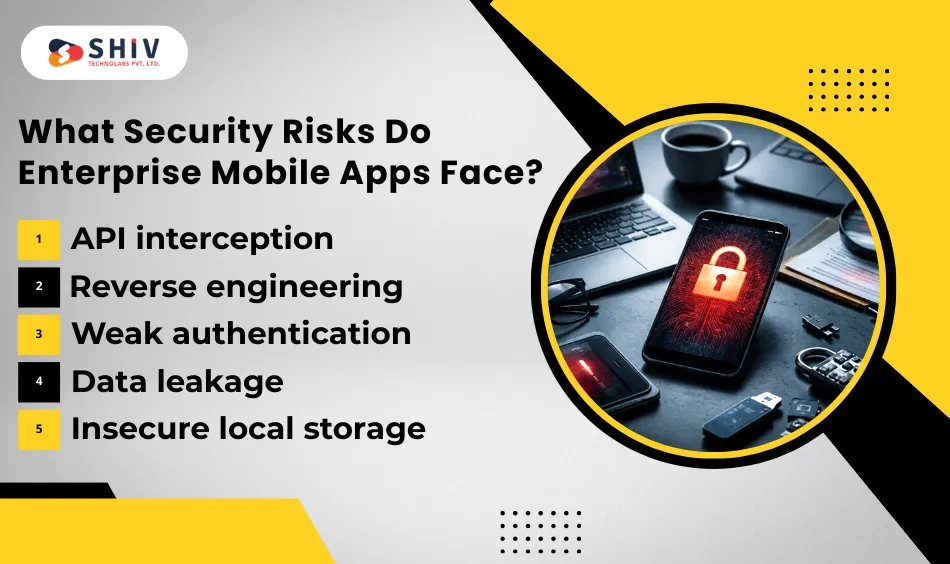
There are various threat vectors to enterprise mobile apps. Unless active protection measures such as Flutter mobile app encryption and Flutter app data security are implemented, security vulnerabilities can easily turn into breaches.
API interception
Proxy tools allow attackers to intercept unsecured API calls. In the absence of password-protected SSL and encrypted messages, sensitive business information can be compromised.
Reverse engineering
Unsecured binaries expose business logic, endpoints, and authentication pathways to attackers, enabling them to decompose applications.
Weak authentication
The risk of account takeover is greater when the session management is not properly provided or when password-only authentication is used, particularly in a distributed enterprise environment.
Data leakage
Confidential enterprise information may be accidentally revealed through unprotected logs, cached files, or screenshots.
Insecure local storage
Saving tokens or credentials in an unencrypted form exposes sensitive information in case a device is lost to a hacker.
To support these defence layers, teams often add vetted security plugins for payments, sign-in, and logging. You can see examples in this guide on Flutter plugins for payments, auth, and analytics.


How Secure Is Flutter for Enterprise Apps Compared to Other Frameworks?
Flutter offers an integrated platform that reduces the need for interpreters or web layers, enhancing its enterprise security posture. In contrast to heavyweight hybrid frameworks like WebView, Flutter has a reduced runtime attack surface and performance parity.
Ahead-of-Time (AOT) Compilation
- compiles code in native binaries.
- Harder to reverse engineer
- Removes risks of run-time script injection.
Dart Type Safety
- Memories are not abused by way of strong typing.
- Minimises runtime crashes + vulnerabilities.
- Promotes the predictable security verification.
Native Rendering Engine
Flutter does not rely on browser-based rendering, which means it is not subject to the same issues as JavaScript bridges.
Reduced WebView Exposure
Reduced reliance on built-in browsers minimises the number of attack vectors based on XSS or injection attacks.
Security Comparison Across Frameworks
| Security Factor | Flutter | WebView-Based Hybrid Apps | Fully Native Apps |
|---|---|---|---|
| Compilation Model | AOT compiled | Runtime interpreted | AOT compiled |
| Exposure to JS Injection | Low | High | Very Low |
| Code Obfuscation Support | Strong | Limited | Strong |
| Performance-Based Security | High | Moderate | High |
| API Control | Direct platform channels | Plugin dependent | Native SDK control |
For a broader business view of where Flutter fits in enterprise stacks, you can also reference the article on building enterprise apps with Flutter.
What Defines a Secure Flutter App Architecture for Enterprises?
The safe Flutter application structure can be layered to separate risk and impose control.
1. Presentation Layer Isolation.
UI components are not connected with sensitive operations:
- Eliminates direct exposure of business logic.
- Hedges propagate attacks via interface layers.
2. Business Logic Separation
Management logic is contained in controlled services:
- Allows pre-check before running.
- Independent security auditing.
3. Encrypted Data Storage
Sensitive data stored using:
- AES encryption
- OS-secured storage
- Tokenised access controls
4. Secure API Gateway
APIs are controlled gateways:
- Authentication validation
- Traffic monitoring
- Rate limiting enforcement
5. Monitoring and Logging Layer
Continuous observability guarantees:
- Threat detection
- Tracking of behavioural anomaly.
- Incident response preparedness.
How Does Flutter Enable Strong Cross-Platform Security Without Compromise?
Flutter enables businesses to have cohesive ecosystem protection.
Unified Codebase Reduces Vulnerability Inconsistencies
- Single codebase eliminates platform mismatch
- Easier to audit + patch vulnerabilities
OS-Level Security API Access
Flutter is integrated with:
- Android Keystore
- iOS Keychain
- Biometric APIs
Consistent Security Patches
Updates are made once and then deployed to both platforms simultaneously.
Reduced Attack Surface Compared to WebView Apps
No dependence on browser engines reduced the number of scripting-based exploits.
What Encryption Standards Strengthen Flutter Mobile App Security?
The encryption in the Modern Flutter mobile application guarantees enterprise-level security.
AES 256 Encryption
- Encrypts local storage
- Publishes unlicensed data transfer.
SSL Pinning
- Validates server identity
- Blocks man-in-the-middle attacks
End-to-End Encryption
Maintains confidential deals during communication.
Secure Key Storage
Stores credentials and tokens using hardware.
Enterprise Encryption Standards in Flutter Apps
| Encryption Type | Purpose | Enterprise Benefit |
|---|---|---|
| AES 256 | Encrypt local storage | Prevents data theft |
| SSL Pinning | Secure API communication | Stops MITM attacks |
| End-to-End Encryption | Protect transmissions | Ensures confidentiality |
| Secure Keychain/Keystore | Store credentials | Hardware-level protection |
What Authentication Methods Should Enterprises Implement in Flutter Apps?
There are robust Flutter application authentication mechanisms that secure enterprise access layers.
- OAuth 2.0: Facilitates delegated authorisation and secure and centralised identity management.
- JWT Token Validation: Checks the validity of every request and avoids session hijacking.
- Biometric Authentication: Fingerprint/Face ID will provide device-level trust over sensitive actions.
- Multi-Factor Authentication: Uses passwords and device checks to provide stronger identity verification.
- Role-Based Access Control: Restricts user roles to control user access and minimize insider threats.
How Can Enterprises Secure Backend Integration in Flutter Apps?
Tight Flutter apps are essential to achieving system integrity by integrating the backend.
- API Gateway Security: Provides throttling, authentication and request validation.
- Token Refresh Policies: Avoid misuse of sessions by using short-term credentials and renewal controls.
- Security (Firewall in the cloud): Blocks unauthenticated traffic before it accesses application services.
- Server-Side Validation: Ensure all business logic is validated without considering client-side operations.
- Logging and Intrusion Detection: Monitors for abnormalities to respond to incidents quickly.
Conclusion
Mobile security is not an option anymore; it is a component of enterprise resilience. Learning about Flutter app security, encryption levels, authentication depth, and secure architecture allows organisations to limit risk, ensure compliance, and scale digital operations with confidence. The compiled architecture, codebase, and robust integration features of Flutter can make it a safe option among the enterprises that require secure cross-platform transformation.
When developing your enterprise applications, working with a company that already builds Flutter apps ensures they are safe, scalable, and compliant with modern compliance requirements. We at Shiv Technolabs provide enterprise-level Flutter solutions, based on a security-first architecture, strong encryption, and permanence.
Frequently Asked Questions (FAQs)
1. Is Flutter sufficiently safe to run enterprise-level applications?
Yes, Flutter compiles to native code, provides strong type safety, and supports encryption, authentication, and backend controls, making it highly suitable for enterprise environments.
2. What is the encryption process of Flutter in mobile applications?
Flutter supports platform APIs for AES encryption, SSL pinning, and safe storage to prevent the leakage of sensitive enterprise data at rest or in transit.
3. Which authentication procedures are most suitable for Flutter enterprise applications?
OAuth 2.0, JWT validation, biometrics, MFA, and role-based access controls work together to develop a layered authentication model that protects identity at the enterprise level.
4. Is it able to comply with GDPR or HIPAA?
Yes, having the right data control measures in place, encryption, audit history and secure storage, Flutter apps can meet the requirements of GDPR, HIPAA, and PCI DSS regulations.
5. What is the Flutter application backend API protection?
The combination of API gateways, token authentication, firewall-based measures, and server-side validation will ensure secure communication between Flutter apps and enterprise systems.