Table of Contents
The majority of ERP implementations are initiated, not terminated, at go-live. Research indicates that almost 65% of ERP projects require further customization following the project due to changing workflows, integration issues, and operational expansion.
That is where Odoo customization services go beyond the initial setup and become a strategic necessity. Companies are rapidly discovering that there are feature additions, API additions, reporting modifications, compliance additions, and performance optimizations. Projects that are not repeated are usually lost, and their knowledge is not passed on, and the cost of support increases.
What is a Dedicated Odoo Development Team?
A committed Odoo development team is an in-house, full-time, assigned team of ERP specialists devoted to your business system. They are not ad hoc developers but rather part of your organization. A specific model usually consists of:
- Long-term engagement
- Intensive knowledge of your processes.
- Ongoing personalization assistance.
- Planning and maintenance of the upgrade.
Such a structure is important so that Odoo is not a one-time deployment but a living enterprise system. The team has stayed on your roadmap, performance goals, and compliance standards.
Why Do Odoo Projects Need a Dedicated Team Model?
The ERP systems expand with the business. Departments grow, automation requirements grow, integrations grow, and reporting requirements grow. And without a consistent team of change managers, the customization process would be disjointed, risking costs and putting more money at risk.
1. Continuous Workflow Changes
Business processes evolve 20%–40% annually in growing organizations. A dedicated team adapts modules, approvals, and automations without disrupting core logic.
- Process restructuring
- Department expansion
- Compliance updates
2. Integration Complexity
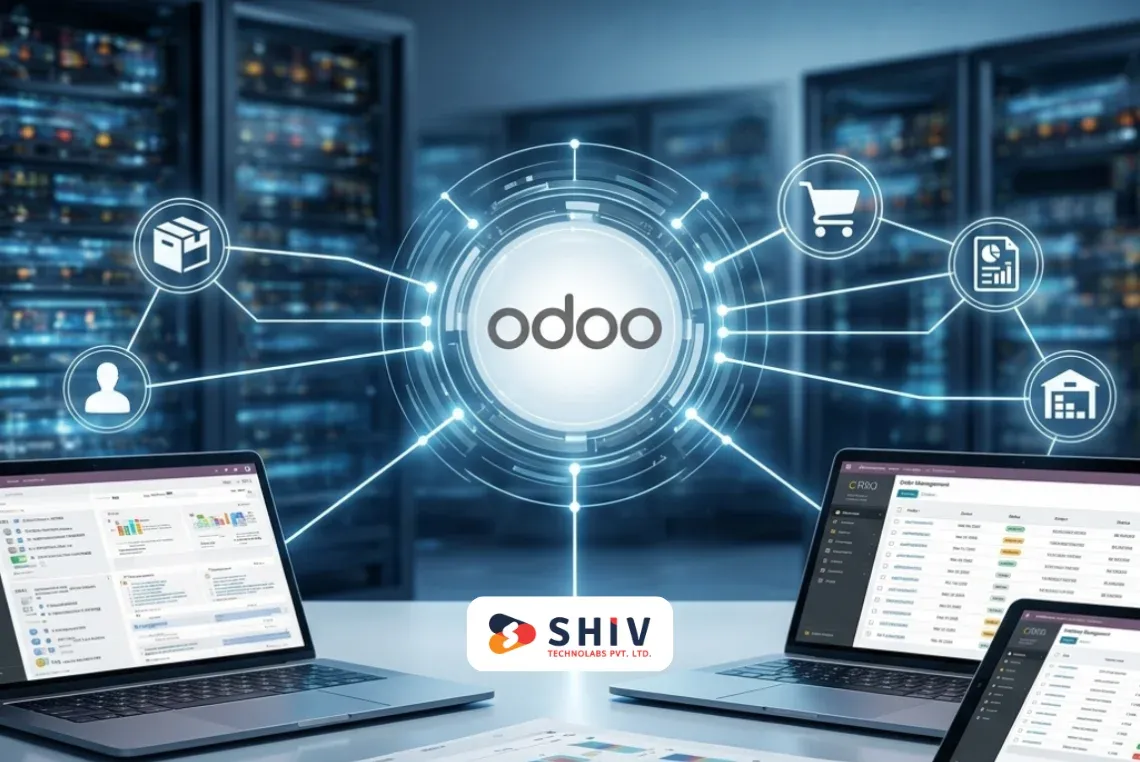
Modern ERP connects with CRM, payment gateways, WMS, HR tools, and accounting software. A dedicated team ensures Odoo API development is stable, providing real-time sync, error handling, and secure data exchange.
A dedicated team ensures:
- API stability
- Real-time sync
- Error handling
- Secure data exchange
3. Custom Module Expansion
New modules are added to businesses as needs increase. Special teams ensure code standards and guard against architectural wars.
4. Performance Optimization
The increase in the database affects speed. Developers are dedicated and will optimize queries, indexing, and server performance.
5. Upgrade Readiness
New releases occur frequently at Odoo. The upgrades are costly and risky without constant monitoring.
How Do Odoo Developers Raise Customization Success Rates?
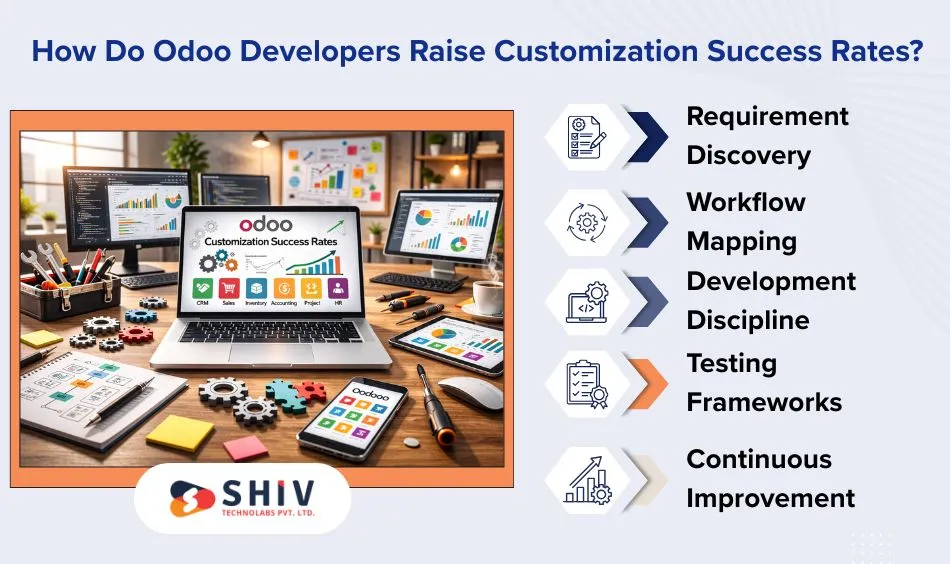
The success of ERP lies in its organised implementation – not a welding.
1. Requirement Discovery
Dedicated teams invest time in:
- Business stakeholder interviews
- Pain-point analysis
- Future roadmap planning
This reduces scope creep by 30%+.
2. Workflow Mapping
They translate business processes into technical flows:
- Approval hierarchies
- Automation triggers
- Role-based permissions
Clear mapping prevents rework.
3. Development Discipline
Structured coding standards ensure scalability:
- Clean module architecture
- Version control
- Documentation
4. Testing Frameworks
Dedicated teams implement:
- Unit testing
- User acceptance testing
- Regression checks
This reduces post-deployment bugs by up to 40%.
5. Continuous Improvement
ERP is iterative. Specialized teams track their usage trends and provide optimization recommendations after every quarter.


When Should You Choose Dedicated Odoo Developers?
All businesses require a long-term team at a given time. But some conditions require it.
- Multi-Department Workflows: When finance, HR, inventory, and sales use Odoo, coordination becomes more complex.
- Frequent Feature Requests: Ongoing change requests require ongoing technical management.
- Integrations Required: API connections need to be maintained.
- Ongoing Upgrades: Companies that upgrade their businesses annually enjoy continuity.
- Long Roadmap: If Odoo is central to the 3-5-year strategy, assign a dedicated team to it.
Dedicated Team vs Freelancers vs In-House Team
Different delivery models affect risk, cost, and knowledge retention.
Delivery Model Comparison for Odoo Projects
| Factor | Dedicated Team | Freelancers | In-House |
|---|---|---|---|
| Knowledge Retention | High | Low | High |
| Availability | Full-time | Limited | Full-time |
| Cost Predictability | Medium | Medium | High |
| Long-Term Support | Strong | Weak | Strong |
| Scalability | High | Low | Medium |
Freelancers save on short-term expenses but increase long-term uncertainty. The in-house teams add to the fixed overhead in terms of dollars. Commitment models compromise between flexibility and stability.
What Roles Should Exist in a Dedicated Odoo Development Team?
A team of developers producing code is not enough to be considered a high-performing dedicated Odoo development team. It is an organized group with ownership of business logic, system stability, scalability, and roadmap implementation.
ERP projects lack role clarity, which results in:
- Scope confusion
- Delayed releases
- Poor documentation
- Upgrade risks
The following are the indispensable roles that ensure ERP stability and long-term customization success.
1. Functional Consultant: Business Logic Architect
A functional consultant mediates between the business requirements and the technical implementation. This position makes Odoo more real and operational, rather than based on assumptions.
Core responsibilities:
- Process discovery workshops.
- Gap analysis between the standard Odoo & business needs
- Approval mapping + workflow documentation.
- Requirement prioritization
A strong functional consultant reduces customization rework by 25–35% and ensures that development aligns with real KPIs, not guesswork.
2. Backend Odoo Developer: Core System Engineer
The Backend Developer is responsible for the core of customization models, business logic, automation logic, and integrations. Responsibilities include:
- Development of custom modules (Python + Odoo ORM)
- Business logic enforcement
- CRM, ERP, WMS, payment gateways, and so on.
- Database performance tuning and optimization.
ERP systems are weak without strong backing. A qualified backend developer will provide scalability, data integrity, and sustainability.
3. Frontend/UI Developer: User Experience Optimizer
Odoo’s usability directly affects adoption rates. Ineffective UI lowers productivity by 20% or more. Frontend specialists specialize in:
- Custom views and dashboards
- simplification of interfaces by roles.
- Reporting layouts
- Mobile responsiveness
An effective UI enhances user adoption, reduces training costs, and speeds up the execution of activities across departments.
4. QA Engineer: Stability & Risk Control Lead
ERP malfunctions may interfere with the finance, inventory, and payroll functions. QA is not optional. Key responsibilities:
- Functional testing
- Regressive testing when upgrading.
- Performance stress testing
- Integration validation
5. Project Manager: Execution & Accountability Driver
The most skilled developers cannot work without organized coordination. The Project Manager maintains the correspondence between the roadmap, budget, and timelines of delivery.
Responsibilities:
- Sprint planning + milestone tracking.
- Stakeholder communication
- Risk management
- Resource allocation
Clarity leads to fewer delays, customization is within budget, and releases are predictable.
How Do Dedicated Teams Support Upgrades?
Upgrades are a given, as Odoo releases major versions every year. Dedicated teams audit custom modules, refactor deprecated code, and manage Odoo migration services to reduce downtime by up to 50%.
- Audit custom modules
- Refactor deprecated code
- Test integrations
- Stage release before live release.
This approach reduces upgrade downtime by up to 50%.
How Can Businesses Hire Dedicated Odoo Developers Successfully?
Recruiting the wrong people puts the risk. Best practices include:
- Evaluate Odoo version expertise
- Review past ERP case studies
- Assess integration experience
- Define SLA and support terms
- Clarify cost structure
When companies choose to Hire Dedicated Odoo Developers, they need to focus on stability, not the lowest cost.
Conclusion
ERP customization is not about short-term code; it’s about ownership, continuity, and a long-term plan. Companies that depend on a single resource tend to experience rising costs, irrationality, and equipment failures. The structured customization, predictable upgrades, and scalable performance of Odoo are made possible by a dedicated Odoo development team.
If you seek a trusted Odoo customization, Shiv Technolabs is a dedicated Odoo customization company offering end-to-end Odoo customization services. Our professionals match the ERP architecture with business growth, integrations and compliance needs.
FAQs
1. Why are dedicated Odoo developers better than freelancers?
Full-time developers offer continuity, retention of long-term knowledge and unmoved availability. Freelancers are also not as engaged as much, thus posing a greater risk for upgrades and integrations.
2. When should a company choose a dedicated team?
Select a team of specialists in case of a multi-departmental ERP, integrations, or ongoing customization that was not covered at the initial release.
3. How long should businesses keep a dedicated team?
To ensure consistent evolution and gradual upgrades, most developing businesses have dedicated teams of 12-36 months.
4. Do dedicated developers help with upgrades?
Yes. They test custom modules, refactor depleted code, test integrations, and manage version migrations with minimal downtime.
5. What skills should dedicated Odoo developers have?
They require skills in Python, Odoo ORM, API integrations, database optimization, testing frameworks, and ERP workflow design.
6. Are dedicated developers suitable for small businesses?
Yes, particularly when ERP is at the heart of operations and is anticipated to expand. Stability eliminates rework in the future.