Table of Contents
The process of Odoo implementation may seem simple and easy on the surface, as one simply installs modules, sets up workflows, and links data; however, the truth is much more technical.
Companies that do not recognize the complexity of architecture often face performance and upgrade issues, as well as costly rework, in the first 12-24 months. Industry estimates suggest that nearly 70% of business software customization projects are redesigned due to inadequate technical planning.
This is why companies are turning to Odoo development, which is supported by actual architectural knowledge rather than configuration-only solutions.
Why Does Strategic Technical Expertise Define the Success of Odoo Development Projects?
Odoo implementations are not a one-time setup but an evolving platform of operation. Strategic technical planning will ensure the system can support workflow and user expansion, as well as integration requirements, without inducing instability.
Architecture-Led Development Prevents Rework
Good planning will ensure that modules are implemented logically and that there will not be redesign costs in the future.
Technical Mapping Aligns Business Logic with System Logic
Professionals encode operational workflows in scalable technical models rather than in deficiencies.
Controlled Customization Reduces Future Conflicts
Well-designed Odoo customization ensures core functionality is not overwritten during updates.
Data Integrity Maintained Across Expanding Operations
Technical controls ensure proper database relationships as usage increases.
Upgrade-Ready Development Protects Long-Term Investment
Version-compatibility systems minimize disruption and downtime during an upgrade.
What Technical Layers Make Odoo Development Complex?

The power of Odoo lies in its flexibility, but this flexibility comes at the cost of technical depth, which can be easily lost. System behavior, performance, and compatibility with the upgrade all depend on each configuration decision.
Module Dependency Structure
Modules are interconnected; changing one affects others.
- Improper sequencing causes workflow conflicts
- Hidden dependencies break during updates
- Architecture-first planning prevents cascading failures
ORM and Database Mapping
Odoo’s ORM (Object Relational Mapping) connects business logic to database tables.
- Poor mapping causes data duplication
- Inefficient queries slow transactions
- Structured schema design ensures performance stability
Access Control Configuration
Role-based permissions require precise planning.
- Incorrect rules expose sensitive data
- Overlapping permissions create workflow confusion
- Secure access models maintain governance
API Integration Mapping
External integrations must align technically before deployment.
- API mismatch leads to data inconsistency
- Integration latency affects operations
- Pre-integration mapping reduces failures
Multi-Company Configuration
Multi-entity environments demand structured separation.
- Shared data without isolation causes reporting errors
- Tax and accounting logic must remain independent
- Proper configuration supports scalable expansion
Upgrade Compatibility Planning
Every customization must survive version upgrades.
- Hard-coded logic breaks in future versions
- Version-aware development ensures continuity
- Upgrade-safe coding protects system longevity


What Are the Most Common Reasons for Odoo Project Failure?
The subsequent causes of Odoo project failure seem general and are likely to arise when there is no strategic expertise.
- Poor Module Planning: Fragmented module deployment disrupts the workflow.
- Lack of Upgrade Strategy: Customizations do not work well at version change – creating instability.
- Performance Mismanagement: Slow interfaces and delayed transactions are brought about by unoptimized queries.
- Weak Integration Design: Poor API mapping will result in cross-system data variation.
- No Scalability Planning: The systems built to meet current requirements fail tomorrow.
Major Odoo Project Risks and Their Strategic Impact
| Risk Category | Technical Cause | Operational Impact | Strategic Prevention |
|---|---|---|---|
| Module conflicts | Poor dependency planning | Workflow disruption | Structured module architecture |
| Upgrade failure | No compatibility review | System instability | Version-aware coding |
| Performance slowdown | Unoptimized queries | Slow transactions | Database tuning |
| Integration breakdown | API mismatch | Data inconsistency | Pre-integration mapping |
| Scalability limitation | No load planning | Growth constraints | Architecture-first planning |
How Do Odoo Technical Experts Minimize Long-Term Risks in Odoo Projects?
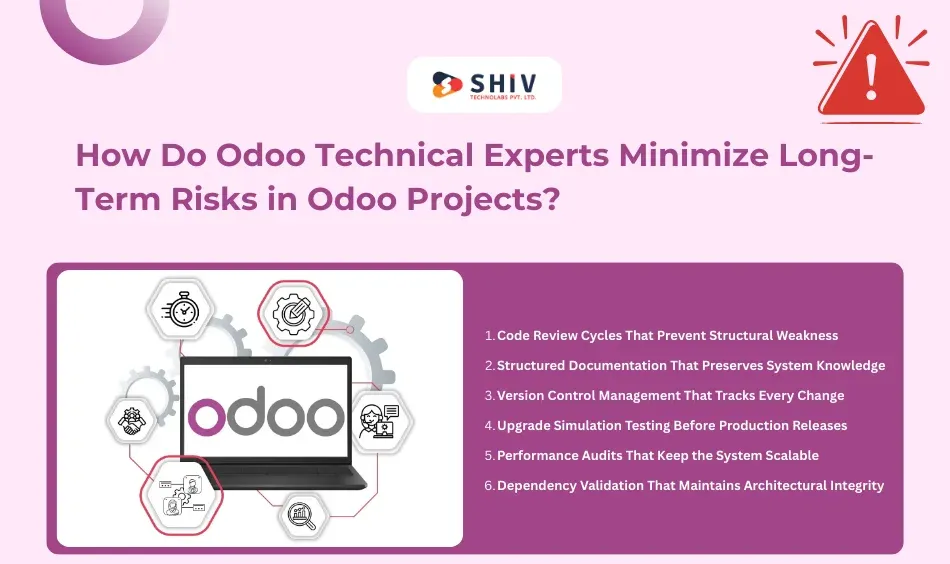
Odoo long-term risks are not often evident in the first launch; they manifest themselves several months after the launch, when the data volume increases, the number of users grows and integrations and upgrades are required.
The dedicated Odoo Developers are building resilience into the system at an early stage to make the platform stable, scalable, and maintainable, even as the business becomes more complex.
Code Review Cycles That Prevent Structural Weakness
Technical teams implement disciplined code review practices to ensure every customization aligns with Odoo’s core framework.
- Validate module compatibility before deployment
- Eliminate inefficient queries that degrade performance over time
- Ensure extensions follow upgrade-safe coding patterns
This structured validation prevents hidden conflicts that often emerge after scaling.
Structured Documentation That Preserves System Knowledge
Comprehensive documentation is not optional; it is essential for risk control.
- Functional logic, workflows, and customization layers are recorded clearly
- Future teams can understand architecture without reverse engineering
- Reduces dependency on individual developers
Well-documented systems reduce maintenance effort by up to 30%–40% over time.
Version Control Management That Tracks Every Change
Robust version control allows organizations to manage evolution safely.
- Track every customization, patch, and configuration update
- Enable rollback in case of instability
- Maintain traceability for audits and troubleshooting
This ensures changes are controlled rather than reactive, a key part of effective Odoo technical supervision.
Upgrade Simulation Testing Before Production Releases
Experts create staging environments to simulate version upgrades. By validating Odoo integration services and database migrations in advance, they identify conflicts before they affect live operations.
- Experts create staging environments to simulate version upgrades
- Validate module compatibility and database migrations in advance
- Identify conflicts before they affect live operations
This proactive testing protects against downtime and unexpected failures during system evolution.
Performance Audits That Keep the System Scalable
As transaction volume grows, poorly optimized systems slow down dramatically. Technical experts conduct periodic audits to maintain efficiency.
- Analyze database load, indexing, and query performance
- Optimize workflows to handle increasing user activity
- Ensure system response time remains consistent even at scale
Regular performance tuning prevents gradual degradation that can otherwise impact productivity.
Dependency Validation That Maintains Architectural Integrity
Odoo’s modular structure requires continuous monitoring of interdependencies.
- Validate how new modules interact with existing ones
- Prevent cascading failures caused by unnoticed conflicts
- Maintain architectural consistency across implementation phases
Why Is Odoo Technical Supervision Critical in Multi-Phase Odoo Implementations?
Massive Odoo deployments happen in phases, such as finance, operations, inventory, and CRM, and have to be supervised by Odoo technocrats constantly to keep in step with each other.
- Practices Architectural Consistency: All the stages become part of a common technical construct rather than forming silos.
- Preventing Configuration Drift: Supervision helps ensure that subsequent modules do not compromise the stability of previous modules.
- Ties System Evolution to Business Growth: Scalability within the departments is achieved by technical oversight.
How to Choose an Odoo Technical Team for Complex Odoo Projects?
The choice of the appropriate team determines a system’s ability to scale or the number of risks within its scope.
- Experience in Architecture Planning: Find teams that create system structures, not only to configure features.
- Big Database Processing Experience: They must handle large volumes of transactions without sacrificing performance.
- Upgrade Management Capability: Proven capability to perform version migrations with a high level of safety.
- Integration Experience: Adequacy to relate logistics, finance, analytics and external tools.
- Code Quality Standards: Best practice of clean coding and documentation.
- Risk Mitigation Approach: Systematic validation minimizes Odoo’s long-term risks.
- Documentation Discipline: Secures continuity of knowledge after implementation.
Conclusion
Strategic technical skills are the distinction between an Odoo implementation that functions operationally and an implementation that generates long-term value. Knowledge of architecture, dependencies, integrations, and upgrade pathways helps organizations manage costs, reduce the risks of Odoo projects, and scale with ease.
Collaborating with an established Odoo development company like Shiv Technolabs provides organized architecture, managed risk, and stability in Odoo implementations. At Shiv Technolabs, we offer intensive technical leadership in terms of customization, integrations, upgrades, and optimization of performance so that your Odoo system is scalable, secure, and future-proof.
Frequently Asked Questions (FAQs)
1. Why do Odoo projects fail without strategic technical expertise?
The majority of failures happen due to the disregard of architecture, dependencies, and the upgrade plan.
2. What role do Odoo technical experts play in complex Odoo implementations?
Odoo technical experts create system architecture, certify integrations, maintain dependencies, and provide upgrade compatibility so the platform can scale without affecting operations.
3. How can businesses reduce Odoo project risks?
Odoo project risks are addressed by organizations through planning, version-conscious customization, performance testing and continuous monitoring, rather than implementing them as a single deployment.
4. Why are Odoo upgrades risky without upgrade experts?
In the absence of Odoo upgrade specialists, custom modules can break, data migration can fail, and workflows can become unstable, resulting in downtime and remediation at high cost.
5. How to choose an Odoo technical team for long-term stability?
When selecting an Odoo technical team to achieve long-term success, businesses should consider architecture capability, integration skills, upgrade experience, and documentation discipline.