
Table of Contents
When businesses consider high-traffic web systems, the real question is not whether they can be built, but how expensive they will be and how many months it will take. Pricing is confusing, and the schedule is unclear because they cannot access the backend systems until they take them offline. This is why clarity at the decision stage regarding pricing and schedules for backend development is necessary.
Statista projects global data creation to reach 181 zettabytes by 2025, driven by digital platforms supporting millions of simultaneous users.
Modern platforms rely heavily on backend development services to address spikes in traffic, API load, integration, and data integrity. A very simple estimate may be based on expected traffic, scaling goals, architectural depth and operational scope.
This guide provides pricing and timelines of the backend work on the development of high-traffic web platforms to make sure that founders, CTOs, and product teams can make plans, not on guesses, but on solid grounds.
What Does Backend Development Pricing Include for High-Traffic Web Platforms?
High-traffic systems require significantly more than an API or a database query to perform backend pricing. When traffic becomes significant, every technical choice should prioritize performance, reliability, and crash recovery. It directly impacts the cost of backend development, as engineering work is distributed across planning, architecture, testing and deployment preparation.
System Planning & Technical Discovery
Traffic modelling, feature mapping, dependency identification and workshops. Busy websites must be cleared first to avoid duplication in the future.
Architecture & Scalability Design
The invention of horizontal scale systems, concurrent and non-bottleneck systems. This layer is an overlay to the cost of the backend development.
Performance-Focused Development
CRUD endpoints are not the only ones; the API also needs optimization, data access patterns, caching logic and asynchronous processing.
Testing & Load Validation
Stress testing, parallel testing, and failure testing are normally absent in standard platforms.
Available Deployment and Environment
CI/CD pipelines, observation and recording strategies of production stability.
How to Accurately Estimate Backend Development for High-Traffic Applications
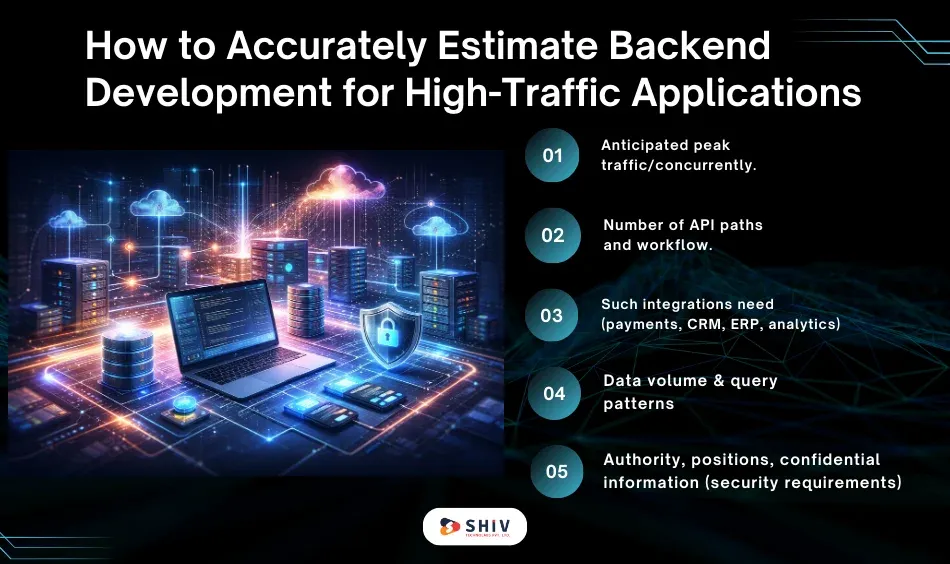
Not a guesswork exercise but a planning exercise. Functional and non-functional requirements can be considered in a high-traffic application, where under-engineering may otherwise occur. Backend development estimation depends on traffic behavior, system interactions and reliability expectations.
Core estimation drivers:
- Anticipated peak traffic/concurrently.
- Number of API paths and workflow.
- Such integrations need (payments, CRM, ERP, analytics).
- Data volume & query patterns
- Authority, positions, confidential information (security requirements).
What Factors Affect Backend Development Pricing for Large-Scale Web Platforms?
Large platforms are operated at capacity. Stability is not an option; it is a must. This affects prices because the engineering work increases in multiple areas.
Traffic Volume & Concurrency
Increasing the number of servers increases the number of simultaneous requests. The systems are supposed to support thousands of concurrent sessions without compromising performance.
Architecture Complexity
Monolithic, modular and service-based systems affect the engineering required to support scalability and fault isolation.
Trends of Data storage and retrieval
Alternative database methods are required for high-read, low-write systems. Poor data modelling increases the future cost of the backend development.
Security & Compliance
Role-based access, encryption, audit logs and compliance standards (GDPR, SOC 2, HIPAA) burden engineering.
Integration Load
Both third-party systems introduce latency, risk of failure and maintenance costs.
These are core pricing drivers for backend development of large-scale web applications.
How Much Does Backend Development Cost for High-Traffic Web Platforms?
Cost varies based on readiness for scale. The ranges below are planning benchmarks, not fixed quotes.
Backend Development Cost Estimates for High-Traffic Platforms (Planning Ranges)
| Project Scope | Typical Use Case | Estimated Cost Range |
|---|---|---|
| Scalable MVP backend | Launch-ready, moderate load, essential APIs | $8,000 – $15,000 |
| Growth-stage backend rebuild | Scaling existing system, more integrations | $15,000 – $25,000 |
| Enterprise-grade backend | High availability, complex workflows, heavy load | $25,000+ |
These numbers reflect backend development pricing that includes architecture, testing and deployment readiness, not just coding.


What is the average life cycle of high-traffic systems of a backend development project?
High-traffic systems cannot be devoid of planning or validation. Timelines include the architectural, performance, and production preparedness.
Planning/ Requirement validation
Traffic modeling, feature scoping, and feature integration mapping. Missing this phase will most likely result in weeks of delay.
Architecture Data Design
The last item is the finalization of the database structure, API boundaries, caching strategy, and system flow graphs.
Simple Backend Development
It is applied in parallel on APIs, business logic, data handling, and integrations.
Performance validity/testing
Test simulation, load testing and failure testing.
Deployment and Monitoring Installation
CI/CD pipelines logs, alert and rollback strategies.
This signifies a realistic schedule of backend development project.
How Long Does Backend Development Take for Scalable Web Applications?

The backend delivery is done in phases. The scope of the total backend development project will determine its duration.
Phased Delivery Overview
Scalable systems are not created simultaneously. The initial releases are related to the basic workflows, followed by the performance optimization and the infrastructure optimization. More integrations and higher reliability ambitions extend schedules. Most platforms are complex and can take 8-16 weeks to deliver.
Backend Development Timeline by Phase for High-Traffic Platforms
Below is a realistic phase plan used for scaling platforms handling real-world traffic:
Backend Development Timeline Breakdown
| Phase | Estimated Duration | What Happens |
|---|---|---|
| Requirements + traffic planning | 1–2 weeks | Features, peak load, integrations and success metrics |
| Architecture + data flow design | 1–2 weeks | System design, DB planning, API structure |
| Core backend development | 6–10 weeks | APIs, business logic, integrations |
| Performance tuning + load testing | 2–3 weeks | Caching, query tuning and concurrency checks |
| Deployment + monitoring setup | 1–2 weeks | CI/CD, logs, alerts, production readiness |
How Does Traffic Scale Impact Backend Development Cost and Timeline?
Below are the leading ways traffic scale impacts backend development cost and timeline:
User Concurrency
More concurrent users require more expensive backend development due to horizontal scaling, stateless services and increased session management.
Higher API Throughput
The APIs must be able to respond faster to load and this requires caching, rate limiting and query optimization.
Infrastructure Preparedness
Autoscaling, monitoring, failover and redundancy costs increase with traffic and affect backend development costs.
What Backend Architecture Is Commonly Used for High-Traffic Web Platforms?
Architecture underpins performance and stability. It is not the code that business leaders need, but clarity.
Traffic Distribution, Energy balancers
Distribute the load across servers to avoid overloading and single points of failure.
Stateless App Services
Horizontal and not session-dependent.
Caching Layer
Improve common read load balancing using Redis / in-memory caches.
Database Scaling Approach
Replica reading, sharding and optimized large set indexing.
Queue based Background Processing
Asynchronous processes that do not block user requests with emails, reports and work.
This is typical when it comes to backend development of scalable applications and large-scale web platforms.
When Should Businesses Plan Backend Development for High-Traffic Growth?
Here are the top scenarios when it is an ideal time for businesses to plan Backend Development for High-Traffic Growth
- Drawing up Seasonal Traffic/Campaigns: Marketing spikes expose the weak backend systems.
- Suffering from long response times to Load: Latency is an issue that identifies scaling constraints.
- Additions of Integrations and Workflows: Each integration complicates the system.
- Diversify to More Users or Regions: It is necessary to improve the architecture to scale by geography.
How Do Backend Development Services Support High-Traffic Web Platforms End-to-End?
Service backend Professional backend development services incorporate the entire lifecycle:
- Planning & Estimation: Traffic modelling, scope definition and realistic pricing.
- Architecture & Build: High-strength implementation and scalable system architecture.
- Testing & Optimization: Load testing, tuning and failure prevention.
- Deployment & Monitoring: Prepared to do production using logs, alerts and recovery plans.
This coincidence makes the timing of the backend development project’s undertakings predictable.
What Should You Prepare Before Requesting Backend Development Pricing?
Planning eradicates cost runaway and schedule slip. Prepare before the price of a backend development is solicited:
- Status of platform (new or existing)
- Anticipated peak traffic/concurrently.
- Core workflows & API needs
- Integrations list
- Security requirements/compliance requirements.
Transparency of inputs = proper estimation of the backend development.
Conclusion
The price and timing of backend development cannot be set as a universal rate. On high-traffic web platforms, costs and timelines depend on scale expectations, architectural depth, performance validation, and long-term reliability requirements. Failure to estimate the backend work is a frequent source of downtime, re-work, and lost sales.
Here, Shiv Technolabs stands as a trusted backend development agency. With deep expertise in backend development services for scalable web applications, Shiv Technolabs has delivered architecture-first solutions in production, not just demos.
When looking to grow, re-platform, or improve performance, our team of experts is well-versed in every edge of backend development.
Frequently Asked Questions (FAQs)
1. What is the cost for the backend development of a high-traffic web platform?
The price for the development is based on the scope, traffic projections, integrations, security considerations and performance testing requirements. High-traffic systems require additional planning, optimization and validation and are more costly than standard applications.
2. What is the reason why backend development estimation is more accurate for scalable platforms?
Clear traffic goals, API lists, correctly modelled data and mapped integrations increase the precision of backend development estimates. The more understanding is provided in the early phases, the fewer assumptions the teams will need to make.
3. What will be the duration of a realistic project schedule for high-traffic systems backend development?
The back-end development project timeline is typically 8-16 weeks and includes planning, development, load testing and project deployment preparation. Skipping steps is risk predisposing on the long term.
4. What is the average time of a backend development project of a large-scale web application?
The parameters for back-end development projects are determined by integrations, performance objectives and architectural complexity. Enterprise-level platforms are also normally slow due to the need for reliability and scalability.
5. How does the cost of the backend development change with an increase in traffic?
Increases in traffic demand, scaling, caching, database optimization, infrastructure upgrades and monitoring, all of which will make backend development more expensive but protect against performance and uptime.