Table of Contents
Businesses today face the challenge of legacy applications that once drove growth but now hinder innovation, increase maintenance costs, and limit scalability. In enterprise digital transformation, reports indicate it is projected to grow by 10% by 2031. Organizations are dedicating more time to maintaining old systems than to creating new value.
This is also where React Native development services are becoming a viable path for modernization. Rather than supporting legacy codebases, enterprises are building new applications with React Native to achieve long-term scalability, a single development cycle, and shorter release cycles.
Why Do Enterprises Rebuild Applications Instead of Maintaining Legacy Systems?
Businesses do not recreate apps without a reason. The move toward a React Native enterprise application strategy is often associated with years of inefficiency, system rigidity, and increased operational pressure that the legacy system cannot support.
An organization-specific React Native modernization plan can help replace depreciated foundations with scalable, maintainable, and forward-compatible platforms that align with today’s product velocity and infrastructure demands.
Technical Debt Accumulation
Old systems are laden with patches, workarounds, and dependencies that are years old. This ultimately results in weak environments where a small number of updates poses a risk.
Rising Maintenance Cost
Businesses typically allocate 60%–80% of IT budgets to maintaining legacy applications rather than investing in innovation. Operation costs are inflated by infrastructure, licensing and specialized developers.
Slow Feature Rollout
Single codebases cannot be shared between iOS and Android, so they must develop and release at different speeds and respond more slowly to market shifts. A detailed comparison between cross-platform and native systems in this React Native vs native app development guide explains how shared codebases reduce development time and cost.
Scaling Challenges
Older architectures struggle to support the growing user base, integrations, and data, leading to performance bottlenecks as they scale.
Limited Integration with Modern Ecosystems
Legacy systems are not easily compatible with APIs, cloud offerings, analytics solutions, or automation tools, limiting digital transformation.
What Are the Clear Signs an Enterprise App Needs Rebuilding?
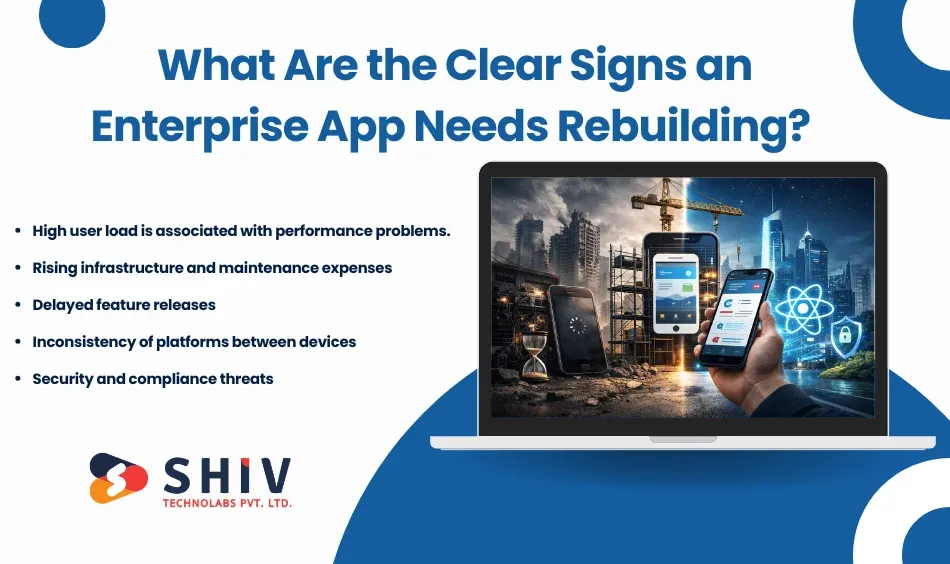
Before modernization, businesses faced operational pressures. These signs indicate that rebuilding enterprise applications with React Native is preferable to continued maintenance.
High user load is associated with performance problems.
When systems are used most frequently, they tend to slow down, leading to inconsistent use and operational inefficiencies that harm productivity and customer confidence.
Rising infrastructure and maintenance expenses
Ongoing maintenance, dedicated support services, and legacy hosting platforms continue to increase costs annually without delivering new features.
Delayed feature releases
The inflexible architecture, redundant workflows, and compatibility restrictions hinder development teams from implementing updates within a short timeframe.
Inconsistency of platforms between devices
Having separate native applications creates a fragmented user experience, inconsistent user interface updates, and increased testing.
Security and compliance threats
Outdated frameworks lack modern encryption, monitoring, and compliance support, increasing sensitivity to regulatory and cybersecurity risks.


What Makes React Native Enterprise App Architecture Scalable?
React Native adds architectural flexibility to enterprise-scale settings. A current-day React Native enterprise application infrastructure is an alternative to siloed systems, in which the development and deployment pipelines are part of a single architectural unit.
Shared Codebase
A single codebase powers multiple platforms.
- Eliminates duplicate development
- Accelerates updates
- Ensures feature consistency
Reusable components and modular architecture help speed development and simplify maintenance. Key technical capabilities discussed in this article on React Native features that speed mobile development further highlight how unified frameworks improve enterprise scalability.
API-Driven Backend
React Native integrates seamlessly with API-first ecosystems.
- Enables faster integrations
- Supports modular backend services
- Enhances system flexibility
Microservices Compatibility
React Native works naturally with microservices environments.
- Independent service scaling
- Faster deployments
- Reduced system coupling
Easier Scaling
Applications scale horizontally across users and services.
- Supports enterprise-level concurrency
- Handles growth without architecture rewrites
- Reduces infrastructure strain
Enterprise Architecture Comparison
| Factor | Legacy Native Apps | React Native Enterprise App Architecture |
|---|---|---|
| Codebase | Separate teams | Shared unified code |
| Release Speed | Slower | Faster |
| Maintenance Cost | Higher | Lower |
| Scalability | Limited | Flexible |
| Long-Term Cost | Higher | Lower |
How Does Migrating to React Native from Native Apps Improve Growth?
The native app-to-React Native migration is not only a technology change but also an operational acceleration approach that helps engineering efficiency keep pace with business scalability.
Engineering Efficiency
Enterprises transitioning to unified codebases often report 30–40% faster feature release cycles, enabled by shared business logic and synchronized platform updates.
- Faster rollout across platforms
- Lower lifecycle cost due to shared development
- Better scalability through unified architecture
Teams spend less time supporting parallel systems and more time on innovation, enabling faster delivery of customer needs and market demands. Many enterprises accelerate this transition by choosing to hire dedicated React Native developers who manage migration and modernization efficiently.
What Is the Cost of Rebuilding an Enterprise Application with React Native?
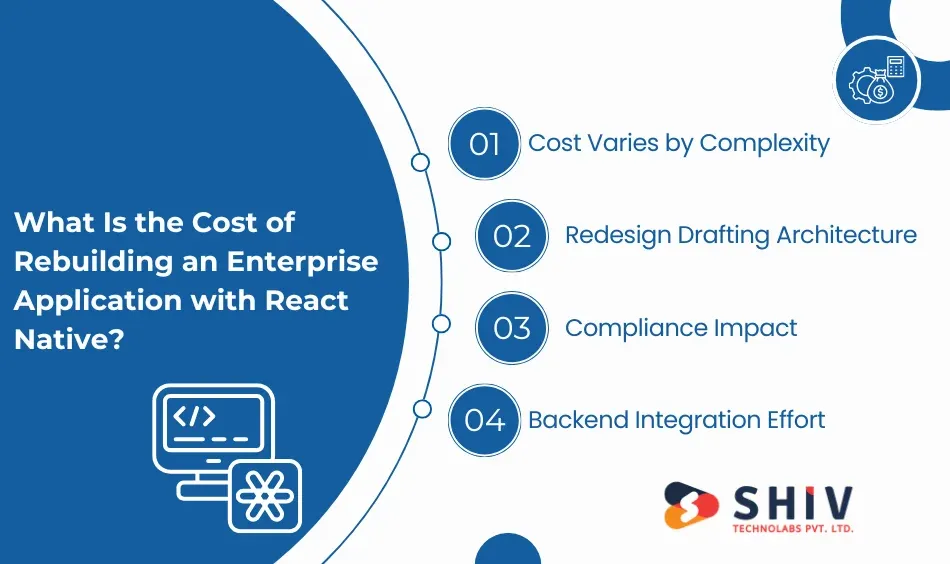
The React Native rebuild cost will vary based on the scope of the architecture, integrations and compliance requirements. Nevertheless, the long-term costs of maintaining independent native app implementations are typically low in the enterprise environment.
Cost Varies by Complexity
Single enterprise applications involve fewer integrations, whereas multi-system platforms require more planning and validation in their architecture.
Redesign Drafting Architecture
Restructuring workflows, APIs and user journeys affects cost, but provides long-term scalability and maintainability.
Compliance Impact
The modernization of industries subject to regulatory requirements requires stronger governance, testing and data controls.
Backend Integration Effort
The combination of the ERP, CRM and analytics systems requires API alignment and testing procedures.
Enterprise React Native Rebuild Cost Table
| Enterprise App Type | Estimated Cost | Timeline |
|---|---|---|
| Mid-Level Enterprise App | $60,000 – $120,000 | 4–6 months |
| Large SaaS Platform | $120,000 – $250,000 | 6–9 months |
| Complex Multi-System Enterprise | $250,000 – $500,000+ | 9–14 months |
How Can Rebuilding Enterprise Apps with React Native Reduce Technical Debt?
React Native modernization eliminates accrued inefficiencies.
Remove Duplicated Logic
Shared code eradicates duplicate workflows, enhancing maintainability and makes testing more complex.
Simplify Tech Stack
React native is a unifying system of tools, frameworks and dependencies.
Reduce Patch Updates
Single updates, rather than spread-out patch cycles, can reduce risk and overhead.
Lower Risk
The current frameworks provide security, surveillance and scalability features, minimizing prolonged exposure.
How Do React Native Consulting Services Support Enterprise Rebuilds?
The rebuilding efforts are not limited to isolated technical exercises, as the professionals provide React Native consulting services, ensuring projects are not created in a vacuum with respect to business objectives.
- Architecture Review: Analyze existing systems, dependencies and scalability needs prior to modernization.
- Migration Roadmap: Develop phased transition plans to minimize upheaval and ensure continued operations.
- Risk Planning: Early identify integration risks, compliance issues and performance considerations.
- Cost Estimation: Present pragmatic financial planning that is in tandem with enterprise-level and schedule projections.
- Infrastructure Alignment: Make sure that there are supporting systems; backend, cloud and integration systems to support the new application architecture.
How React Native App Development Services Support Long-Term Enterprise Growth?
Modernization is not a recreation. Constant optimization ensures long-term performance.
- Ongoing Optimization: Regular updates enhance efficiency, compatibility and feature delivery.
- Feature Scaling: A cohesive architecture enables quick deployment of new business capabilities.
- Monitoring: The tracking of the performance makes sure that the applications are able to respond as the demand increases.
- Governance: Controlled supervision ensures compliance, trustworthiness and discipline in operations.
Conclusion
Enterprise applications rebuilt with React Native deliver quantifiable benefits, including improved scalability, reduced operational expenses, reduced technical debt and better long-term ROI. Enterprise systems no longer need to be fragmented by legacy systems; they can adopt a unified architecture that fuels ongoing innovation and growth.
Shiv Technolabs is a reputable React Native app development company that specializes in modernizing legacy enterprise systems into scalable, future-proofed systems. Our specialists will offer long-term modernization, from architectural planning and migration to performance optimization and governance alignment. Rebuild smarter, faster and future-proof enterprise applications with Shiv Technolabs.
Frequently Asked Questions (FAQs)
1. Can React Native be used to recreate large enterprise applications?
Yes, React Native is scalable, integrates with APIs and delivers the performance enterprises require, making it suitable for rebuilding large systems without sacrificing flexibility or cross-platform compatibility.
2. What is the cost of recreating an enterprise application using React Native?
Prices range from $60,000 to $500,000+, depending on complexity, integrations and compliance needs and long-term savings include reduced maintenance and cohesive development.
3. Is the long-term maintenance cost lower in case of migrating to React native?
Absolutely, Simplified infrastructure and shared codebases reduce duplicated development, support overhead and patch management and significantly lower overall lifecycle costs.
4. What is the duration of an enterprise rebuild project?
Implementation of most modernization projects in enterprises typically takes 4-12 months, depending on system complexity, integration and the scope of migration.
5. Can React Native enterprise applications support multi-tenant SaaS platforms?
Yes, React Native can be combined with scalable back-end services and microservice architectures, making it well-suited for a multi-tenant SaaS environment.