Table of Contents
Are you losing time and money every day when your systems fail to connect properly? Duplicate data, lagging reports, paperwork, and sluggishness influence your entire team. Report estimates that poor system integration can cut an enterprise’s productivity by 20 to 30% annually due to data silos and non-functioning workflows.
This is why getting professional Odoo integration services right matters so much. The partner you choose will directly affect how your automation runs, how accurate your reports are, and what return you see on your investment. A good Odoo ERP integration specialist does more than connect systems. They build an architecture that holds up as your business grows.
Why Is Choosing the Right Odoo Integration Partner Critical for Long-Term Business Stability?
Odoo is a powerful platform. However, poorly done integration causes problems to accumulate. The effectiveness of your accounting, the transparency of your inventory, and the quality of your CRM information, along with the reports your team acts with, will depend on your system’s connection. Lack of proper implementation leads to API failures, reconciliation errors, and unwanted downtime.
By selecting the right partner, you receive:
- Regular real-time flow of data between systems.
- Automation that runs without creating duplicate records
- ERP performance that holds up as your business scales
- Secure API connections
- Clean and reliable reports
What Should You Look for in an Odoo Integration Partner Before Signing a Contract?
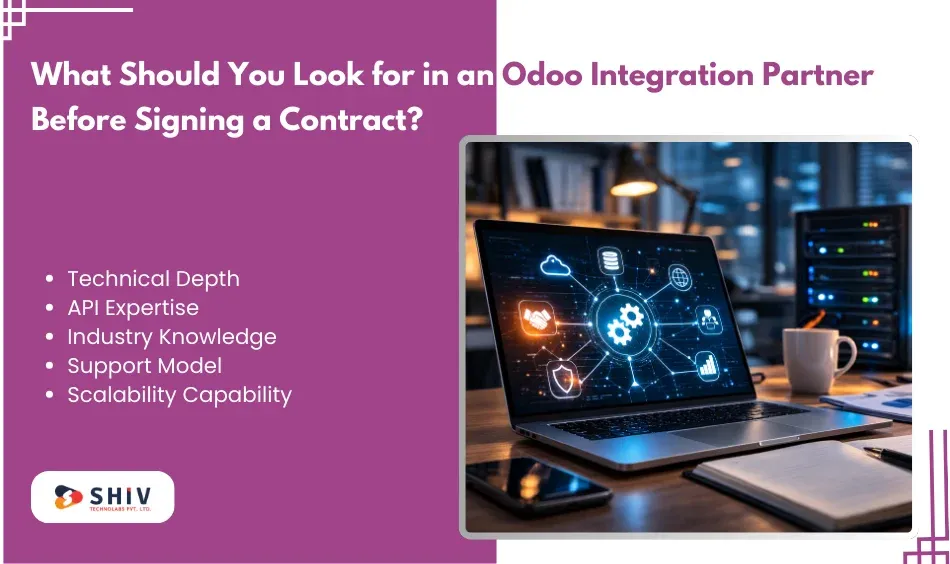
Most integration failures have been linked to a lack of technical expertise, improper planning, or even a support model that disappears once it goes online. An effective estimate will save you time, prevent budget overruns, and avoid scaling issues.
Technical Depth
Your Odoo integration specialist should have strong knowledge of Odoo module architecture, data mapping logic, backend customization, and performance optimization. In its absence, integrations fail as transaction volume grows.
API Expertise
Solid Odoo API integration means the team knows how to handle REST and XML-RPC protocols, secure authentication with OAuth and tokens, manage rate limits, and log errors. Without this, integrations fail quietly, and your team ends up working with incorrect data.
Industry Knowledge
A reliable Odoo system integration company should understand your sector’s tax rules, inventory complexity, multi-location operations, and regulatory requirements. Industry knowledge speeds up delivery and reduces unnecessary customization.
Support Model
Get clear answers on SLA commitments, monitoring tools, how version upgrades are managed, and response times when something breaks. ERP integration needs ongoing attention well after deployment.
Scalability Capability
If your business grows two to five times, can the architecture keep up? Look for cloud readiness, modular connector design, load testing, and database optimization. It is the difference between a quick-fix approach and long-term infrastructure.
Evaluation Checklist for Selecting an Odoo Integration Partner
| Evaluation Area | What It Covers | Why It Matters |
|---|---|---|
| Technical Architecture | API structure, data flow design | Prevents future breakdown |
| Industry Experience | Sector workflows | Reduces customization risk |
| Testing Protocol | Sandbox and staging validation | Avoids live errors |
| Post-Go-Live Support | Monitoring and updates | Long-term stability |
| Documentation Quality | API and workflow documentation | Easier future upgrades |
How to Choose an Odoo Integration Partner for Complex or Multi-System Environments?
Most businesses run multiple systems at once. A normal business links the CRM, accounting, inventory, eCommerce, POS, and manufacturing. It takes good architectural thought to choose a partner in this type of environment.
CRM
Integration must include lead-to-order mapping, platform-wide customer records, and real-time updates. Poor CRM integration is the direct cause of sales forecasting errors.
Accounting
Integration needs tax logic that fits your business requirements, synchronized ledger records, and clean payment reconciliation. Even a 1% mismatch in financial data poses audit risks.
Inventory
It has to support stock updates in real-time, multi-warehouse logic, and automated reorder triggers. Inventory mistakes are detrimental to revenue and customer confidence.
eCommerce
Integration provides balance in orders, pricing, returns, and customer accounts across channels. Any downtime here leads to direct revenue loss.
POS
Integration needs instant transaction recording, clean refund processing, and offline sync so operations do not stop when a connection drops.
Manufacturing System
Integration covers production scheduling and quality tracking. Use Odoo development to fix broken timelines.


What Questions Should You Ask an Odoo Integration Provider During Vendor Evaluation?
Go into vendor conversations with specific questions ready. Vague answers to direct questions tell you a lot about how a vendor works.
- How do you estimate Odoo integration cost? Do you provide a full breakdown? Is billing milestone-based?
- What affects the Odoo integration timeline? How many testing rounds are planned?
- What testing methodology do you use? Do you run sandbox tests, staging validation, and failure scenario testing?
- What is your approach to integration failures? Does it have an automatic retry logic and alert system?
- Do you offer long-term maintenance, such as versioning, API changes, and continuous monitoring?
- Are there any case studies from similar industries with recorded results?
- What is your way of securing API communication? Which encryption standards and access controls do we have?
What Factors Influence Odoo Integration Cost for Businesses?
The cost of Odoo integration depends on what you are creating, not on the number of connectors.
- System Complexity: Additional systems translate to additional data mapping, additional validation logic and increased cost.
- Number of Modules: Each addition of Sales, Accounting, Inventory and HR adds further configuration layers.
- Custom API Connectors: Unlike the standard plug-and-play integrations, custom builds are more expensive.
- Data Migration Volume: The large volumes of historical data add time to both migration and testing.
- Support Requirements: 24/7 surveillance increases the hourly cost but reduces the total risk.
Estimated Odoo Integration Cost Range by Scope
| Integration Scope | Business Type | Estimated Cost Range |
|---|---|---|
| Single System Sync | Small business | $3,000 to $7,000 |
| Multi-App ERP Integration | Mid-sized company | $8,000 to $20,000 |
| Enterprise-Level Architecture | Large enterprise | $25,000 to $60,000 and above |
What Is a Realistic Odoo Integration Timeline for Growing Businesses?
One of the most widespread reasons for the failure of an integration is rushing. A planned schedule makes the deployment stable and on time.
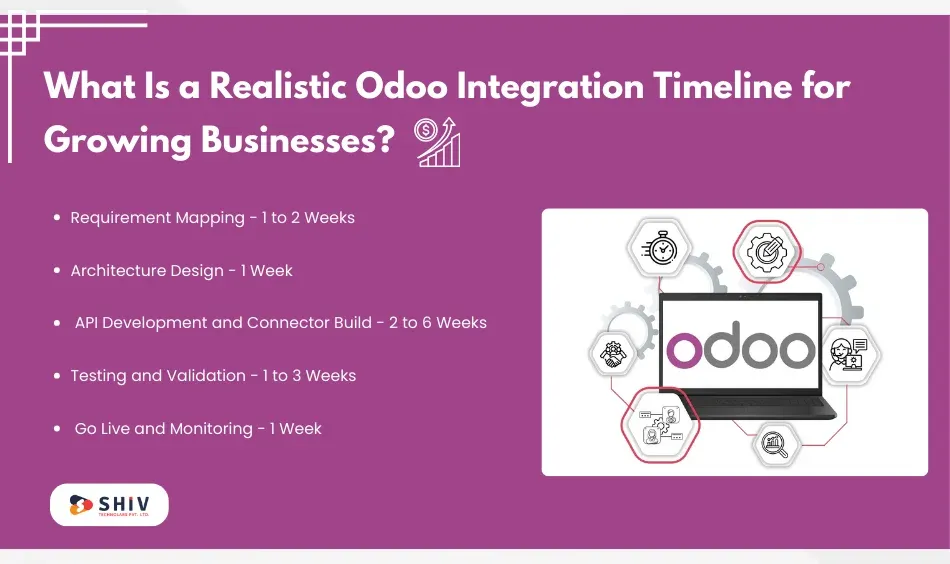
1. Requirement Mapping – 1 to 2 Weeks
This is the most significant stage. It discusses stakeholder interviews, workflow documentation, data field mapping, goal-setting for automation, and risk assessment. Overlooking this stage results in costly rework in the future.
2. Architecture Design – 1 Week
After the requirements are verified, the team develops an API communication model, data flow diagrams, security protocols, middleware decisions, and error-handling logic. An architecture that is not well designed will become ineffective as transaction volume increases.
3. API Development and Connector Build – 2 to 6 Weeks
This is where most of the technical work happens. Scope depends on the number of modules, the amount of custom logic required, the authentication setup, and the complexity of the third-party system.
4. Testing and Validation – 1 to 3 Weeks
This phase confirms that integration works under real conditions through sandbox testing, staging validation, volume simulation, failure-scenario testing, and financial reconciliation checks.
5. Go Live and Monitoring – 1 Week
Going live is not the end of the project. Active monitoring begins here, covering real-time sync observation, error log review, performance tracking, and rollback readiness.
Typical Odoo Integration Timeline Summary
| Phase | Duration | Impact on Stability |
|---|---|---|
| Requirement Mapping | 1 to 2 weeks | Prevents rework |
| Architecture Design | 1 week | Ensures scalability |
| API Development | 2 to 6 weeks | Builds integration logic |
| Testing and Validation | 1 to 3 weeks | Prevents live failures |
| Go Live | 1 week | Ensures operational continuity |
Conclusion
Choosing the right Odoo integration partner is a business decision. Your integration affects automation, financial reporting, compliance, and your ability to scale. Cutting costs on the wrong partner will cost far more when the integration needs to be fixed later.
At Shiv Technolabs, we build structured, scalable, and secure custom Odoo integration solutions for growing businesses. As a trusted Odoo integration company, our team designs an architecture built for performance and long-term growth.
If you are evaluating vendors right now, do not risk your ERP stability.
Frequently Asked Questions (FAQs)
1. How do I evaluate the technical expertise of an Odoo integration partner?
Request to view architecture diagrams, API documents, actual ERP examples, and the testing process. A team that can describe its methodology and illustrate how it has done the same before is a major sign of a true professional.
2. What is the average Odoo integration cost for mid-sized companies?
The costs of mid-sized integrations are usually between $8,000 and $25,000, with modules, custom connectors, and support needs.
3. How long does a typical Odoo integration timeline take?
The typical timeframe for most planned integrations is 4-10 weeks, depending on scope, number of systems, and level of testing.
4. What should be included in an Odoo integration proposal?
A solid proposal should include an architecture plan, cost breakdown, phased timeline, API security approach, and post-launch support terms.
5. Should I choose a consultant or a full-service integration team?
For enterprise projects, a team-based Odoo system integration company offers greater accountability, faster issue resolution, and post-deployment support.