Table of Contents
Contemporary online networks are designed to process thousands (and, in some cases, even millions) of users, requests, and transactions simultaneously. Regardless of whether businesses start with SaaS platforms, enterprise dashboards, or high-traffic web portals, the technology base they use will directly impact performance, development costs, and scalability.
Based on insights, React, Angular, and Vue are the most popular frontend frameworks for their scalability and ecosystem maturity in enterprise projects.
When businesses outsource Frontend development services, the choice of the top Frontend framework is more strategic than technical. An inappropriately selected framework may increase development and maintenance time and delay the release of future features.
Why Does Choosing the Best Frontend Framework Matter for Development Cost?
The structure adopted in a project directly affects the speed at which teams create features, tools, and applications that are maintained over time. The most appropriate Frontend framework makes development and engineering processes very simple and keeps long-term maintenance costs minimal.
Framework Ecosystem and Libraries
Framework ecosystems have a significant impact on development efficiency. Mature ecosystems such as React and Angular have thousands of open source libraries, UI kits, and integrations. This saves on custom development work and cost.
Developer Availability
When a framework has a vast talent pool, it would be easier to hire skilled developers. React and Angular frameworks control the global labor market, allowing businesses to hire Frontend developers more quickly and at lower cost. The adoption of niche structures can increase recruitment costs and project timelines.
Development Speed
The current structures have reusable objects, CLI tools, and workflows that speed up the development cycles. The construction speed reduces project costs. With effective structures, teams can release products a few weeks earlier than other teams, reducing operational costs and shortening time-to-market.
Long-Term Maintenance
In most cases, maintenance costs exceed initial development expenses. Structures that are well documented, have active community support, and have regular updates lower the technical debt. With a properly backed structure, stability is guaranteed over the long term, and the costly refactoring projects encountered later are reduced.
What Makes a Scalable Frontend Framework for High-Traffic Websites?
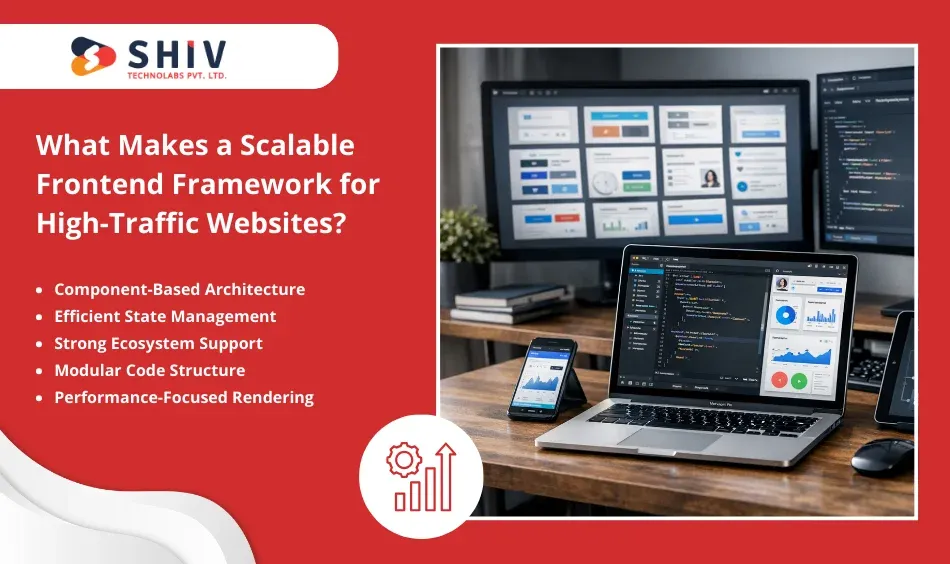
Applications with high traffic must use performance-oriented, modular, and scalable structures. A scalable Frontend framework is enabled by the right Frontend structure so that applications are not slowed by high user traffic.
Component-Based Architecture
In a component-based architecture, applications are divided into reusable components. This enhances maintainability and performance. Other frameworks, such as React, are built on modular components to construct large systems effectively, making them a good choice as front-end frameworks for large applications.
Efficient State Management
Tools for state management help ensure data consistency across multifaceted interfaces. Efficient systems eliminate unnecessary rendering and enhance responsiveness. Scalable web application development requires proper handling of states, since in large applications, the state must be predictable and stable.
Strong Ecosystem Support
A good ecosystem offers plugins, development tools, and libraries to facilitate big projects. Active communities within frameworks develop more rapidly and offer solutions to common performance issues.
Modular Code Structure
Modular architecture will enable teams to build, test, and roll out features independently. This enhances scalability and eases collaboration among development teams building the same application.
Performance-Focused Rendering
Modern frameworks include rendering methods that cut unnecessary UI updates. This improves responsiveness and helps applications perform well under heavy load. For projects that need server-side rendering and speed-focused page delivery, Next.js development services can be a strong fit.
Which Frontend Frameworks Work Best for Large Applications?
For large-scale digital platforms, selecting the right framework is crucial for maintaining performance and scalability
| Framework | Strengths | Best Use Cases | Scalability Level |
|---|---|---|---|
| React | Component architecture, huge ecosystem | SaaS platforms, dashboards | High |
| Angular | Structured framework, TypeScript support | Enterprise platforms | Very High |
| Vue | Lightweight and flexible | Medium-scale applications | High |
| Next.js | Server-side rendering, performance | SEO-driven websites | High |
What is the impact of Frontend Architecture on a high traffic website?
The effective Frontend architecture of high-traffic websites will dictate whether an application will survive as user traffic increases.
Micro Frontend Architecture
Instead, a micro-frontend architecture breaks a large application into autonomous modules that can be developed and deployed by different teams. This enhances scalability and allows big organizations to update much more quickly without affecting the whole system.
Modular UI Components
Reusable user interfaces can be used to design similar applications and enhance performance. Modular design minimizes code duplication and enables faster functional development on large platforms.
CDN-Based Asset Delivery
Content Delivery Networks are used to distribute assets across global servers, thereby reducing latency and load times. The integration of a CDN helps websites deliver static resources faster, improving the user experience during peak traffic.
Caching Strategies
Caching minimizes server load, especially for highly accessed resources. Browser caching, server caching, and CDN caching are used to enhance performance and minimize operational costs.
API-Driven Architecture
Modern web applications use APIs to interact with the backend services. API-based architecture enables frontend and backend developers to operate independently while ensuring each application scales appropriately. This matters even more in custom web app development projects.


How Does Frontend Framework Selection Impact Performance and Speed?
The framework adopted is directly related to optimizing Frontend performance and site speed.
Rendering Approach (SSR vs CSR)
Server-Side Rendering (SSR) provides pre-rendered pages to users, enhancing page load speed and search engine rankings. Client-Side Rendering (CSR) also enables dynamic user experiences but can increase load time. The use of a suitable rendering model is an important consideration for optimizing website speed.
Code Splitting
Code splitting enables applications to load only the required JavaScript files rather than the complete codebase. This helps reduce the time to load the first page and improves performance for users on slower networks.
Lazy Loading
Lazy loading means that images, components, or scripts are only loaded when needed. This helps to avoid the wasteful use of resources and promotes the performance of high-traffic websites.
Bundle Size Management
The size of bundles is very large and slows down applications. Structures that assist tree-shaking and optimization tools are used to minimize file sizes and improve load times.
Efficient DOM Updates
Virtual dominion technologies minimize unwarranted changes by updating only the part of the interface that is needed. This significantly enhances the performance of complex web applications.
How Does the Framework Choice Influence Hiring and Development Teams?
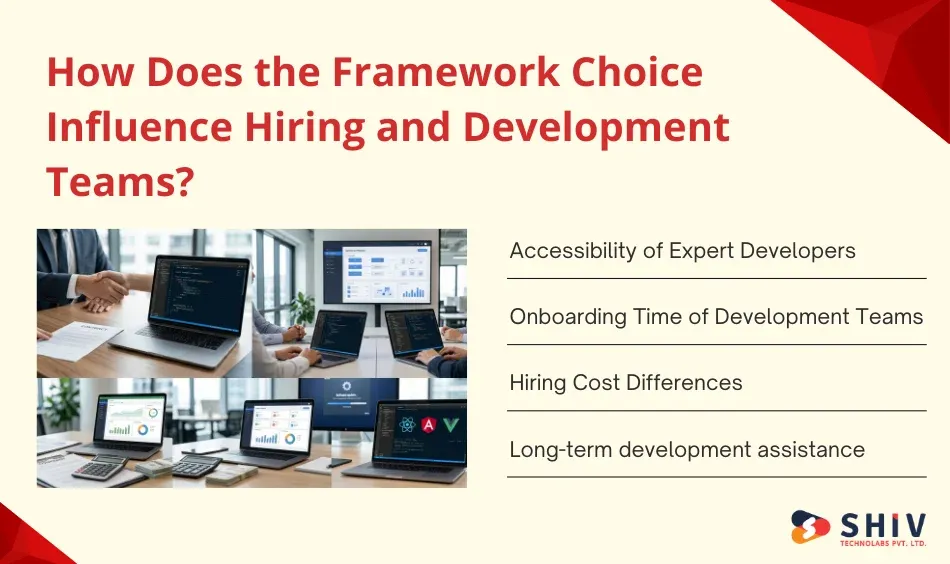
The choice of the framework also affects recruitment, training, and team productivity.
Accessibility of Expert Developers
The level of framework popularity defines the ease of recruiting developers. With such technologies having large communities, the talent pool is larger, making recruitment cheaper and faster.
Onboarding Time of Development Teams
Properly documented structures enable novice developers to learn a project’s architecture quickly. Quick onboarding saves training costs and shortens development schedules.
Hiring Cost Differences
The Demand Framework affects developers’ salaries. With a high talent supply, popular technologies offer competitive prices, whereas niche frameworks may increase hiring costs. If internal hiring is too slow, businesses often choose to hire dedicated developers instead.
Long-term development assistance
Structures supported by large communities or business sponsors are periodically updated and sustained in the long run. This makes the applications safe and compatible with the changing technologies.
When Should Businesses Prioritize Enterprise Frontend Frameworks?
At the enterprise level, there is usually a need for complex frameworks that can support operations at scale.
SaaS Platforms with Large User Bases
Thousands of people should be able to use the applications. Enterprise architectures offer scalability, strong state management, and efficient rendering to ensure uniform performance.
Enterprise Dashboards
Dynamic dashboards based on real-time analytics demand frameworks that can process data updates and support multiple users interacting with them simultaneously.
Large-volume eCommerce Systems
During promotions and seasonal sales, large eCommerce websites show a huge volume of traffic. Enterprise structures guarantee hassle-free browsing, a multifaceted product search, and a consistent checkout.
Conclusion
The selection of an appropriate Frontend framework determines almost every facet of a digital product’s development, including cost, scalability, performance, and sustainability.
Before starting development, businesses developing enterprise platforms must consider framework ecosystems, developer availability, architectural capabilities, and performance features.
Shiv Technolabs is an expert in Frontend development, offering scalable, high-performance web apps to startups, SaaS, and other enterprises.
Our professionals can assist companies in creating scalable Frontend systems, improving performance, and creating applications that will be ready in the future.
Frequently Asked Questions (FAQs)
1. Which Frontend framework is best for high-traffic websites?
Developers build high-traffic websites using frameworks like React, Angular, and Next.js because these frameworks support modular architecture, efficient performance handling, and reliable rendering even when thousands of users access the system.
2. What is the most scalable Frontend framework?
Experts widely regard React and Angular as the most scalable frameworks because they use component-based architectures, support advanced state management, and follow enterprise development practices that scale efficiently for large applications.
3. Does the Frontend framework affect website speed?
Yes, the choice of framework influences how teams handle rendering, manage bundle sizes, and apply performance optimization strategies. Modern frameworks with efficient rendering engines help improve load times and enhance the overall user experience.
4. Which framework works best for enterprise applications?
Angular and React have become widely used in enterprise applications because of their well-organized structures, TypeScript support, and the ability to handle large-scale applications across multiple development teams.
5. Why should businesses hire professional Frontend developers?
Senior developers design optimal architectures, shorten development cycles, and build scalable systems. Professional teams also apply performance optimization strategies to keep applications stable as traffic increases.