Table of Contents
AI agent development cost is no longer only about building a chatbot. In 2026, the price depends on workflow depth, autonomy, data quality, integrations, model usage, governance, and post-launch monitoring. A simple support bot and a multi-system enterprise agent sit at very different ends of the budget, which is the same gap that defines the difference between an AI agent and a chatbot.
Industry coverage shows a clear pattern: enterprises struggle to get measurable results when planning, data quality, integration, and governance are weak. Gartner’s enterprise AI agent research expects more than 40% of agentic AI projects to be canceled by 2027 due to rising costs, unclear value, and weak controls. A phased budget lowers that risk.
What Is the Average AI Agent Development Cost in 2026?
AI agent development cost in 2026 usually starts near $5,000 for a basic agent and can pass $300,000 for enterprise systems. The final figure depends on scope, integrations, data, and governance.
As IBM’s AI agents guide explains, an AI agent designs its own workflow and uses tools to reach a goal. That ability to act, not only chat, is what separates a simple bot from an enterprise agent and drives the budget.
| AI Agent Type | Estimated Cost Range | Best For | Timeline |
| Basic Task Agent | $5,000 to $20,000 | FAQs, simple internal tasks, lead routing | 2 to 5 weeks |
| Workflow Automation Agent | $20,000 to $60,000 | CRM updates, support tickets, document processing | 6 to 10 weeks |
| AI Agent MVP | $30,000 to $80,000 | Validating a real use case with limited users | 8 to 12 weeks |
| Enterprise AI Agent | $80,000 to $200,000+ | Multi-system workflows, compliance, analytics | 3 to 6 months |
| Multi-Agent System | $150,000 to $500,000+ | Complex reasoning, multiple teams, high-scale use | 6+ months |
These are planning ranges, not quotes. Your real number sits where your scope, data, and integrations land.
Industry ranges vary widely. Current pricing pages commonly place simple agents near $5,000 to $20,000, mid-range builds around $15,000 to $100,000, and enterprise-grade systems from $70,000 to $150,000 or higher.
Why Does AI Agent Development Cost Vary So Much?
AI agents differ far more than websites or apps. One agent answers questions, while another reasons, calls tools, and acts across systems. The factors below explain where budgets rise.
# Business Use Case Complexity
Cost rises with what the agent must do. A single-task agent costs little, while an autonomous, multi-step agent costs much more. The five levels below show the climb:
- Single-task agent
- Multi-step workflow agent
- Decision-support agent
- Autonomous agent
- Multi-agent system
Each step up adds reasoning, tool calls, exception handling, and context management. That extra logic raises both build effort and testing time.
# Data Readiness and Knowledge Base Setup
Agents answer well only when the data behind them is clean. Preparing that data is often the quiet bulk of a project. Common data work includes:
- Data cleanup
- Document structuring
- Knowledge base creation
- Vector database setup
- RAG pipeline
- Data permission rules
Structured, ready data keeps this work light. Scattered files, duplicates, and unclear permissions add real hours, so AI/ML development services often start here before any agent logic is written.
# Model Choice and Token Usage
The model you pick shapes both quality and running cost. Choices range across hosted and open-source options:
- OpenAI, Anthropic, and Gemini models
- Open-source models
- Token cost (input and output)
- Prompt length
- Output length
- High-volume usage
Premium reasoning models cost more per task than smaller ones. Output tokens usually cost several times more than input tokens, so long answers add up fast. Token-based pricing can make enterprise cost hard to forecast, because output length changes with every generation.
# Third-Party Integrations
An agent earns value when it connects to the tools your team already uses. Each connection adds setup and testing. Common integrations include:
- CRM
- ERP
- Helpdesk
- eCommerce platform
- Internal databases
- Payment systems
- Slack, Teams, email, and WhatsApp
Integrations often take a large share of an enterprise build budget. Teams modernizing older tools may also need custom software development so the agent can connect to clean, reliable data.
# Security, Compliance, and Governance
Sensitive data and real actions raise the bar for controls. Strong governance protects the business but adds design and review work. This layer usually covers:
- Role-based access
- Audit logs
- Data privacy
- Guardrails
- Approval flows
- Human handoff
- Compliance testing
Regulated industries carry the most weight here. The added testing and policy work explain part of the gap between a basic agent and an enterprise build.
# Testing, Evaluation, and Monitoring
Agents behave probabilistically, so they need broad testing before launch. Good checks catch failures before users do. A solid plan includes:
- Prompt testing
- Red-team testing
- Accuracy testing
- Hallucination checks
- Workflow failure testing
- Live monitoring
- Feedback loop
Strong evaluations help teams ship AI agents with confidence, as Anthropic’s engineering team describes. Production work also needs context engineering, human review, and live measurement to stay reliable.
AI Agent Development Cost by Project Stage
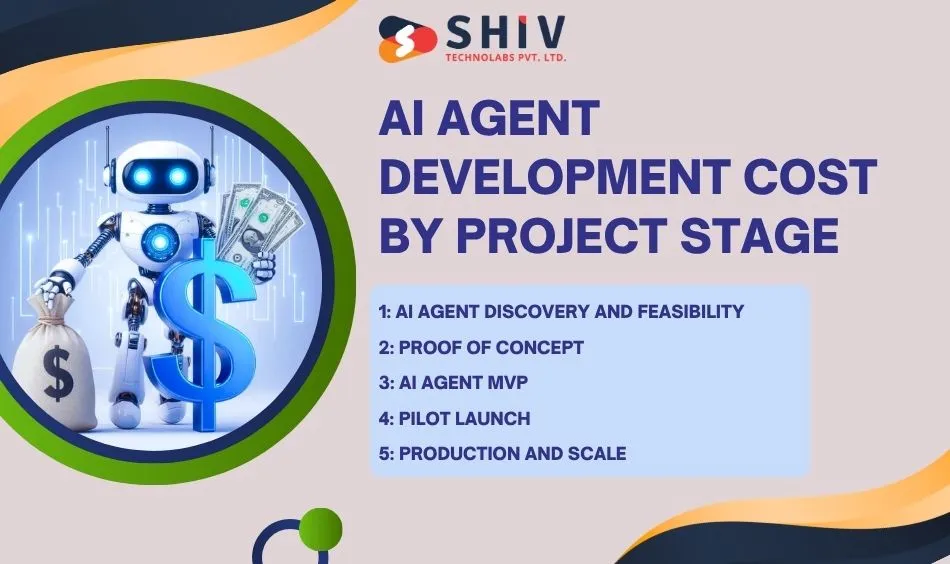
A staged plan gives the clearest view of cost. You fund each stage after the last one proves value. This keeps spending tied to results, not guesses.
| Stage | Estimated Cost | Timeline | Main Focus |
| Discovery and feasibility | $3,000 to $10,000 | 1 to 3 weeks | Scope and risk review |
| Proof of concept | $8,000 to $25,000 | 3 to 6 weeks | Feasibility on one workflow |
| MVP | $25,000 to $80,000 | 6 to 12 weeks | Real workflow, limited users |
| Pilot launch | $50,000 to $120,000 | 2 to 4 months | Live users and measurement |
| Production and scale | $100,000 to $300,000+ | 4 to 8+ months | Multi-workflow and governance |
Ranges are planning guides. A focused project can start at the low end and grow only as results justify it.
# Stage 1: AI Agent Discovery and Feasibility
Discovery defines the work before any code starts. It keeps cost low and prevents expensive surprises later. Cost runs about $3,000 to $10,000 over 1 to 3 weeks, and it covers:
- Use case selection
- Workflow mapping
- Data audit
- Integration audit
- Model selection
- Risk review
- Cost estimate
A short generative AI consulting engagement can sharpen scope at this stage and make every later estimate more accurate.
# Stage 2: Proof of Concept
A proof of concept checks whether the agent can solve one problem. It stays small on purpose. Cost runs about $8,000 to $25,000 over 3 to 6 weeks, and it includes:
- One workflow
- Limited data
- Basic prompt logic
- One or two tools
- Internal demo
- Basic testing
# Stage 3: AI Agent MVP
An MVP turns the idea into a working agent for a small group. It adds a real interface and live connections. Cost runs about $25,000 to $80,000 over 6 to 12 weeks, and it covers:
- Real workflow
- User interface
- API integrations
- Basic role access
- Logging
- Human fallback
- Limited production use
# Stage 4: Pilot Launch
A pilot tests the agent with real users and live data. It measures performance under daily conditions. Cost runs about $50,000 to $120,000 over 2 to 4 months, and it adds:
- Real users
- Live data
- Error handling
- Security checks
- Analytics dashboard
- Feedback cycle
- Performance measurement
# Stage 5: Production and Scale
Scaling turns a working pilot into a reliable production system. This stage carries the most cost because it adds governance and reliability. Cost runs about $100,000 to $300,000 or more over 4 to 8+ months, and it covers:
- Multiple workflows
- Multi-agent architecture
- Governance
- Admin controls
- High availability
- Cost monitoring
- Ongoing model tuning
Cost Breakdown by Component
A breakdown shows where the budget goes inside a single build. Shares shift with scope, but the pattern below is common. Use it to sanity-check any quote you receive.
| Cost Component | Budget Share | What It Includes |
| Strategy and discovery | 5% to 10% | Use case, workflow, scope, risk planning |
| UI and experience design | 5% to 15% | Agent interface, dashboards, approval screens |
| AI logic and orchestration | 20% to 30% | Prompts, tools, memory, reasoning flow |
| Data and RAG setup | 15% to 25% | Knowledge base, embeddings, vector search |
| Integrations | 20% to 35% | CRM, ERP, databases, APIs, business tools |
| Security and compliance | 10% to 20% | Access control, audit logs, policies |
| Testing and evaluation | 10% to 20% | Accuracy, safety, workflow, user testing |
| Launch and monitoring | 5% to 15% | Release, logs, alerts, performance checks |
Cost by Agent Type
Different teams need different agents. The cost shifts with the workflow each one handles. The build types below are the most common.
# Customer Support AI Agent Cost
A support agent resolves routine requests and passes complex cases to a person. Typical scope covers:
- Ticket handling
- FAQ answering
- Order status
- Refund requests
- Human handoff
- CSAT tracking
You can see this pattern in how AI agents transform customer support. Support pricing is also shifting toward outcome-based models, where some vendors charge per verified resolution, often near $1 to $2 each, rather than per seat.
# Sales AI Agent Cost
A sales agent moves leads forward and keeps the CRM current. Common tasks include lead qualification, CRM updates, follow-up emails, proposal support, and meeting scheduling.
# HR AI Agent Cost
An HR agent handles routine people queries and onboarding steps. Common tasks include candidate screening, internal HR queries, policy support, and employee onboarding.
# Finance AI Agent Cost
A finance agent checks documents and supports approvals. Common tasks include invoice checks, expense review, report generation, and approval workflows.
# Operations AI Agent Cost
An operations agent watches processes and flags issues early. Common tasks include inventory alerts, vendor updates, process automation, and document review. Analytics-heavy operations often pair an agent with predictive AI development for forecasting.
Custom AI Agent vs Ready-Made AI Agent: Which Costs More?
Many teams compare a ready-made tool against a custom build. Each fits a different need. The table shows the trade-offs.
| Factor | Ready-Made AI Agent | Custom AI Agent |
| Initial cost | Lower | Higher |
| Setup speed | Faster | Depends on scope |
| Workflow fit | Limited | Strong |
| Data control | Medium | Strong |
| Integration depth | Limited to available connectors | Built around business systems |
| Long-term flexibility | Lower | Higher |
| Best for | Simple use cases | Process-specific use cases |


Hidden Costs in AI Agent Development
Some costs appear after the build, not during it. Planning for them early keeps your budget honest. The items below catch many teams by surprise.
# Token and API Usage Cost
Running an agent costs money on every call. These charges scale with usage and can climb quickly in agentic loops. They include input tokens, output tokens, model calls, tool calls, and long context cost.
# Data Cleaning Cost
Messy source data slows the whole project. Cleanup work covers messy documents, duplicate records, outdated policies, and unstructured files. This effort is easy to miss in an early estimate.
# Integration Maintenance Cost
Connections need upkeep after launch. APIs change, and data sync can break. Common costs include API changes, authentication updates, data sync errors, and legacy system issues.
# Human Review Cost
Strong agents still need human checks for high-stakes actions. Anthropic notes that effective agents pause for human review before irreversible steps. Review costs cover approval workflows, escalations, quality review, and compliance checks.
# Monitoring and Improvement Cost
A live agent needs steady attention to stay accurate. Ongoing work covers logs, alerts, feedback review, prompt updates, and model changes. This keeps performance steady as usage grows.
Monthly AI Agent Maintenance Cost After Launch
A live agent keeps costing money after launch. Hosting, model usage, monitoring, and updates continue every month. Plan these into your budget from the start.
| Maintenance Area | Monthly Cost Range |
| Hosting and infrastructure | $500 to $5,000+ |
| Model and API usage | $500 to $20,000+ |
| Monitoring and alerts | $500 to $3,000 |
| Prompt and workflow updates | $1,000 to $8,000 |
| Security and compliance checks | $1,000 to $10,000 |
| Support and bug fixes | $1,500 to $10,000 |
High-usage products can spend a large share of budget on model usage as volume grows. Tracking model usage as a percentage of revenue keeps cost in check and flags problems early.
How to Estimate AI Agent Development Cost Before You Start
A little preparation makes any estimate sharper and faster. Clear inputs help a vendor scope work without guesswork. Use the steps below before your first call.
# Start With One High-Value Use Case
One strong workflow beats five weak ideas. Pick the workflow with clear value and steady volume, then prove it before adding more.
# Map Every System the Agent Must Touch
List each system the agent will read from or write to. Include CRM, ERP, data warehouse, internal apps, documents, and communication tools. This map drives much of the integration cost.
# Define What the Agent Can and Cannot Do
Clear limits keep risk and testing under control. Write down the actions allowed, actions blocked, approval needs, human handoff points, and risk levels for each task.
# Estimate Usage Volume
Usage shapes running cost as much as the build itself. Estimate the number of users, number of tasks, number of conversations, average response length, and model calls per task.
# Decide Success Metrics
Metrics prove the agent works and justify the spend. Pick a few clear measures, such as time saved, cost saved, accuracy, resolution rate, revenue impact, and user satisfaction.
AI Agent Pricing Models You May See in 2026
Vendors price AI agents in several ways. The right model depends on your scope and usage. The options below are common in 2026.
# Fixed Project Pricing
Fixed pricing works best for a clearly defined POC or MVP. You agree on scope and pay a set fee, which makes budgeting simple.
# Time and Material Pricing
This model fits evolving projects where scope may change. You pay for the hours and resources used, which suits research-heavy work.
# Dedicated Team Pricing
A dedicated team suits long-term AI product work. You fund a steady team over months, which keeps knowledge and speed in one place.
# Usage-Based Pricing
Usage-based pricing fits SaaS-style agents with variable demand. You pay by tokens, tasks, or calls, so cost rises and falls with activity.
# Outcome-Based Pricing
Outcome-based pricing ties cost to results, such as resolved tickets or verified actions. Support vendors now charge per resolution, often near $1 to $2 each. Pricing is moving beyond seat-based models toward usage-based and outcome-based billing.
How to Reduce AI Agent Costs Without Cutting Quality
Lower cost does not have to mean lower quality. Smart scoping and model choices keep spending in line. The steps below help.
# Start With a Narrow Scope
Begin with one workflow, one user group, and one measurable outcome. A tight first build proves value and limits early spend.
# Use Existing APIs Where Possible
Stable APIs save custom integration work and reduce future maintenance. Reach for proven connectors before building anything from scratch.
# Keep Human Approval for High-Risk Actions
Human checkpoints lower risk on sensitive steps. They also reduce testing pressure in early stages, which keeps the first build affordable.
# Use Smaller or Open-Source Models for Simple Tasks
Route simple tasks to smaller models and save premium models for hard ones. Companies are testing lower-cost and open-source models to control AI spending.
# Build Cost Monitoring From Day One
Track model calls, token usage, failed tasks, and user feedback from the start. Early visibility stops small leaks from becoming large bills.
When Should You Build a Custom AI Agent?
A custom build is not always the right call. It pays off when the workflow is core to your business. The signs below point toward a custom agent:
- The workflow repeats often
- The task needs multiple tools or systems
- The agent must follow company-specific rules
- Data security matters
- The workflow has clear ROI
- Ready-made tools cannot match the process
- The agent needs approval logic or human handoff
When several of these apply, AI agent development services usually return more value than an off-the-shelf tool over time.
How Our Team Helps With AI Agent Cost Planning
Shiv Technolabs helps companies plan AI agent work with a phased cost approach, from discovery and POC to pilot and production. The focus stays on budget clarity, use case validation, integrations, testing, and long-term support. You start small, prove value, and grow only when results support it.
With our AI development services, you get an estimate tied to real scope, not a flat guess.
Conclusion
AI agent development cost in 2026 depends on scope, data quality, integrations, model use, testing, and governance. A small POC starts at a lower budget, while enterprise agents need stronger planning, security, monitoring, and maintenance. The wider the workflow and the more systems involved, the higher the cost climbs.
The most reliable approach is phased, not flat, so your budget follows proof at each step. Start with one clear, high-value use case, measure the results, and scale only when they justify the next phase. This keeps spending tied to value and lowers the risk of an overbuilt agent.
FAQs About AI Agent Development Cost
These answers cover the questions buyers ask most about cost.
# How Much Does AI Agent Development Cost in 2026?
AI agent development cost usually starts around $5,000 for basic agents and can pass $300,000 for enterprise systems with complex workflows, integrations, governance, and monitoring. Your final figure depends on scope, data quality, and usage volume.
# What Is the Cost of an AI Agent MVP?
An AI agent MVP may cost between $25,000 and $80,000. The range depends on workflow complexity, data sources, model usage, integrations, and testing needs. A tighter scope keeps the figure near the lower end of that range.
# Why Do Enterprise AI Agents Cost More?
Enterprise AI agents cost more because they need security, compliance, role-based access, audit logs, and multiple integrations. They also need heavier testing, monitoring, and stronger fallback handling, all of which add design and review effort.
# What Are the Hidden Costs of AI Agent Development?
Hidden costs include token usage, API calls, data cleanup, model monitoring, and prompt updates. They also cover security reviews, integration maintenance, and post-launch support. Planning for these early keeps your budget realistic and avoids surprises after launch.
# Is a Custom AI Agent Better Than a Ready-Made AI Agent?
A ready-made agent works for simple tasks. A custom AI agent fits better when workflows need company-specific logic, private data, integrations, approvals, and long-term flexibility. The right choice depends on how core the workflow is.
# How Can I Reduce AI Agent Development Cost?
Start with one use case, limit early integrations, and use existing APIs where possible. Set clear approval rules, route simple tasks to smaller models, monitor token usage, and build the agent in phases to control spend.