
Table of Contents
Introduction
The EU AI Act has reached an important deadline for companies building generative AI applications. December 2, 2026, is the compliance deadline for certain existing AI systems to meet Article 50(2) machine-readable content marking requirements. It is not the date when all AI transparency rules begin.
Most Article 50 transparency obligations have applied since August 2, 2026. The additional four-month transition applies to systems placed on the market before that date, specifically for marking and detecting AI-generated content.
For software companies, SaaS providers, and AI app developers, this distinction matters. A product may already need chatbot disclosures, while its older generative content pipeline has a separate marking deadline. Development teams must review content pipelines, marking technologies, third-party APIs, user interfaces, and technical testing.
This guide explains EU AI Act watermarking requirements, who is responsible, how marking can be implemented, and what development teams should prioritize before December 2.
Quick answer: Under Article 50(2), providers of covered generative AI systems must make synthetic outputs machine-readable and detectable as artificially generated or manipulated, subject to applicable exceptions. Teams should confirm the transition rules for their systems, identify their legal role, select suitable marking methods, and test outputs across supported formats.
Regulatory note: This article provides technical information, not legal advice. The December 2026 transition and any later implementation milestones should be confirmed against the current consolidated EU legislation and official Commission guidance before publication.
What Is the December 2, 2026 EU AI Act Deadline?
December 2, 2026, is the end of the transitional period for providers of certain generative AI systems that were already on the market before August 2, 2026. These providers must meet the machine-readable marking and detection requirements under Article 50(2).
The deadline does not postpone chatbot disclosure, deepfake disclosure, or other Article 50 obligations. Those requirements began applying on August 2, 2026, subject to their specific scope and exceptions.
The European Commission confirms this distinction in its Article 50 transparency guidance. The timeline reflects amendments introduced through Regulation (EU) 2026/1744, commonly called the Digital Omnibus on AI.
For an engineering team, the practical question is whether its AI system generates content covered by Article 50(2), when that system entered the EU market, and whether the output already carries a suitable machine-readable mark.
Important consideration: The transition concerns eligible existing systems, not every AI product or every transparency requirement. Newer systems subject to Article 50(2) were expected to comply when those obligations became applicable.


EU AI Act Transparency Timeline: Which Dates Matter?
The EU AI Act uses several application dates because different requirements apply to different systems and activities. Product teams should avoid treating a single deadline as the compliance date for every AI feature.
The following milestones are particularly relevant to generative AI applications.
| Date | Requirement | Main Impact |
| February 2, 2025 | Certain prohibited AI practices and AI literacy provisions began applying | Organizations operating AI systems |
| August 2, 2025 | General-purpose AI model obligations began applying, subject to transition rules | GPAI model providers |
| August 2, 2026 | Article 50 transparency requirements began applying | Relevant AI providers and deployers |
| December 2, 2026 | Article 50(2) transition ends for eligible existing systems | Providers of covered generative AI systems |
| December 2, 2027 | Certain Annex III high-risk AI obligations apply under the amended timeline | Relevant high-risk AI providers and deployers |
The European Commission’s AI Act implementation timeline provides further details on the phased application dates. A business may fall under several provisions at once. For example, an AI-powered recruitment application could face transparency duties alongside separate requirements relating to high-risk AI systems. Its obligations depend on the actual functionality and legal classification, not merely the technology used.
Does the EU AI Act Apply to Your Software or AI Application?
The EU AI Act distinguishes between organizations that provide AI systems and those that use them. These roles determine which obligations may apply, and a company can have different roles across different products.
For software businesses, classification should happen at the feature and product level. Simply describing the company as an AI developer, software vendor, or API customer is not enough to establish its legal responsibilities.
AI System Providers
A provider generally develops an AI system, or has one developed, and places it on the market or puts it into service under its own name or trademark.
For example, a business selling an AI-powered image-generation platform may qualify as a provider. If the system falls within Article 50(2), the business must assess the requirement to mark generated content in a machine-readable and detectable format.
This responsibility can affect system architecture, output generation, technical documentation, and quality testing. The provider should also identify whether marking is performed internally or through a contracted technology supplier.
AI Deployers
A deployer generally uses an AI system under its authority, except for personal, non-professional activities.
A marketing company using an AI video generator to produce promotional content may be a deployer. Its responsibilities can include disclosing qualifying deepfake content when published, depending on the applicable provisions and exceptions.
A deployer is not automatically responsible for implementing the underlying model’s machine-readable marking system. However, it should examine whether its own editing, export, and publication processes affect the markings or disclosures required for its activities.
Companies Acting as Both Providers and Deployers
A business may provide an AI application to customers while using separate AI tools internally. It may therefore have provider obligations for one system and deployer obligations for another.
Consider a SaaS company that offers an AI writing assistant and also uses an external image-generation service for its advertising campaigns. The writing assistant and advertising workflow need separate assessments.
Documenting each activity helps prevent teams from applying the wrong obligations to the wrong product. It also clarifies responsibility for disclosure notices, content marking, and third-party contracts.
SaaS and App Companies Using Third-Party AI Models
Many applications integrate models supplied by external providers through APIs. These models may generate text, images, speech, or video while the SaaS application manages the customer experience and distribution.
Using a third-party model does not automatically eliminate the application’s legal responsibilities. Depending on the arrangement, the company offering the finished system may still qualify as a provider.
Review the model supplier’s marking capabilities, API documentation, contractual commitments, and output restrictions. Confirm whether generated files retain marking information after the application processes or exports them.
This is especially important for businesses adding AI to existing platforms. Teams planning AI and machine learning development should assess provider responsibilities during product design rather than waiting until release.
Expert implementation insight: Create a separate responsibility record for every AI feature. Record the model supplier, customer-facing product owner, generated content types, EU availability, and the party responsible for marking and disclosure. This prevents compliance tasks from getting lost between vendors and internal teams.
Non-EU Companies Offering AI Applications in Europe
The AI Act can apply beyond companies established inside the European Union. Article 2 sets out territorial rules covering certain providers, deployers, and situations involving AI outputs used in the EU.
A software company based in the United States, India, or another country should therefore assess its EU-facing activities rather than relying on its office location. Review where the system is offered, who uses it, where its outputs are used, and which legal role the company occupies. Qualified counsel should confirm the resulting obligations.
Expert insight: Build a responsibility matrix for each AI feature. Include the product owner, underlying model supplier, content type, EU availability, applicable obligation, and implementation owner. This becomes particularly useful when several vendors contribute to one customer-facing application.
What Does Article 50 Require for AI-Generated Content?
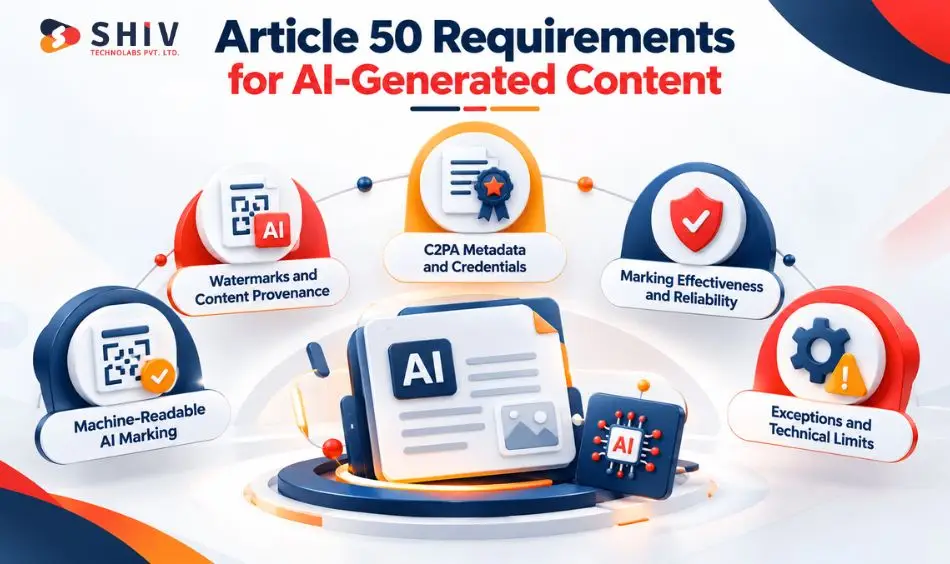
Article 50(2) addresses synthetic content generated by certain AI systems. It requires providers to make covered outputs machine-readable and detectable as artificially generated or manipulated, subject to the regulation’s conditions and exceptions. The requirement is technology-neutral. It does not prescribe one universal watermarking vendor or require every system to use exactly the same implementation.
Machine-Readable Marking and AI Content Detection
Machine-readable marking means that technical systems can identify information indicating that content was generated or manipulated using AI. The marking may be associated with a generated image, audio recording, video, or text output. The technical method depends on the media type, file format, generation process, and applicable standards.
A visible AI-generated badge may help users, but it does not automatically satisfy a machine-readable marking requirement. Similarly, a machine-readable signal may not be understandable to an ordinary person without an appropriate detection tool.
Embedded Watermarks and Content Provenance
An embedded watermark places a detectable signal within the content itself. Depending on the method, it may be designed to remain identifiable after certain processing operations. Content provenance serves a related but different purpose. It provides information about a file’s origin, processing history, or authenticity.
For example, a generated image may carry provenance information describing its creation process. A watermark may separately help identify that the image contains synthetic content. Neither approach is perfect. Editing, compression, rewriting, and conversion can affect detection, so engineering teams should test their chosen solution under realistic conditions.
C2PA Metadata and Content Credentials
The Coalition for Content Provenance and Authenticity, or C2PA, develops technical specifications for content provenance.
Its framework supports content credentials that can carry signed information about the origin and processing of digital media. This can help verification systems evaluate provenance claims and detect certain forms of tampering.
Developers can review the official C2PA specifications when considering provenance architecture. However, C2PA is not automatically mandatory for every application under Article 50. Teams should evaluate whether it meets the relevant requirements for their outputs and whether additional marking methods are needed.
Effectiveness, Interoperability, and Reliability
Article 50(2) refers to technical solutions that are effective, interoperable, robust, and reliable as far as technically feasible.
Effectiveness concerns whether the solution serves its intended identification purpose. Interoperability concerns whether marking and detection can function across relevant technical environments.
Robustness matters when content is modified or converted. Reliability concerns whether detection produces dependable results within the intended operating conditions. These characteristics should be tested rather than assumed from a vendor’s product description.
Exceptions and Technical Limitations
Article 50(2) includes exceptions, including certain assistive functions for standard editing and situations where the system does not substantially alter the input data or its meaning. Other specific exceptions also appear in the regulation. An exception should be assessed against the actual system behavior. For example, minor editing assistance may raise different questions from generating a completely synthetic image.
Teams should also document technical limitations. Some marking approaches work better for images than text, while others may be affected by compression or significant content modification.
Consider this: Selecting a marking method is both a compliance and architecture decision. The team should assess output formats, expected user behavior, technical feasibility, detection performance, and the effect of future software changes.
Which AI Transparency and Disclosure Rules Already Apply?
Machine-readable marking is only one part of the EU AI Act’s transparency framework. Article 50 also addresses circumstances where people must be informed that they are interacting with AI or encountering AI-generated or manipulated material. These duties should be implemented according to their specific scope. A chatbot notice, deepfake disclosure, and synthetic content mark are different controls with different purposes.
Chatbot and AI Interaction Disclosures
Article 50(1) addresses AI systems intended to interact directly with people. Where the obligation applies, providers must design these systems so individuals are informed that they are interacting with AI.
For example, an AI customer support assistant may need a clear notice within the conversation interface. The information should appear at the appropriate time rather than being buried in an unrelated policy page.
Teams should test the notice across web, mobile, and embedded chat experiences. The disclosure must remain understandable even when the interface changes or a third-party chat component is updated.
Deepfake Image and Video Labelling
Article 50(4) addresses disclosure by deployers of qualifying AI-generated or manipulated image, audio, or video content constituting a deepfake. This may affect businesses publishing synthetic footage, altered visual representations, or other material covered by the regulation.
The provision contains specific qualifications, including treatment of artistic, creative, satirical, and fictional works. The applicable disclosure approach depends on the circumstances and should be reviewed with legal counsel.
AI-Generated Audio and Synthetic Speech
Synthetic speech can be used in customer support, training, entertainment, accessibility, and automated communications. Teams should assess both the provider’s marking obligations and any deployer disclosure duties that apply to the specific audio content.
Technical implementation may involve audio marking, export metadata, user-facing notices, or other controls. The final approach should account for audio encoding, editing, and distribution methods.
AI-Generated Text on Public Interest Topics
Article 50(4) also addresses certain AI-generated or manipulated text published for the purpose of informing the public on matters of public interest. The provision includes an exception related to human review or editorial control and editorial responsibility.
This means the requirements should not be interpreted as a universal rule requiring every AI-assisted email, product description, or internal document to carry a public disclosure.
Accessibility and Timing of AI Disclosures
Article 50(5) addresses how required information should be provided. Relevant disclosures must be clear and distinguishable, appropriately timed, and aligned with applicable accessibility requirements.
For developers, this means disclosure design should be part of user-interface planning. Review text clarity, screen-reader accessibility, mobile layouts, contrast, and the timing of notices. A disclosure that disappears before users can read it may fail to serve its intended purpose.
EU AI Act Watermarking Compliance Checklist for Software and App Teams
A workable compliance plan needs clear ownership, technical decisions, test results, and release evidence. Rather than treating watermarking as a final feature, development teams should integrate the requirements into the content-generation workflow.
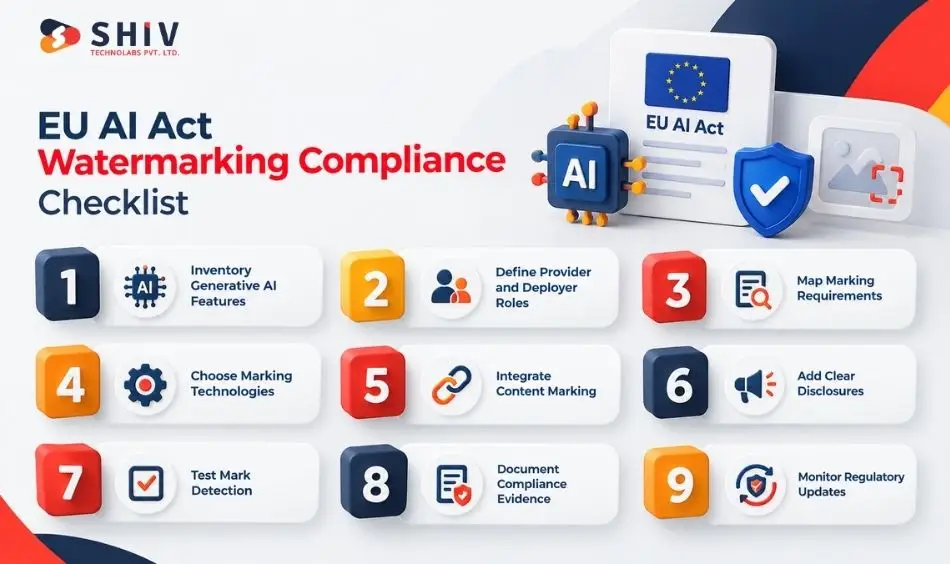
1. Inventory Every Generative AI Feature
List the AI features currently available to customers or internal teams. Include chatbots, text generators, image tools, audio synthesis, video generation, and applications that transform existing content.
For each feature, record the generated content type, model provider, release date, EU availability, and output formats. This inventory helps identify systems that may fall within Article 50(2), including older products approaching the December transition deadline.
2. Confirm Provider and Deployer Responsibilities
Work with legal and compliance teams to classify the company’s role for each AI system. Do not assume that using a third-party API makes the model vendor responsible for every part of the finished application.
Document which party handles output marking, visible disclosures, technical documentation, and updates when the underlying model changes.
3. Map Marking Requirements to Output Formats
Different content types need different technical assessments. For images, examine file formats, resizing, compression, and metadata preservation. For video, review transcoding and distribution workflows. For text, assess the available marking methods and their limitations.
The objective is to identify where the mark enters the pipeline and what happens to it before the content reaches the user.
4. Select Suitable Marking and Detection Technologies
Evaluate the chosen method against the requirements for effectiveness, interoperability, robustness, and reliability. C2PA-based provenance, embedded watermarking, and other marking approaches may serve different purposes.
Avoid choosing a method solely because it is easy to integrate. Test whether authorized detection tools can still recognize the output after ordinary processing.
5. Add Marking to the Content-Generation Pipeline
Apply marking at a controlled point in the generation or export process. For example, an image application may generate an image, attach relevant provenance information, apply a supported embedded mark where appropriate, and then produce the final downloadable file.
The exact sequence depends on the technology. The important point is that marking should not be bypassed by alternative export routes, batch processing, or API access.
6. Build Clear Disclosure Interfaces
Review every place where users interact with AI or encounter covered synthetic content. Depending on the applicable obligation, disclosures may appear in chat interfaces, media viewers, publishing workflows, or exported content.
Test the notices on desktop and mobile devices. They should be understandable, appropriately timed, and accessible.
7. Test Mark Detection and Content Transformations
Generate representative outputs and test whether the chosen marking method remains detectable after expected processing.
Include realistic operations such as image resizing, video transcoding, audio compression, and supported file exports. Record the results, including cases where the mark becomes unreliable or is lost.
8. Document Compliance Decisions and Evidence
Maintain records of the feature inventory, legal role assessment, technical approach, testing, limitations, and release approvals. Include vendor documentation where third-party systems are involved.
Documentation does not replace compliance, but it helps demonstrate why the team selected a particular implementation and how it assessed the results.
9. Monitor Standards and Update Dependencies
Review changes to technical standards, Commission guidance, the Transparency Code of Practice, and third-party model behavior.
A marking implementation may need maintenance when content formats, detection methods, or provider APIs change. Assign an owner for these updates rather than treating compliance as a one-time release.
Expert implementation insight: The most common engineering gap is an incomplete output inventory. A team may add marking to the main web interface while forgetting bulk downloads, background jobs, mobile exports, or public APIs. Every route that produces covered synthetic content needs to be included in testing.
What Technical Challenges Should AI Developers Consider?
AI watermarking introduces practical engineering challenges that differ across media formats and application architectures. A method that works well in a controlled demonstration may not perform the same way after files pass through production services, external platforms, and user editing tools.
Watermark Removal During Compression and Editing
Generated content is frequently resized, compressed, cropped, or converted before reaching its final destination. These operations may affect embedded signals or remove provenance metadata.
For example, an image-generation application may create a marked image and then pass it through a separate image-processing service. The exported file needs to be tested because the processing stage may change its marking characteristics.
Compatibility Across Image, Audio, Video, and Text
Different content types present different technical constraints. Images may support particular embedded marking techniques, while audio and video require approaches suited to their encoding and processing pipelines.
Text presents additional challenges because rewriting, translation, and editing can change the patterns used by some detection methods. A single marking implementation may therefore be unsuitable for every media type.
Third-Party AI APIs and Content Export Workflows
Applications often depend on external AI models, storage services, media processors, and publishing integrations. Each service may handle metadata or embedded signals differently.
Review whether the model supplier provides marking features, whether those features remain active through the API, and whether downstream processing affects the output. Include supplier changes in regression testing.
Proprietary Watermarking and Interoperability Risks
A proprietary marking service may be convenient, but its long-term suitability depends on detection access, technical compatibility, and vendor support. Teams should examine whether independent verification is possible and what happens if the provider changes its technology.
Review relevant open standards and the European Commission’s transparency implementation materials before committing to a tightly coupled architecture.
Watermarking Failures and Recovery Procedures
Marking can fail because of service outages, unsupported formats, processing errors, or configuration problems. Define how the application responds when a required marking step cannot be completed.
Depending on the approved compliance design, the system may need to prevent export, retry processing, or route the output for review. Silent failure should not be the default behavior for a required control.
Implementation consideration: Design marking as a managed application capability with monitoring, error handling, and version control. Treating it as a one-time script makes future maintenance more difficult.
How Should Teams Test AI Watermarking Before Release?
Testing should demonstrate that the selected technical controls work across the application’s supported content-generation and distribution processes. A successful test should produce evidence, not simply confirm that a marking library ran without errors.
Validate Machine-Readable Mark Detection
Generate representative outputs and run the appropriate detection procedure. Record the content type, marking method, detection result, and relevant configuration. Where practical, test both marked and unmarked samples to identify false detections or missed marks.
Test Image Resizing and File Conversion
Check whether marks remain detectable after common image operations. These may include resizing, compression, format conversion, and supported editing functions. Test the formats customers actually download or publish, rather than relying only on original files.
Check Audio and Video Processing
Audio and video may pass through several encoding stages. Test supported compression settings, file conversions, and editing operations. Document whether the selected marking approach remains reliable under the application’s expected processing conditions.
Verify API Responses and Bulk Content Exports
Test generated content delivered through public APIs, background tasks, scheduled processing, and batch downloads. These workflows may use different code paths from the main interface. Confirm that required marking is applied consistently and that processing failures are handled according to the approved design.
Test User-Facing Disclosure Messages
Verify that applicable notices appear at the correct point in the user journey. Test desktop and mobile interfaces, different user roles, and accessibility behavior. Check whether disclosures remain visible and understandable when users interact with generated content.
Document Test Results and Remaining Limitations
Maintain a record of successful tests, failed tests, unresolved limitations, and corrective actions. Link the results to the relevant software version and marking configuration. Before release, obtain the required technical and compliance approvals.
Expert insight: Testing should reflect the complete lifecycle of generated content. The most meaningful result is not whether the original output carries a mark, but whether the application handles that mark appropriately throughout its supported workflows.
What Are the Penalties for EU AI Act Watermarking Non-Compliance?
The EU AI Act establishes an administrative penalty framework for different categories of infringement. Under Article 99 of the original regulation, breaches of certain obligations, including relevant transparency requirements, may be subject to fines of up to €15 million or 3% of worldwide annual turnover, whichever is higher.
The applicable penalty depends on the specific infringement and the regulation’s detailed provisions. Factors such as the nature, gravity, and duration of the infringement may be considered, alongside proportionality requirements and rules affecting smaller businesses.
Enforcement responsibilities are assigned through the EU AI Act’s supervisory framework. National competent authorities and other designated bodies have roles depending on the provision and circumstances.
For the legal wording, consult Article 99 of Regulation (EU) 2024/1689. Businesses should avoid treating the maximum figure as an automatic fine. The practical priority is to establish which obligations apply, implement the required controls, and retain evidence supporting the compliance assessment.
What Common EU AI Act Compliance Mistakes Should Developers Avoid?
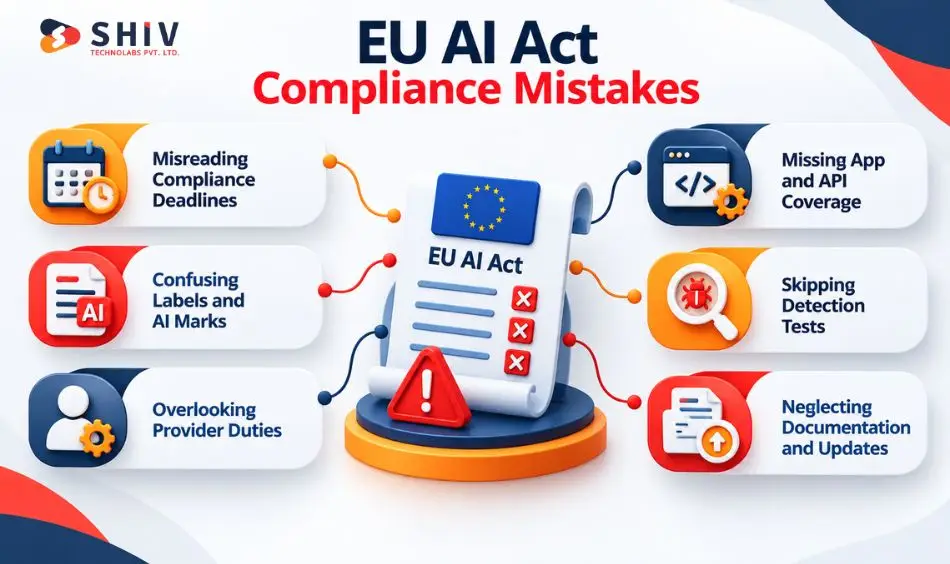
AI transparency problems often arise from incomplete product assessments rather than a lack of development effort. Teams may implement a visible notice but forget machine-readable marking, or add marking to one export route while overlooking others.
Treating December 2 as the Start of All Transparency Rules
Different AI Act obligations have different application dates. The December 2026 transition identified in the supplied brief should not be treated as a general postponement of every Article 50 requirement. Review the current legislation and assess each applicable obligation separately.
Confusing Visible Labels With Machine-Readable Marks
A visible label communicates information to people. Machine-readable marking supports technical identification. Both may be relevant, but they are not interchangeable. Product teams should map each legal requirement to a specific technical or interface control.
Assuming Third-Party AI Providers Handle Every Obligation
External model suppliers may provide marking capabilities, but the finished application may alter or distribute generated content. Review contractual responsibilities and the technical behavior of the entire output pipeline. Do not assume that a supplier’s compliance statement automatically covers every feature of your application.
Forgetting Mobile Apps, APIs, and Background Generation
A web interface may be correctly configured while another generation route remains unmarked.
Include mobile applications, API responses, bulk exports, and scheduled processing in the feature inventory.
Test these paths independently when they use different services or code.
Using Watermarks Without Testing Detection Reliability
A watermarking library may report successful processing even when the final exported file cannot be detected reliably. Test representative outputs after the transformations your product supports. Record limitations rather than claiming that the method is resistant to every form of modification.
Ignoring Documentation and Future Technical Changes
Models, APIs, file formats, and marking standards can change. Without technical documentation and ownership, teams may struggle to determine whether a software update affects compliance. Maintain a review process for significant changes and include marking tests in release planning.
How Shiv Technolabs Supports AI Watermarking Implementation
Implementing AI transparency requirements can involve application development, content-processing architecture, API integration, user-interface changes, and technical testing.
At Shiv Technolabs, we work with businesses developing and maintaining software applications, including AI-powered solutions. Our technical teams can help translate approved compliance requirements into development tasks, integration plans, and test procedures.
Depending on the project, implementation support may include:
- AI feature and content-generation workflow assessments
- Machine-readable marking integration
- Content provenance and metadata handling
- Third-party AI API integration
- AI disclosure interface development
- Output validation and regression testing
- Technical documentation and maintenance
Businesses planning wider application changes can also review our Odoo and enterprise software development expertise where AI capabilities connect with business systems.
Final Thoughts on EU AI Act Watermarking Compliance
EU AI Act watermarking requirements affect more than the appearance of generated content. They can influence how AI systems create, process, export, and distribute text, images, audio, and video.
For software teams, the starting point is a clear assessment of the product’s legal role and applicable obligations. From there, the technical work involves choosing suitable marking methods, integrating them into the application, and testing their behavior across real output workflows.
The December 2026 transition identified in the compliance brief makes early planning especially important for affected existing systems. Teams should verify the current legal timetable, document their decisions, and avoid leaving critical implementation work until the final release window.
Frequently Asked Questions
What Is the December 2, 2026 EU AI Act Deadline?
The supplied regulatory brief identifies December 2, 2026 as a transition deadline for certain existing generative AI systems under Article 50(2). Companies should verify the applicable amended legislation and determine whether their systems qualify for that transition.
Who Must Watermark AI-Generated Content?
Article 50(2) places machine-readable marking obligations on providers of covered AI systems generating synthetic text, images, audio, or video. The regulation includes exceptions, and responsibility depends on the company’s role and the system’s functionality.
Is C2PA Mandatory Under the EU AI Act?
No single C2PA implementation is universally prescribed by Article 50. C2PA is a relevant provenance standard, but providers must assess whether their selected technical solutions meet the applicable marking and detection requirements.
Do AI Chatbots Need Watermarking?
A chatbot may have obligations under Article 50(1) to inform people they are interacting with AI. If it also generates covered synthetic content, Article 50(2) may be relevant. The requirements should be assessed separately.
Does Article 50 Apply to AI Apps Outside Europe?
It can. The AI Act includes territorial provisions that may cover companies established outside the EU. Applicability depends on how the system is offered, used, or placed on the EU market and the relevant statutory conditions.
Can AI Watermarks Be Removed?
Some watermarking methods can be affected by compression, editing, rewriting, or file conversion. Reliability depends on the technology and processing conditions. Developers should test realistic transformations and document known detection limitations.
Does Using OpenAI or Another AI API Remove Compliance Responsibilities?
Not automatically. A company integrating a third-party AI model may still have responsibilities for the finished application. Its role, contractual arrangements, generated content, and applicable provisions must be assessed.
What Happens if an AI Application Fails to Meet Article 50 Requirements?
Applicable infringements may result in regulatory enforcement and administrative penalties under the AI Act. The outcome depends on the relevant provision, circumstances, and penalty rules. Businesses should seek legal advice when assessing compliance gaps.