Table of Contents
Managing inventory without the right data is expensive. Businesses lose money to overstocking slow-moving products, and they lose customers when popular items run out unexpectedly. Traditional ERP systems can track what you have, but they cannot tell you what you will need.
That gap is exactly where AI-powered inventory management in Odoo changes the game. Odoo’s AI layer works on top of your existing stock data to predict demand, adjust reorder points automatically, and flag problems before they affect your operations. AI overhauls companies’ forecasting, planning, and inventory optimization processes by implementing Odoo ERP. Whether you run a single warehouse or a multi-location supply chain, the combination of Odoo ERP and machine learning gives your team the visibility and speed needed to make better decisions every day.
What is AI-Powered Inventory Management in Odoo?
AI-powered inventory management in Odoo refers to the use of machine learning algorithms, predictive analytics, and automated decision logic directly within the Odoo ERP platform to handle stock planning, demand forecasting, and replenishment.
Instead of relying on fixed reorder points set by a manager months ago, the system reads your sales history, detects seasonal trends, and calculates when and how much to reorder, all in real time. This means your inventory decisions are based on live business data, not assumptions.
Odoo connects its core inventory module with AI-driven analytics tools that can learn from your transaction history and adapt as your business changes. The result is a system that manages itself more than it needs to be managed.
How AI-Powered Inventory Management in Odoo Works
Odoo AI stock management uses machine learning and computer algorithms to utilize past data, forecast future demand, and provide autonomous replenishment decisions for inventory.
Odoo ERP and Machine learning inventory optimization Odoo can use AI-driven inbuilt algorithms to utilize the history of sales, seasonality, and market patterns to create highly accurate forecasts of demand. The forecast feature is used to bridge the difference between reactive stock management and proactive future planning.

The system integrates the basic inventory feature of Odoo with artificial intelligence-based analytics for designing intelligent workflows, which are capable of responding and adapting sensibly to changing business environments.
Machine learning algorithmic solutions implemented within Odoo ERP are a great combination, rendering it easy to analyze collected data.
What Are the Benefits of AI Inventory Management in Odoo?
Businesses that move from manual or rules-based inventory management to AI-driven Odoo systems see measurable improvements across cost, accuracy, and customer service within the first few months of operation. Here are the listed benefits of AI-powered inventory management systems that reduce cost, errors, inaccurate predictions and enhance customer satisfaction.
Significant Reduction in Inventory Costs
AI demand forecasting reduces both overstock and stockout situations, the two biggest drivers of inventory carrying costs. When your reorder quantities are calibrated to actual demand patterns, you stop tying up working capital in safety stock that is never needed. Teams working with AI-driven Odoo inventory have reported procurement cost reductions in the range of 20 to 30 percent once the system is properly trained and calibrated.
Beyond the savings on stock itself, automated purchasing removes the manual labour cost of reviewing stock reports and raising purchase orders by hand. Procurement teams shift from data entry to exception management.
Higher Forecast Accuracy
Machine learning forecasting in Odoo consistently outperforms spreadsheet-based demand planning because it processes more variables simultaneously and recalibrates in real time. Accuracy rates above 85 to 90 percent are achievable for businesses with clean historical data going back 12 months or more.
Higher accuracy means fewer emergency purchases, fewer last-minute supplier negotiations, and fewer instances of promising customers stock that is not actually available.
Fewer Stockouts and Better Customer Satisfaction
Stockouts damage customer trust quickly, especially in repeat-purchase categories. Odoo AI flags risk of stockout days or weeks ahead of time, giving purchasing teams enough lead time to act. Businesses in retail and distribution that use predictive restocking see stockout frequency drop significantly compared to manual or rule-based approaches.
When customers can rely on products being in stock consistently, order cancellation rates fall, and repeat purchase rates climb.
Smarter Business Decisions from ERP Data
Odoo’s analytics layer converts inventory and sales data into decision-ready reports. Managers can see which product categories are eating cash through excess inventory, which suppliers are causing lead time problems, and which sales channels are creating unpredictable demand spikes. These insights come from the same system running the day-to-day operations, not from a separate BI tool that needs manual data feeds.
| Area | Traditional Approach | Odoo AI Approach |
| Demand Forecasting | Manual review of past sales | Machine learning on real-time data |
| Reorder Points | Fixed, set manually | Dynamic, adjusted automatically |
| Stock Levels | Reactive after problems appear | Predictive before problems occur |
| Data Entry | Manual barcode scanning and input | Automated barcode processing |
| Decision Speed | Days to weeks | Real-time |


AI Techniques Used in Odoo Inventory Management
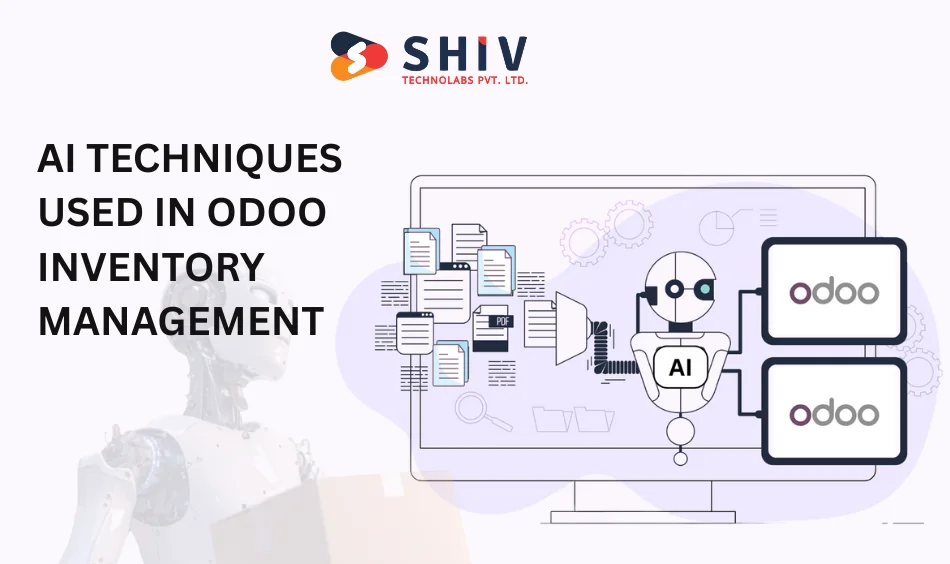
These techniques can foster real-time optimization, forecasting and reliability in Odoo inventory management:
Machine Learning-based Demand Forecasting
- History analysis – AI reads past sales history and identifies trends and patterns that may not otherwise be readily perceivable by human experts to find
- Seasonal Adjustments – Algos inherently account for seasonality, holidays, and cycles of the market
- External Factor Integration – Weather patterns, economic forecasts, and industry trends are integrated into the system
Smart Replenishment Rules in Odoo
Dynamic Reorder Points – Artificial intelligence determines dynamic minimum stock levels by considering:
- Uncertainty in lead times
- Variability in demand
- Supplier reliability
- Seasonal factors
Automated Buy Recommendations – Artificial intelligence determines reorder points and automatically triggers purchase orders when inventories drop to them
Real-time Inventory Optimization
- Analysis Automation – AI categorizes inventory items and modifies management strategies accordingly
- Dead Stock Prevention – AI detects slow-moving stock even prior to becoming dead stock
- Multi-Location Stock Balancing – AI balancing stock across multiple warehouses and locations
How to Implement AI Inventory Management in Odoo
Implementation of AI in the Odoo inventory goes through a lot of phases like:
Step 1: Data Preparation
- Clean Historical Data – Keep a minimum 12-month sales history to get a good forecast
- Standardize Product Details – Same product groups and SKU numbers
- Configure Inventory Settings – Define lead times, safety stock quantities, and reorder strategies
Step 2: AI Module Setup
Install Forecasting Modules (Odoo AI inventory forecasting)
- Configure Odoo Apps Store and install AI inventory forecasting modules
- Configure machine learning settings according to business needs
- Configure automatic data synchronization between the sales and inventory modules
Configure Smart Rules
- Configure reorder points according to AI suggestions
- Utilize automated generation of purchase orders
- Create exception handling for outlier patterns of demand
Step 3: Training and Calibration
- Initial Training Phase – Give 2-4 weeks to AI models to get trained on your trend data
- Accuracy Checking – Continuously check forecast accuracy and tweak parameters if needed
- Ongoing Improvement – Give continuous checks and tweak AI forecasts according to reality
Use Cases and Applications
AI in manufacturing supply chain has benefits ranging from automation, reduction of cost, defect detection and defect detection strategies and here’s how it is used:
Supply Chain Manufacturing
- Production Planning – AI predictive demand modules within Odoo ERP automate order creation for production based on forecasted demands
- Raw Material Optimization – AI calculates the material needed and guides delivery to minimize carrying costs
- Quality Control Integration – machine learning detects trends in pattern defects and resizes buffers of inventory
Retail and E-commerce
- Seasonal Demand Management – AI governs holiday season, promotion, and market event levels of inventory
- Multi-Channel Optimization – Algos optimizes stock in offline and digital channels
- Customer Behavior Analysis – AI monitors purchases to predict future orders
Distribution and Wholesale
- Supplier Performance Optimization – AI monitors supplier reliability and strategy-adjusts for safety stock (Odoo distribution management system)
- Route Optimization – Machine learning maps the best routes and inventory distribution
- Risk Management – AI estimates likely supply chain disruptions and creates backup plans
Best Practices for AI Inventory Success
In an AI-powered inventory management, techniques and strategies like Machine learning inventory optimization Odoo and AI in manufacturing supply chain can give promising results and these practices can be listed as:
Data Quality Management
- Periodic Data Audits – Validate inventory data integrity every month
- Standardized Processes – Single data entry process per department
- Integration Testing – Regularly test data integration across various Odoo modules
Performance Monitoring
- Key Metrics Tracking – Keep track of forecast accuracy, stock turnover, and service level
- Exception Reporting – Produce exception patterns or system anomaly alerts
- Continuous Optimization – Review and readjust AI parameters at regular intervals
User Training Programs
Educate staff on AI suggestions and override mechanisms
- Change Management – Gradually introduce AI capability to allow accommodation by the team
- Feedback Loops – Enable users to report and provide feedback to other users
Advanced Features and Future Functionality
The future of AI in Odoo inventory management and Odoo distribution management system is evolving and here are some advanced features and functionalities that can contribute:
Predictive Maintenance Integration
Predictive maintenance with AI allows inventory management hardware to be serviced before failure, avoiding system downtime and business continuity.
IoT Sensor Integration
Smart sensors provide instant inventory data utilized by AI to determine instant stock level and reorder point decisions.
Blockchain Traceability
Artificial intelligence with blockchain technology provides end-to-end traceability along the supply chain and real-time reporting of compliance.
How Shiv Technolabs Builds AI-Driven Odoo Inventory Systems
Shiv Technolabs has built and customised Odoo ERP systems for businesses across manufacturing, retail, and distribution. Our Odoo development team has hands-on experience configuring AI forecasting modules, building custom demand planning logic, and integrating Odoo inventory with third-party data sources like supplier portals and ecommerce platforms.
We do not deploy and walk away. Our implementation process includes a full data audit before setup, a calibration phase where we review forecast accuracy alongside your team, and ongoing support to refine the system as your business grows.
If you are evaluating whether Odoo AI inventory is right for your operation or you are mid-implementation and need technical guidance, our team can walk you through the process.
Talk to our Odoo team about your inventory challenges. Contact Shiv Technolabs!
Conclusion
Odoo AI-driven inventory management is a major leap towards supply chain accuracy and efficiency using inventory forecasting with AI in Odoo, which can contribute $1.3 trillion to the global economy in the coming two decades if utilized correctly for supply chain and logistics management.
We, Shiv Technolabs are embracing such technologies like AI in manufacturing supply chain to build competitive edges through cost savings, enhanced customer satisfaction, and decision-making acumen that fuel business growth.
The success formula lies in well-managed AI capabilities, real-time visibility, and phased deployment. Through compliance with the principles of thumb and best practices outlined in this guidebook, organizations can revolutionize their inventory management to be the cost driver of operational excellence and customer delight.
FAQs
Q1: What is AI inventory management in Odoo?
AI inventory management in Odoo uses machine learning to forecast demand, set dynamic reorder points, and automate purchasing decisions based on real-time sales and stock data rather than fixed manual rules.
Q2: Does Odoo have a built-in AI forecasting module?
Yes. Odoo offers forecasting modules through its Apps ecosystem that connect to the inventory and sales modules. These modules use historical sales data to generate demand predictions and replenishment recommendations.
Q3: How much historical data does Odoo AI need to forecast accurately?
A minimum of 12 months of clean sales history is recommended. Businesses with seasonal demand patterns benefit from having at least 18 to 24 months of data to allow the model to learn seasonal cycles reliably.
Q4: Can Odoo AI prevent stockouts automatically?
Odoo AI flags stockout risk ahead of time and can trigger purchase orders automatically when stock drops toward the AI-calculated threshold. It does not eliminate all stockouts, but it significantly reduces unplanned ones.
Q5: Is AI inventory management in Odoo suitable for small businesses?
Yes, provided the business has consistent sales data and operates a defined product catalogue. Smaller businesses with fewer SKUs often see faster calibration results because the model has cleaner, less complex data to learn from.
Q6: How long does it take to implement Odoo AI inventory?
A basic implementation takes two to four weeks including data preparation and calibration. More complex setups involving multiple warehouses, custom integrations, or large product catalogues typically take six to twelve weeks to go fully live.
Q7: Can Odoo AI inventory integrate with third-party platforms?
Yes. Odoo supports integration with ecommerce platforms, supplier portals, and logistics systems through its API layer. AI forecasting can pull demand signals from multiple sales channels simultaneously when properly configured.
Q8: How do I know if my Odoo AI inventory setup is working correctly?
Monitor forecast accuracy month over month by comparing AI predictions with actual sales. A well-calibrated system should reach above 80 percent accuracy within two to three months. Track stockout frequency and overstock levels as secondary indicators.