Table of Contents
Every week, a business owner somewhere signs a SaaS contract that they will regret in eighteen months. Another one approves a custom build that takes twice as long and costs three times the estimate.
The build vs buy software decision is one of the most consequential choices a growing business makes. Get it right, and you have a system that fits how you actually operate. Get it wrong, and you are either trapped in a vendor’s pricing model or stuck with a half-finished codebase that nobody wants to maintain.
This guide gives you a structured way to make that decision. Real cost models, a scored decision framework, and three industry scenarios that show how the analysis plays out in practice.
What Does the Build vs Buy Software Decision Actually Mean?
Before getting into frameworks and costs, it helps to be precise about what each path involves, because both terms cover a wider range of options than most business owners realize.
1. What Does Building Software Mean?
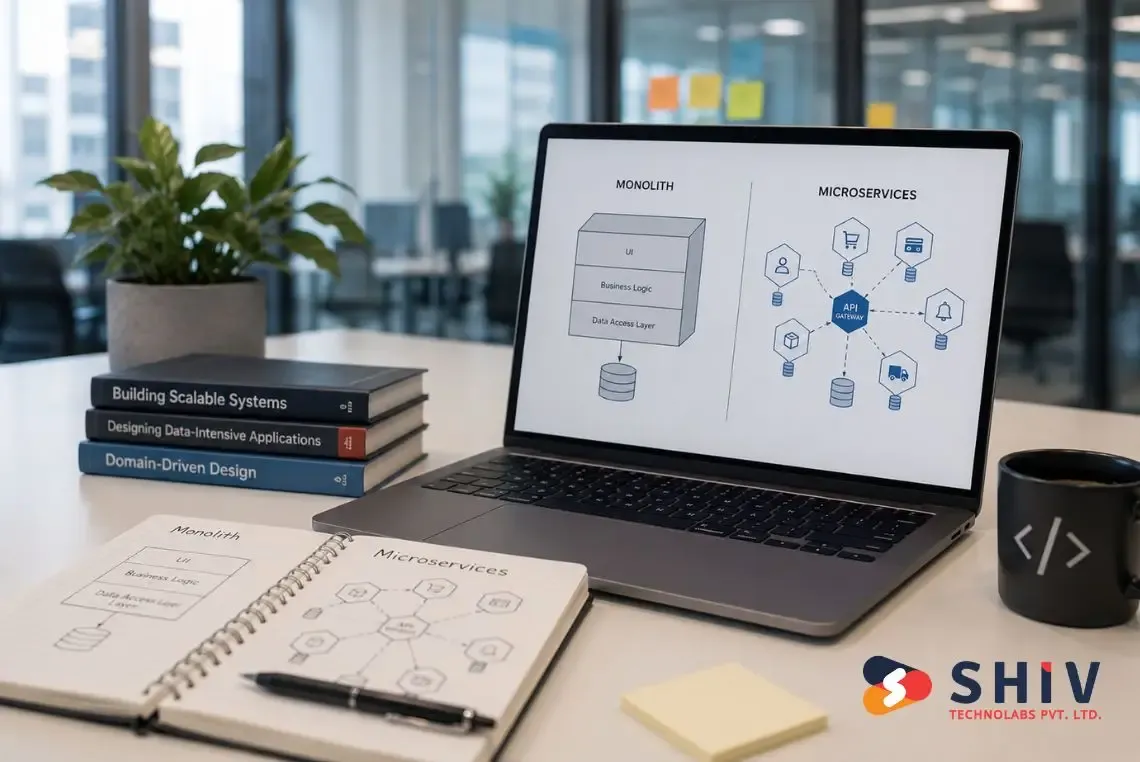
Building means your company creates the software from scratch, either using an internal development team or by working with an external software development partner. You control the architecture, the features, the data model, and the roadmap. The software is built to match your exact business logic, not the other way around.
Building does not always mean starting from zero. Many custom builds today use open-source frameworks, pre-built APIs, and AI-assisted development tools that cut build time significantly compared to five years ago.
2. What Does Buying Software Mean?
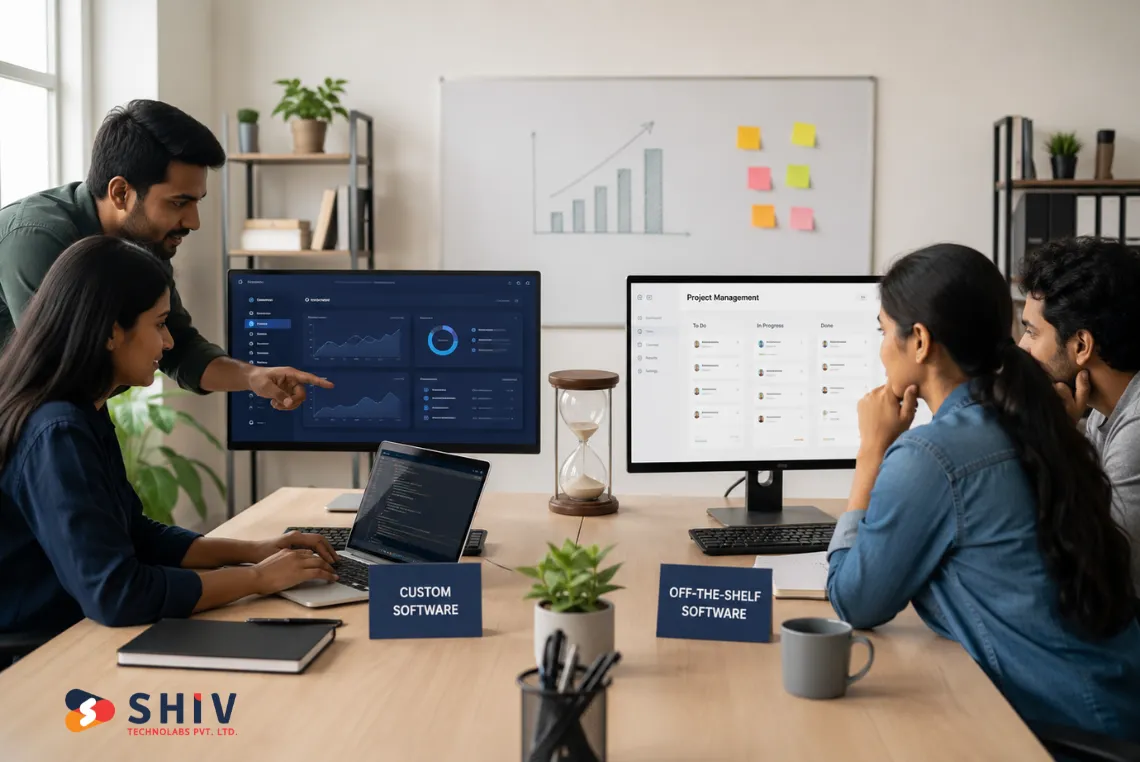
Buying means purchasing a pre-built solution from a vendor, either as a one-time license or a SaaS subscription. The software is designed for a broad range of businesses, not your specific workflows. You configure it to fit your needs as closely as possible within the boundaries the vendor has set.
The SaaS landscape in 2026 is vast. There are purpose-built platforms for almost every standard business function: finance, HR, CRM, inventory, customer support, and project management. If your needs fall within that standard range, buying is often the faster and cheaper starting point.
3. The Third Option: Go Hybrid!
Many businesses land on a hybrid approach. They buy a platform for standard functions and build custom integrations, modules, or tools that handle the workflows the platform cannot. This is increasingly common as API-first architecture makes it easier to connect bought and built components without heavy custom engineering.
How Has AI Changed the Build vs Buy Decision in 2026?
AI-assisted development tools, including code generation platforms, automated testing frameworks, and AI pair programming tools, have materially reduced the cost and timeline of building custom software. Work that used to take a team of five developers six months now takes a smaller team three to four months with significantly less debugging overhead.
On the buy side, AI has made SaaS products smarter but has also introduced new pricing complexity. Many vendors now charge separately for AI features, automation tiers, and advanced analytics. A platform that cost $2,000 per month two years ago may now run $4,500 per month once the AI and integration add-ons are included.
The practical implication: if you ran a build vs buy analysis before 2024, the numbers may no longer reflect what either path actually costs today. The analysis needs to be redone with current build cost estimates and current vendor pricing.
When Does Building Custom Software Make Business Sense?
Building software is the right move in specific situations. It is not the right move for every business, and it is not a prestige decision. The question is whether the business case justifies the investment.
1. Your Workflows Are Unique
If your competitive advantage depends on how you operate, not just what you sell, buying a platform built for generic businesses can actively work against you. Custom software lets you encode your business logic into the product itself, which means the software gets smarter as your processes mature rather than constraining them.
A good test: if a competitor could buy the same platform and run the same operations, the platform is not giving you an edge. It is just a cost.
2. You Need Full Data Ownership and Control
Regulated industries, businesses handling sensitive client data, and companies operating across multiple jurisdictions often have requirements that SaaS vendors cannot meet. Custom software lets you define exactly where data lives, how it is encrypted, who can access it, and how it is retained. This is not possible to the same degree with most cloud-based platforms.
Shiv Technolabs holds ISO 27001:2022 certification, which means any custom software built through the team is developed under a formally audited information security management framework. For businesses where data governance is a board-level concern, that matters.
3. Long-term Total Cost of Ownership Favors Building
SaaS subscriptions do not stay flat. Vendors increase pricing, introduce usage-based tiers, and charge for integrations. Research consistently shows that total SaaS spend over a five-year period often exceeds what a custom build would have cost, while the business still does not own the software at the end of the contract.
If you expect to use the software for more than three years and the vendor’s pricing model scales with your growth, a build analysis almost always returns a better long-term number.
4. Scalability is Core To the Growth Plan
Custom software is built to scale the way your business scales, not the way the vendor’s pricing model scales. When your user count doubles, a custom platform does not automatically double in cost. When you enter a new market, a custom system can be adapted. When your workflows evolve, the software evolves with them.
When is Buying Off-the-Shelf Software the Smarter Move?
Buying is the right decision more often than many businesses assume, particularly when the function being covered is not a source of competitive differentiation.
1. You Need a Working Solution in Weeks, Not Months
Time-to-market matters. If your business is launching a new product line, entering a new market, or replacing a system that has failed, the three-to-twelve-month timeline of a custom build may not be viable. A proven platform can be configured and live within weeks. The operational cost of waiting for a custom build can easily exceed the premium of buying something ready-made.
2. The Function is Standard and Well-Served by Existing Platforms
Payroll, bookkeeping, email marketing, appointment scheduling, help desk, basic CRM. These are functions where dozens of mature, well-supported platforms exist. Building a custom solution for a function that off-the-shelf software already handles well is an expensive way to solve a solved problem.
The test here is straightforward: does the available software cover at least 80% of your requirements without significant modification? If yes, buy and configure. The 20% gap can often be bridged with custom integrations rather than a full build.
3. Your Internal Technical Capacity is Limited
Custom software requires ongoing ownership. Someone needs to manage deployments, handle security patches, coordinate feature development, and maintain the codebase as the technology landscape shifts. If the business does not have that capacity internally and is not planning to build it, the ongoing cost of owning custom software is higher than it first appears.
Buying shifts that responsibility to the vendor. For businesses without a technical team, that trade-off is often worth the subscription cost.
4. Budget Constraints Favor a Lower Upfront Investment
The initial capital outlay for custom software development is significantly higher than a SaaS subscription. For early-stage businesses, businesses in growth mode, or businesses managing tight cash flow, preserving capital for core operations may matter more than the long-term ownership benefits of building.
Build vs Buy Software – Pros and Cons
Before choosing either path, business owners should look at the practical trade-offs. The buy vs build software pros and cons are not limited to cost. They also affect speed, control, ownership, scalability, maintenance, and long-term business flexibility.
| Option | Pros | Cons |
| Build Software | Full control over features, workflows, data structure, and product roadmap. Better fit for unique operations, strict compliance needs, and long-term scalability. The business also owns the software asset. | Higher upfront cost, longer development timeline, and ongoing maintenance responsibility. You also need technical oversight for updates, hosting, security, and future improvements. |
| Buy Software | Faster launch, lower upfront cost, vendor-managed maintenance, and proven features for standard business functions. Good fit when your needs are common and time-to-market matters. | Limited customization, recurring subscription costs, vendor lock-in, pricing changes, and workflow compromises. As the business grows, licensing, add-ons, and integration costs can increase quickly. |
| Hybrid Approach | Combines speed and flexibility. You can buy a platform for standard functions and build custom modules, integrations, dashboards, or workflows where the business needs more control. | Requires careful planning, API compatibility checks, and ongoing integration management. Poor architecture can create data gaps between bought and built systems. |
For most high-ticket businesses, the right answer is rarely based on one factor. If the process is standard, buying usually makes sense. If the process directly affects margins, customer experience, compliance, or competitive advantage, building or taking a hybrid approach deserves serious consideration.
Build vs Buy Software: Real Industry Scenarios
Abstract comparisons are useful up to a point. Real decisions happen in specific business contexts. These three scenarios show how the framework plays out in practice.
Scenario 1: B2B Logistics Company With a Custom Pricing Model
A regional logistics company was using a standard freight management platform but found it could not handle their tiered pricing rules, which varied by shipment weight, destination zone, contract tier, and seasonal adjustment. Every month, the finance team spent forty hours manually recalculating invoices in spreadsheets because the platform could not replicate the logic.
The audit showed that 40 hours per month at an average fully loaded cost represented over $60,000 per year in lost productivity. A custom pricing and invoicing module built on top of their existing infrastructure took four months and cost $95,000. The break-even was under eighteen months, and the business regained forty staff hours per month permanently.
Verdict: Build the custom module. The workflow was unique, and the manual cost was quantifiable.
Scenario 2: Healthcare Startup Needing a Patient Management System
A healthcare startup launching a telehealth service needed a patient management platform before its soft launch. The timeline was ten weeks. Building a custom HIPAA-compliant patient management system from scratch would have taken six to nine months.
The business evaluated three purpose-built telehealth platforms. One covered 85% of requirements, had HIPAA Business Associate Agreement documentation ready, and could be live in three weeks. The annual subscription was $48,000. Custom development would have cost $280,000 and delayed the launch by six months.
Verdict: Buy the platform. Time-to-market and regulatory compliance requirements made the build case uncompetitive.
Scenario 3: Multi-Location Retail Chain With a Custom Inventory Model
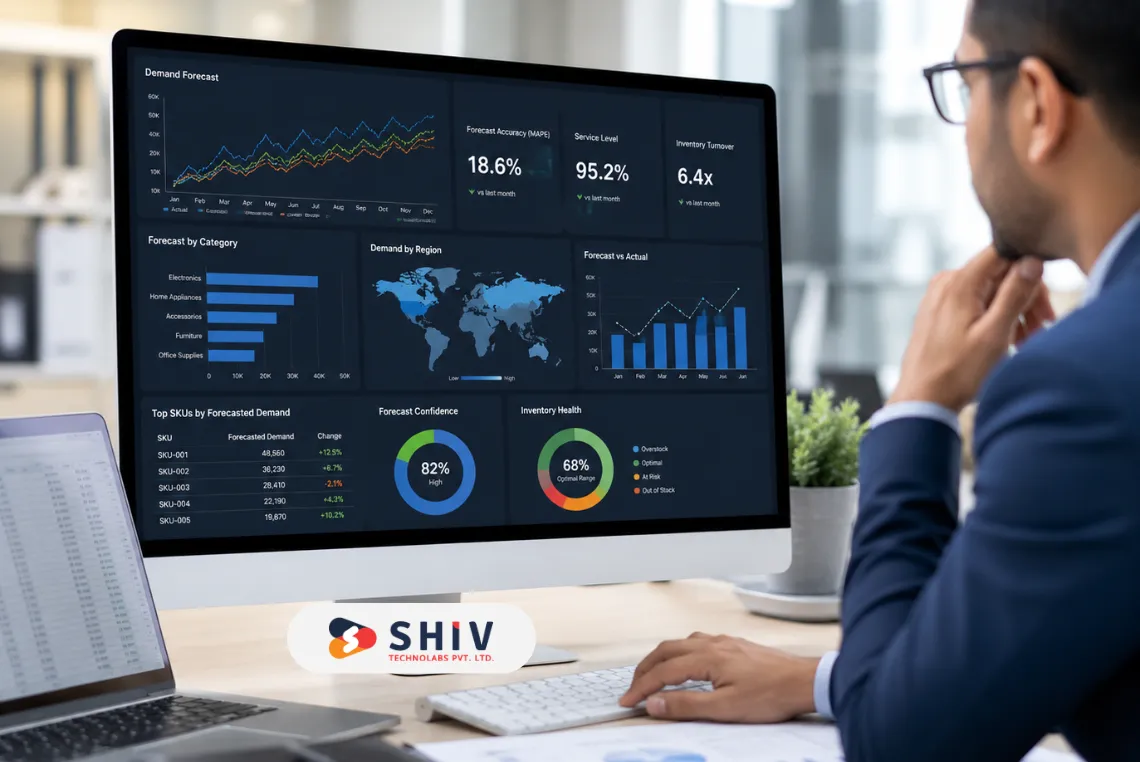
A retail chain operating fifteen locations across three countries was using a popular inventory management platform. As they scaled, the platform’s reporting module could not produce the cross-location, multi-currency inventory aging reports the operations team needed. They were paying $12,000 per month for the platform plus an additional $3,500 per month for a BI tool to compensate for the reporting gaps.
A custom reporting layer built on top of their existing database eliminated both the BI tool cost and the manual reconciliation overhead. The build cost $65,000 and saved $42,000 per year in subscription costs alone, before accounting for staff time.
Verdict: Hybrid approach. Keep the platform for inventory management, but build the reporting layer. The financial case was clear within two years.
How Do You Calculate the True Cost of Building vs Buying?

The most common mistake in build vs buy software analysis is comparing the wrong numbers. Comparing a custom build quote to a vendor’s Year 1 subscription cost is not a real comparison. The right comparison is the total cost of ownership over the same time horizon, typically three to five years.
1. Cost of Building Custom Software
The initial software development cost is the most visible line item, but rarely the only significant one. A thorough cost model for a custom build should include:
2. Initial development
Design, architecture, development, QA testing, and deployment. For a mid-complexity business application, this typically ranges from $80,000 to $400,000, depending on scope, team location, and technology stack.
3. Infrastructure and hosting
Cloud servers, storage, CDN, database hosting. This is typically $500 to $8,000 per month, depending on scale. Most businesses underestimate this at the planning stage.
4. Ongoing maintenance
Security patches, dependency updates, performance monitoring, and bug fixes. Budget 15 to 20% of the initial build cost per year as a baseline.
5. Feature development
The software will need to evolve. Plan for ongoing development investment, even if the initial build covers all current requirements.
6. Internal technical oversight
Someone needs to manage the vendor relationship or the internal team. This is a real cost, even if it is not a direct line item.
| Cost Component | Estimated Range (USD) | Frequency |
| Initial development | $80,000 to $400,000+ | One-time |
| Infrastructure/cloud hosting | $500 to $8,000 / month | Ongoing |
| Maintenance and security updates | 15 to 20% of the build cost/year | Ongoing |
| Feature development (Year 2+) | $20,000 to $100,000 / year | Ongoing |
| Technical oversight | $30,000 to $80,000 / year | Ongoing |
Cost of Buying Off-the-Shelf Software
The subscription price is the floor, not the ceiling. Hidden costs compound over time and frequently bring the true buy cost much closer to the build cost than the initial comparison suggests.
1. Licensing or Subscription Fees
These scale with users, data volume, or features. A platform priced at $2,000 per month today may cost $5,000 to $8,000 per month in three years as your business grows and vendor pricing tiers apply.
2. Configuration and Implementation
Most platforms require significant configuration before they are usable. Expect $10,000 to $80,000 in implementation costs for any mid-complexity platform, often delivered by certified implementation partners at $150 to $300 per hour.
3. Custom Integrations
Connecting the platform to your existing systems costs $15,000 to $75,000 per major integration. This is almost always underestimated.
4. Training and Change Management
Staff training, process documentation, and the productivity dip during transition. Budget 10 to 20% of the annual license cost for Year 1.
Vendor Dependency Risk
If the vendor raises prices, changes direction, or discontinues the product, migration costs can run from $50,000 to several hundred thousand dollars, depending on data volume and system complexity.
| Cost Component | Estimated Range (USD) | Frequency |
| License or subscription fees | $1,000 to $15,000 / month | Ongoing |
| Implementation and configuration | $10,000 to $80,000 | One-time |
| Custom integrations | $15,000 to $75,000 per integration | One-time |
| Training and change management | 10 to 20% of the Year 1 license | Year 1 |
| Upgrade and migration costs | $5,000 to $30,000 / major upgrade | Periodic |
Build vs Buy Decision Framework: Score Your Situation
A structured framework removes guesswork from a decision that is easy to make on instinct and hard to defend to a board or investors. Score each factor below on a scale of one to five and add up the totals. The column with the higher score points to the stronger case.
| Decision Factor | Score Toward BUILD (1-5) | Score Toward BUY (1-5) | Notes |
| Workflow uniqueness | Workflows are proprietary and not replicable by standard platforms | Workflows are standard and well-covered by existing tools | Most important factor |
| Timeline pressure | You have 6+ months before the solution is needed | You need a working solution within 8 to 12 weeks | Can be a dealbreaker |
| Budget (upfront) | Capital available for $100K+ investment | Budget constraints favor lower upfront spend | Consider TCO, not just Year 1 |
| Technical ownership | You have or plan to hire technical staff | No internal technical team or plans to build one | Ongoing ownership matters |
| Competitive advantage | The software is core to how you compete | The function is operational, not differentiating | Critical for strategic fit |
| Regulatory requirements | Strict data residency or compliance needs | Vendor compliance certifications meet your requirements | Non-negotiable for some sectors |
| Scalability horizon | Growth will stress standard platform pricing tiers | Scale is predictable and within the vendor tier structure | Look at 3-year pricing projections |
| Integration complexity | Deep integrations with proprietary internal systems needed | Standard APIs available and well-documented | Often underestimated |
If your build score is significantly higher, the business case for custom development is strong. If buy scores higher, evaluate two or three platforms against your top-priority requirements before committing. If scores are close, a hybrid approach is worth exploring before choosing either path exclusively.
What Should You Ask a Software Development Partner Before Deciding?
If the decision is leaning toward build, the development partner you choose will shape the outcome more than any other factor. These are the questions that separate partners who will give you an honest assessment from those who will tell you what you want to hear.
1. Can you show me a total cost of ownership model, not just a build quote?
A credible partner will walk you through ongoing maintenance costs, infrastructure costs, and future development budget requirements alongside the initial build estimate. If the answer is only a project quote, the conversation is incomplete.
2. What does the build vs buy analysis look like for my specific use case?
A digital transformation partner who only builds software will always recommend building. Ask specifically whether they would recommend buying an existing solution for any part of your requirements. The answer reveals whether they are advising in your interest or theirs.
3. How does your development process account for changing requirements?
Requirements shift. Business needs evolve during a build. The development process needs to accommodate this without ballooning the timeline or the cost. Ask for specifics on how scope changes are handled and priced.
4. What does the handover process look like at the end of the build?
You should leave the engagement owning the codebase, the documentation, and the infrastructure configuration. Get clarity on what is handed over, in what format, and what ongoing support looks like.
5. How do you handle data security and compliance during development?
For businesses handling sensitive data, the development process itself needs to meet security standards. Ask about security practices, code review protocols, and whether the firm operates under any formal information security certifications.
How Shiv Technolabs Approaches This Decision?
Most software development firms will recommend building. That is their business. Shiv Technolabs approaches this differently because long-term client relationships matter more than project revenue from a decision that was not the right fit.
Before any build proposal, the team runs a structured evaluation of your current systems, workflow requirements, available platforms, and total cost of ownership across both paths. If buying a platform covers your needs well, the recommendation will say so clearly, along with guidance on which platform fits best and what a custom integration layer might look like on top of it.
For businesses that do move forward with a custom build, the team operates under ISO 27001:2022 certification, which means development, data handling, and infrastructure decisions are all governed by a formally audited information security framework. For business owners, that is not a minor credential. It is the difference between a vendor relationship and a partner relationship.
Frequently asked questions
Is it cheaper to build or buy software?
In Year 1, buying is almost always cheaper. Over three to five years, the answer depends on how much the platform scales in price with your business, how much configuration and integration cost is required, and whether a custom build would require significant ongoing maintenance. Run a full TCO comparison before treating the subscription price as the cost of buying.
How long does it take to build custom software?
For a mid-complexity business application, the typical range is four to twelve months. AI-assisted development has compressed timelines at the lower end of that range for projects with well-defined requirements. Complex enterprise applications with deep integrations can take twelve to eighteen months or longer. MVP builds designed to test a core function first typically deliver a working product in eight to sixteen weeks.
What is the biggest risk of building custom software?
Scope creep. Requirements expand during development, timelines stretch, and costs climb. The most effective mitigation is a clearly defined scope before development starts, a structured change management process, and a development partner who prices scope changes transparently rather than absorbing them silently and recovering the cost later.
What is vendor lock-in, and why does it matter?
Vendor lock-in happens when switching away from a platform becomes so costly or complex that the business is effectively trapped. This can occur when data is stored in a proprietary format, when integrations are deeply embedded in the vendor’s ecosystem, or when internal processes have been fully adapted to the platform’s workflow. Migration from a deeply embedded SaaS platform can cost $50,000 to $300,000 or more, depending on data volume and system complexity.
Can I build software on top of a platform I already bought?
Yes. This hybrid approach is increasingly common and practical. Most enterprise platforms expose APIs that allow custom applications, reporting layers, workflow automation tools, and integrations to be built on top of them. This can solve the problem of a platform covering most requirements without forcing a full rebuild of everything.
How do I know if my workflows are unique enough to justify a custom build?
A useful test: identify your three most complex workflows and evaluate whether any standard platform can replicate them without significant manual workarounds. If the answer is no for all three, the workflows are likely complex enough to justify a build conversation. If two of the three are handled adequately by available platforms, a hybrid approach is probably more cost-effective than a full custom build.