Table of Contents
Retail, ecommerce, FMCG, and manufacturing teams face the same monthly challenge. They need to predict how much stock to hold without tying up cash in products that will not sell. A small prediction error shows up fast. It shows up as lost sales on a popular item or as storage costs for stock nobody wants.
Demand forecasting software was built to close that gap. It replaces guesswork and outdated spreadsheets with models that learn from sales history, stock movement, and current demand signals. This guide covers how the software works, its 2026 cost, the setup process, and where it works best.
Quick Overview
Demand forecasting software studies past sales, stock levels, and current demand signals to predict what customers will need next. Most platforms cost $250 to $28,000 a month, with setup taking four weeks to six months. Businesses that switch from manual forecasting typically cut excess stock by 15% to 40%. Stockouts often drop by 20% to 50% as well.
How Does Demand Forecasting Software Work?
Demand forecasting software combines statistical models, machine learning methods, and live data inputs to do this. The process focuses on patterns that are hard to spot manually, especially across large SKU groups and multiple sales channels.
1. Pattern Detection Through Historical Data
The system analyzes sales history, stock movement, season cycles, store traffic, supplier timelines, and returns. This helps it understand long-term behavior such as steady growth, decline, or repeated seasonal peaks.
2. Machine Learning Model Execution
Machine learning models study deeper relationships in the data. They read signals created by price changes, promotions, weather shifts, and competitor activity, then adjust continuously as new data arrives.
3. Short-Term Demand Sensing
Short-term demand sensing focuses on near real-time signals. It reads POS activity, website traffic, and order frequency to catch sudden spikes within hours or days.
4. Scenario Simulation
Many systems let planners run simulations. A planner can test how demand shifts if a discount runs, a shipment is delayed, or a new product launches.
5. Continuous Forecast Refresh
The system refreshes forecasts automatically at fixed intervals, daily, weekly, or in real time. This keeps predictions aligned with current customer behavior.
What Key Features Should You Look for in Demand Forecasting Software?
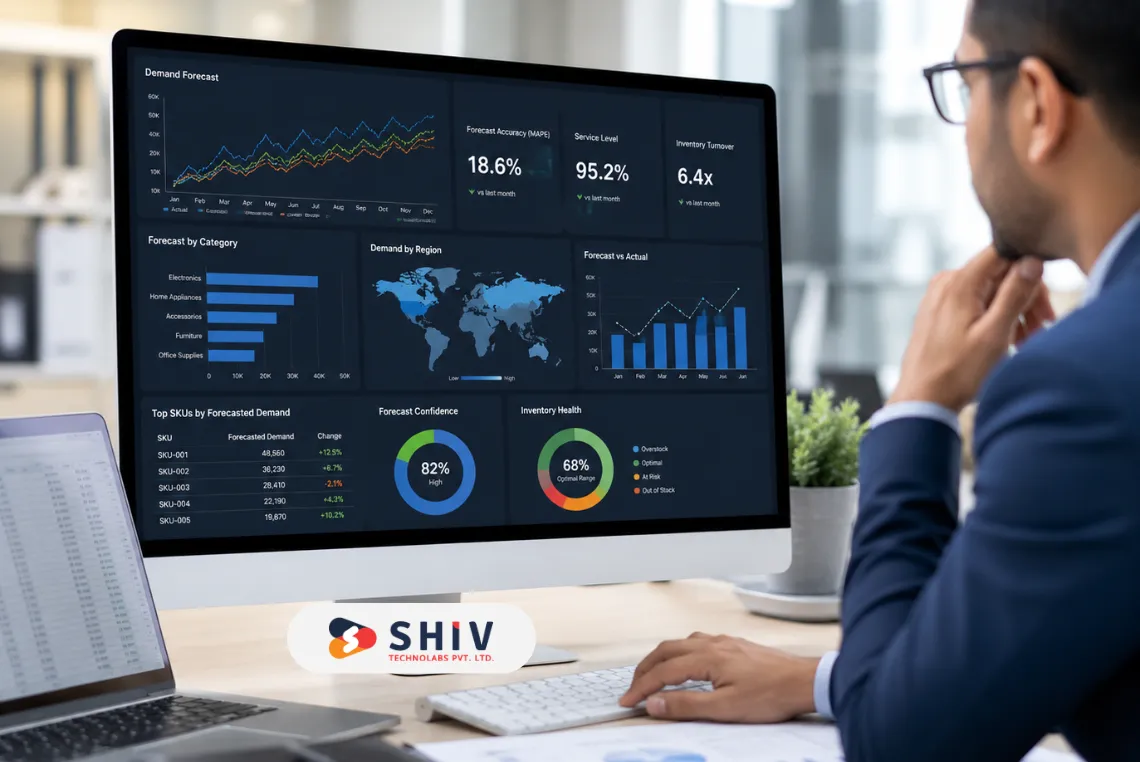
The strength of a forecasting system depends on its features. They determine how clearly the software reads patterns and how fast it reacts to change. They also shape how well it supports planning teams.
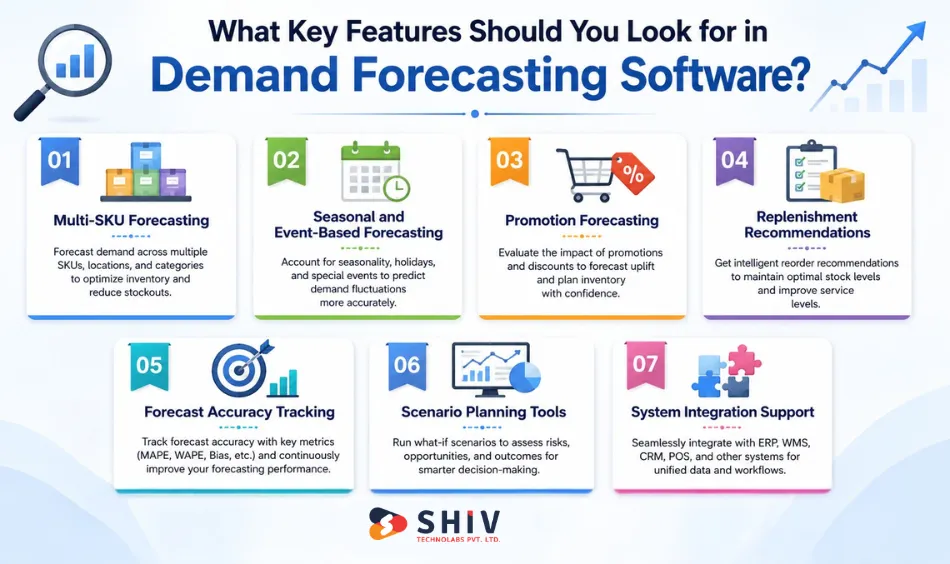
Here are the features that matter most when you compare platforms.
1. Multi-SKU Forecasting
Businesses with large catalogs need forecasting that works across thousands of SKUs at once. The system should handle size, color, and pack-size variants without slowing down. Strong multi-SKU support reduces both stockouts and excess stock.
2. Seasonal and Event-Based Forecasting
Many industries see strong seasonal cycles or high-impact events such as holidays or local festivals. Good forecasting software detects these patterns automatically and adjusts upcoming predictions based on past cycles.
3. Promotion Forecasting
Discounts, flash sales, and influencer pushes can create sudden spikes. The software should read how past promotions affected demand. It applies those patterns to future campaigns, helping planners avoid last-minute stock gaps.
4. Replenishment Recommendations
Beyond forecasting, strong tools suggest replenishment quantities for warehouses and stores. These suggestions factor in lead times, safety stock levels, and warehouse limits, cutting manual guesswork.
5. Forecast Accuracy Tracking
A dependable system tracks its own accuracy. It compares predicted numbers against actual results and flags gaps. This shows planners which SKUs are stable and which need closer attention.
6. Scenario Planning Tools
Scenario tools let planners simulate conditions such as a supplier delay or a pricing shift. They can also test a traffic spike tied to an event. This supports better preparation and lowers operational risk.
7. System Integration Support
The forecasting tool must connect with ERP, POS, eCommerce, and warehouse systems to receive clean, continuous data. Shiv Technolabs implements this kind of system integration so the forecasting engine stays aligned with real operations.
How Much Does Demand Forecasting Software Cost in 2026?
The cost of demand forecasting software depends on system depth, SKU volume, and integration needs. Businesses with large catalogs or multi-location setups usually spend more, since their data structure and accuracy requirements are more complex.
Below is a breakdown of typical pricing patterns across global forecasting tools in 2026.
1. Typical Monthly Pricing by Business Size
| Business Type | Estimated Monthly Cost | What’s Included |
|---|---|---|
| Small Business (up to ~2,000 SKUs) | $250 – $1,200 | Basic forecasting, seasonal detection, and limited integrations |
| Mid-Size Business (2,000-20,000 SKUs) | $1,200 – $7,000 | Promotion forecasting, multi-location support, ERP, and POS integrations |
| Enterprise (20,000+ SKUs) | $7,000 – $28,000+ | ML-based forecasting, real-time updates, scenario tools, high data volume |
These figures reflect typical SaaS and enterprise forecasting tools used in retail, eCommerce, FMCG, and manufacturing in 2026. Pricing also shifts based on where the vendor or development team is based. Hourly rates in the US and UK run higher than in offshore development hubs.
2. Implementation Costs
Apart from the subscription fee, most companies invest in setup and configuration. This covers data preparation, system integration, and model configuration so the forecasting engine receives clean, structured data.
- Data Preparation: cleaning historical data, fixing SKU errors, and merging channels. Typical range: $1,500 to $12,000.
- System Integration: connecting ERP, POS, eCommerce, and warehouse systems. Standard integrations run $2,500 to $7,000. Multi-location or custom systems run $8,000 to $22,000.
- Custom Model Setup: Industries with unusual patterns, such as perishable goods or region-specific demand, often need custom ML models. Typical range: $6,000 to $32,000 or more.
SaaS Subscription or Custom-Built: Which Costs Less over Time?
Off-the-shelf SaaS tools work well for businesses with standard catalogs and a fixed budget, since the monthly fee is predictable. A mid-size business paying $3,000 a month spends about $108,000 over three years. That bill keeps climbing as SKU count and user seats grow. Subscription costs also stay fixed even after the business outgrows certain features.
A custom-built forecasting solution typically costs $40,000 to $100,000 to build. Ongoing hosting, updates, and model retraining add $8,000 to $20,000 a year. That avoids per-user fees and per-SKU pricing tiers entirely. For businesses with unusual product cycles or strict data privacy needs, the upfront cost often pays off. Over three to five years, a custom build can cost less than a growing SaaS subscription.
Cloud-Based or On-Premise Demand Forecasting Software: Which Should You Choose?
Forecasting software ships in two deployment models, and the choice affects setup cost, maintenance, and how fast the system scales. Cloud-based deployment has become the default for most new buyers.
A report by Future Market Insights states that cloud-based deployment will account for two-thirds of demand forecasting software implementations this year. Lower setup costs and easier scaling are driving that shift.
Here is a quick side-by-side comparison of both models.
| Factor | Cloud-Based | On-Premise |
|---|---|---|
| Setup time | 2 to 6 weeks | 2 to 6 months |
| Upfront cost | Low, subscription-based | High, includes hardware and licenses |
| Maintenance | Handled by the vendor, automatic updates | Handled in-house, manual updates |
| Scalability | Add SKUs, users, or locations on demand | Needs new hardware to scale further |
| Data control | Hosted on the vendor’s servers | Full control on the company’s own servers |
| Best for | Growing, multi-location businesses | Regulated industries with strict compliance needs |
What Do You Need Before Going Live with Demand Forecasting Software?
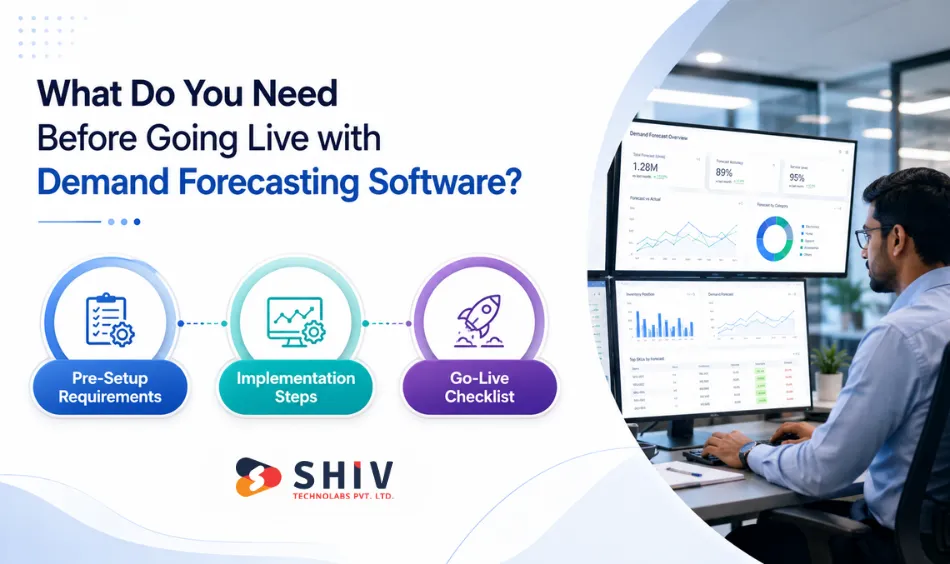
The success of demand forecasting software depends on how well the setup is executed. Forecast quality improves when historical data is clean, integrations are stable, and operational rules match real business processes.
Here is what teams need to prepare and implement before launch.
1. Pre-Setup Requirements
Before activating the forecasting engine, businesses need a few inputs ready.
- Clean Sales and Inventory Data: Historical sales, stock movement logs, and returns must be organized. Most forecasting models perform well with at least 12 to 24 months of structured data.
- Supplier Lead Time Information: Accurate lead time data helps the system calculate order timing. It also shows how much safety stock to hold.
- Channel and Location Data: Brands operating across stores, warehouses, and eCommerce channels need complete records for each location. This helps the system spot location-specific trends.
2. Implementation Steps
Once the data foundation is ready, most companies follow the same setup sequence.
- Data Mapping: Product categories, SKUs, locations, and historical records get aligned with the system’s structure, preventing mismatches during model training.
- Integration Setup: The software connects with ERP, POS, eCommerce, and warehouse or logistics systems. This gives the forecasting engine continuous updates.
- Model Configuration: The system gets configured around product hierarchy, season patterns, safety stock rules, and lead time profiles.
- Initial Forecast Run: The system runs its first round of predictions using historical data. Planning teams then check if the trends match known behavior.
- Accuracy Review: The software compares predicted values against recent sales, and the team adjusts the model before full deployment.
3. Go-Live Checklist
Before switching to the live environment, teams should verify the following:
- Data refresh timing
- Integration stability
- User access rights
- Approval workflows
These checks support a smoother transition and stronger adoption across departments.
Where Is Demand Forecasting Software Used Across Industries?
Demand forecasting software supports a wide range of industries, each with its own patterns and pressures. The software adapts by studying category-specific behavior, stock cycles, and customer activity.
1. Retail
Retail brands manage both store traffic and online orders. Forecasting software helps them project demand per SKU, plan replenishment across locations, and prepare for seasonal peaks or regional promotions.
2. eCommerce and D2C
Online demand shifts quickly due to promotions or sudden traffic spikes. Forecasting software predicts order surges and readies warehouse teams for packing and shipping volume during flash sales. Many eCommerce brands pair this with real-time stock visibility across channels.
3. FMCG and CPG
Fast-moving goods need frequent restocking. Forecasting software captures daily and weekly consumption patterns along with trade promotion impact. This helps distributors maintain steady supply without unnecessary surplus.
4. Grocery and Essentials
Grocery chains depend on accurate short-term forecasting because demand changes daily. The software predicts needs for perishable items, reduces waste, and prepares stock for weekends or holiday periods.
5. Fashion and Apparel
Fashion demand is unpredictable since styles, sizes, and colors shift fast. Forecasting software helps brands project demand across variants and plan seasonal transitions without overbuying slow sellers.
6. Manufacturing and Wholesale
Manufacturers looking for professional manufacturing ERP solutions work with long production cycles and supplier constraints. Forecasting software predicts upcoming bulk requirements and helps schedule production around expected demand, reducing delays.
What Problems Does Demand Forecasting Software Solve?
Demand forecasting software addresses issues that directly affect revenue, stock health, and supply chain performance.
1. Frequent Stockouts
Stockouts happen when demand rises unexpectedly or planners underestimate future needs. Industry research suggests global retailers lose more than a trillion dollars a year to stockouts. Forecasting software detects early demand shifts so teams can keep enough stock on hand.
2. Excess Inventory and Dead Stock
Carrying excess stock ties up working capital, and storage typically costs 20% to 30% of inventory value each year. Forecasting software flags slow-moving items and declining patterns early, so planners can adjust orders before stock turns into a write-off.
3. Inaccurate Manual Forecasting
Spreadsheet-based forecasting struggles with large SKU sets, multiple locations, and irregular patterns. Forecasting software processes thousands of data points at once and produces consistent predictions with a lower error margin.
4. Poor Replenishment Timing
Wrong timing in procurement leads to delayed orders or overfilled warehouses. Forecasting software uses lead time data and predicted demand to recommend the right replenishment window.
5. Sudden Short-Term Demand Spikes
Promotions, weather shifts, or viral trends can cause rapid jumps in demand. Short-term sensing tools detect these changes early, lowering the risk of missed sales during a surge.
How Are AI and Machine Learning Changing Demand Forecasting?
Artificial intelligence and machine learning have reshaped how forecasting systems operate. Traditional statistical methods alone cannot handle the volume or speed of current sales and inventory patterns. AI and ML add the precision needed to analyze large datasets and react to fast shifts in customer behavior.
1. Learning from Complex Data
AI models process large datasets that include sales logs, returns, website activity, and supplier timelines. Instead of relying on one pattern, ML models study multiple signals at once. They catch relationships that basic formulas often miss.
2. Adapting to New Behavior
AI-driven models adjust automatically when new patterns appear. Changes caused by price shifts, competitor actions, or viral trends get detected quickly. This lets planners correct stock levels before the shift becomes costly.
3. Short-Term Demand Sensing
ML models improve short-term sensing by scanning POS data, online traffic, and order frequency in near real time. This helps brands respond faster during sudden demand increases, especially for FMCG, grocery, or fashion goods.
4. Scenario Evaluation
AI models run simulations that test how demand changes under different conditions. Examples include a new product launch or a supply delay. These simulations support better planning during uncertain periods.
5. Higher Forecast Accuracy
Because ML models learn continuously from new data, accuracy improves over time. This produces stronger predictions for seasonal products and items with unpredictable demand behavior.
What ROI Can You Expect from Demand Forecasting Software?
Demand forecasting software delivers measurable financial and operational returns. These gains come from better inventory decisions, less waste, and more accurate planning.
1. Lower Stockout-Related Losses
Stockouts lead to immediate revenue loss and often push customers toward competitors. Many businesses report 20% to 50% fewer stockouts within the first year of using forecasting software.
2. Reduction in Excess Stock
Excess stock ties up working capital and occupies warehouse space. Studies across retail and FMCG sectors show a 15% to 40% reduction in excess stock. This follows a switch to ML-driven forecasting.
3. Better Inventory Turnover
Forecasting software helps maintain healthier stock rotation and reduces the number of slow-moving items. This results in higher inventory turnover and fewer long-term storage costs.
4. More Accurate Procurement Decisions
With forecast-driven replenishment suggestions, teams order at the right time and in the right quantity. This lowers emergency orders and improves supplier coordination.
5. Higher Team Productivity
Automated forecasting removes hours of manual work spent preparing spreadsheets and updating stock projections. Planning teams can then focus on analysis instead of data entry.
6. Improved Customer Satisfaction
Stable stock availability and faster fulfillment help brands maintain higher customer satisfaction scores. Shoppers find what they need without delay.
Why Partner with Shiv Technolabs for Demand Forecasting Software?
Demand forecasting works best when the system is configured correctly and connected to every part of the supply chain. Shiv Technolabs helps businesses build forecasting solutions that match their data structure, product hierarchy, and operational flow.
Our team builds ML-driven forecasting models tailored to each client’s industry and SKU structure. We then connect them to clean, organized data pipelines. We handle end-to-end integration across ERP, POS, eCommerce platforms, and warehouse systems. We also design custom dashboards that give planners a clear view of upcoming demand.
For businesses managing multiple locations or channels, we add scenario planning features for launches, promotions, and supply delays. We also build automated workflows that cut manual forecasting effort. Brands across retail, FMCG, D2C, fashion, grocery, and manufacturing work with us for one reason. We build forecasting setups that stay dependable as they scale.
Ready to fix your forecasting accuracy? Talk to our team about your SKU count, current tools, and timeline. We will recommend a setup that fits your budget.
Conclusion
Demand forecasting software has become a central part of modern supply chain and inventory planning. As product catalogs expand and sales channels multiply, manual forecasting cannot keep up with the accuracy that stable performance requires. Software-driven forecasting brings clarity by reading sales patterns, seasonal behavior, and short-term demand signals with far higher precision.
With machine learning and structured data, planners can make better decisions for replenishment, procurement, and production. This lowers stockouts, reduces excess stock, and improves inventory turnover across the business. This holds across retail, eCommerce, FMCG, grocery, fashion, and manufacturing. Forecasting software gives each one a foundation for predictable stock movement.
Companies that choose the right forecasting solution and the right implementation partner build a stronger path for long-term growth. The system stays useful as its catalog and channels grow.
FAQs
What is demand forecasting software and how does it work?
It studies sales history, stock movement, and short-term signals such as website traffic to predict future demand. Machine learning models scan large datasets to spot repeating patterns and sudden shifts. That analysis turns into daily, weekly, or monthly predictions.
What is the difference between demand forecasting software and demand planning software?
Demand forecasting software predicts future customer demand using historical and real-time data. Demand planning software takes that forecast a step further. It turns the forecast into production schedules, procurement plans, and inventory targets across the supply chain.
How much does demand forecasting software cost in 2026?
Costs vary by business size and SKU count. Small businesses typically spend $250 to $1,200 a month. Mid-size companies pay $1,200 to $7,000, and large enterprises pay $7,000 to $28,000 or more, plus implementation costs.
How long does it take to set up a demand forecasting system?
Smaller deployments take four to twelve weeks. Multi-location enterprise rollouts usually take three to six months, depending on data quality and integration complexity.
Should I choose a cloud-based or on-premise demand forecasting tool?
Most small and mid-sized businesses save time and money with cloud-based tools. Setup is faster, and there is no hardware to maintain. Enterprises with strict compliance needs often prefer on-premise systems instead.
Can demand forecasting software work for new products with no sales history?
Yes. The system uses similar product categories, past launches, and early customer signals to estimate demand. Accuracy improves as real sales data comes in.
How much historical data does the software need to forecast accurately?
Most systems perform well with 12 to 24 months of clean, structured data. Businesses with frequent SKU changes or strong seasonal cycles may need a longer history for reliable patterns.
Does demand forecasting software help with sudden demand spikes from promotions?
Yes. Short-term demand sensing reads point-of-sale and website traffic in near real time. This helps the system react faster during promotions, flash sales, or sudden viral demand.