
Table of Contents
Building a Minimum Viable Product (MVP) is a strategic step for any startup. It allows you to test your core business idea with real users before committing to a full-scale build. In 2026, the MVP development cost is shaped by new technologies like AI, changing developer rates, and a focus on high-quality user experiences.
For any business, understanding the financial commitment is vital. This guide provides a detailed breakdown of costs, covering everything from planning to post-launch support.

Understanding the MVP Philosophy
The concept of a Minimum Viable Product is often misunderstood as a cheap or incomplete version of an app. In reality, an MVP is a focused version of your product that contains just enough features to satisfy early customers and provide feedback for future development.
The primary goal is not just to build something, but to learn. You want to find out if your solution solves a problem that people are willing to pay for. By stripping away the bells and whistles, you reduce the financial risk and shorten the time it takes to get to your first user.
In a fast-moving economy, speed is often more valuable than a perfect set of features.
# Why the MVP Approach is Essential in 2026
The software industry has shifted. Users have higher expectations for speed and design than they did a decade ago.
However, the competition is also fiercer. If you spend eighteen months building a perfect product, there is a high chance a competitor will launch a simpler version in three months and capture your audience.
An MVP helps you:
- Confirm Problem-Solution Fit: Does your product actually solve the pain point you identified?
- Conserve Capital: You avoid wasting thousands of dollars on features that nobody uses.
- Gather Data: Real user behavior is better than any survey or focus group.
- Attract Funding: Investors in 2026 are looking for traction, not just ideas. A working MVP with even a small user base is much more convincing than a slide deck.
Average MVP Development Cost Breakdown
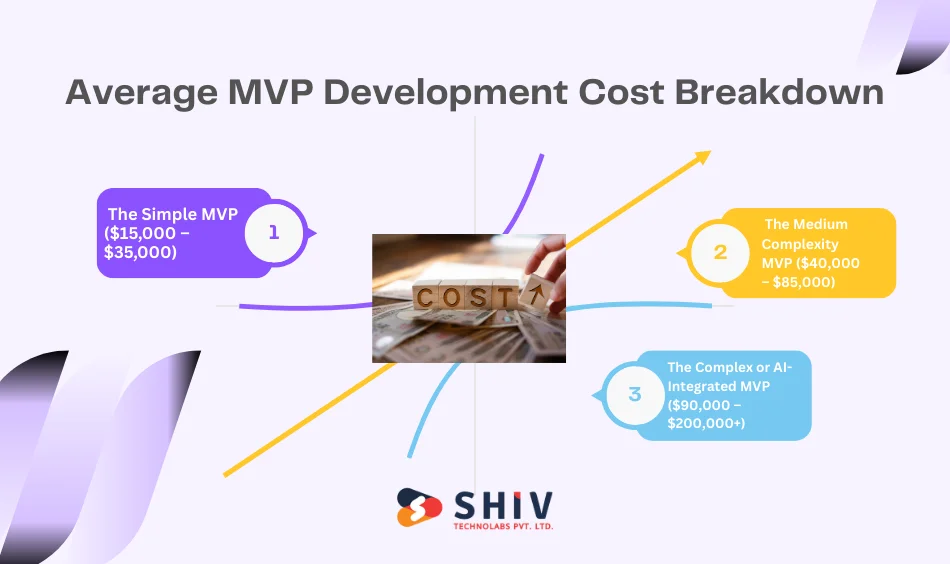
When asking how much an MVP costs, the answer depends on the scope. While every project is unique, we can look at three general tiers of development that most startups fall into.
1. The Simple MVP ($15,000 – $35,000)
This level is best for founders who want to test a single core hypothesis. It is usually a web-based application or a basic mobile app with a clean, standard interface.
- Timeline: 4–8 weeks.
- Focus: A single primary function (e.g., a simple booking tool or a basic data dashboard).
- Tech Stack: Standard frameworks like React or Vue for the front end and a managed backend like Firebase or Supabase to save on infrastructure costs.
- Team: One developer, one part-time designer, and a project manager.
2. The Medium Complexity MVP ($40,000 – $85,000)
Most consumer-facing apps fall into this category. This includes marketplaces, social networking tools, or retail platforms.
- Timeline: 10–16 weeks.
- Focus: Core functionality plus essential integrations.
- Key Features: User profiles, payment gateway integration (Stripe or PayPal), basic search filters, and notification systems.
- Team: Two developers (Frontend and Backend), a dedicated UI/UX designer, and a Quality Assurance (QA) tester.
3. The Complex or AI-Integrated MVP ($90,000 – $200,000+)
In 2026, many MVPs are being built with artificial intelligence at their core. These projects require specialized talent and more intensive testing.
- Timeline: 4–6 months.
- Focus: Proprietary logic, high-level data security, or machine learning.
- Key Features: Custom AI model integration, real-time data processing, multi-role access levels, and compliance features for industries like healthcare or finance.
- Team: Senior developers, an AI/ML specialist, a DevOps engineer, and a lead designer.
Phase-by-Phase Cost Distribution
To better manage your budget, it helps to see where the money is allocated during the development lifecycle.
Phase 1: Discovery and Product Strategy
Budget Allocation: 10% – 15% Many founders want to start coding on day one. This is a mistake. The discovery phase involves defining user personas, mapping out user journeys, and creating a feature list that fits your budget.
By spending $3,000 to $8,000 here, you can prevent $20,000 in rework later. You leave this phase with a clear roadmap and a technical specification document.
Phase 2: UI/UX Design
Budget Allocation: 15% – 20% Design is not just about how the app looks; it is about how it works. In 2026, minimal does not mean ugly. Users expect a professional feel.
- Wireframes: These are the blueprints of your app.
- Prototyping: A clickable version of the design that lets you feel the flow without any code being written.
- Visual Identity: Establishing the brand voice through colors, typography, and iconography.
Phase 3: Development and Engineering
Budget Allocation: 50% – 60% This is the largest expense. It involves building the frontend (the part users interact with) and the backend (the server-side logic and database).
The cost here is driven by the number of features and the complexity of the integrations. For instance, connecting to a simple weather API is cheap, but building a custom recommendation engine is expensive.


The Geography of Cost: Comparison by Country
In 2026, the global talent pool is more accessible than ever, but pricing still follows distinct trends based on local economies and labor markets.
While North American and Australian teams offer local proximity, offshore teams in countries like India provide a significant cost advantage without compromising on technical quality.
| Country | Hourly Rate (USD) | Simple MVP Cost | Timeline (Weeks) |
|---|---|---|---|
| USA | $120 – $250 | $60,000 – $150,000 | 6 – 10 |
| Australia | $90 – $180 | $45,000 – $110,000 | 6 – 10 |
| UK | $80 – $160 | $40,000 – $100,000 | 6 – 12 |
| UAE | $60 – $140 | $35,000 – $85,000 | 8 – 12 |
| Poland | $40 – $90 | $25,000 – $60,000 | 8 – 14 |
| India | $20 – $50 | $15,000 – $40,000 | 8 – 14 |
While a USA-based team offers local proximity to major financial hubs and a deep grasp of Western market trends, working with MVP development experts in UAE provides a bridge to rapidly growing Middle Eastern markets and innovation-friendly regulations.
Furthermore, integrating Indian development talent into the mix allows businesses to extend their financial runway significantly by accessing top-tier technical skills at a fraction of the cost.
This global approach gives founders the best of all worlds—strategic oversight, market proximity, and the budget flexibility to pivot their product based on user feedback before needing a second round of funding.
Platform Choice: Web vs. Mobile vs. Cross-Platform
The platform you pick for your launch will have a direct impact on your initial spend and your speed to market. While a web-first approach is often the most affordable, mobile apps offer better user retention for certain industries like fitness or social media.
| Platform Type | Cost Range (USD) | Time to Market | Best For |
|---|---|---|---|
| Web Application | $15,000 – $45,000 | 4 – 8 Weeks | SaaS tools, B2B platforms, Dashboards |
| Native Mobile (iOS or Android) | $40,000 – $90,000 | 12 – 18 Weeks | High-performance apps, heavy sensor use |
| Cross-Platform (Flutter/React Native) | $25,000 – $65,000 | 8 – 14 Weeks | Retail, Social, Most consumer apps |
| Progressive Web App (PWA) | $18,000 – $40,000 | 6 – 10 Weeks | Content platforms, low-budget mobile needs |
Cross-platform development has become a popular choice for MVPs in 2026. It allows you to maintain a single codebase for both iOS and Android, which can reduce development and maintenance costs by nearly 30% compared to building two separate native apps.
Feature-Based Cost Estimates
Not all features are created equal. Adding a simple chat function or a basic payment system involves different levels of backend logic. Below is a breakdown of what common MVP components typically cost to build.
| Feature Component | Estimated Development Time | Estimated Cost (USD) |
|---|---|---|
| User Registration (Social + Email) | 20 – 40 Hours | $1,500 – $3,500 |
| Payment Integration (Stripe/PayPal) | 30 – 50 Hours | $2,500 – $5,000 |
| Push Notifications / SMS Alerts | 15 – 30 Hours | $1,200 – $2,500 |
| Real-Time Chat (WebSockets) | 60 – 100 Hours | $5,000 – $9,000 |
| Admin Dashboard (Basic) | 40 – 80 Hours | $3,500 – $7,000 |
| AI Integration (API-based) | 50 – 120 Hours | $4,500 – $11,000 |
| Geolocation & Mapping | 30 – 60 Hours | $2,500 – $5,500 |
The Hidden Costs of MVP Development
Many founders only budget for the initial build, but the launch is just the beginning of the financial journey. To avoid running out of cash, you must account for recurring operational expenses.
| Expense Category | Purpose | Estimated Monthly Cost (USD) |
|---|---|---|
| Cloud Hosting (AWS/GCP) | Server and Database storage | $100 – $500 |
| Third-Party APIs | Maps, AI tokens, and Email services | $50 – $300 |
| Technical Maintenance | Bug fixes and security patches | $1,000 – $3,000 |
| Customer Support Tools | Help desk or live chat software | $50 – $200 |
| Analytics & Monitoring | Tracking user behavior and errors | $0 – $150 |
A good rule of thumb is to set aside 20% of your initial development cost for annual maintenance and updates.
How to Choose the Right MVP Development Partner

In 2026, the technical landscape is crowded. Finding a team that can write code is easy, but finding a partner that understands business strategy is rare. When evaluating a potential development company, consider these three critical pillars:
1. Product Thinking Over Task Execution
A great partner does not just follow a list of features; they challenge your assumptions. They should ask questions like, Does this feature solve the core user problem? Or can we simplify this flow to launch faster? Look for teams that prioritize the Minimum and Viable parts of the MVP.
2. Technical Versatility
The right team should be proficient in modern, scalable technologies that allow for fast iteration. In 2026, this often means expertise in:
- AI Integration: Ability to connect your product with LLMs or custom machine learning models.
- Cloud Architecture: Knowledge of AWS, Google Cloud, or Azure to ensure your product can handle thousands of users overnight.
- Cross-Platform Tools: Mastery of Flutter or React Native to keep costs down while reaching both mobile platforms.
3. Transparency and Communication
Distance should not be a barrier to clarity. Your partner should provide:
- Real-time Visibility: Access to project management boards (like Jira or Trello).
- Regular Demos: Bi-weekly meetings to show functional progress.
- IP Ownership: Clear legal agreements ensuring you own the code and data from day one.
Build Your Vision with Shiv Technolabs
Navigating the complexities of MVP development cost requires more than just a developer; it requires a strategic partner. At Shiv Technolabs, we specialize in transforming ambitious ideas into high-performing digital products across the USA, UAE, and India.
By choosing our specialized team, you benefit from:
- Cost-Effective Scalability: We utilize cross-platform frameworks and cloud-native architectures to keep your initial MVP development cost low while ensuring the system can handle future growth.
- Market-Specific Expertise: Whether you are targeting the competitive landscape of the USA, the innovative hubs of the UAE, or leveraging the technical excellence of India, our global presence ensures your product meets local user expectations and regulatory standards.
- Fixed-Budget Certainty: We eliminate the fear of hidden fees by providing transparent, milestone-based pricing that aligns with your startup’s financial runway.
Our goal is to ensure that every dollar you put into our MVP development services is an investment toward a scalable, profitable future.
Conclusion
Optimizing your MVP development cost is a balancing act between speed, functionality, and long-term vision. As we have explored, factors like geographical location, platform choice (Web vs. Cross-platform), and feature complexity are the primary drivers of your budget.
By focusing on a Must-Have feature set and choosing a partner that offers global delivery models, you can launch a product that resonates with users without exhausting your capital.
The most successful founders in 2026 aren’t those who spend the most, but those who spend most wisely—prioritizing user feedback and rapid iteration over perfect initial versions.
Ready to transform your vision into a market-ready reality? Contact us today for a custom quote on our MVP development services.
Frequently Asked Questions (FAQs)
1. What is the average MVP development cost in 2026?
While costs vary, a simple MVP typically starts at $15,000 to $35,000. Medium-complexity products often range between $40,000 and $85,000, while complex, AI-driven platforms can exceed $100,000 depending on the depth of integration and compliance requirements.
2. How can I reduce my MVP development cost without losing quality?
The most effective way is to use Cross-Platform development (like Flutter or React Native) to target both iOS and Android with one codebase. Additionally, focusing strictly on Must-Have features and using pre-built third-party APIs for things like payments or authentication can save hundreds of development hours.
3. Does the choice of country significantly impact the budget?
Yes. Hourly rates in the USA can be 4–5 times higher than in India. By utilizing a global delivery model—combining local US-based strategy with offshore Indian development—you can reduce your total MVP development cost by up to 60% while maintaining 24/7 productivity.
4. What are the hidden costs after launching an MVP?
Founders should budget for post-launch expenses, which typically include cloud hosting ($100–$500/month), third-party API usage fees, and a maintenance reserve (usually 20% of the initial build cost per year) for bug fixes and updates based on user feedback.
5. How long does it take to build a typical MVP?
A standard MVP usually takes 8 to 14 weeks from the discovery phase to deployment. AI-integrated or highly regulated fintech products may take longer (4–6 months) due to the extensive testing and security protocols required.