Table of Contents
Enterprise volatility in demand and supply, and escalating inventory costs, are compelling enterprises to reconsider their forecasting. Report estimates that AI-driven forecasting can reduce supply chain error rates by 20-50% and lost sales by as much as 65%. This is why predictive AI development services are increasingly strategic priorities.
Predictive AI demand forecasting systems are the new technology that enterprises are investing in to enhance planning accuracy, minimize overstocking, and achieve measurable ROI. It does not matter whether you are building an AI demand forecasting solution into manufacturing or deploying AI forecasting software into the retail sector; the questions are similar: What will it cost? How long will it take? What return can we expect?
What Is Predictive AI Demand Forecasting and Why Is It Important for Enterprises?
Predictive AI demand forecasting is an information-intensive framework that estimates future product demand using machine learning models, historical data, seasonal patterns, external factors and real-time indicators. Unlike conventional spreadsheets, which require manual updates, AI is responsive to new information and automatically adjusts patterns. For added background, see predictive AI solutions for business decision-making.
For enterprises, this means:
1. Reduces Inventory Risk
Predictive models reduce inventory imbalances by matching supply to demand patterns.
2. Improves Forecast Accuracy
AI-driven models can improve accuracy by 15–25% and outperform manual forecasting.
3. Enables Real-Time Decision Making
Automated recalibration enables dynamic adjustments in response to demand spikes.
4. Enhances Operational Efficiency
Forecast-driven automation reduces manual intervention and planning errors.
5. Drives Competitive Advantage
Companies using predictive AI forecasting consistently respond faster to market shifts.
How to Build Predictive AI for Forecasting Step by Step?
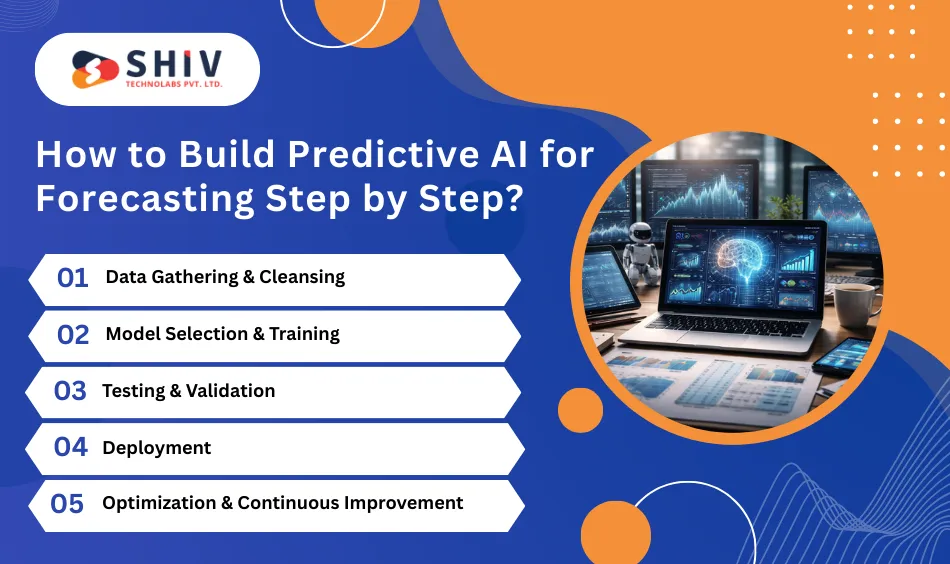
Developing a predictive AI is not merely a matter of writing model code; it requires a business-oriented roadmap. The following is a simplified architecture for building predictive AI to generate forecasts in enterprise settings.
1. Data Gathering & Cleansing
No AI system is superior to its data. The initial stage focuses on centralizing historical, current and external data into a single pipeline.
This includes:
- Sales history (24–36 months minimum)
- Promotions, pricing changes, discounts
- Seasonality trends + external variables (weather, macro factors)
- Supplier lead times + logistics delays
Then comes cleansing:
- Remove anomalies + duplicates
- Standardize formats
- Handle missing values
- Normalize across regions
Poor data can reduce forecast accuracy by 20% or more. Clean data improves model reliability before any algorithm is selected.
2. Model Selection & Training
After organizing the data, the second step to creating a predictive AI solution is to choose an appropriate modeling approach.
Enterprises can use:
- ARIMA / SARIMA (time-series models)
- LSTM / deep learning models
- Gradient boosting frameworks
- Hybrid ensemble models
Training involves:
- Hyperparameter tuning
- Cross-validation
- Performance comparison (MAPE, RMSE, MAE)
It is not only high accuracy but also stability across product lines, geographies, and volatility cycles.
3. Testing & Validation
The forecasting models should be tested under real-world conditions before being implemented in production. This stage includes:
- Backtesting using historical rolling windows
- Scenario simulation (peak season, demand shock, supply disruption)
- Bias and error analysis
- Threshold performance benchmarks
Businesses that do not validate are likely to lose trust among their internal stakeholders. Strict testing is to ensure that the forecast is reliable even under pressure, not just in ideal conditions.


4. Deployment
A model does not have ROI before it can be integrated with the operational systems. Forecast outputs are linked to deployments that connect to the ERP, CRM, inventory planning, or retail dashboards. This source supports your ERP integration point: AI in ERP improving business operations.
Deployment tasks include:
- API-based model serving
- Real-time or batch prediction system.
- Dashboard visualization
- Role-based access controls
Here, software development for on-demand forecasting does not change; it enters an execution phase at a production scale. The metrics of stability, latency (inference time under 200ms), and uptime become significant.
5. Optimization & Continuous Improvement
Markets change- and forecasting models need to change. Model drift should be avoided through constant monitoring. Optimization includes:
- Dashboards for tracking performance
- Cycles of retraining that are automated.
- Update of features (new data inputs)
- Drift detection alerts
Enterprises implementing continuous optimization maintain 15–25% accuracy gains long term, while static systems degrade within months.
What Is the Cost to Build Predictive AI for Demand Forecasting Software?
Predictive AI software cost to construct demand forecasting software is based on the depth of architecture, data complexity, extent of integration and scale of enterprise.
Enterprise Cost Breakdown for Predictive AI Demand Forecasting
| Cost Category | Scope | Estimated Enterprise Cost (USD) |
|---|---|---|
| Data Engineering | Data cleaning & preparation | $30,000 – $70,000 |
| Model Development | ML model design & tuning | $50,000 – $120,000 |
| Infrastructure | Cloud & storage | $15,000 – $50,000 annually |
| Integration | ERP/CRM connectivity | $20,000 – $60,000 |
| Testing & Deployment | QA & rollout | $25,000 – $50,000 |
What Is the Predictive AI Deployment Timeline for Demand Forecasting Software?
The time of deployment is dependent on the readiness of the data and internal approvals and the complexity of the system.
Predictive AI Deployment Timeline Overview
| Phase | Duration |
|---|---|
| Data Preparation | 4–6 weeks |
| Model Development | 6–10 weeks |
| Validation & Testing | 4–6 weeks |
| Integration & Deployment | 3–5 weeks |
| Optimization | Ongoing |
Total estimated time:4-6 months.
An AI implementation plan for demand forecasting software is organized to reduce delays and meet measured rollout milestones.
What ROI Can Enterprises Expect from Predictive AI Demand Forecasting?
Predictive AI demand forecasting ROI can be measured by revenue growth, inventory reduction, and savings.
How Does Predictive AI Improve Revenue and Reduce Costs?
Companies that use AI forecasting software to manage retail and supply chain processes usually experience:
- +15–25% forecast accuracy improvement
- 20–30% reduction in inventory holding costs
- 5–15% revenue growth from better availability
- 10–20% fewer stockouts
More accurate forecasting leads to waste reduction, customer satisfaction, and agility of operations.
What Is the Expected Payback Period?
ROI & Payback Metrics
| KPI | Expected Improvement |
|---|---|
| Forecast Accuracy | +15–25% |
| Inventory Carrying Cost | -20–30% |
| Revenue Impact | +5–15% |
| Payback Period | 9–18 months |
Depending on the size of the operation, most enterprises can recover the initial investment in 9-18 months.
Should Enterprises Build In-House or Use Predictive AI Development Services?
Enterprises must evaluate internal capability vs speed-to-market.
In-House vs Specialized AI Experts
| Factor | In-House Team | AI Specialists |
|---|---|---|
| Hiring Cost | High | Project-based |
| Time to Market | Slow | Faster |
| Domain Expertise | Limited | Specialized |
| Scalability | Internal limits | Flexible scaling |
Partnering with experts accelerates delivery and reduces execution risk.
What Challenges Should Enterprises Prepare for When Building Predictive AI?
Even well-planned AI initiatives face operational challenges.
- Data Silos: Fragmented data across systems reduces model quality.
- Model Drift: Demand patterns evolve; retraining is mandatory.
- Integration Issues: Legacy ERP systems may require API or middleware bridges.
- ROI Measurement Complexity: Measuring the direct impact of AI requires baseline comparisons and performance dashboards.
Conclusion
The construction of predictive AI demand forecasting systems should be grounded in clear cost, schedule, and ROI expectations. Companies that approach predictive AI strategically, including data organization, model validation, and integration planning, record quantifiable improvements in revenue and efficiency.
We at Shiv Technolabs provide enterprise-level, business-specific predictive AI solutions. Being a reliable predictive AI development company, we design, deploy and optimize AI forecasting systems that scale safely and effectively.
Frequently Asked Questions (FAQs)
1. What is the cost of the predictive AI requirement?
Implementation of enterprise solutions typically costs between $150,000 and $700,000+, depending on the volume of data to be handled, model complexity, and integration requirements.
2. What is the time frame of the predictive AI implementation?
Enterprise implementations last 46 months and include data preparation, model training, testing, and integration.
3. Is there a way that predictive AI can be integrated into ERP systems?
Yes, Predictive AI can be integrated with ERP, CRM, or supply chain systems via APIs or middleware connectors.
4. What kind of ROI can enterprises expect in reality?
Companies usually gain 15-25% in the accuracy of forecasts and recoup the investment in 9-18 months.
5. Is predictive AI appropriate for a mid-size retail business?
Yes, AI forecasting is useful for mid-size retailers, as it helps reduce inventory waste and improve stock availability.